
 Worksheets
US History 8: 2024-2025 Review Game
Total questions: 80
Worksheet time: 40mins
After the _____________, the country had to reunite (come back together) again.
Civil War
Industrial Revolution
Great Depression
World War I
The ____________ of slavery meant people who were once enslaved were now free.
abolition
expansion
continuation
promotion
President Lincoln gave the _________________ to free the slaves in rebelling states.
Emancipation Proclamation
Bill of Rights
Gettysburg Address
Declaration of Independence
4. A government program called the _____________________ helped freed people get food and learn.
Freedmen's Bureau
Homestead Act
Black Codes
Sharecropping
Some people wanted to give forgiveness, also called ____________, to Southern leaders.
amnesty
treason
secession
embargo
Many people rushed to places like California to find ____________ underground.
gold
oil
coal
silver
Trains helped ____________ goods and people across the country.
transport
eat
paint
hide
The ____________________ connected the East and West coasts of America.
Transcontinental Railroad
Erie Canal
Panama Canal
Oregon Trail
Farmers moved west with help from the _____________________________.
Homestead Act
Emancipation Proclamation
Monroe Doctrine
Missouri Compromise
On the plains, Native Americans lived in homes called _______________.
tepees
igloos
pueblos
longhouses
11. New machines and ________________ made it easier to build tall buildings.
steel
cotton
coal
timber
Cities grew fast, but many people lived in crowded homes called ____________.
tenements
mansions
cottages
bungalows
A woman named _____________________ helped people in need with Hull House.
Jane Addams
Susan B. Anthony
Clara Barton
Harriet Tubman
Unions fought to end child labor and improve ________________ conditions.
working
living
educational
recreational
People joined together to go on ________________ to make changes at work.
strike
holiday
picnic
meeting
Writers called ________________ told the public the truth about bad business and city life.
muckrakers
tycoons
philanthropists
industrialists
Jacob Riis wrote about bad housing, and Upton Sinclair showed problems in __________ factories.
meatpacking
textile
automobile
shoe
The __________________________ helped break up big companies that had too much power.
Sherman Antitrust Act
Homestead Act
Interstate Commerce Act
Federal Reserve Act
The _______________ Amendment let the government tax people’s income.
16th
14th
18th
10th
The ____________________ Act made sure people got government jobs based on skill using a system of civil service exams.
Pendleton Civil Service
Homestead
Sherman Antitrust
Dawes Severalty
America stayed out of World War I until after the ________________ was sunk by a U-boat.
Lusitania
Titanic
Bismarck
Arizona
In 1917, the _________________ Telegram showed that Germany wanted Mexico to attack the U.S.
Zimmermann
Morse
Balfour
Versailles
The Great War ended with the signing of an _______________________ in 1918.
armistice
contract
revolution
embargo
After World War I, the Treaty of Versailles punished ________________.
Germany
France
Italy
Russia
In World War II, the surprise attack on ________________________ brought the U.S. into WWII in 1941.
Pearl Harbor
Normandy
Stalingrad
Midway
The Civil War was:
a conflict between the North and South in the United States during the 19th century
a war between France and England in the 18th century
a battle fought in ancient Rome
a modern-day conflict in Asia
Abolition is:
The act of formally putting an end to a system, practice, or institution
The process of creating new laws
The study of ancient civilizations
A type of government structure
The Emancipation Proclamation is:
a speech given by Abraham Lincoln
a law that ended the Civil War
an executive order that freed slaves in Confederate states
a treaty with Native Americans
The Freedmen’s Bureau was:
a government agency established to help former slaves after the Civil War
a military organization during the Civil War
a political party formed by freed slaves
a southern state legislature
Amnesty is:
A type of punishment
A general pardon for offenses
A form of government
A legal contract
The Gold Rush was:
a period when large numbers of people moved to a region where gold had been discovered
a famous horse race in the 1800s
a type of government tax on gold
an ancient festival celebrating gold
Transport in history refers to:
The movement of people and goods from one place to another
The study of ancient civilizations
The invention of the wheel
The development of writing systems
The Transcontinental Railroad was:
a major highway built across the United States
a railroad that connected the east and west coasts of the United States
a canal system linking major rivers
an early telegraph line
The Homestead Act was:
A law that gave free land to settlers in the West
A treaty with Native Americans
A tax on imported goods
A railroad construction project
Tepees are:
Traditional Native American tents
A type of food
A musical instrument
A kind of dance
Elevators in the context of history are:
Devices used for vertical transportation in buildings
Ancient tools for farming
Historical weapons used in wars
Traditional musical instruments
Tenements are:
Large luxurious houses
Small, crowded apartment buildings
Government offices
Shopping complexes
Jane Addams was:
a famous social reformer and activist
a professional athlete
a renowned scientist
a famous artist
Strikes are:
A form of protest by workers
A type of sports event
A government policy
A financial term
The Muckrakers were:
a group of early 20th-century journalists who exposed corruption and social injustices
a political party in the United States
leaders of the women's suffrage movement
supporters of the Prohibition movement
The Sherman AntiTrust Act was:
A law to promote fair competition and prevent monopolies in the United States.
A treaty between the US and Britain.
A tax reform act.
A law to regulate immigration.
The 16th Amendment is:
The amendment that abolished slavery
The amendment that gave women the right to vote
The amendment that allows Congress to levy an income tax
The amendment that established prohibition
The Pendleton Act is:
a law that established the civil service system in the United States
a treaty between the US and Britain
an amendment to the US Constitution
a law that ended slavery in the US
The Lusitania was:
a famous ship
a type of weapon
a treaty
a city
An Armistice is:
A peace treaty ending a war
A temporary suspension of fighting
A declaration of independence
A type of government
Germany is significant in history because:
It played a major role in both World Wars.
It is the largest country in Europe.
It was never involved in any major conflict.
It is the birthplace of democracy.
What happened at Pearl Harbor?
A volcanic eruption occurred.
The United States declared independence.
The Japanese attacked the U.S. naval base.
A peace treaty was signed.
Railroads are:
A type of transportation system using trains on tracks
A type of food
A kind of animal
A musical instrument
Reconstruction was:
A period after the Civil War when the Southern states were reorganized and reintegrated into the Union.
A time when the United States expanded westward.
The era when the Constitution was written.
A movement to end slavery in the United States.
Sharecroppers were:
Landowners
Farmers who worked on someone else's land for a share of the crops
Merchants
Industrial workers
Industrialization is:
The process of developing industries in a country or region on a wide scale.
The study of ancient civilizations.
A method of farming.
A type of government.
Textile is:
A type of fabric or cloth
A kind of food
A musical instrument
A chemical element
Ulysses Grant was:
A famous artist
The 18th President of the United States
A renowned scientist
A famous explorer
Propaganda is:
A form of communication aimed at influencing the attitude of a community toward some cause or position.
A type of scientific research.
A method of cooking food.
A style of painting.
Capitalism is:
An economic system based on private ownership and free markets
A political system ruled by a king
A religious belief system
A form of government with no leaders
The 18th Amendment is:
The amendment that abolished slavery
The amendment that granted women the right to vote
The amendment that prohibited the manufacture, sale, and transportation of alcoholic beverages
The amendment that established the income tax
What was a major reason organized crime grew during the 1920s?
More people lived in rural areas.
Alcohol was illegal during Prohibition.
Federal law enforcement increased.
The stock market crashed.
What was the purpose of the Harlem Renaissance?
To promote African Americans into political office.
To increase awareness of African American culture.
To end segregation in public schools.
To relocate African Americans to the North.
What did the Supreme Court decision in Plessy v. Ferguson (1896) establish?
School integration
Equal pay for all races
‘Separate but equal’ segregation
Desegregation of transportation
What caused the Dust Bowl in the 1930s?
Industrial pollution
Overfarming and drought on the Great Plains
Urbanization
Government rationing
Which New Deal law created unemployment insurance and retirement pensions?
Social Security Act
Fair Labor Standards Act
National Recovery Act
National Labor Relations Act
Why did Americans call make-shift towns 'Hoovervilles' during the Great Depression?
Hoover provided free homes for the unemployed
Hoover was blamed for not helping the poor
Hoover supported wealth taxes
Hoover promoted suburban expansion
What was the goal of the Ku Klux Klan during Reconstruction?
Encourage immigration
Promote Southern industry
Prevent African Americans from using their rights
Support education for freedmen
What did the Triangle Shirtwaist Factory fire lead to?
A rise in textile production
Safer working conditions
Growth in corporate monopolies
The passage of antitrust laws
What happened during the Great Depression?
People had lots of money to spend
Many people lost their jobs and homes
Everyone went on vacation
The U.S. government gave free cars to all citizens
What was the Cold War mostly about?
A big snowstorm
A fight between the U.S. and Soviet Union about ideas and power
A war with Canada
A new kind of weather system
Why did children practice hiding under desks during the Cold War?
For earthquake drills
For fire safety
In case of a nuclear bomb attack
To play a fun school game
What was the Berlin Wall?
A wall around a zoo
A way to stop people from leaving East Berlin
A playground for kids
A wall to keep animals inside a farm

The symbol used on the map to show locations of oil resources is:
A barrel
A tree
A wave
A star

According to the map, which two natural resources are found in the western United States?
Coal and oil
Gold and timber
Iron and cotton
Corn and rice
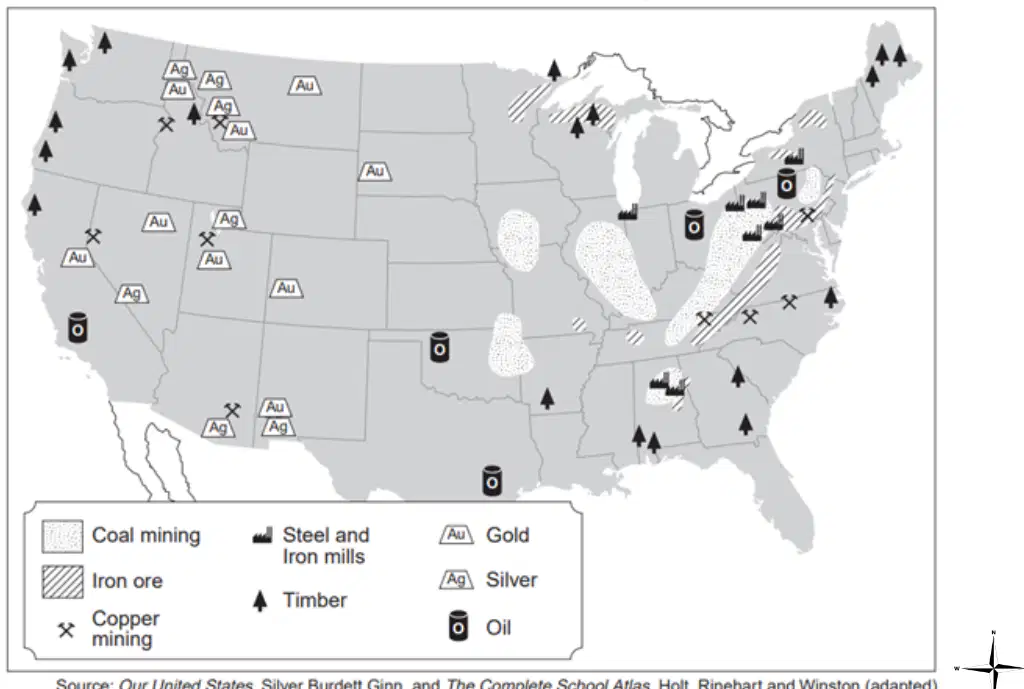
The two natural resources shown on the map that were most important for the steel industry were:
Coal and iron ore
Timber and water
Gold and silver
Copper and oil
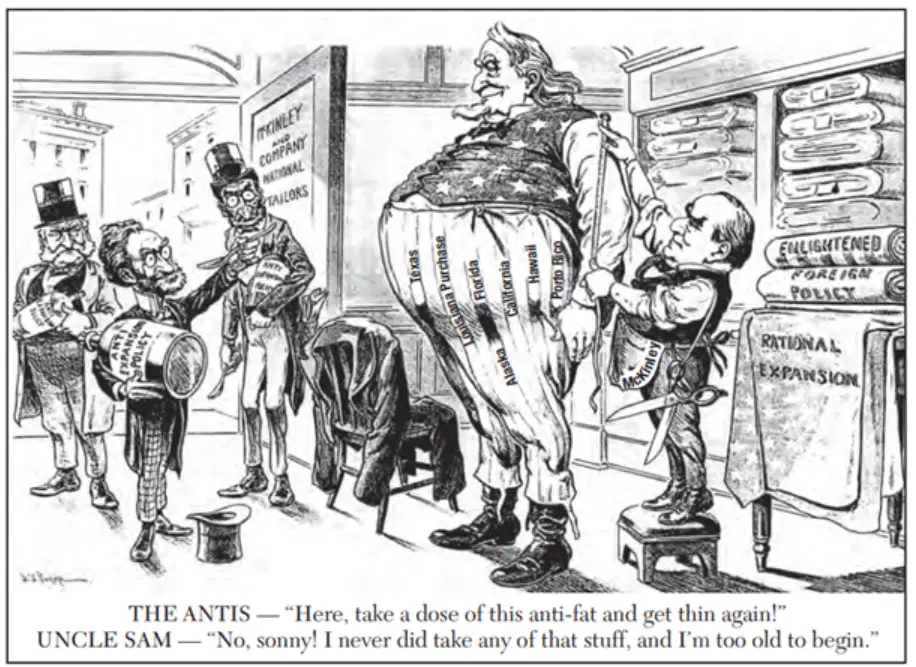
The large figure in the center of the cartoon represents:
Uncle Sam
George Washington
Ulysses S. Grant
Andrew Johnson
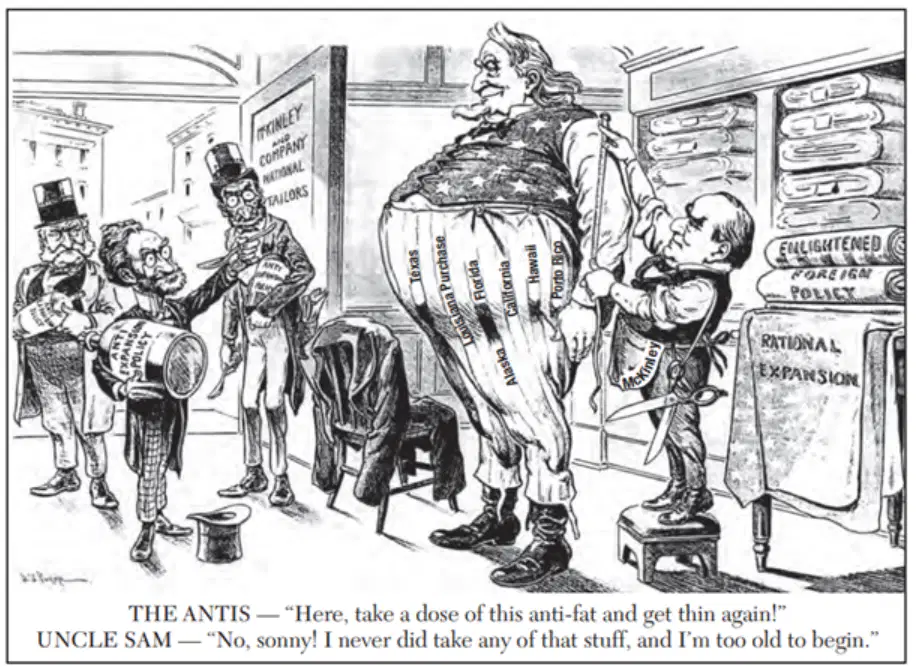
The names written on Uncle Sam’s pants (e.g., Hawaii, Philippines, Puerto Rico) in the cartoon represent:
U.S. territories acquired during imperial expansion
States that joined the Union during the Civil War
Countries allied with the U.S. in World War I
Native American tribes displaced by settlers
The historical context of documents can be described as:
The events and circumstances surrounding the creation of the documents.
The main arguments presented in the documents.
The authors' personal opinions about the documents.
The future impact of the documents.
What was the main purpose of government propaganda used in war posters?
To encourage enlistment and boost morale/support for the war effort
To advertise consumer products during wartime
To promote peace negotiations with enemy nations
To discourage women from joining the workforce
African Americans and Japanese Americans each experienced discrimination. Which of the following best describes how they were affected?
Both groups faced segregation and internment camps.
African Americans faced segregation, while Japanese Americans were placed in internment camps.
Both groups were given equal rights during this period.
Japanese Americans faced segregation, while African Americans were placed in internment camps.
What does the 'Historical Context' criterion require in the Short Essay Response?
Clearly describes the time period and relevant background for both documents.
Provides a summary of the main argument in both documents.
Focuses only on the author's perspective in one document.
Describes the future implications of the documents.
What does the 'Document Analysis' criterion require in the Short Essay Response ?
Accurately describes the message and meaning of each document.
Summarizes the historical context of the essay prompt.
Lists the authors of each document.
Explains the grading process for short essays.
What does the 'Comparison/Contrast' criterion require in the Short Essay Response ?
Explains similarities or differences between propaganda tools and between African American and Japanese American experiences.
Describes the historical context of propaganda tools only.
Summarizes the main points without analysis.
Focuses solely on the impact of propaganda on Japanese Americans.
What does the 'Evidence' criterion require in the Short Essay Response ?
Describes information provided by sources
Provides a summary of the essay's main argument.
Lists unrelated historical facts without analysis.
Focuses only on personal opinions without supporting details.

