
Font size
 Worksheets
SS FINAL REVIEW
Total questions: 57
Worksheet time: 29mins
The 13th, 14th, and 15th amendments were added to the Constitution during the Reconstruction period to
a. Bring an end to the Civil War
b. Limit the powers of the President
c. Improve the operation of the Electoral College
d. Grant legal rights to African Americans
What do these song lyrics show about the goals of Reconstruction and reactions to it?
Northerners and Southerners had similar goals immediately following the Civil War
Most Southerners believed that slavery was genuinely wrong
All Northerners were equally accepting of the apologies of Southerners
Southerners were unhappy with Reconstruction plans because they believed they did not do anything wrong
In the United States, which factor led to the rapid movement and settlement of the West, between 1860 and 1900?
Transcontinental railroad
Selling the most fertile public land to Native American Indians
Building of canals
Passing an increased number of liberal immigration laws
What was the RESULT of the process described in this quotation?
Native American Indians were granted farmland under the Homestead Act.
The disappearance of their main resource helped drive Native American Indians onto reservations.
Many Native American Indians moved to eastern cities to work in factories.
Most Native American Indians migrated to Canada to find new ways to earn a living.
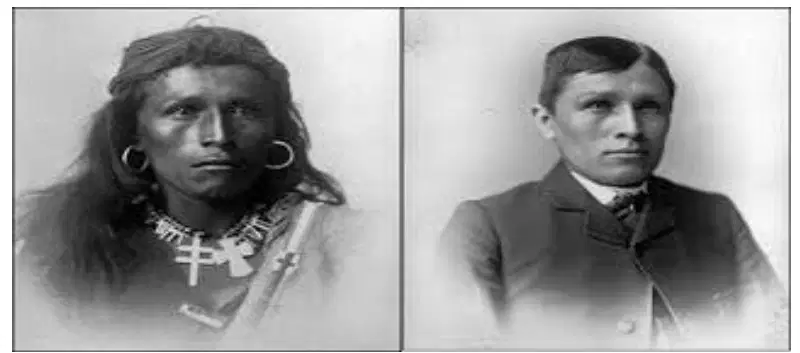
What do the images above and the Dawes Act (1887) show about how the United-States government perceived Native Americans?
The government respected the culture of Native Americans
Native Americans gained the right to vote in the late 1800s
The government viewed Native Americans as “inferior” people who need to be assimilated
Most Native Americans were happy about the government policies that affected them
Andrew Carnegie, Cornelius Vanderbilt, and John D. Rockefeller are most commonly associated with:
Limiting state taxation rates following the Civil War
Introducing scientific farming methods
Consolidation of big business in the late 19th century
Banking reform during the Progressive period
Based on Samuel Gompers’ argument (above), which statement would most accurately reflect his viewpoint?
It is fair in a capitalistic society that the governments favor business owners over the workers.
The working man should be happy with any salary they receive.
The greatest strength a working man has is his ability to work and unionize.
The working man has been protected by Congress from the harsh working conditions of big business.
Base your answer to Question 8 on the following passage and your knowledge of social studies. “I think that…with a free market economy like this…it is perfectly reasonable for management to determine how a man shall work, and how long he shall work, and what wages he receives.” - Thomas L. Livermore 8. Thomas L. Livermore would most likely support the following
Policy of Laissez Faire
Collective Bargaining
Sherman Antitrust Act
Stricter government regulations on big business
Which heading best completes the partial outline below? I. ______________________ • Secret ballot • Direct election of US Senators • Recall • Referendum
Checks and Balances
Unwritten Constitution
Progressive Reforms
Universal Suffrage
Which two speakers would most likely DISAGREE with the Nativists?
Speakers A & B
Speakers A & D
Speakers B & C
Speakers C & D
Between 1881 and 1921, one major cause of the INCREASING number of immigrants to the United States was the
Dust Bowl drought in the Midwest.
increased job opportunities in factories.
increased need for military personnel.
federal aid to pay the housing costs of new arrivals.
The term “muckraker” was used during the Progressive Era to describe
dissatisfied workers who went on strike.
Northerners who went south following the Civil War.
journalists who exposed problems in society.
women who supported the Prohibition movement.
What was one action taken by the federal government to deal with the issues described in this letter?
Continuing to let business owners to regulate their own companies
Increasing federal aid for farmers
Passing “Square Deal” legislation, such as the Federal Meat Inspection Act
Limiting freedom of expression
The fact that Upton Sinclair wrote this letter to President Theodore Roosevelt to inform the president proves
the government was ready to end their policy of Laissez-faire.
politicians were willing to take a more active role in reforms.
the role of government was changing in American society.
All the above
What has always been the underlying principle of U.S. foreign policy?
The U.S. must protect its national security and self-interest.
The U.S. must help needy nations.
The U.S. must take full responsibility for international debts.
The U.S. should always be neutral.
Why would William G. Sumner believe that imperialism threatened our nation’s democratic foundations?
The people of our country choose their leader.
Our nation fought for its independence from a more powerful country.
Our country believes that we have unalienable rights that the government must protect.
All of the above
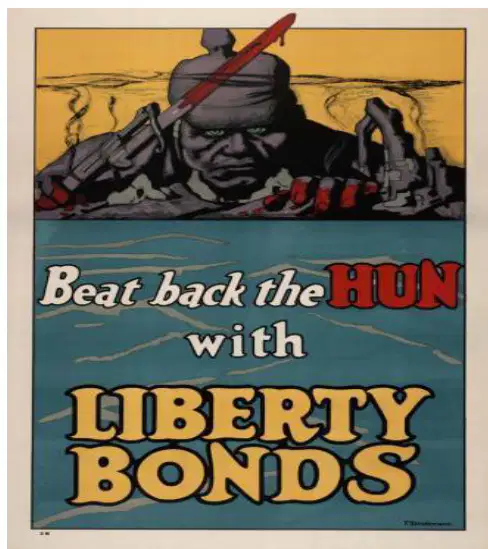
Why did the United States government produce these posters?
Persuade Americans to support the war.
Put an end to anti-war feelings in America.
Raise money for the war efforts.
All of the above
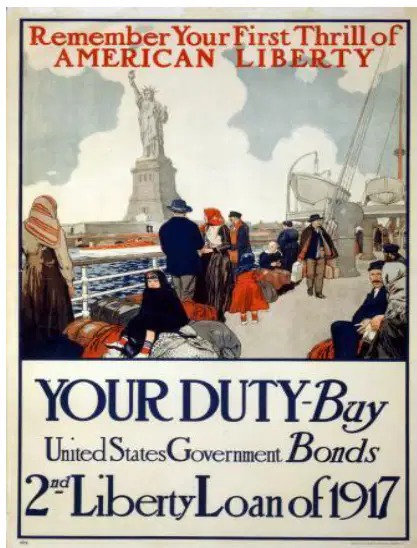
Who in America is Poster #2 meant to appeal to?
Immigrants
Wealthy business owners
Nativists
None of the above
Base your answer to Questions 19 & 20 on the passage below and on your knowledge of social studies. “No single person invented the automobile. In the 1890s, several Americans began building cars. Still, only the wealthy could afford them. It was Henry Ford who made the auto a part of everyday American life. In 1913, Ford introduced the moving assembly line. With this method of production, workers stay in one place as products edge along on a moving belt. Ford’s assembly line allowed for mass production of cars. Automobiles offered them freedom and greater mobility. By 1917, more than 4.5 million autos were chugging down American roads.” 19. How did Henry Ford revolutionize the automobile?
He invented the automobile
He customized the color of each automobile
He introduced the moving assembly line
The automobile had no impact on American society
What was the long-term impact of mass production?
Automobiles were made more affordable
People traveled and lived further away from where they worked
Eventually the suburban population boomed
All the above
What do the Supreme Court’s ruling in Schenck vs. United States and the internment of Japanese Americans show about Constitutional freedoms during times of crisis?
Basic freedoms can be limited to protect national security
Even during a war, the government cannot limit civil liberties
During times of crisis, government control over the people decreases
The president of the United States has always vetoed Congress’ attempts to take away basic freedoms
The Harlem Renaissance of the 1920s influenced American society by
ending racial segregation of public facilities.
increasing awareness of African American contributions to American culture and racial inequality.
encouraging urban renewal projects in major American cities.
establishing government programs to assist African American.

Langston Hughes often wrote poems that
Expressed the desire for African Americans to have equality.
Denounced violence against African Americans.
Expressed the desire to end segregation.
All of the above
A major cause of the stock market crash of 1929 was
Buying stocks on margin
Too much government regulation of businesses
Restricting bank loans
Outlawing installment buying
A major difference between the philosophies of President Herbert Hoover and President Franklin D. Roosevelt in responding to the Great Depression is that Roosevelt
wanted to rely on private charities to provide assistance.
stressed the need for individual self-reliance.
Supported the government’s direct relief to people out of work.
thought the government should not be involved in economic reform.
The primary reason President Harry Truman made the decision to use atomic bombs on Hiroshima and Nagasaki was to
Save American lives by avoiding the invasion of Japan
Destroy the entire Japanese military in Southeast Asia
Allow the United States to defeat Germany
Halt the Japanese invasion of the Soviet Union
The Nuremberg Trials established the international legal precedent that
the United States will give refugee status to all victims of war.
individuals who violate human rights can be held responsible for their actions.
invaders must pay to rebuild the areas they destroyed.
territory lost in war cannot be regained.
The Truman Doctrine, the Marshall Plan, and the North Atlantic Treaty Organization (NATO) are examples of United States
Economic policies during the Great Depression
Involvement in Europe after World War Two to contain Communism
Civil rights efforts during the 1960s
Efforts to put a person on the moon
The successful launching of Sputnik by the Soviet Union in 1957 signaled the beginning of
American fears that the Soviets had achieved technological superiority.
the Cold War with the U.S.
Soviet aggression in Afghanistan and China.
disarmament discussions between the superpowers.
What can be proven by the Supreme Court’s decisions in Plessy v. Ferguson (1896) and Brown v. Board of Education (1954)?
The Court never overturns earlier rulings
The Court is the weakest of the three branches of the federal government
The Court can make decisions, which overturn earlier decisions, thus changing society
The Court only makes rulings relating to people over 18 years old
McCarthyism of the early 1950s resulted in
the end of the arms race.
decreased tension of the Red Scare.
increased discrimination against returning veterans.
damage to the reputations of many innocent people and increased tension of the Red Scare.
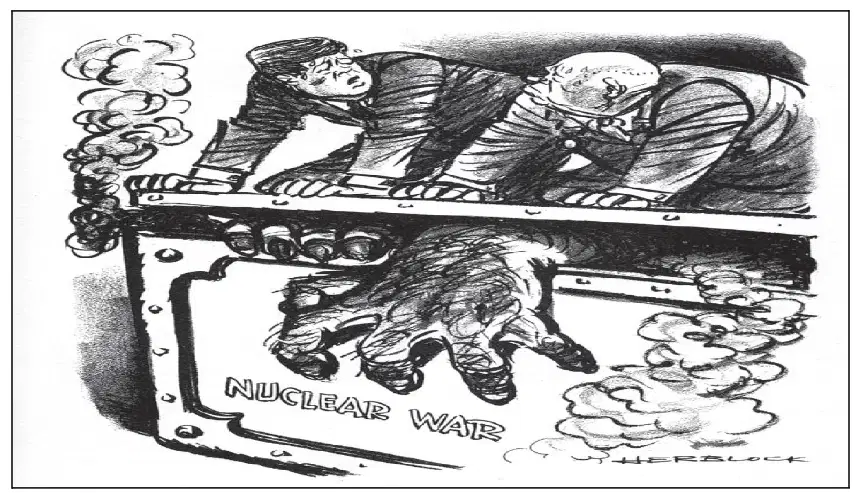
The cartoon above, depicting John F. Kennedy and Nikita Khrushchev, was published shortly after the
Cuban Missile Crisis
Vietnam War
Berlin Airlift
Korean War
Which of the following options would be the BEST title for the topics listed below? I. • President Truman’s Executive Order to Desegregate the Military • The Supreme Court’s Decision in Brown v. Board of Education • The Montgomery Bus Boycott • The Freedom Riders • The Civil Rights Act of 1964
Civil Rights Becomes A National Movement to End Discrimination and Segregation
The Civil Rights Movement Struggled to Gain the Support of the Executive and Judicial Branches
Advancing Civil Rights was Only a Priority for People Living in the North
The Civil Rights Movement was Only Successful Due to Government Action
Base your answer to Question 34 on the passage below and on your knowledge of social studies. “…And when this happens, when we allow freedom (to) ring, when we let it ring from every village and every hamlet, from every state and every city (Yes), we will be able to speed up that day when all of God’s children, black men and white men, Jews and Gentiles, Protestant and Catholics, will be able to join hands and sing in the world of the old Negro Spiritual: Free at last! (Yes) Free at last! Thank God almighty, we are free at last!” - Martin Luther King Jr. 34. Which statement MOST clearly supports the message of this passage?
a. Equality and mutual respect will benefit all Americans
b. African Americans are the leaders for civil rights
c. Freedom of religion is our most important freedom
d. The end of slavery is worthy of celebration
Which generalization most accurately describes writers of the Harlem Renaissance (like Langston Hughes), the writer of “Brother, Can You Spare a Dime?,” and the writers of anti-Vietnam-War songs?
Works of art do not reflect social and political views
The best literature concerns the lives of the wealthy
Works of musicians, poets, and writers often reflect the times in which it is created
Poems and songs cannot be viewed considered as accurate reflections of current events
President Lyndon Johnson’s “Great Society” programs were similar to the “Square Deal” and the “New Deal” in that they
strictly enforced antitrust laws.
focused on expanding civil rights for African Americans.
used federal government power to improve social conditions.
made urban renewal their primary concern.
One similarity between President Franklin D. Roosevelt and President Lyndon B. Johnson is that both
believed strongly in States rights
expanded the power of the Presidency
supported a strict construction of the Constitution
opposed most civil rights legislation
Protests against the United States’ involvement in Vietnam grew in the late 1960s and early 1970s mainly because many Americans
believed that the war was unjust.
objected to the drafting of women.
feared nuclear war with the Soviet Union.
opposed participation in conflicts involving the United Nations.
The Watergate scandal was an example of checks and balances because
Nixon resigned as president
The Supreme Court unanimously decided that Nixon wasn’t protected by Executive Privilege
Congress began the process of impeachment
Both B and C
The Camp David accords promoted by President Jimmy Carter were significant because they represented
the first peace agreement between Israel and an Arab nation.
the establishment of a worldwide human-rights policy.
a lasting arms-reduction treaty.
the end of the Vietnam War.
"Reaganomics" was based upon which of the following theories?
Cutting taxes for corporations and the wealthiest Americans would help the economy grow
Government increases taxes for the wealthiest Americans to help pay for government programs
Most Americans were happy to pay more taxes, if it meant better educational opportunities for their children
The government must control prices of goods in order to fight inflation
One direct result of the Persian Gulf War (operation desert storm) was that the United States
gained control of oil resources in the Middle East
liberated Kuwait from Iraqi control
brought about peaceful relations between Israel and its neighbors
obtained overseas colonies in the Middle East
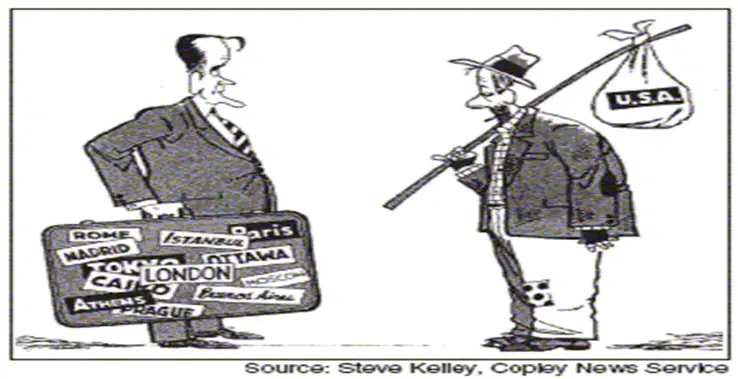
This 1991 cartoon is criticizing President George H.W. Bush for
refusing to support the United Nations
involving the United States in foreign wars
using foreign affairs to hide domestic failures
ignoring the advancement of Saddam Hussein into Kuwait
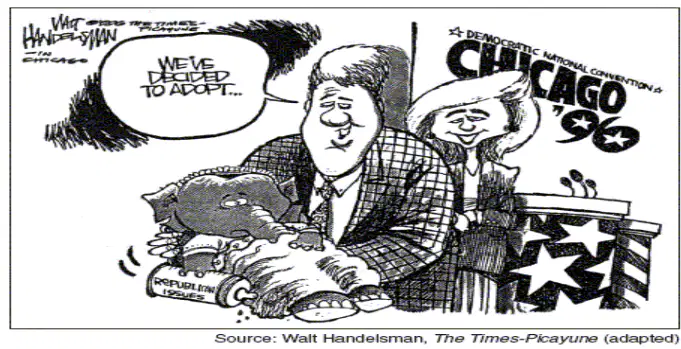
The point of view expressed in this cartoon is that
President and Mrs. Clinton have made Chicago their new home
President Clinton supports adoption over abortion
Republican issues should not be part of the Democratic National Convention
Democrats sometimes support traditionally Republican issues
Which of the following best describes the formula used by President Clinton to end the deficit and create a surplus in the economy?
Increase spending and decrease taxes
Decrease taxes and increase government programs
Increase taxes and decrease spending
None of the above, Clinton didn’t create a surplus
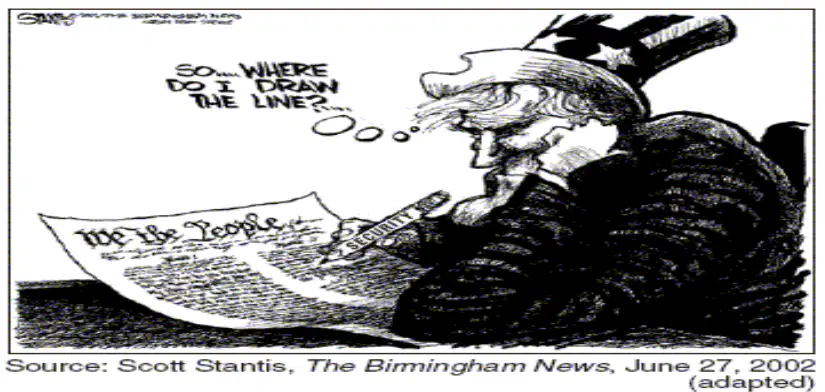
Which issue is the central focus of this cartoon drawn after September 11, 2001?
Is there a need to give up some civil liberties to protect the nation?
Should the United States reduce oil imports from the Middle East?
Does the United States need fewer limits on immigration?
Should the United States abandon the Constitution?
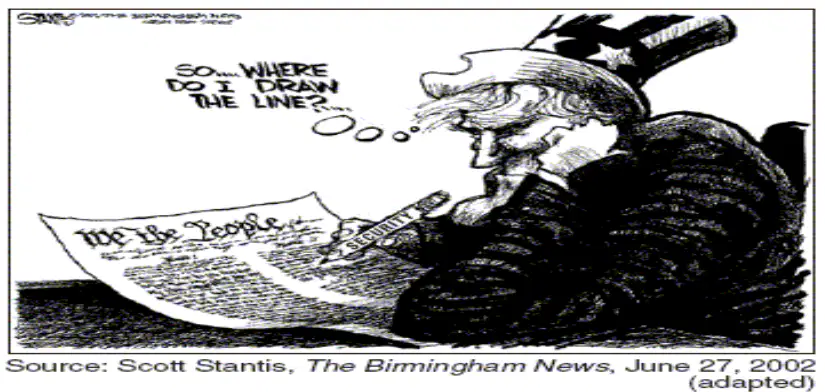
Which of the following events in history most closely relates to the cartoon above?
Patriot Act
Muckrakers
Tenure of Office Act
New Deal
One similarity that can be made between the U.S. policy of containment and the U.S. policy on the war against terrorism is
It allows the U.S. to remain isolated
It allows the U.S. to have more money for domestic issues
It puts the U.S. in conflict in many areas of the world
They were very much supported by U.S. citizens
Which of the following accurately states a goal for Obamacare?
Give every American access to affordable health care
Create quality health insurance for all
Reduce the amount of healthcare spending
All of the above
Results of the Bush-Gore presidential election of 2000 and the Trump-Clinton presidential election of 2016 renewed the debate over
term limits for elected officials
the electoral college system
presidential use of the veto power
loose versus strict interpretation of the Constitution
The historical context surrounding these documents is:
The period of the American Revolution and the struggle for independence.
The era of the Great Depression and economic hardship.
The time of the Civil Rights Movement in the 1960s.
The age of European exploration and colonization.
The relationship between the events and/or ideas found in these documents can best be described as:
Cause and Effect
Turning Point
Unrelated Events
Simultaneous Occurrences
According to Dr. King, what is the true meaning of the nation's creed?
All men are created equal
All men should be judged by their color
Only some people deserve freedom
Justice is not important
Read Document 1: Source: Rev. Dr. Martin Luther King Jr., “I Have a Dream”, March on Washington for Jobs and Freedom, August 28th, 1963. Dr. King dreams that his children will one day live in a nation where they will not be judged by the color of their skin but by the _________
content of their character
wealth they possess
clothes they wear
friends they have
language they speak
What law was President Johnson about to sign in 1964?
The Emancipation Proclamation
The Civil Rights Act
The Voting Rights Act
The Bill of Rights
According to President Johnson, why are millions being deprived of the blessings of liberty?
Because of their own failures
Because of the color of their skin
Because of lack of education
Because of economic status
Their messages about equality and justice are:
Identical in every way
Completely opposite
Similar in advocating fairness and rights
Focused only on economic issues

