
 Worksheets
7th Grade 15:1 - 2024-25 Middle School Final Exam Antonetti
Total questions: 80
Worksheet time: 40mins
Name
Class
Date
1.
Last Name, First Name
4 lines
2.
What period do you have science?
a)
1&4A
b)
2&3B
c)
7&8A
3.
1. Which of the following describes a key feature of a controlled experiment?
a)
Multiple variables are tested simultaneously to observe their combined effects.
b)
Only one variable is changed at a time while all other variables are kept constant.
c)
The outcome of the experiment is not measured or observed.
d)
The experiment is conducted without a hypothesis or prediction.
4.
2. In a controlled experiment, it is important to compare the effect of the variable being tested to something else. What is typically used as a comparison to the experimental group?
a)
The independent variable being tested.
b)
The control group, which does not receive the experimental treatment.
c)
The outcome or result of the experiment.
d)
The procedure or steps used in the experiment.
5.
3. Which of the following procedures would best determine the effectiveness of a vaccine for a disease in 100 birds?
a)
vaccinate 50 birds, don't vaccinate 50 birds and then expose only the vaccinated birds to the disease
b)
vaccinate 100 birds and expose only 50 birds to the disease
c)
vaccinate 100 birds and expose all 100 birds to the disease
d)
vaccinate 50 birds, do not vaccinate 50 other birds, and expose all 100 birds to the disease
e)
6.
4. Identify the independent variable in this experiment.
a)
the amount of body fat on the mice
b)
water
c)
high-fructose corn syrup
d)
childhood obesity
e)
7.
5. Identify the control group in this experiment.
a)
Children that only drank soda
b)
Children that only drank water
c)
Mice that only drank water
d)
Mice that only drank water with added fructose
8.
6. When you increase the magnification of an object from low to high power, what happens to the image you see under the microscope?
a)
You see more of the object, in less detail
b)
The object divides in two
c)
It does not change how much you see
d)
You see less of the object, in more detail
9.
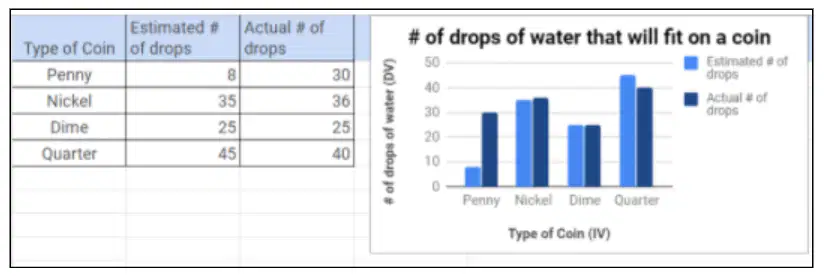
7. How do tables and graphs help scientists?
a)
they make the experiment look pretty
b)
they organize and analyze the data collected
c)
they help create a hypothesis
d)
they manipulate the data
10.
8. Which sequence correctly represents the levels of biological organization in a multicellular organism, from simplest to most complex?
a)
Cell --> Tissue --> Organ --> Organ System
b)
Tissue --> Organ --> Cell --> Organ System
c)
Organ System --> Organ --> Cell --> Tissue
d)
Cell --> Organ --> Tissue --> Organ System
11.
9. A group of similar cells that work together to perform a specific function is called a:
a)
organ
b)
organ system
c)
cell
d)
enzyme
12.
10. Proteins are involved in cell growth and repair. Identify the organelle responsible for making (synthesizing) proteins?
a)
mitochondria
b)
vacuole
c)
ribosome
d)
nucleus
13.
11. Identify the gas that is given off when plants make food during the process of photosynthesis?
a)
Nitrogen
b)
Oxygen
c)
Carbon Dioxide
d)
Hydrogen
14.

12. Identify the substance (chemical) in the leaf that absorbs the light energy needed for photosynthesis?
a)
chlorophyll
b)
upper epidermis
c)
guard cells
d)
stomata
15.

13. The given diagram shows the plant leaf with stomata. Determine which gas enters through the stomata of the leaf and is needed for photosynthesis to occur?
a)
Oxygen
b)
Carbon dioxide
c)
Hydrogen
d)
Nitrogen
16.
14. Identify the name of the gas that is transported by the circulatory system in humans and is used by cells during respiration to release energy stored in food?
a)
nitrogen
b)
carbon dioxide
c)
hydrogen
d)
oxygen
17.
15. Which of the following descriptions supports the function of cellular respiration?
a)
Energy for cell processes is released
b)
Cells undergo decomposition
c)
Oxygen is released for photosynthesis
d)
Nutrients are excreted to prevent buildup of body fat
18.
16. Which term describes the sum of all chemical reactions in the human body
a)
feedback
b)
metabolism
c)
dynamic equilibrium
d)
biological adaptation
19.
17. The life process of nutrition includes the breaking down of food into smaller parts. This is called
a)
ingestion
b)
digestion
c)
growth
d)
excretion
20.
18. Nutrients from digested food enter the bloodstream through the process of
a)
absorption
b)
elimination
c)
respiration
d)
secretion
21.
19. Identify the life function that is the most important for the survival of the species?
a)
homeostasis
b)
metabolism
c)
growth
d)
reproduction
22.

20. The diagram provides evidence of the interaction of two body systems. Which two body systems are interacting in this diagram?
a)
skeletal and muscular
b)
nervous and endocrine
c)
reproductive and digestive
d)
circulatory and respiratory
23.
21. Human body systems interact with each other to maintain homeostasis. Which of the following is the best evidence for this?
a)
the excretory system and digestive system work to transport nutrients throughout the body
b)
the excretory system and digestive system work to respond to stimuli in the environment
c)
the circulatory system and respiratory system work to transport oxygen throughout the body
d)
the circulatory system and respiratory system work to repair and synthesize (bulid) new cells
24.
22. Hormones are chemical messengers that the body secretes into the bloodstream to assist with control and regulation of the body to maintain homeostasis. You are at a birthday party and hear a balloon "pop" and get startled. Which of the following describes why you respond to THIS stimulus?
a)
Insulin is secreted into the bloodstream, increasing your heartrate
b)
Insulin is secreted by the pancreas to regulate glucose levels in the bloodstream
c)
Adrenaline is secreted into the bloodstream, increasing your heartrate
d)
Adrenaline is secreted by the pancreas to regulate glucose levels in the bloodstream
25.
23. The lungs help to maintain homeostasis as a part of two body systems, the respiratory & excretory systems. Which of the following is NOT evidence of this?
a)
Oxygen enters the lungs to be transported to all body cells via the bloodstream
b)
The lungs remove urea and liquid waste from the body
c)
Carbon dioxide exits the lungs after being filtered and removed from the blood
d)
Gas exchange occurs in the tiny blood vessels of the lung's alveoli
26.
24. Which of the following best describes the function of the nervous system?
a)
It circulates blood, nutrients and wastes throughout the body.
b)
It breaks down food into smaller molecules so they can be absorbed into the bloodstream.
c)
It provides shape, support and structure for our body.
d)
It gathers and interprets information from inside our body and the outside world and then responds to the information.
27.
25. Humans require organ systems to carry out life processes. Single-celled organisms do not have organ systems and yet they are able to carry out life processes. This is because
a)
human organ systems lack the organelles found in single-celled organisms
b)
organelles present in single-celled organisms perform the life processes of organs
c)
a human cell is more efficient than the cell of a single-celled organism
d)
it is not necessary for single-celled organisms to maintain homeostasis
28.
26. Homeostasis is maintained by regulating all of your body systems. This coordination is achieved mainly by which two (2) body systems?
a)
Skeletal and Excretory
b)
Nervous and Endocrine
c)
Respiratory and Reproductive
d)
Circulatory and Digestive
29.
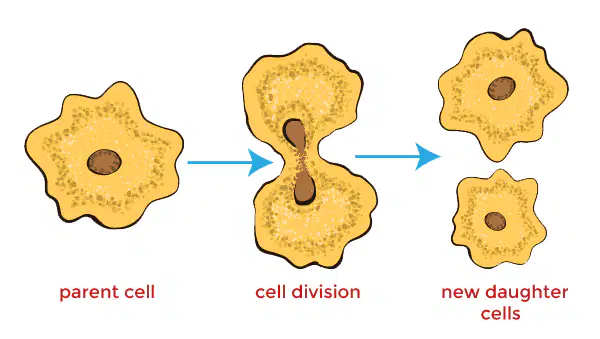
27.Based on the model given, the daughter cells resulting from this type of reproduction have genetic information that is
a)
identical to the parent
b)
different from the parent
c)
different from each other
d)
formed by two parents
30.
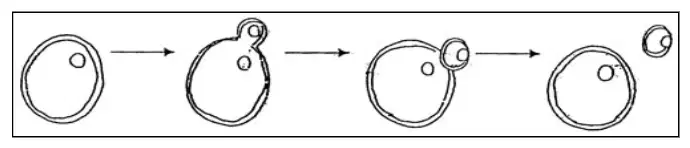
28. A new yeast cell is sometimes produced from a single parent by a process called budding. The process of budding is best described as
a)
sexual reproduction, with genetically identical offspring
b)
sexual reproduction, with genetically different offspring
c)
asexual reproduction, with genetically identical offspring
d)
asexual reproduction, with genetically different offspring
31.
29. Which of the following models represent the process of sexual reproduction?
a)
A hydra budding
b)
A potato vegetatively propagating
c)
A lion requiring a mate to produce offspring
d)
A sea star regenerating a limb
32.
30. What advantage does a species that reproduces sexually have over a species that reproduces asexually?
a)
There is greater variation among the offspring
b)
The offspring are identical to the parents
c)
Only one parent is necessary for reproduction
d)
No sex cells are needed for reproduction
33.
31. Which of the following models represents reproduction that results in the offspring with genetic variation?
a)
Option 1
b)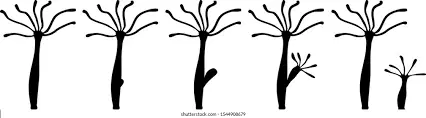
Option 2
c)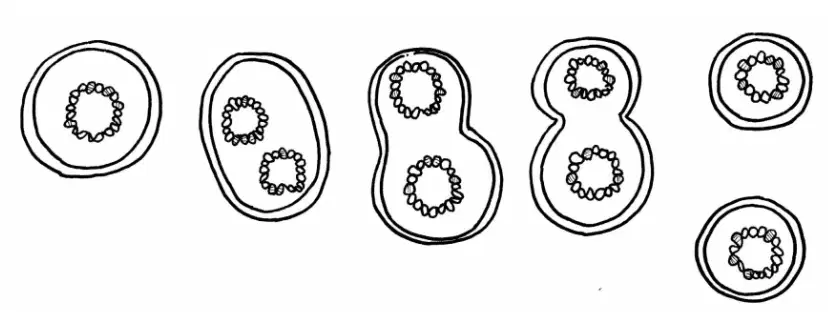
Option 3
d)
Option 4
34.
32. Sperm cells are to the testes as egg cells are to the ___________:
a)
ovaries
b)
cervix
c)
estrogen
d)
vagina
35.
33. The sex of a human baby is determined by which parent(s)?
a)
mother
b)
both parents
c)
father
d)
neither parent
36.
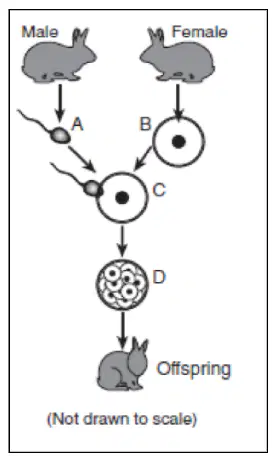
34. The diagram shows information about the reproduction and development of a rabbit. Which letter in the diagram represents fertilization?
a)
A
b)
B
c)
C
d)
D
37.
35. The main purpose of the stamen is:
a)
produce eggs
b)
produce pollen
c)
respiration
d)
photosynthesis
e)
38.
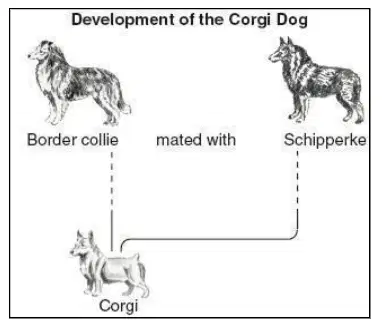
36. The illustration below traces the development of the corgi dog over several generations as a result of human activity. This is an example of the human activity called
a)
mutation
b)
selective breeding
c)
cloning
d)
natural selection
39.
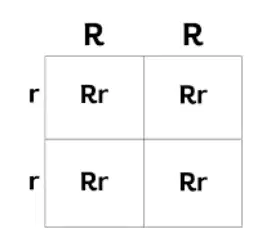
37. The diagram shows a model of human inheritance developed by Gregor Mendel. Why will heterozygous Rr individuals be right-handed rather than left-handed?
a)
Right handedness occurs only in females
b)
Right handedness is the recessive trait
c)
Right handedness is the dominant trait
d)
Left handedness is a mutation
40.
38. The genetic makeup of an organism is called the:
a)
genotype
b)
trait
c)
phenotype
d)
mutation
41.
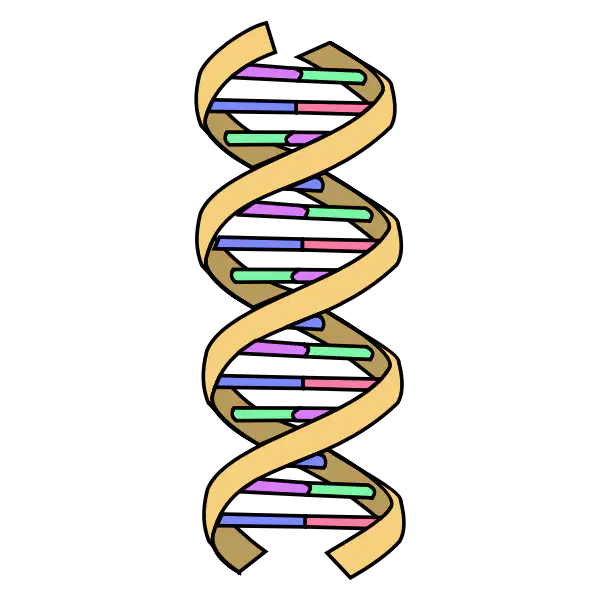
39. Franklin, Watson, and Crick discovered that the structure of DNA was a twisted double helix. What letters represent the 4 bases located on the "rungs" of the ladder?
a)
A,B,C,D
b)
A,T,C,G
c)
W,X,Y,Z
d)
F,Y,A,O
42.
40. What best describes the relationship between genes and DNA?
a)
Genes contain DNA
b)
Both contain chromosomes
c)
DNA destroys genes
d)
They are unrelated
43.
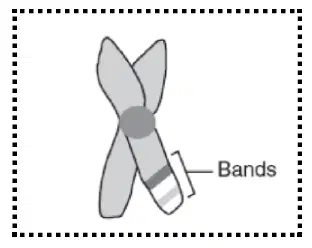
41. The drawing below represents a pair of chromosomes. The area labeled "bands" shows the location of
a)
egg cells
b)
sperm cells
c)
hormones
d)
specific genes
44.
42. A sudden change in a gene sequence is called:
a)
an adaptation
b)
evolution
c)
a mutation
d)
a variation
45.
43. Which process is a common practice that has been used by farmers for hundreds of years to develop new plant and animal varieties?
a)
Selective breeding for desirable traits
b)
Cloning
c)
Genetic engineering
d)
Cutting DNA and removing segments
46.
44 What is produced as a result of the genetic engineering process by which scientists transfer genes directly from one organism to another organism?
a)
mutation
b)
inbreeding
c)
a genetically modified organism (GMO)
d)
a selectively modified organism (SMO)
47.
45. A positive result of genetic engineering is having
a)
cloned human babies with “perfect” human DNA/traits
b)
bacteria produce human insulin for diabetics
c)
cloned cows that make our meat supply endless
d)
cloned human babies so parents can have identical twins
48.
46. Which of the following organisms do scientists commonly use for genetic engineering?
a)
bacteria
b)
paramecium
c)
protozoa
d)
fungi
49.
47. CRISPR is a new technology tool used for
a)
baking
b)
gene editing
c)
creating mutagens
d)
monitoring genes
50.
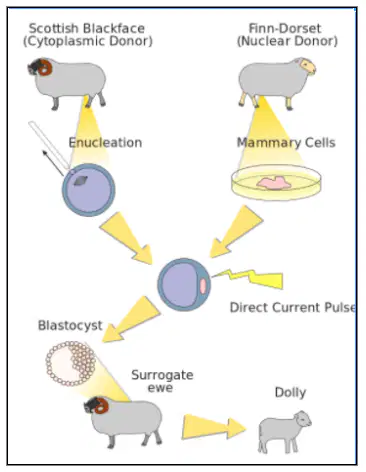
48. Which process was used in cloning Dolly the sheep?
a)
Using a hair follicle to borrow DNA
b)
Using restriction enzymes to cut out DNA
c)
Using an egg from a donor sheep and removing the nucleus
d)
Using bacteria to replicate the DNA
51.
49. Scientists have cloned sheep, monkeys, cats, and dogs. Why haven't geneticists cloned humans yet?
a)
cloning humans would take too long
b)
human reproduction is different from other mammals
c)
there are ethical issues with cloning humans
d)
the technology to clone humans has not been developed
52.
52. In the 1800’s Darwin observed that finches belonging to different species on the Galapagos Islands have many similar physical characteristics. This supports the conclusion that finches:
a)
have the ability to interbreed
b)
acquired traits through use and disuse
c)
occupy the same niche on the island
d)
came from a common ancestor
53.
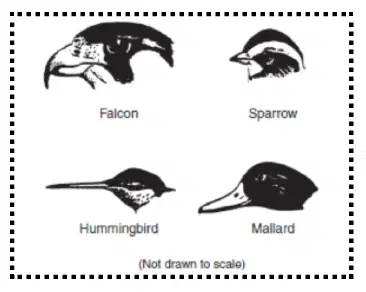
53. The diagram to the right shows the head structure of four different birds. The diversity of the birds’ beaks show how the birds
a)
compete for the same food in their community
b)
require different amounts of food for survival
c)
are adapted to get food from different sources
d)
store food for the winter months
54.
54. How does natural selection operate to cause change in a population?
a)
the members of a population differ so only some survive when the environment changes
b)
the members of a population are equally able to survive any environmental change
c)
the members of a population do not adapt to environmental changes
d)
all members of a population do adapt to environmental changes
55.
55. The term "Survival of the Fittest" suggests that:
a)
organisms best suited to their environment will survive
b)
organisms that eat healthiest will survive
c)
the organisms that work out the most will survive
d)
organisms that are the best looking will survive
56.
56. Beneficial traits that enable an organism to survive and reproduce in its environment are called:
a)
adaptations
b)
hybrid characteristics
c)
recessive
d)
clones
57.
57. Body parts of different organisms that are similar in origin and structure are called:
a)
adaptive structures
b)
necessary structures
c)
chronological structures
d)
homologous structures
58.
58. Although snakes have no legs, there are tiny leg bones in the skeletons of some snake species today. What conclusion might you draw from this?
a)
snakes will grow legs when they get older
b)
snakes evolved from animals that had legs
c)
snakes can walk when necessary
d)
snakes need legs for balance
59.
59. Organisms with favorable traits reproduce more successfully than organisms with less favorable traits. This statement best describes the concept of:
a)
overproduction
b)
inheritance
c)
use and disuse
d)
natural selection
60.
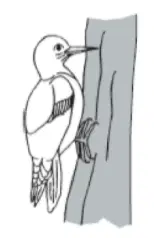
60. The diagram shows a woodpecker using its long sharp beak to obtain insects. What factor might contribute to the extinction of this species of woodpecker?
a)
an increase in the insect population
b)
the use of pesticides in the forest
c)
the overabundance of trees
d)
a new source of food
61.
61. In a food chain, the arrows represent
a)
the sun's energy
b)
the flow of energy
c)
photosynthesis
d)
decomposition
62.
62. Different species of carnivorous animals that share the same habitat in an ecosystem may:
a)
become decomposers
b)
compete for food
c)
produce their own food
d)
mate with each other
63.
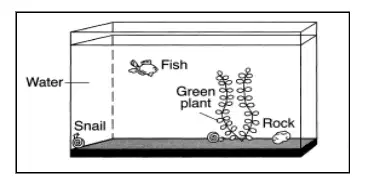
63. The diagram shows an ecosystem in a fish tank. One consumer in this tank is the
a)
water
b)
fish
c)
green plant
d)
rock
64.
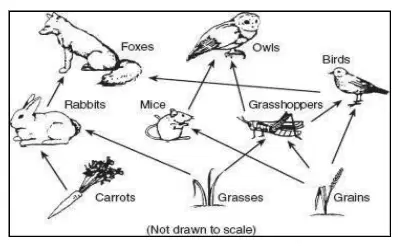
64. The diagram below shows a food web for a community. Which organisms in the diagram are carnivores?
a)
rabbits and birds
b)
grasshoppers and mice
c)
carrots and grasses
d)
foxes and owls
65.
65. How do decomposers obtain their food?
a)
Hunting and killing prey for food
b)
Changing carbon dioxide and water into food
c)
Breaking down dead organisms and absorbing nutrients
d)
Producing food from oxygen and sunlight
66.
66. Herbivores obtain most of their energy by
a)
consuming plants
b)
consuming animals
c)
absorbing sunlight
d)
producing sugar
67.
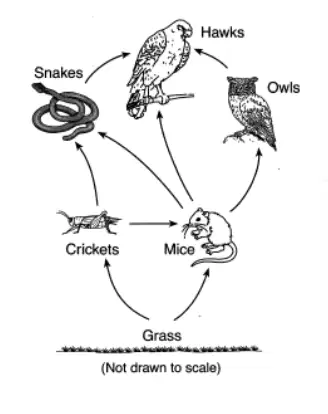
67. Why are mice considered to be omnivores?
a)
They consume plants only
b)
They are decomposers
c)
They consume plants and animals
d)
They are producers
68.

68. The diagram below shows a rabbit population at two different times. Which environmental factor may have contributed to the increase in the rabbit population?
a)
decrease in resources
b)
decrease in predators
c)
increase in disease
d)
increase in pollution
69.
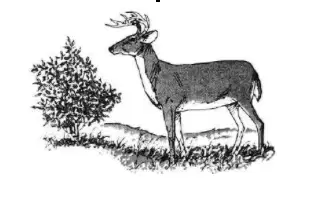
69. Which statement best describes the relationship between the deer and the plants?
a)
The deer supplies food and oxygen to the green plants
b)
The deer supplies food and carbon dioxide to the green plants
c)
The green plants supply food and carbon dioxide to the deer
d)
The green plants supply food and oxygen to the deer
70.
70. A symbiotic relationship exists between two organisms of different species. If both organisms benefit from the relationship, it is know as
a)
mutualism
b)
commensalism
c)
parasitism
d)
saprophytism
71.
71. Moving water in a river is considered a renewable resource because it
a)
carries dissolved oxygen
b)
is made of natural gas
c)
easily erodes sediments
d)
can be recycled by nature over time
72.
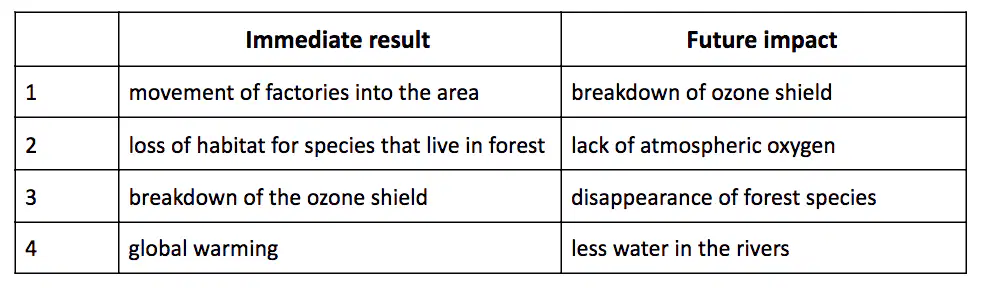
72. Deforestation is the removal of trees in an area. What are the potential immediate and future results of this action?
a)
1
b)
2
c)
3
d)
4
73.
73. Which greenhouse gas (in addition to methane) when released into the atmosphere, is believed to contribute the most to global warming?
a)
Oxygen
b)
Nitrogen
c)
Carbon Dioxide
d)
Water Vapor
74.
74. The burning of fossil fuels causes an increase in the release of greenhouse gases into the atmosphere. Which human activities involve the burning of fossil fuels?
a)
Driving a car
b)
Using electricity
c)
Heating your home
d)
All of the above
75.
75. Animals that are introduced to an ecosystem (usually by human activity) and aren't part of the existing food web compete with native species for resources. These organisms are called:
a)
biological control
b)
invasive species
c)
herbivores
d)
biodiversity
76.
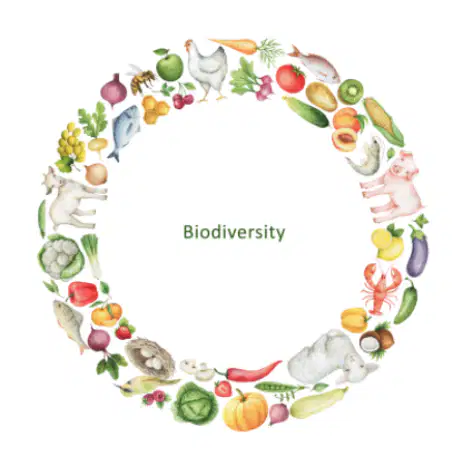
76. The variety of organisms in an ecosystem is called biodiversity. A major threat(s) to biodiversity is:
a)
habitat loss
b)
invasive species
c)
both (1) and (2)
d)
neither (1) and (2)
77.
77. In the passage, the word cuticle most likely means which of the following?
a)
protective covering
b)
water vapor
c)
double doors
d)
transpiration
78.
78. Based on the passage, which of the following is true about stomata?
a)
Oxygen enters the leaf through the stomata
b)
Stomata are always open
c)
Stomata are surrounded by two guard cells
d)
Carbon dioxide exits the leaf through the stomata
79.
79. Which of the following statements about water vapor is a fact in the passage?
a)
Water vapor enters the leaf through the stomata
b)
Water vapor is produced during photosynthesis
c)
Water vapor is lost through transpiration
d)
Water vapor does not enter or exit the leaf
80.
80. Which of the following organs is used for reproduction in most plants?
a)
stem
b)
root
c)
leaf
d)
flower
100 %

