
 Worksheets
NBC EMC
Total questions: 99
Worksheet time: 50mins
What is a suffix?
A letter or group of letters added to the beginning of a root word
A letter or group of letters added to the end of a root word
A type of root word
A synonym for prefix
An example of a suffix is _____. When added to the end of the root word 'thank,' it forms the word 'thankful.'
-ful
-pre
un-
re-
Which of the following is an example of a derivational affix?
-s
-ed
un-
-ing
Inflectional affixes change the part of speech of a word.
True
False
Adding the inflectional affix '-ed' to the word 'walk' changes it to _____
walked
walking
walker
walks
Which of the following best describes the relationship between knowledge of roots and affixes and the use of context clues?
They are unrelated
They are closely related and help determine the meanings of unknown words
Only roots are important
Only affixes are important
According to the passage, what is the first stage of reading development called?
Transitional reading
Fluent reading
Emergent reading
Early reading
The last stage of reading development is called _________.
fluent reading
emergent reading
phonemic awareness
decoding
Which of the following is NOT a characteristic of emergent readers?
They begin to identify capital and lowercase letters.
They read a wide range of complex texts independently.
They understand the predictable relationships between letters and sounds.
They display pre-reading behaviors.
What skills do emergent readers develop that help them manipulate phonemes within words?
Phonemic awareness skills
Vocabulary skills
Comprehension skills
Fluency skills
Name one instructional strategy teachers should use in the emergent stage according to the passage.
Shared reading
Silent reading
Independent research
Peer assessment
According to the passage, what should texts designed for emergent readers include?
Complex sentence structures and advanced vocabulary
Pictures or illustrations, repetitive words and phrases, high-frequency and easily decodable words
No pictures and only long paragraphs
Only unfamiliar topics
Some emergent texts follow a pattern in which only the last word in each sentence changes. For example, each page of a text might say, "I like to _____."
The missing word could be easily guessed based upon picture support.
The missing word is always a verb.
The missing word is never repeated.
The missing word is unrelated to the story. atmosphere
Which of the following is a characteristic of the early reading stage of reading development?
Readers rely only on picture clues
Readers use strategies to figure out unknown words and make meaning from texts
Readers do not self-monitor their reading
Readers only read aloud
In the early reading stage, readers begin to read silently and no longer need to point to each word while reading.
True
False
Texts for early readers contain more print than those for emergent readers. Which of the following is NOT a characteristic of texts for early readers?
Longer sentences
More sentences per page
More pages per book
Only simple vocabulary words
There is less reliance on picture clues in books for early readers, with the print carrying most of the _____
meaning
weight
color
pictures
According to the passage, what do teachers need to provide during the early reading stage to help students increase their reading rates and build fluency?
Only silent reading time
Systematic and explicit phonics instruction
Only picture books
No instruction is needed
According to the passage, what are transitional readers able to do that early readers may not?
Engage in sustained, quiet reading for extended periods of time
Only read simple texts
Focus only on pictures for meaning
Avoid using text structures
Transitional readers have knowledge of complex spelling patterns, which they use to independently decode most unknown words, including ________ words.
multisyllabic
simple
foreign
archaic
Which of the following is NOT a characteristic of texts for readers in the transitional reading stage?
Texts may include graphs, charts, and photographs
All texts are simple and familiar
Some challenging and unknown vocabulary words may be included
Story elements may be described in detail
Books written for transitional readers may have many pages with clearly defined spaces between lines of text.
True
False
Teachers can teach strategies to determine the meanings of unknown vocabulary words by analyzing word morphology, which includes recognizing and analyzing both ________ and roots.
affixes
prefixes
syllables
synonyms
Transitional readers rely more on the print than the pictures for meaning and can identify story elements, such as characters, setting, problem, and ________.
solution
author
genre
title
What is one characteristic of readers in the fluent stage of reading development?
They read only simple texts
They read complex texts both quickly and accurately
They struggle with unknown words
They do not use context clues
Fluent readers use multiple strategies to determine unknown words they encounter. Which of the following is NOT one of those strategies?
Cueing systems
Context clues
Substitutions
Ignoring the word
Fluent readers are able to comprehend a wide range of complex ______ and nonfiction texts.
fiction
poetry
manuals
recipes
Which of the following is a skill that fluent readers use to comprehend what they have read?
High-level thinking skills
Memorization only
Guessing
Skimming only
Texts for readers in the fluent reading stage are often complex, varied, and sometimes ______.
abstract
colorful
short
predictable
What is one instructional strategy teachers can use with readers in the fluent reading stage?
Avoid using research tools
Encourage rereading texts multiple times
Focus only on familiar topics
Discourage analyzing texts from multiple perspectives
Teachers can model how to efficiently use research tools to learn more about unfamiliar topics for readers in the fluent stage.
True
False
According to the passage, what is the relationship between reading and writing development?
They are unrelated and should be taught separately.
They are interrelated and should be taught together.
Reading is more important than writing.
Writing is more important than reading.
The earliest stage of children's writing development is called _________.
scribbling
drafting
publishing
editing
Which of the following is a characteristic of the preliterature stage of writing development?
Writing full sentences
Scribbling at random places on the page
Using correct punctuation
Writing only in lowercase letters
In the emergent stage, students begin to use their understanding of letter-sound relationships to write words.
True
False
In the emergent stage, what do students typically use to write their first words?
Names and high-frequency sight words
Only numbers
Only drawings
Only punctuation marks
Fill in the blank: In the preliterature stage, there is no evidence of ________ relationships in the writing.
letter-sound
word-meaning
sentence-structure
punctuation
Which of the following best describes the writing pieces produced by students in the emergent stage?
Long and complex
Short and typically use left-to-right directionality
Only consist of scribbles
Written entirely in lowercase letters
Which of the following is a characteristic of writers in the transitional stage of writing development?
They use a mixture of capital and lowercase letters appropriately.
They spell most words correctly and use capitalization and punctuation marks conventionally.
They do not consider letter-sound relationships.
They do not use descriptive details in their writing.
Transitional writers are able to encode many words quickly, which allows them to focus more attention on developing story elements and including descriptive details.
True
False
Fluent writers are able to edit and evaluate their own writing and provide constructive feedback to others.
True
False
In the _______ stage of spelling development, students spell using random letter and number strings, with no letter-sound relationships evident in words.
pre-phonetic
phonetic
transitional
conventional
Which stage of spelling development involves students using knowledge of roots and affixes to spell related words?
Pre-phonetic stage
Semi-phonetic stage
Phonetic stage
Derivational constancy stage
In the semi-phonetic stage, students typically learn to correctly spell the _______ and ending sounds in words first, followed later by the medial sounds.
beginning
vowel
middle
silent
In the transitional, or word extension stage, students learn to use _______ patterns to spell more complex words.
syllable patterns
phoneme patterns
morpheme patterns
letter patterns
What does orthography refer to in the context of language?
Orthography refers to the conventional spelling of words in a language.
Orthography refers to the study of word meanings in a language.
Orthography refers to the pronunciation of words in a language.
Orthography refers to the grammatical structure of sentences in a language.
According to the passage, what are the three layers of orthography that students can explore during word work?
Alphabet layer, Pattern layer, Meaning layer
Phoneme layer, Syntax layer, Context layer
Grapheme layer, Syllable layer, Structure layer
Sound layer, Rule layer, Usage layer
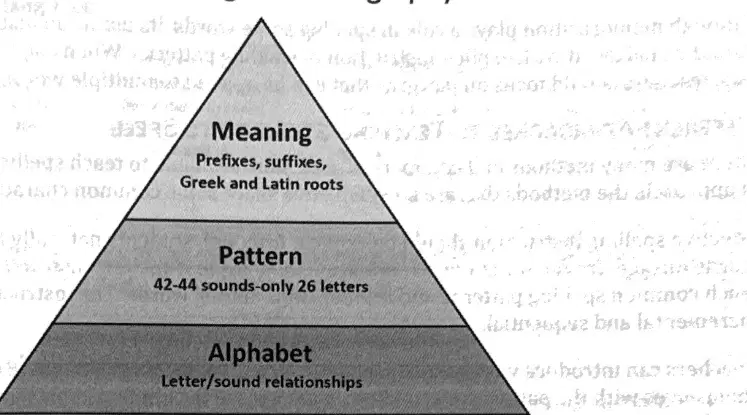
Refer to the diagram 'Layers of English Orthography.' Which layer focuses on prefixes, suffixes, and Greek and Latin roots?
Meaning layer
Sound layer
Pattern layer
Phonemic layer
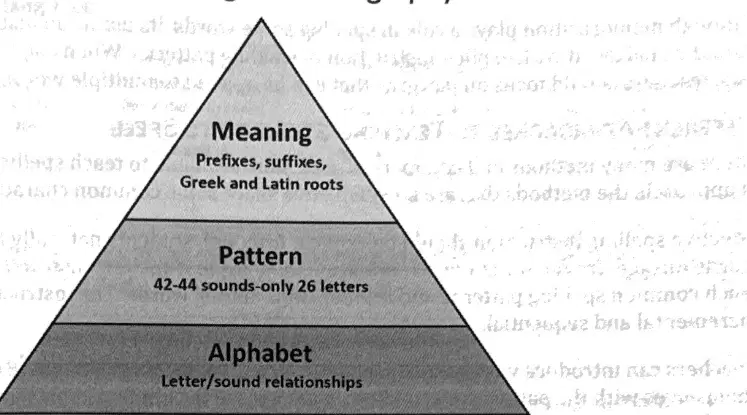
Refer to the diagram 'Layers of English Orthography.' Which layer involves letter/sound relationships?
Alphabet layer
Morpheme layer
Syllable layer
Semantic layer
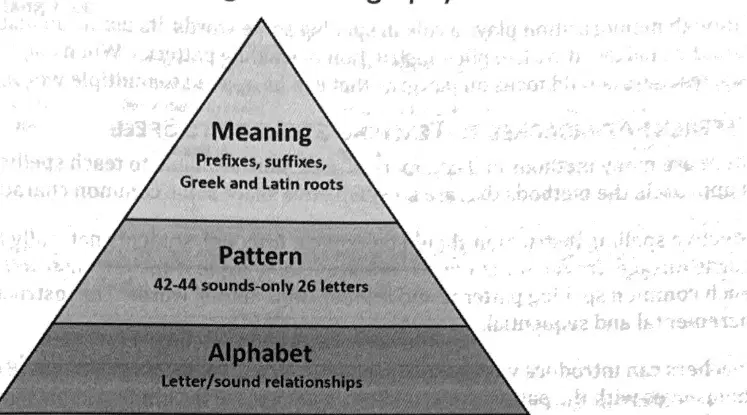
The pattern layer in orthography is concerned with 42-44 sounds but only 26 letters.
True
False
What is phonetic spelling and why is it important in early writing development?
Phonetic spelling is when students use knowledge of phonics rules to select letters or groups of letters to represent the sounds they hear. It is important because it helps students encode words they do not know how to spell and plays a role in reading and writing development.
Phonetic spelling is when students memorize the spelling of every word. It is important because it helps students remember words visually.
Phonetic spelling is when students use only vowels to spell words. It is important because it makes writing faster.
Phonetic spelling is when students copy words from a dictionary. It is important because it ensures perfect spelling every time.
Which stage of first language acquisition is characterized by babies making vowel sounds as their first attempts at oral language?
Babbling stage
Cooling stage
One-word stage
Telegraphic stage
At what age do children typically enter the one-word stage of language acquisition?
12 to 24 months
6 to 9 months
2 to 3 years
3 to 4 years
In which stage do children begin to use language to convey meaning by stringing together words, often omitting articles and conjunctions?
Babbling stage
Telegraphic stage
Oral fluency stage
One-word stage
After age three, most children enter the beginning oral fluency stage.
True
False
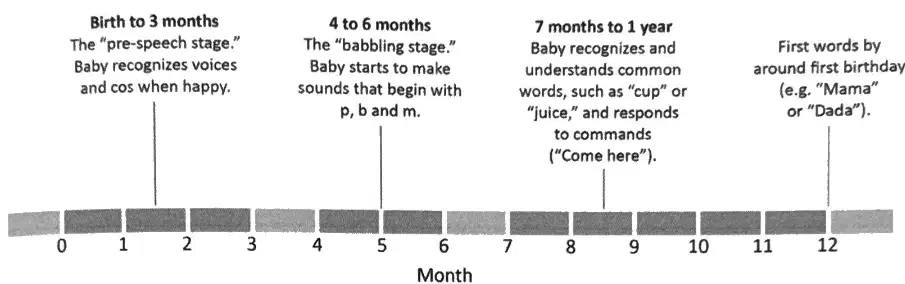
According to the diagram, at what age do babies typically start to make sounds that begin with p, b, and m?
4 to 6 months
1 to 2 months
7 to 9 months
10 to 12 months
In the preproduction stage of second language acquisition, English language learners (ELLs) may communicate with gestures or single words.
True
False
Which stage of second language acquisition is marked by increased comprehension and the use of longer sentences, though grammatical errors may be present?
Preproduction stage
Early production stage
Speech emergence stage
Intermediate proficiency stage
In which stage do ELLs understand academic vocabulary and need little support to participate actively in the classroom?
Advanced fluency stage
Beginning stage
Early production stage
Speech emergence stage
Which of the following is a component of oral language development that involves the ability to recognize and manipulate sounds in spoken words?
Syntactic skills
Phonological skills
Pragmatics
Morphological skills
Syntactic skills refer to understanding ________ and how to correctly arrange words in sentences.
grammatical rules
punctuation marks
vocabulary lists
intonation patterns
Oral language also includes a semantic component, which refers to the ability to understand the meanings of words, phrases, sentences, and longer texts.
True
False
Morphological skills include understanding the meanings of ________.
word parts
punctuation marks
sentence structures
paragraphs
Pragmatics refers to understanding the social rules of language, such as knowing how to adjust the formality of language depending on the audience.
True
False
Early language play, such as sharing songs, nursery rhymes, and poems, assists young children with the development of which of the following skills?
Phonological awareness
Mathematical reasoning
Physical coordination
Artistic skills
Oral language leads to the development of other communication skills. Through listening, children learn to ________ the messages of others and make sense of newly learned information.
evaluate
ignore
translate
repeat
According to the passage, what is the main benefit of introducing English vocabulary words that contain unfamiliar phonemes to ELLs?
It helps them memorize spelling rules
It gives these sounds a meaningful context
It makes reading more difficult
It replaces their native language
Phonological awareness and phonics assessments are important only for struggling readers.
True
False
Natural exposure to phonics is also known as _______ instruction.
implicit
explicit
systematic
synthetic
Which of the following is a characteristic of implicit phonics instruction?
Skills are taught in isolation
Skills are taught in context
Only letter sounds are taught
It does not help with unknown words
According to the passage, what should instruction for struggling readers be based upon?
Random selection
Observation and assessment data
Student preference
Teacher's favorite method
Research has shown that it is not important to schedule time for explicit and systematic phonics instruction if implicit instruction is used.
True
False
What is a recommended strategy to avoid when teaching letter identification to students?
Introducing letters with high value to learners first
Teaching commonly confused letter pairs simultaneously
Focusing on letters that play prominent roles in books
Sequencing letters by physical characteristics
To help students recognize letters, which activity can be used?
Playing memory games with letter forms
Writing essays
Solving math problems
Reading only numbers
To teach letter formation, students can be given letter stencils to trace with _________.
pencils
spoons
erasers
rulers
Which of the following is a multisensory approach to practicing letter formation?
Writing letters in containers filled with salt or sand
Memorizing spelling lists
Reading silently
Listening to music
What is the term for the understanding that each letter makes a predictable sound in print?
Alphabetic principle
Phonemic awareness
Letter formation
Print concept
Concepts of print are the conventions used to convey meaning in ________ text.
printed
spoken
digital
visual
Which of the following is NOT a concept of print?
Recognizing the front cover of a book
Recognizing the print carries the message
Memorizing multiplication tables
Recognizing the title of a book
What does phonemic awareness refer to?
The relationship between letters and the sounds they make
Identifying and manipulating phonemes in spoken language
Reading with speed and intonation
Translating print to speech
Phonics refers to the relationship between ______ and the sounds they make.
letters
numbers
colors
shapes
If an activity involves identifying the sounds in the word 'cat' in spoken language, is it related to phonemic awareness or phonics?
Phonemic awareness
Phonics
Fluency is defined as reading accurately with the appropriate ______ and intonation.
speed
volume
accent
pitch
What is one major predictor of reading comprehension according to the passage?
Phonemic awareness
Reading fluency
Decoding
Encoding
When readers use syntactic cues, they use knowledge about ______ to decode and make meaning.
prior knowledge
correct oral language structures and sentence construction
pictures
phonemes
Decoding refers to the process of translating print to speech, which is done by translating ______ into phonemes.
graphemes
morphemes
syllables
words
According to Howard Gardner's Theory of Multiple Intelligences, which intelligence prefers visual representations and activities that incorporate drawing, building, creative expression, and manipulatives?
Logical-Mathematical
Visual/Spatial
Verbal-Linguistic
Musical
According to Howard Gardner's Theory of Multiple Intelligences, which intelligence excels in solving math equations, conducting science experiments, and analyzing data?
Logical-Mathematical
Bodily-Kinesthetic
Interpersonal
Musical
According to Howard Gardner's Theory of Multiple Intelligences, which intelligence prefers learning through reading, writing, speaking, and listening, and excels in activities that incorporate discussion, debate, oral presentations, and written assignments?
Verbal-Linguistic
Intrapersonal
Naturalistic
Musical
According to Howard Gardner's Theory of Multiple Intelligences, which intelligence prefers hands-on learning experiences that involve movement and physical interaction with the learning environment?
Interpersonal
Bodily-Kinesthetic
Logical-Mathematical
Visual/Spatial
According to Howard Gardner's Theory of Multiple Intelligences, which intelligence prefers learning opportunities that involve communicating and collaborating with others, and excels in partner, small group, and whole-group learning activities?
Intrapersonal
Interpersonal
Musical
Naturalistic
According to Howard Gardner's Theory of Multiple Intelligences, which intelligence prefers to learn and work independently, usually possesses a strong sense of self-awareness, and excels in activities that allow for independent, self-paced learning and self-reflection?
Intrapersonal
Interpersonal
Visual/Spatial
Musical
According to Howard Gardner's Theory of Multiple Intelligences, which intelligence learns best when music is incorporated into instruction and prefers using mnemonic devices and rhythms to learn concepts and retain information?
Musical
Logical-Mathematical
Naturalistic
Verbal-Linguistic
According to Howard Gardner's Theory of Multiple Intelligences, which intelligence learns best when opportunities to connect with nature are incorporated into instruction and prefers activities such as nature walks and working outside?
Visual/Spatial
Naturalistic
Bodily-Kinesthetic
Intrapersonal
Multiple literacies are important in modern learning and business because:
They help individuals navigate diverse information, technologies, and cultures.
They only focus on reading and writing skills.
They are not relevant in the digital age.
They limit communication in global markets.
Which of the following is a characteristic of auditory learners?
Prefer visual representations
Gather and process information through listening
Prefer hands-on learning experiences
Learn best when music is incorporated into instruction
Auditory learners easily gather and process information through ________.
listening
reading
writing
drawing
According to the passage, what are the three main roles a teacher may adopt in student learning?
Lecturer, model, facilitator
Observer, participant, leader
Instructor, grader, counselor
Speaker, listener, writer
The teacher's role as a ______ is most appropriate when introducing a new concept, providing instructions for an upcoming activity, or reviewing material.
lecturer
counselor
facilitator
observer

