
 Worksheets
SS Part 3 Practice- Final USE DOC 2 AT THE BOTTOM TO ANSWER QUES
Total questions: 18
Worksheet time: 12mins
Alexander the Great was considered 'great' because he:
Conquered a vast empire and spread Greek culture.
Was a famous philosopher in Athens.
Invented new forms of government.
Wrote many famous plays.
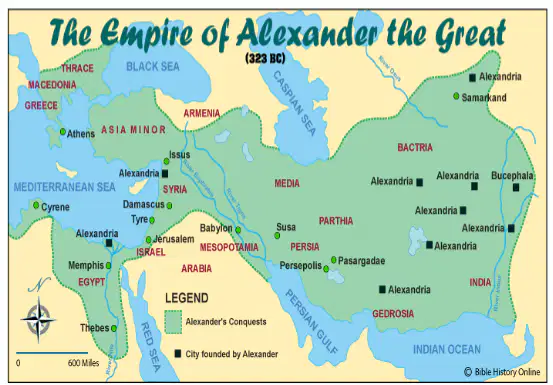
Refer to DOCUMENT 1 - Map of Alexander the Great’s Huge Empire. Which of the following cities was founded by Alexander the Great?
Athens
Alexandria
Babylon
Tyre
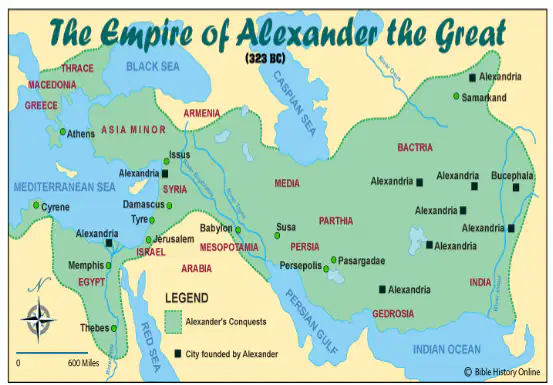
Name one region that was part of Alexander the Great's empire.
Egypt
China
Scandinavia
Japan
Refer to DOCUMENT 2 - The Legend of the Helmet. Why were Alexander and his men struggling in the desert?
They were struggling because they had to reach water, which was still far away, and the sun was blazing down upon them.
They were struggling because they were lost and could not find their way out of the desert.
They were struggling because they were being attacked by wild animals in the desert.
They were struggling because their supplies of food had run out and they were starving.
What did Alexander do with the water that was brought to him in a helmet?
He poured the water on the ground in full view of his troops.
He drank all the water himself.
He shared the water only with his generals.
He used the water to wash his hands.
What effect did Alexander’s action of pouring the water on the ground have on his troops?
The effect was so extraordinary that the water wasted by Alexander was as good as a drink for every man in the army.
It made the troops angry and they refused to march further.
The troops felt betrayed and lost trust in Alexander.
It caused the troops to become dehydrated and weak.
Alexander the Great was considered "Great" because of his:
military conquests and spread of Greek culture
interest in philosophy and poetry
role as a Roman emperor
invention of democracy
Which description best fits the 'Excellent (5 pts)' level for the 'Introduction' criterion in the Alexander the Great Paragraph Response rubric?
A) Introduces the topic clearly but may lack engagement or context.
B) Clear and engaging, and sets up the paragraph with context and focus.
C) Attempts an introduction, but it may be vague or only partially sets up the topic.
D) Missing or unclear introduction.
Which description best fits the 'Needs Improvement (0-1 pts)' level for the 'Use of Document 1' criterion in the Alexander the Great Paragraph Response rubric?
A) Evidence from Document 1 is used but explanation is weak or connection is unclear.
B) No use of evidence, or incorrect or misunderstood use of Document 1.
C) Evidence from Document 1 is used and mostly accurate with some connection to the topic.
D) Specific, accurate evidence from Document 1 is fully explained and clearly supports the topic.
Match each performance level to its description for the 'Use of Document 2' criterion in the Alexander the Great Paragraph Response rubric:
Excellent
C
Proficient
A
Satisfactory
D
Needs Improvement
B
Which description best fits the 'Satisfactory (2-3 pts)' level for the 'Conclusion' criterion in the Alexander the Great Paragraph Response rubric?
Strong conclusion that summarizes the paragraph.
Conclusion restates the topic and gives some closure.
Simple or unclear conclusion that only partially addresses the topic.
No conclusion or does not relate to the paragraph topic.
Fill in the blank: A good conclusion should state the ________ effectively.
main idea
supporting details
introduction
examples
Fill in the blank: A good conclusion should provide some sense of ________.
closure
confusion
delay
repetition
Fill in the blank: A good conclusion should restate the ________.
topic
introduction
evidence
summary
Which of the following best describes the leadership style of Alexander the Great?
He ruled from a distance and rarely interacted with his troops.
He led by example and shared hardships with his soldiers.
He delegated all decisions to his generals.
He avoided battles and preferred negotiations.
Fill in the blank: A strong introduction should clearly state the ________ of the paragraph.
main idea
conclusion
summary
evidence
Which of the following was a major achievement of Alexander the Great?
Building the Colosseum
Inventing the Olympic Games
Writing famous philosophical works
Founding several cities named Alexandria
Use this to answer the questions
DOCUMENT 2- The Legend of the Helmet
Source: Lucius Flavius Arrianus, The Campaigns of Alexander, circa 130 СЕ.
The Legend of the Helmet
The army was crossing a desert of sand; the sun was already blazing down upon them, and they were struggling because they had to reach water, which was still far away. Alexander, like everyone else, was very thirsty, but he was nonetheless marching on foot at the head of his men. It was all he could do to keep going, but he did so, and the result (as always) was that the men were the better able to deal with their misery when they saw that Alexander was also struggling. As they marched on, some of Alexander’s men who had gone off looking for water found some-just a little bit collected in a shallow ditch. They scooped what water they could with difficulty and hurried back ... to Alexander; then, just before they reached him, they tipped the water into a helmet and gave it to him. Alexander, with a word of thanks for the gift, took the helmet and, in full view of his troops, poured the water on the ground. So extraordinary was the effect of this action that the water wasted by Alexander was as good as a drink for every man in the army.

