
 Worksheets
Genetics Pre Test
Total questions: 37
Worksheet time: 2hrs 33mins
What is an adaptation?
A type of weather
A change in an organism that helps it survive in its environment
A kind of plant
A type of rock
Which term describes the process by which organisms better suited to their environment tend to survive and produce more offspring?
Photosynthesis
Natural selection
Respiration
Mutation
A population of beetles has both green and brown individuals. Birds can easily spot green beetles on brown soil. Which beetle color is more likely to survive and reproduce?
Green
Brown
Both equally
Neither
A species of fish develops longer fins over generations. What could be a possible reason for this adaptation?
To swim faster and escape predators
To eat more plants
To sleep better
To make more noise
The color of your eyes
Inherited
Acquired
Being able to ice-skate
Inherited
Acquired
Which of the following describes a trait?
The differences among individuals.
Observable characteristics, such as eye color, fur color and ear shape in dogs.
The color of an organism
The differences in features, such as blue, green, or brown eyes.
Which of the following describes a variation.
A characteristic of an organism.
A difference within a characteristic of an organism.
Something that describes why people are the same.
Something that describes why people are different.

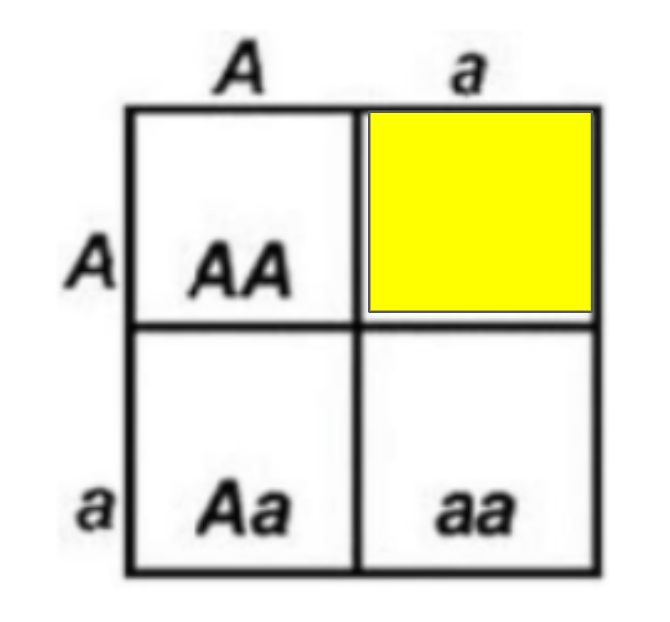
What allele combination should go in the missing box?
AA
Aa
aa

In a pedigree, what shape represents a female?
This trait is hidden whenever the dominant allele is present
dominant allele
codominance
recessive allele
Punnett Square
This trait always shows up in an organism when the allele is present
dominant allele
codominance
probability
recessive allele

B = brown fur b = white fur
In the Punnett square, what is the probability for white fur?
0%
25%
50%
75%

Which layer contains the oldest fossil?
Layer 1
Layer 2
Layer 3
Layer 4

Which layer contains the youngest fossil?
layer 1
layer 2
layer 3
layer 4

The graphs below show the changes in crab color at one beach.
Which of the following is most likely to have caused the change in the distribution?
A new predator arrived that preferred dark-tan crabs.
A new predator arrived that preferred light-tan crabs.
A change in beach color made medium-tan crabs the least visible to predators.
A change in beach color made medium-tan crabs the most visible to predators.

_________ is the process of change by which species of organism change over time.
Nucleotides
Evolution
Mutation
Carbon
A species that no longer exists is said to be _______________.
extinct
endangered
threatened
born
Involves two parents and produces offspring different from parents
external fertilization
sexual reproduction
internal fertilization
asexual reproduction
Type of reproduction that makes an identical copy of a parent cell
sexual reproduction
asexual reproduction
internal fertilization
external fertilization

The process on the right is:
Right: meiosis
Right: cloning
Right: meiosis
Right: mitosis

An organism’s genetic makeup; the pair of alleles for a trait is called a(n)
dominant trait
genotype
phenotype
recessive trait

What is happening to the light colored moth population?
It is increasing over time.
It is staying the same.
It is decreasing over time.
It increases then decreases over time.

What is on the X-axis of the graph?
Moth Generations
Percentage of Moths
Number of Moths
Number of Dark Colored Trees

Which axis would you place the INDEPENDENT variable?
X-Axis
Y-Axis

Which axis would you place the DEPENDENT variable?
X-Axis
Y-AXIS

According to the graph above, how many minutes can a seal hold it's breath?
7
12
19
6
According to the graph above, which animal can hold their breath the longest?
Dolphins
Whales
Seals

Which answer below charts the data presented in the table above correctly?


What is the variation in the graph above ?
Size
Color
Weight
Age

Which color became dominant by Year 400?
Blue
Pink
Red
Purple

