
 Worksheets
Grade 6: SCIENCE FINAL EXAM
Total questions: 72
Worksheet time: 36mins
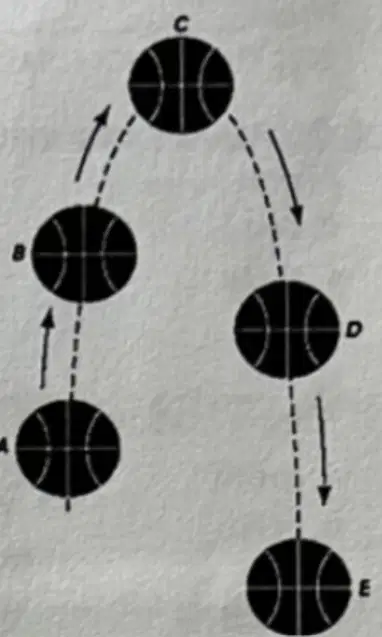
Identify the forms of energy the ball has at point D:
Elastic and Chemical
Chemical and Nuclear
Nuclear and Potential
Potential and Kinetic

At which point does the ball have the greatest Gravitational Potential Energy (GPE)?
A
B
C
D
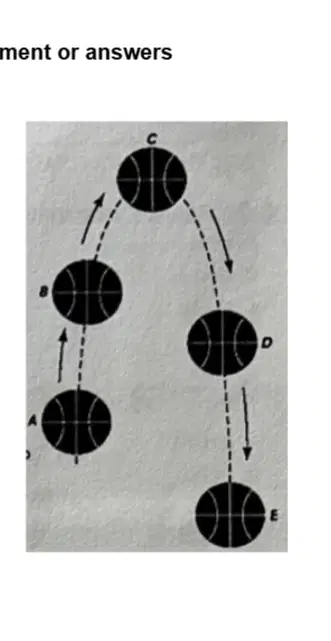
If the ball at point E were to hit the floor and bounce, this would be an example of a transfer of energy from:
Nuclear to Kinetic
Kinetic to Sound
Potential to Kinetic
Kinetic to Electrical
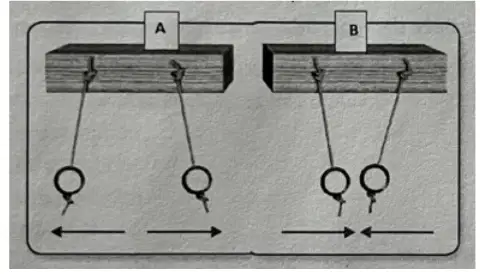
Which letter in the diagram below shows charges that attract?
A
B
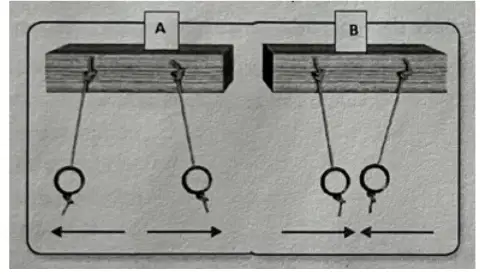
Which letter in the diagram below shows charges that repel?
A
B
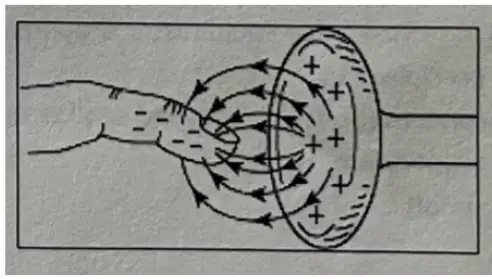
How will the charges between the finger and the doorknob react?
They will attract
They will repel
They will not attract or repel
None of the above
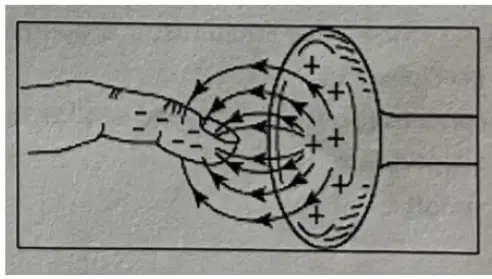
What do the lines connecting the finger and the doorknob represent in the diagram below?
Magnetic field lines
Chemical field lines
Electric field lines
None of the above
On average, how many high tides are there each day?
1
2
3
4
What kind of tide will cause the Earth's ocean levels to be extremely high or extremely low?
Spring Tide
Neap Tide
Ebbing Tide
Flooding Tide
Tides tend to have the greatest difference between high and low tides when the Moon is in which phases?
New Moon & Full Moon
1st Quarter & 3rd Quarter
Waxing & Waning Crescents
Waxing & Waning Gibbous
When the Moon is at the 1st and 3rd Quarter phases, oceans have the least difference between high and low tides. What do we call this type of tide?
Spring Tide
Neap Tide
Ebbing Tide
Flooding Tide
This type of tide occurs only at New and Full Moon phases.
Spring Tide
Neap Tide
Ebbing Tide
Flooding Tide
People who wear glasses may notice that their glasses fog up when they come indoors on a cold day. What process caused tiny liquid water droplets to form on the lenses?
Precipitation
Condensation
Evaporation
Run-off
What percent of our atmosphere is made up of gases other than Oxygen and Nitrogen?
1%
78%
21%
100%
What happens to the air pressure as you descend through the atmosphere?
Air pressure increases
Air pressure stays the same
Air Pressure decreases
Air Pressure depends on the wind belt over the area
Why do mountain climbers wear oxygen masks to minimize the chance of health hazards or even death?
The air at high altitudes is denser, so it is harder to breathe in enough oxygen.
The air at high altitudes is less dense, so it is harder to breathe in enough oxygen.
The air at high altitudes sinks, so it is harder to breathe in enough oxygen.
The air at high altitudes rises, so it is harder to breathe in enough oxygen.
In which layer of Earth's atmosphere does the weather occur?
Troposphere
Mesosphere
Stratosphere
Exosphere
Sarah exhaled against a glass window and noticed that it made a spot from the water vapor in her breath. What stage of the water cycle does this show?
Precipitation
Evaporation
Condensation
Transpiration
You have been playing hard on a hot summer day. You have been perspiring (sweating). When the sweat disappears, your body feels cooler. What process occurs when your sweat disappears?
Transpiration
Condensation
Evaporation
Precipitation
Why are you less likely to see a Total Solar Eclipse than a Total Lunar Eclipse?
The Moon's shadow covers all of Earth during a Solar Eclipse
New Moon phases occur less often than Full Moon phases
Only Solar Eclipses are spectacular events
The Moon's umbra only covers a small area on Earth's surface
Where is a total solar eclipse visible from?
All over Earth
Only within the Moon's umbra
Only the Northern Hemisphere
Only the nighttime side of Earth
What would an observer on Earth see during a Total Lunar Eclipse?
New Moon
Moon turning a reddish color
No moonlight
1st Quarter Moon
What do we call the darkest part of a shadow in space?
Umbra
Penumbra
Axis
Far side
This type of eclipse occurs when a New Moon blocks our view of the Sun.
Lunar Eclipse
Solar Eclipse
Umbral Eclipse
Penumbral Eclipse
What do we call a partial shadow in space?
Umbra
Penumbra
Orbit
Axis
What is the natural phenomenon that causes winds to curve differently in the Northern and Southern Hemispheres due to Earth's rotation?
Revolution
Coriolis Effect
Jet Stream
Sea Breeze
Heat is transferred through the atmosphere when warm air rises and cool air sinks in which process?
Convection
Conduction
Radiation
Precipitation
What is the narrow band of fast-moving air about 6 miles high above North America is called?
Sea Breeze
Coriolis Effect
Jet Stream
Prevailing Easterlies
What is the warm water current that affects the climate of the Eastern coast of the United States?
Trade Wind Current
South American Gyre
El Nino Current
Gulf Stream Current
What is the Greenhouse Effect?
Process by which gases in our atmosphere hold heat
Reflection of solar radiation back to space
Cooling effect of clouds in the atmosphere
Mixing of warm and cool air in the atmosphere

What is the net force of the rope in the tug-of-war model?
12N to the right
12N to the left
4N to the right
4N to the left
The force of gravity pulls you to the ground. The ground pushes back with an equal and opposite force. This is an example of which law of motion?
1st Law (Law of Inertia)
2nd Law (Law of Acceleration)
3rd Law (Law of Action & Reaction)
None of the above
Which law states that an object will continue moving at a constant velocity, or a stationary object will remain at rest unless acted on by an unbalanced force?
1st Law (Law of Inertia)
2nd Law (Law of Acceleration)
3rd Law (Law of Action & Reaction)
None of the above
Insulators of electrical charges are materials such as…
Iron
Rubber
Metal Coins
Stainless Steel
Conductors of electrical charges are materials such as…
Copper
Glass
Wood
Rubber
Elastic Potential Energy (EPE) is energy…
Of motion
Stored in a stretched or compressed object
Of gravity
Of mass
Rock climbers have Gravitational Potential Energy (GPE), which is Potential Energy caused by an object's…
Height or Position
Stretching
Motion
Mass
The ability to do work, or cause change is called…
Energy
Gravity
Velocity
Motion
When a ball is dropped from the top of a ladder, at what point does it have the most Potential Energy?
At the top, before it is released
After it stops bouncing and stays motionless on the ground
Halfway down the ladder
At the bottom of the ladder
Which statement best describes the energy changes that occur when a skier is down a steep mountain?
Kinetic energy decreases and potential energy increases
Kinetic energy increases and potential energy decreases
Both potential energy and kinetic energy increase
Both potential energy and kinetic energy decrease
In either hemisphere, there is 1 day per year when the sun appears highest in the sky. What do we call this day?
Fall Equinox
Spring Equinox
Winter Solstice
Summer Solstice
Throughout the year, where are the Sun's rays most direct on Earth's surface?
At the poles
At the equator
At high altitudes
At low elevations
Approximately how long does it take for the Earth to orbit the Sun?
24 hours
29.5 days
90 days
365 ¼ days

The phase of the Moon you see depends on…
Where you are on Earth's surface
How much of the sunlit side of the Moon faces Earth
The distance between Earth and the Moon
Whether or not an eclipse is occurring
How long does it take for the Moon to orbit the Earth?
24 hours
29.5 days
90 days
365 ¼ days
Approximately how many days are there from New Moon to Full Moon?
7
14
21
28
From New Moon to Full Moon, what does an observer on Earth see?
An increasing amount of sunlight reflected from the Moon
A decreasing amount of sunlight reflected from the Moon
The same amount of sunlight reflected from the Moon
No sunlight reflected from the Moon.
Which order of phases shows increasing sunlight reflected to Earth? (Moon getting "larger")
new, full, gibbous, crescent
new, crescent, gibbous, full
full, gibbous, crescent, new
crescent, gibbous, full, new
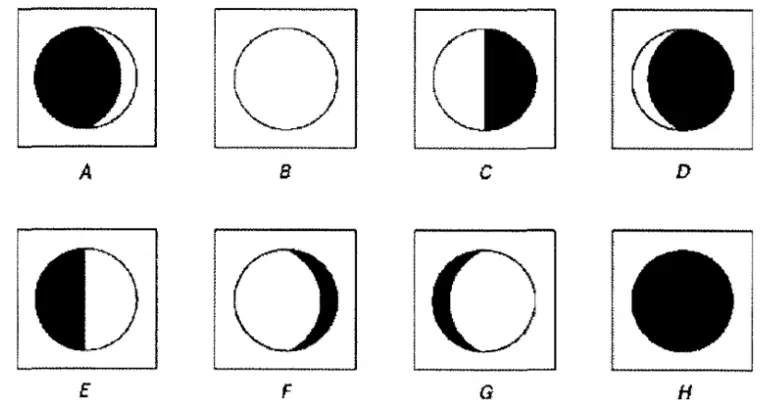
The Full Moon is represented by which letter?
A
B
C
D

Approximately how many days pass between B and H?
About 14 days
About 7 days
About 21 days
About 30 days

Which 2 letters show quarter moons?
C & E
A & D
B & F
D & H

Which 2 letters show crescent moons?
A & D
B & D
C & F
D & E
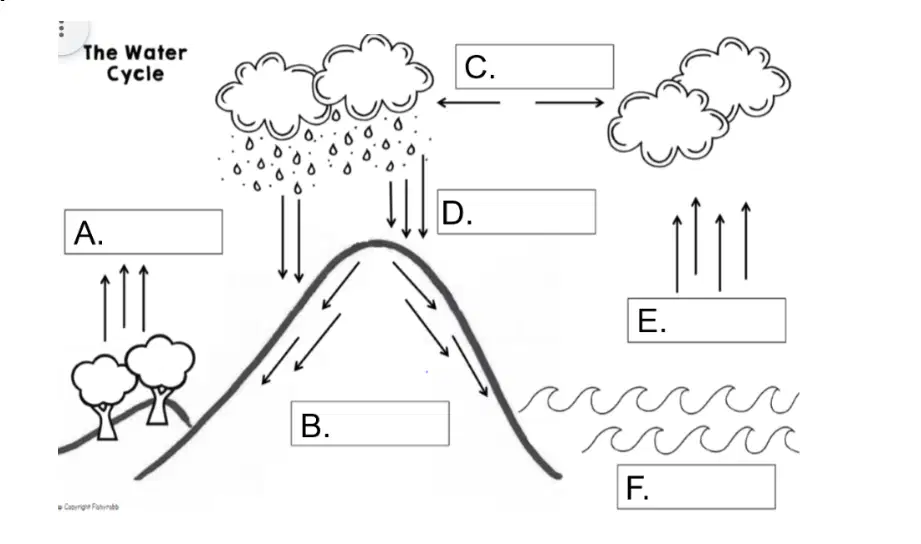
Using the diagram below, name the objects located at: C: ________________________________
Condensation (assuming standard water cycle labeling)
Precipitation
Evaporation
Collection
Which of the following are criteria for an object in space to be classified as a planet?
It orbits a star and has cleared its orbit of other debris.
It is made entirely of gas and has no solid surface.
It is smaller than an asteroid and has an irregular shape.
It emits its own light like a star.

What is labeled A in the diagram?
Transpiration
Photosynthesis
Respiration
Condensation

What is labeled B in the diagram?
Runoff
Evaporation
Condensation
Transpiration

What is labeled D in the diagram?
Precipitation
Evaporation
Condensation
Transpiration
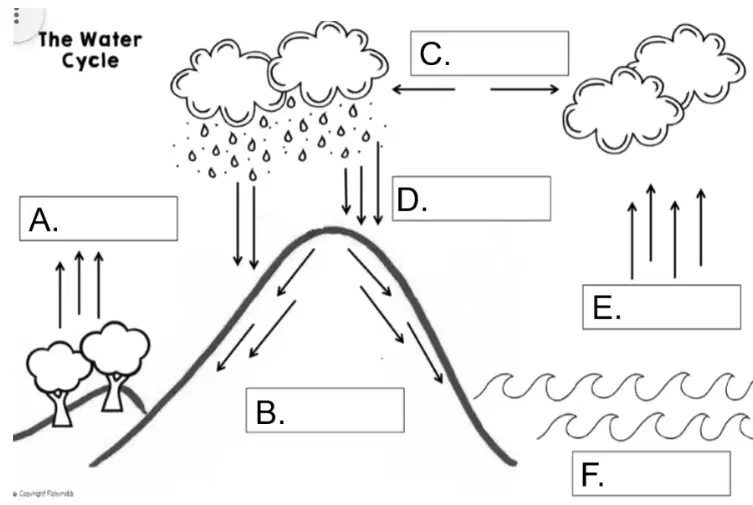
What is labeled E in the diagram?
Evaporation
Condensation
Precipitation
Transpiration
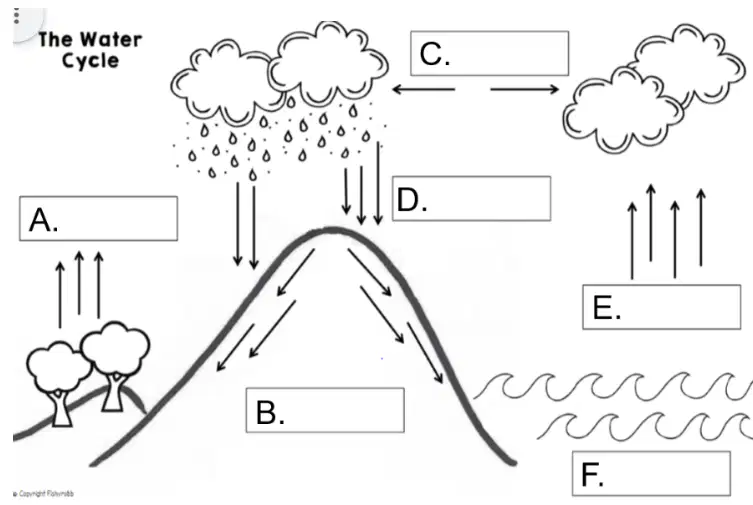
What is labeled F in the diagram?
Collection
Condensation
Precipitation
Transpiration

54. (a) Air mass F is:
Continental
Maritime

Identify air mass F as Polar or Tropical:
Polar
Tropical

Air mass B brings with it cool and dry weather to the United States because:
it originates over warm oceans
it forms over cold, dry land areas
it is formed in tropical regions
it carries moisture from the Gulf of Mexico

55. (a) The object that would accelerate toward the left is:
Object 1
Object 2
Object 3
Object 4
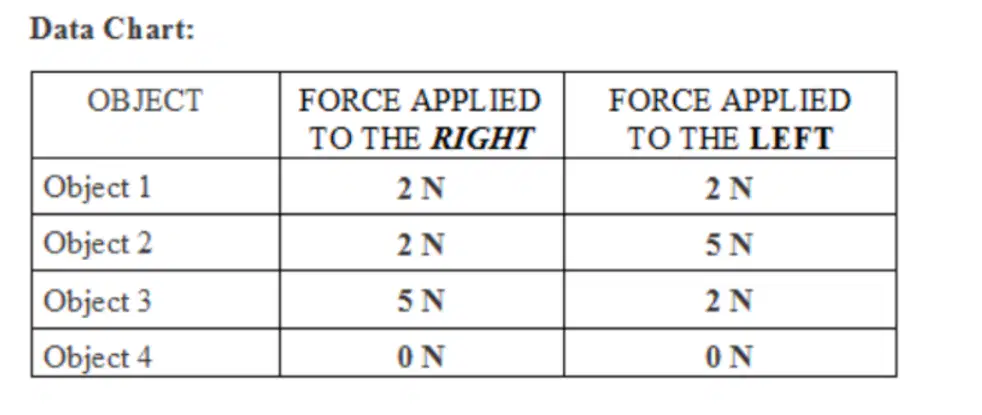
Which 2 objects would not accelerate in either direction?
1 and 2
1 and 4
3 and 4
None

Identify which of Newton's Laws of Motion is best depicted in the diagram.
Newton's Third Law of Motion (For every action, there is an equal and opposite reaction).
Newton's First Law of Motion (An object at rest stays at rest and an object in motion stays in motion unless acted upon by an external force).
Newton's Second Law of Motion (Force equals mass times acceleration).
Newton's Law of Universal Gravitation (Every mass attracts every other mass in the universe).

Using the diagram, in which direction will the balloon travel?
The balloon will travel to the right (opposite to the direction of the ejected air molecules).
The balloon will travel to the left (in the same direction as the ejected air molecules).
The balloon will remain stationary.
The balloon will move upward.
The balloon travels in the direction you chose in (b) because:
Air pressure inside the balloon pushes air out, causing an equal and opposite reaction that moves the balloon forward.
Gravity pulls the balloon in that direction.
The balloon is attracted to magnetic fields.
The balloon moves due to friction with the air.

The 2 major motions of the Earth in space are:
Rotation and Revolution
Rotation and Precession
Revolution and Nutation
Precession and Nutation
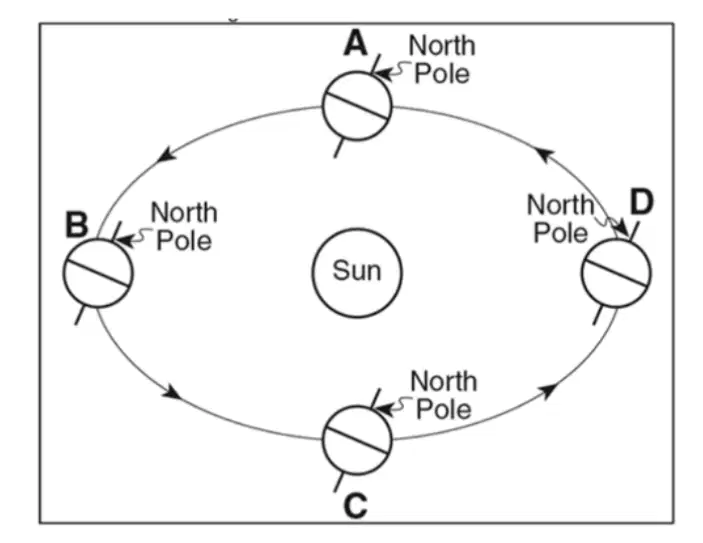
The letter that indicates the summer solstice for the Northern Hemisphere is:
A
B
C
D
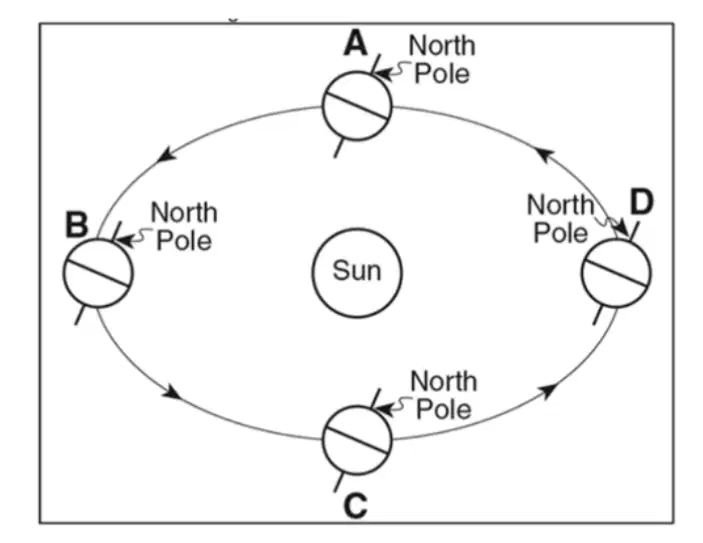
The 2 letters that indicate equinoxes for the Northern Hemisphere are:
A and C
B and D
C and E
D and F
What is the reason for the seasons on Earth?
The tilt of Earth's axis relative to its orbit around the Sun is the reason for the seasons on Earth.
The distance between Earth and the Sun changes drastically during the year.
The phases of the Moon affect the seasons on Earth.
Earth's rotation speed increases and decreases throughout the year.
What two factors combine to keep Earth in its orbit around the Sun?
Gravity and inertia combine to keep Earth in its orbit around the Sun.
Friction and magnetism combine to keep Earth in its orbit around the Sun.
Electricity and pressure combine to keep Earth in its orbit around the Sun.
Wind and temperature combine to keep Earth in its orbit around the Sun.

