
 Worksheets
Inflation and Deflation
Total questions: 50
Worksheet time: 25mins
Which price indices are used to interpret the rate of inflation?
RPI and CPI
GDP and GNP
WPI and IIP
Current and Constant
Which GDP take into account inflation?
Real and constant
Absolute and relative values
Fixed and variable values
Nominal and current
Which GDP values do NOT take into account inflation?
Constant and current prices
Nominal and real prices
Fixed and flexible prices
Wholesale and retail prices
Which of the following is a cause of inflation?
Demand pull
Cost push
Both A and B
Which of the following is an impact of inflation on firms?
Uncertainty
Loss of international competitiveness
Both A and B
Which of the following is an impact of inflation on individuals?
Loss of real income
Savers and borrowers
Both A and B
Inflation is defined as the rate of change in the ________ over time.
average price level
unemployment rate
interest rate
money supply
Which of the following best describes inflation?
The sustained increase in the cost of living / fall in the purchasing power of money
The decrease in the average price level over time
The increase in the value of money
The reduction in the cost of goods and services
Which of the following is a measure of inflation?
Consumer Prices Index (CPI)
Gross Domestic Product (GDP)
Unemployment Rate
Interest Rate
Which index is the preferred measure and the Bank of England target?
Retail Prices Index (RPI)
Consumer Prices Index (CPI)
Producer Price Index (PPI)
Exchange Rate Index
Both the Consumer Prices Index (CPI) and the Retail Prices Index (RPI) are ________.
weighted
unregulated
fixed
seasonal
Who publishes data on the CPI and RPI in the UK?
Bank of England
Office of National Statistics (ONS)
Department for Education
HM Treasury
How many items are in each basket used by the ONS?
100
500
700
1000
Different items are ______ according to their importance in terms of how much their price changes impact upon consumers.
weighted
ignored
priced
measured
Which of the following is NOT mentioned as having a high weighting in the basket of goods and services?
Petrol
Housing
Staple foods
Electronics
Which of the following is a recent addition to the basket of goods and services?
Bread
Sewing Machines
Broadband subscriptions
Condensed Milk
The ONS updates the 'basket' every year to reflect changes in ______ patterns.
spending
weather
language
education
Few people fit the definition of what term according to the limitations of measurement? Few people fit the definition of “______”.
average
unique
exceptional
perfect
What is the government’s target measure of inflation?
RPI
CPI
GDP
GNP
The RPI is considered more realistic than the CPI because it includes mortgage payments and interest.
True
False
What does the CPI ignore when measuring inflation? CPI ignores improvements in the _______ of goods and services.
quality
price
quantity
brand
What is expressed in monetary terms and does not take into account inflation?
Real value
Nominal value
Constant prices
Current prices
Constant prices are prices that have been adjusted for inflation. They are ______ values.
real
nominal
fictitious
gross
Current prices are prices that have not been adjusted for inflation. They are ______ values.
nominal
real
adjusted
deflated
Demand-pull inflation occurs when there is too much money (______) chasing too few goods/services (supply).
demand
supply
production
consumption
What is the formula for aggregate demand (AD)?
C + I + G + (X-M)
C + S + T + (X-M)
C + I + G + X + M
C + I + G - (X+M)
Which of the following is the largest component of aggregate demand (AD)?
Investment
Government spending
Consumption
Net exports
__________ increases disposable income, allowing people to spend more.
Reduced taxation
Increased taxation
Higher interest rates
Rising unemployment
__________ makes borrowing more attractive and saving less rewarding.
Lower interest rates
Higher taxes
Increased inflation
Stricter lending rules
__________ can increase export growth.
Weak exchange rate
High inflation rate
Strict import tariffs
Decreased foreign demand
__________ in other countries (such as China/India) may increase demand for UK exports.
Fast growth/increasing incomes
Falling population
Decreasing productivity
Lower education levels
__________ of future growth may cause higher consumer spending and investment.
Rise in confidence/expectations
Decrease in confidence/expectations
Stagnation in confidence/expectations
Uncertainty in confidence/expectations
What is the immediate effect of a cut in interest rates according to the diagram?
Consumption falls
Consumption rises
Saving becomes more rewarding
Borrowing becomes less attractive

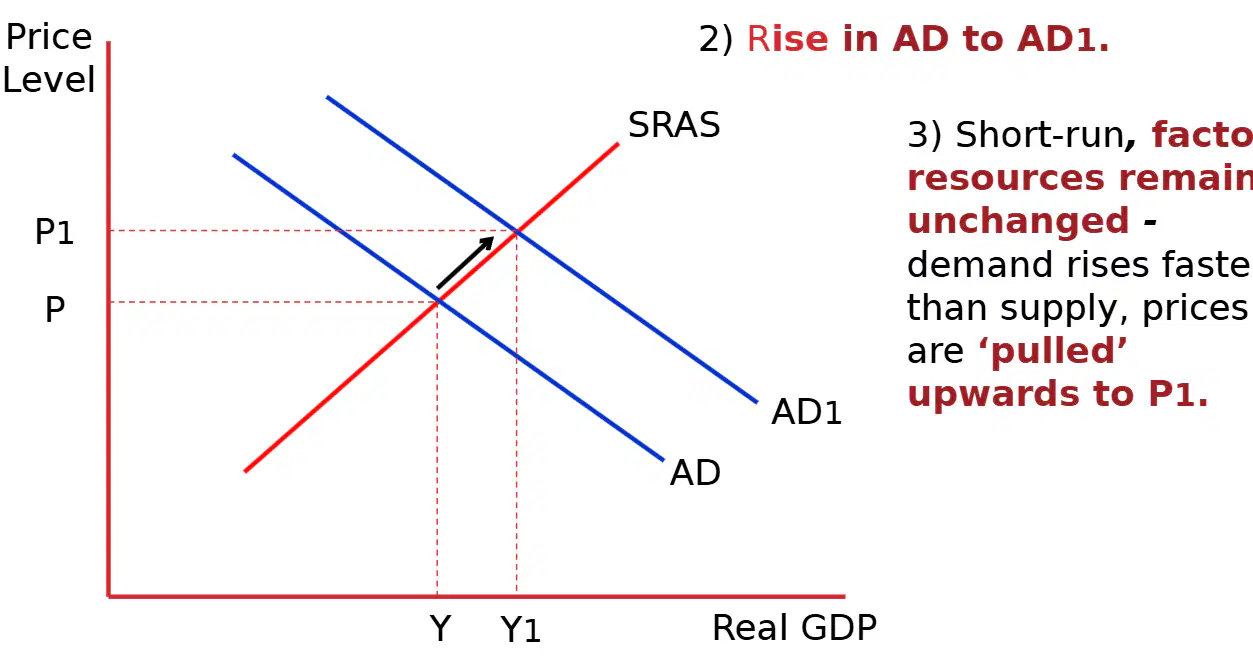
Refer to the DEMAND-PULL INFLATION DIAGRAM. When aggregate demand (AD) increases to AD1, what happens to the price level in the short run?
It falls to P
It rises to P1
It remains unchanged
It falls to zero

A cut in interest rates makes borrowing on credit more attractive and saving less rewarding, leading to a rise in consumption.
True
False
Cost-push inflation occurs due to ________, firms increasing prices.
rising costs of production
increased consumer demand
higher government spending
lower interest rates
Which of the following is a cause of cost-push inflation?
Wage increases
Lower raw material costs
Decreased taxes
Lower import prices
What happens when raw materials become scarce and demand increases?
Prices fall
Prices rise
Wages decrease
Taxes are reduced
Higher taxes imposed by the government on firms can lead to cost-push inflation.
True
False
A weaker exchange rate or rising prices abroad can make imports more expensive, leading to higher costs of production.
True
False
Natural disasters or war can temporarily or permanently reduce the supply of raw materials or disrupt the supply chain, increasing their prices.
True
False
Fill in the blank: Higher wage costs can lead to higher prices, then workers will want higher wages, leading to a _________.
wage-price spiral
deflationary cycle
productivity boom
supply shock
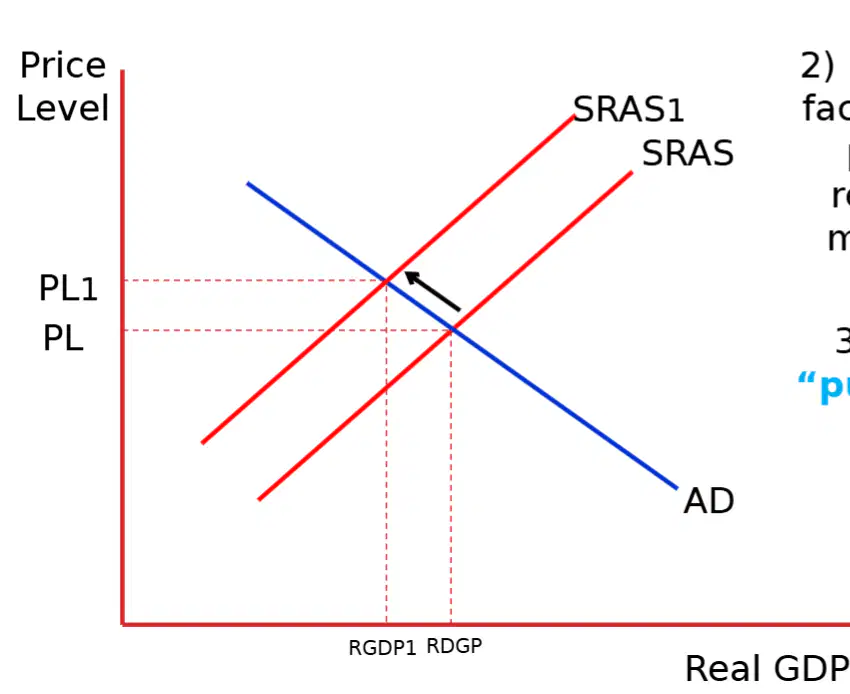
What is the effect of an increase in wage rates on a firm's costs of production?
Decrease costs
Increase costs
No effect
Increase demand
What is deflation? Deflation is a ________ in the general price level.
decrease
increase
stabilization
fluctuation
If inflation changes from 2.7% to 2.3%, does this mean prices are falling?
Yes
No
Prices increasing at a slower rate is called ________.
disinflation
hyperinflation
stagflation
deflation
Deflation is a (a) inflation rate. For example, inflation at -4%.
positive
negative
Which of the following best describes disinflation?
A fall in the rate of inflation
Prices are falling rapidly
Prices are rising at a faster rate
The inflation rate is negative
Deflation occurs in periods of ................ growth (GDP).
very low
very high
moderate
rapid
As prices fall, what do consumers do because they think prices will fall further?
Increase their purchases
Delay purchasing decisions
Spend more money
Save less

