
 Worksheets
Government
Total questions: 77
Worksheet time: 39mins
Governments have control over which of the following decisions?
Setting tax rates
Choosing family vacation spots
Deciding what movies are popular
Selecting individual career paths
Some decisions governments have control over include: _________.
Laws
Personal hobbies
Favorite foods
Weather patterns
Some decisions governments have control over include: _________.
Taxes
Favorite movies
Personal hobbies
Pet names
Some decisions governments have control over include: _________.
Wars
Personal hobbies
Favorite foods
Private dreams
Some decisions governments have control over include: _________.
Treaties
Weather patterns
Planetary orbits
The laws of physics
The purpose of government is to:
maintain order and provide services
control all aspects of citizens' lives
eliminate all laws and rules
focus only on economic growth
The purpose of government is to: _______ & _______ the citizens of the nation.
Protect & Serve
Ignore & Exploit
Punish & Isolate
Distract & Divide
What is Social Contract Theory?
A) A philosophy or way of thinking developed by French philosopher Jean-Jacques Rousseau and English philosopher John Locke.
B) A type of government system based on monarchy.
C) A scientific theory about society.
D) A religious belief system.
Who are the philosophers associated with the development of Social Contract Theory?
A) Jean-Jacques Rousseau and John Locke
B) Plato and Aristotle
C) Karl Marx and Friedrich Engels
D) Thomas Hobbes and Adam Smith
Fill in the blank: Social Contract Theory is the belief that there is a contract between the citizens and government, where citizens would give the government the right to rule, or power, as long as the government promised to protect the rights of the citizens or do _______ acts in the best interest of the citizens.
good
selfish
illegal
harmful
The main idea behind Social Contract Theory is:
People agree to form a society and accept certain rules for mutual benefit.
Individuals should always act in their own self-interest.
Laws are created only by kings and rulers without public input.
Society functions best without any rules or agreements.
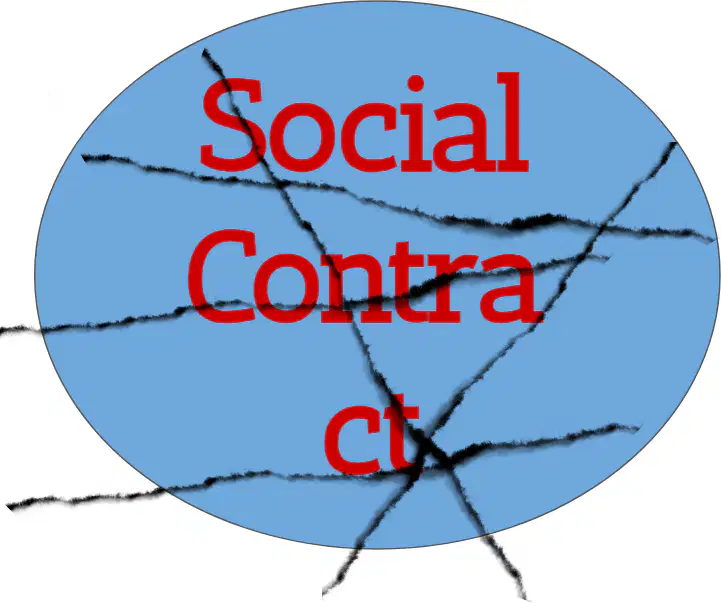
What is the social contract? Fill in the blank: The social contract is an agreement between the _______ and the _______.
citizens; government
teachers; students
employers; employees
parents; children
According to the passage, when may the social contract between the citizens and the government be broken?
When the government protects the citizens
When the government abuses its power or does not look after the best interests of the citizens and country
When the citizens follow the law
When the government is fair
The social contract may be broken if the government does not look after the best interests of the citizens and country.
True
False
Government is:
an organization that makes and enforces laws for a society
a type of weather system
a form of entertainment
a kind of animal
Fill in the blank: ______ are regions that share a common government.
States
Mountains
Rivers
Forests
What common types of governments do the following entities share: New York (State: Albany), Maine (State: Augusta), Iowa (State: DesMoines), Texas (State: Austin), United States (Federal: Washington D.C.), Rockland County (County: New City), Orangetown (Town: Orangeburg)?
Representative democracy
Monarchy
Dictatorship
Theocracy
What is the capital of the state of New York?
Albany
Buffalo
Rochester
Syracuse
What is the capital of the state of Maine?
Augusta
Portland
Bangor
Lewiston
What is the capital of the state of Iowa?
Des Moines
Cedar Rapids
Davenport
Sioux City
What is the capital of the state of Texas?
Austin
Houston
Dallas
San Antonio
What is the capital of the United States federal government?
Washington D.C.
New York City
Los Angeles
Chicago
States can be divided into how many main types based on the level of control they have over making decisions?
1
2
3
4
According to the definitions provided, is New York a Dependency or a Nation-State?
Dependency
Nation-State
According to the definitions provided, is Puerto Rico a Dependency or a Nation-State?
Dependency
Nation-State
According to the definitions provided, is Bermuda a Dependency or a Nation-State?
Dependency
Nation-State
According to the definitions provided, is United States a Dependency or a Nation-State?
Dependency
Nation-State
According to the definitions provided, is Mexico a Dependency or a Nation-State?
Dependency
Nation-State
According to the chart in 'Introduction to Types of Government,' which type of government is classified as 'Rule by Many'?
Democracy
Oligarchy
Dictatorship
Monarchy
According to the chart in 'Introduction to Types of Government,' which type of government is classified as 'Rule by a Few'?
Democracy
Oligarchy
Dictatorship
Anarchy
According to the chart in 'Introduction to Types of Government,' which type of government is classified as 'Rule by One'?
Monarchy
Anarchy
Democracy
Oligarchy
According to the chart in 'Introduction to Types of Government,' which type of government is classified as 'Rule by None'?
Dictatorship
Anarchy
Democracy
Monarchy
According to the chart in 'Introduction to Types of Government,' which type of government is also classified as 'Rule by One'?
Dictatorship
Democracy
Oligarchy
Anarchy
What is the meaning of 'Anarch'? Fill in the blank: Without a chief or head; The absence of ________.
government
education
freedom
religion
Believers in anarchy feel the government should be abolished in order to allow human communities to develop and flourish as they see fit WITHOUT interference from the ________.
government
media
military
economy
Anarchists believe people should be allowed to live wherever they like and 'share' in both work as well as products.
True
False
Anarchists believe that government is harmful and unnecessary and people's actions should never be forced.
True
False
Anarchists oppose rules and laws.
True
False
Without rules and laws, ______ often exists and serious concerns for safety appear.
chaos
order
peace
harmony
A monarchy is a form of government that has a 'monarch'. Monarchs use titles such as king, queen, emperor, empress and their position is usually achieved through ________.
heredity
election
appointment by parliament
random selection
A monarchy is a form of government that has a 'monarch'. Monarchs use titles such as king, queen, emperor, empress and their position is usually achieved through heredity. In other words, he/she is (a) the position and usually passes from father to oldest son.
elected to
born into
appointed to
voted into
There are 2 types of monarchies: Absolute Monarchy and Constitutional Monarchy. Name the two types of monarchies.
Absolute Monarchy and Constitutional Monarchy
Federal Monarchy and Parliamentary Monarchy
Direct Monarchy and Indirect Monarchy
Hereditary Monarchy and Elected Monarchy
Which type of monarchy has a title inherited at birth and keeps the position until death?
Absolute Monarchy
Constitutional Monarchy
Both
Neither
In which type of monarchy does the monarch have ABSOLUTE or UNLIMITED power?
Absolute Monarchy
Constitutional Monarchy
Both
Neither
In a Constitutional Monarchy, power is LIMITED by a ________.
constitution
president
parliament
prime minister
In an Absolute Monarchy, there is nothing in place to prevent changing or creating new laws.
True
False
Which type of monarchy is described as 'untouchable'?
Absolute Monarchy
Constitutional Monarchy
In a Constitutional Monarchy, who acts as the government to make rules/laws?
The Monarch
A separate body
The people
No one
The monarch's position in a Constitutional Monarchy is mainly for ________ and is out of tradition, not necessity.
public relations
law enforcement
economic planning
military command
A dictatorship is a form of government that is led by a person or small group with _________
almost unlimited power
limited voting rights
shared responsibilities
democratic values
What is the ruler of a dictatorship called?
President
Dictator
Monarch
Prime Minister
Dictators _______ the rules and laws. That means they give orders. If the orders of a dictator are not followed, there are usually harsh consequences.
dictate
obey
ignore
question
Similar to an absolute monarch, dictators also have ________ power, however, dictators do not inherit their position from birth.
unlimited
limited
shared
temporary
Dictators sometimes seize power (take the position by force) or use _______ to mislead people into electing them into power.
deception
bravery
charity
honesty
Countries that do not have a strong governing body with a system of checks and balances are more likely to be ruled by a dictator.
True
False
Democracy literally means "______". (Fill in the blank)
rule by the people
rule by the king
rule by the wealthy
rule by the military
What are the two types of democracies?
Direct Democracy
Indirect Democracy
Representative Democracy
Monarchy
Which form of democracy is considered the purest form of democracy?
Direct Democracy
Representative Democracy
Monarchy
Oligarchy
Which form of democracy is considered a modified form of democracy?
Direct Democracy
Representative Democracy
Monarchy
Dictatorship
In Direct Democracy, who takes part in the decision making process?
All eligible members take part in the decision making process. Everyone has a 'vote'.
Only elected representatives take part in the decision making process.
Only the head of the state takes part in the decision making process.
Only a select group of officials take part in the decision making process.
In Representative Democracy, who makes decisions in the best interest of the citizens?
Elected representatives make decisions in the best interest of the citizens.
Citizens make all decisions directly through voting.
The military makes decisions for the citizens.
Foreign leaders make decisions for the citizens.
A con of Direct Democracy is that the public may have too much power and make mistakes with the power.
True
False
Direct Democracy was used in which ancient civilization?
Ancient Greece
Ancient Egypt
Ancient China
Ancient Rome
Representative Democracy is used in the United States at both national and state levels.
True
False
In Representative Democracy, the powers of the elected representatives are defined by a set of laws called the ________.
constitution
manifesto
referendum
treaty
Based on the title 'Representative vs. Direct' and the image showing three pairs of people in different attire, what type of government is being compared?
Monarchy vs. Oligarchy
Representative Democracy vs. Direct Democracy
Dictatorship vs. Democracy
Theocracy vs. Republic
What is an oligarchy? Fill in the blank: An oligarchy is a form of government where the political power lies with a small, powerful segment of society.
A form of government where the political power lies with a small, powerful segment of society.
A form of government where all citizens have equal power.
A form of government ruled by a single monarch.
A form of government where religious leaders hold power.
According to the passage, the small ruling class in an oligarchy may be powerful due to which of the following?
Wealth
Military strength
Political influence
All of the above
Rulers in an oligarchy typically use their ruling power to seek personal gains or benefits for their group rather than the welfare of all citizens.
True
False
Some political scholars argue that all societies are actually oligarchies no matter what political system they identify with.
True
False
Oligarchies are often controlled by a few powerful families whose children are ______ and ______ to take over the ruling power.
raised; trained
ignored; discouraged
isolated; forbidden
punished; neglected
A theocracy is a type of government where ______ and government are combined.
religion
economics
military
education
Who is recognized as the supreme ruler in a theocracy?
The people
A god or goddess
The president
The military
In a theocracy, laws are based on ______ laws and teachings. Fill in the blank.
religious
scientific
economic
military
Some theocracies share power between a secular ruler (such as an emperor or king) and a ______ leader (such as a pope). Fill in the blank.
religious
military
economic
judicial
In all theocracies, only religious leaders have power.
True
False
Fill in the blank: ________ is the person or people who make decisions and laws for a nation, state, or community.
Government
Citizen
Teacher
Artist

