
Font size
 Worksheets
Science 8 Final Quizizz Review
Total questions: 231
Worksheet time: 6hrs 35mins
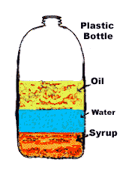

Which of the squares below is more dense?


find the mass of an object with a density of 1.2 g/cm3 and volume 5 cm3
4.17 gram
0.24 gram
6 gram
3.8 gram
Which of the following is an example of an object with a low density?
Pillow
Bowling Ball
Brick
Which of the following is an example of an object with a high density?
Pillow
Bowling Ball
Beach Ball
Which of the following is the correct units for density?
grams (g)
Newtons (N)
cm3
g/cm3
What is the density of an object if it has a mass of 6g and a volume of 3cm3? (Hint: Density = mass/volume)
6 g/cm3
3 g/cm3
2 g/cm3
1/3 g/cm3
What is the density of an object with a mass of 3g and a volume of 1cm3? (Hint: Density = mass / volume)
1/3 g/cm3
3 g/cm
3 g/cm3

What pressure will be exerted by a force of 10 N acting on an area of 4m2 ?
1 Pa
2 Pa
5 Pa
2.5 Pa
20 Pa
What force will be produced by a pressure of 100 N/m2 on an area of 4 m2
400 N
100 N
25 N
104 N

Calculate the density of the cube.
2 g/cm3
4 g/cm3
6 g/cm3
8 g/cm3

what is the volume of the cube?
123
144
244
150

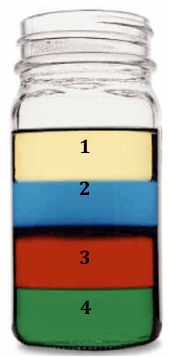
Which substance is the most dense in this picture?
Vegetable Oil
Dish Soap
Honey
Corn Syrup
What force will be produced by a pressure of 2 000 N/m2 on an area of 5 m2
4000 N
1000 N
250 N
10 000 N
What force will be produced by a pressure of 100 N/m2 on an area of 4 m2
400 N
100 N
25 N
104 N
What are two the two types of mixtures?
elements
compounds
heterogenous
homogenous
A pure substances ________ be broken down into simpler matter using physical methods.
sometimes
can
can not
Why kind of mixture is this? All parts of the mixture are visible because they do not mix together.
Heterogeneous
Homogenous
Element
Compound
Why kind of mixture is this? Compounds cannot be distinguished from each other.
Heterogeneous
Homogenous
Element
Compound
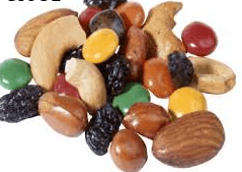
Why kind of mixture is this?
Heterogeneous
Homogenous
Element
Compound
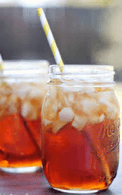
Why kind of mixture is this? (the sugar in the tea)
Heterogeneous
Homogenous
Element
Compound
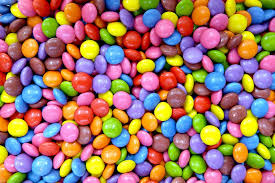
Why kind of mixture is this?
Heterogeneous
Homogenous
Element
Compound
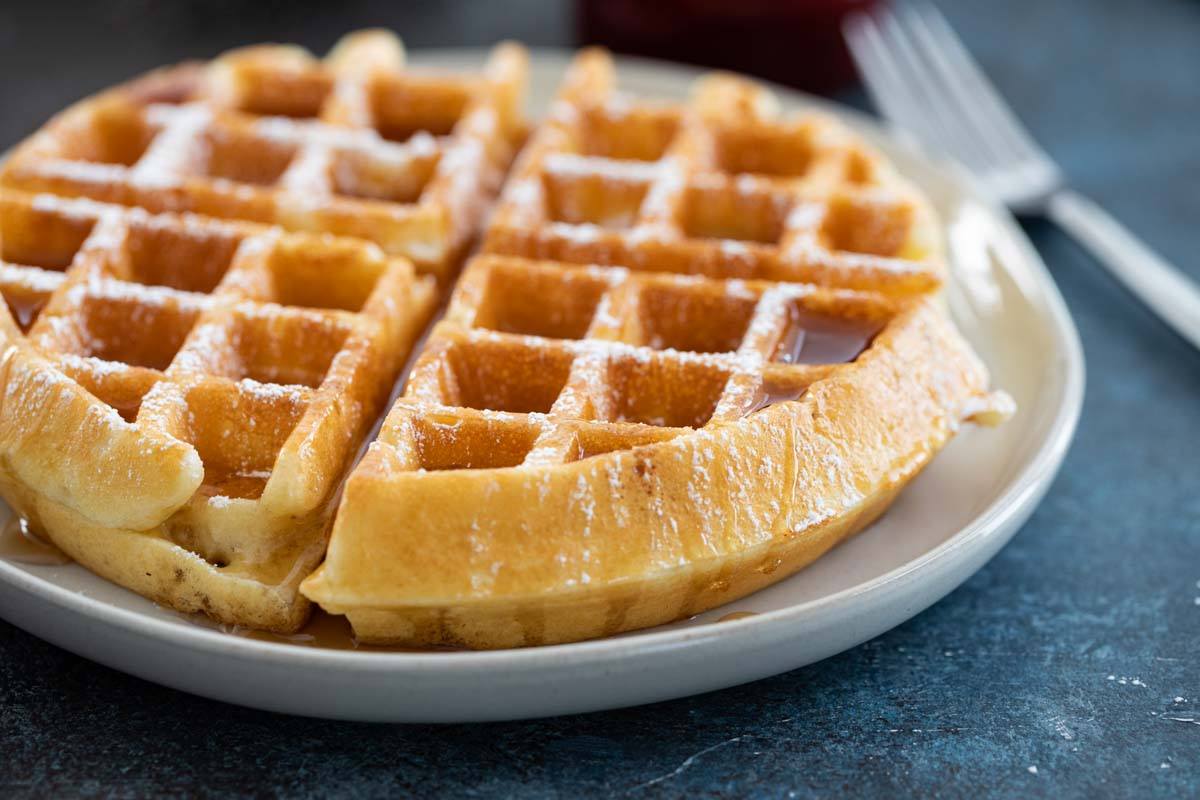
Why kind of mixture is this?
Heterogeneous
Homogenous
Element
Compound
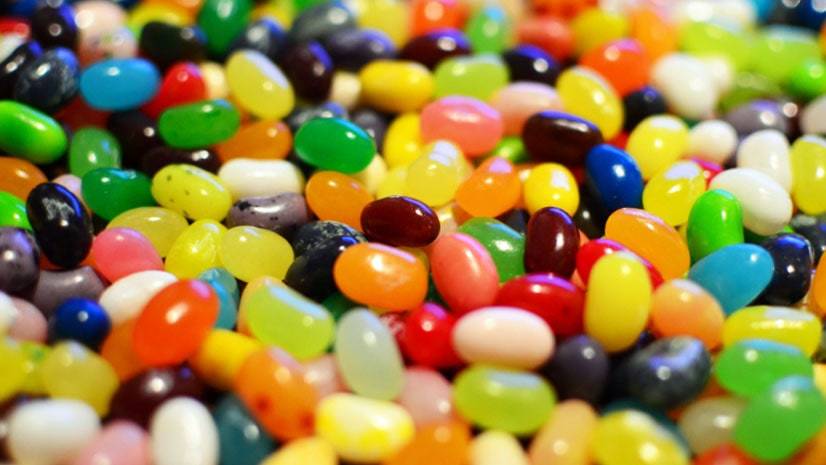


SEA WATER is an example of:
solution
colloid
LEMONADE is an example of:
solution
colloid
SMOKE is formed when solid particles of ash are suspended in the air. This is an example of a:
solution
colloid
The "BEST MIXED" of all mixtures is
colloid
solution
heterogeneous
element
Which is a colloid?
Air
Rice in water
Fog
Rain water
Which one is a colloid?
sea water
air
river water
milk
which one is a suspension?
oil in water
soapy water
air
brass
Which is True?
Suspensions do not settle
suspension settle
colloids settle
Solutions settle
Which of the following would result in being able to dissolve a greater amount of solid in a solution?
Lower the temperature.
Decrease the pressure of the solution.
Increase the pressure of the solution.
Heat the solution.
Which one of these is considered a SOLUTE?
Salt
Water
Salt Water
What are the factors that affect solubility?
rate of stirring
particle size
temperature
all of these
What combination would dissolve a solid solute the fastest?
high temperature, no stirring
no heat, no stirring
sugar cube, no heat
high temperature, stirring
Why do sugar particles dissolve faster in hot water?
water particles move slow
water particles move fast
water particles settle down
water particles stay on top
Which of the following structures are not found in animal cells?
Cell Membrane
Cell Wall
Nucleus
Cytoplasm
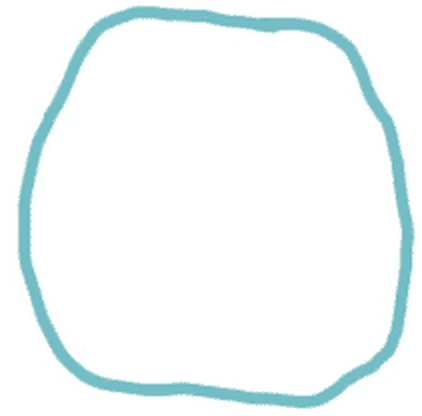



What are unicellular organisms?
Living things made of multiple cells
Living things made of a single cell
Living things made of two cells
Living things made of three cells
Which one of these is NOT one of the characteristics of living things?
All living things drink water.
All living things are composed of one or more cells.
All living things grow, develop and have life spans.
All living things reproduce.
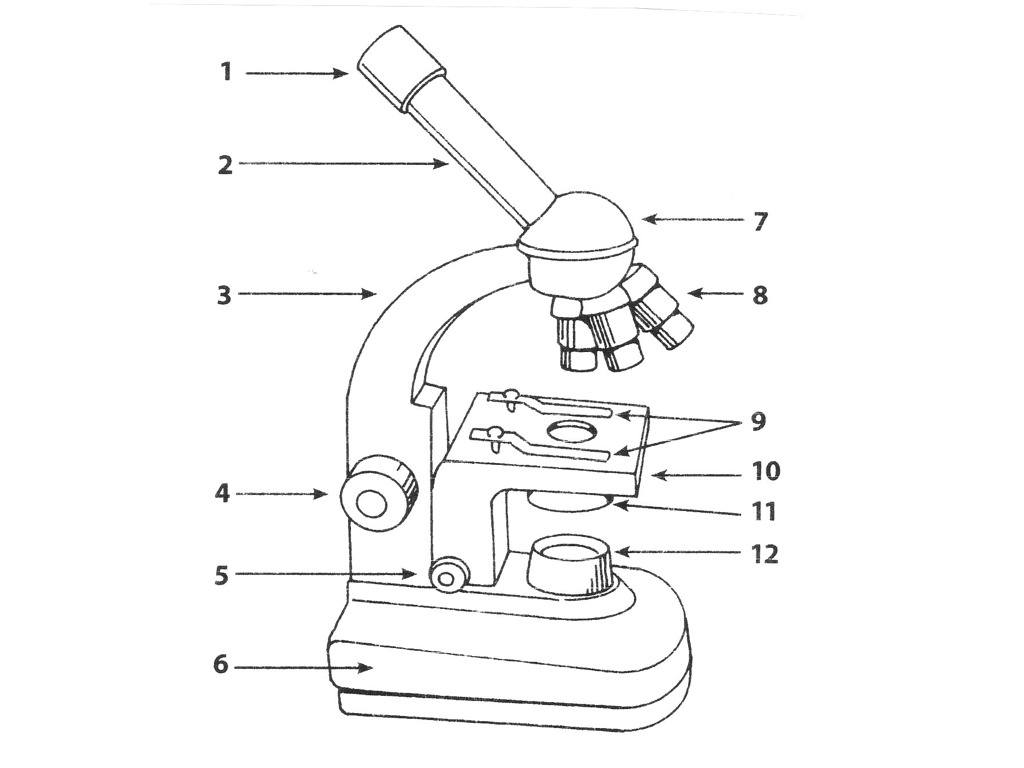
What is the function of the eyepiece in a compound microscope?
To focus the image produced by the objective lens.
To adjust the brightness of the image.
To magnify the image produced by the objective lens and allow the viewer to see the magnified image.
To hold the specimen in place for observation.
Which part of a compound microscope controls the amount of light passing through the specimen?
Stage
Eyepiece
Objective lens
Diaphragm
What is the purpose of the stage in a compound microscope?
To adjust the focus of the microscope.
To hold and support the specimen being observed.
To control the intensity of the light source.
To magnify the specimen being observed.
Which part of a compound microscope is used to focus the image?
condenser
eyepiece
stage
objective lens
What is the function of the objective lens in a compound microscope?
The function of the objective lens is to rotate the specimen.
The function of the objective lens is to illuminate the specimen.
The function of the objective lens is to focus the light on the specimen.
The function of the objective lens is to magnify the specimen.
Which part of a compound microscope is used to switch between different objective lenses?
eyepiece
base
nosepiece
stage
What is the purpose of the diaphragm in a compound microscope?
To magnify the image of the specimen.
To control the amount of light that passes through the specimen.
To hold the specimen in place.
To adjust the focus of the microscope.
Which part of a compound microscope is used to hold and secure the slide?
eyepiece
stage
base
lens
What is the function of the coarse adjustment knob in a compound microscope?
The function of the coarse adjustment knob in a compound microscope is to rotate the stage.
The function of the coarse adjustment knob in a compound microscope is to adjust the brightness of the light source.
The function of the coarse adjustment knob in a compound microscope is to bring the specimen into rough focus.
The function of the coarse adjustment knob in a compound microscope is to change the magnification of the objective lens.
Which part of a compound microscope is used to view the magnified image?
stage
objective lens
eyepiece
nosepiece
Which of the following shows the levels of organization in order from simple to complex?
1. Cell
2. Tissue
3. Organ
4. Organ System
5. Organism
1. Cell
2. Tissue
3. Organelle
4. Organ
5. Organ System
1. Tissue
2. Organelle
3. Cell
4. Organ
5. Organism
1. Organ
2. Tissue
3. Cell
4. Organism
5. Organ System

Organs that work together are part of a(n) ________________________.
cells
tissue
organ system
What structures belong to the skeletal system? Be sure to choose the answer that contains all of the correct structures.
Bones, muscles, stomach
Ligaments, bones, muscles
cartilage, spinal cord, nerves
bones, ligaments, tendons
Which group of structures belong to the circulatory system?
heart, stomach, muscles
blood, bones, ligaments
kidneys, heart, blood
blood, heart, blood vessels
Which system removes excess water and waste from the blood?
Integumentary system
Endocrine system
Excretory system
Respiratory system
Which organ system does the esophagus belong to?
Excretory system
Digestive system
Endocrine system
Nervous system
Which system do the kidneys belong to?
Endocrine system
Excretory system
Digestive sytsem
Respiratory system
Which system does the trachea belong to?
Circulatory system
Digestive system
Skeletal system
Respiratory system
Which two words below complete the sentence: The function of the respiratory system is to bring in ____________ and get rid of _________________________.
carbon dioxide, oxygen
oxygen, carbon dioxide
oxygen, nitrogen
nitrogen, carbon dioxide
Which system transports materials throughout the body?
Respiratory system
Circulatory system
Muscular system
Endocrine system
How does the nervous system work?
signals come only from the sense organs
signals come only from the spinal cord
signals travel along nerves to all the body organs
signals come only from the brain
Complete the sentences for the 4 main properties of light
Light travels in a ________
straight line
Light can be _______
reflected
Light can _____
bend
Light is _______
a form of energy
Define refraction of light.
The reflection of light off a surface
The bending of light as it passes from one medium to another.
The absorption of light by a medium
The emission of light from a source


Light travels in (a) lines.
Light is a form of
food
energy
particles
transformation


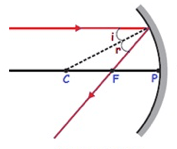
This ray diagram is for which mirror?
concave
convex
plane
window


Type of mirror that can produce an inverted image...
Plane
Convex
Concave

Type of mirror used as a side mirror on a vehicle to provide a wide angle view...
Plane
Convex
Concave

Type of mirror found in a bathroom...
Plane
Convex
Concave

Convex Lens

Concave Lens

Plane Glass
Which one of these is a convex lens?


None of the above

Glass has a _____________ density than air.
Smaller

The angle of reflection is
90 degrees
55 degrees
45 degrees
135 degrees

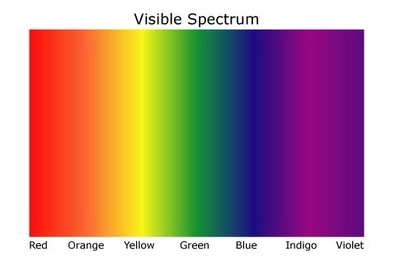
What color of light has the longest wavelength?
red
green
yellow
violet
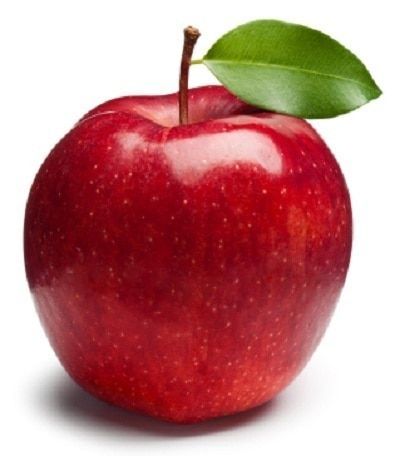
Why does this apple look red?
The apple reflects red light and absorbs all other colors
The apple absorbs red light and reflects all other colors
The apple reflects all the light shinning on it
The apple is red because we see that color.
Electromagnetic waves that you can see
radio waves
visible light
x-rays
ultraviolet rays
Complete the following analogy. RADIO WAVES : LONGEST WAVELENGTH :: ____________ : SHORTEST WAVELENGTH
INFRARED LIGHT
ULTRAVIOLET LIGHT
X-RAYS
GAMMA RAYS

The distance between 2 crests or troughs. J on the diagram.
wavelength
amplitude
frequency
wave speed


Light travels in forms of _______________.
Rays
Waves
Reflection
Colours,
What is NOT one of the 3 primary colors that make up white light?
Red
Green
Blue
Pink
Match the part of the eye to the correct label
Pupil
Lens
Retina
Iris
Cornea
Optic nerve

Why does your pupil increase in size when you enter a dark room?
To protect the eye
to allow more light to enter the eye
to allow less light to enter the eye
to creep people out

An image with a low resolution is (a) compared to an image with a high resolution, which appears to be more (b)


This 2000 N weight is raised 1 meter by pulling 4 meters of rope. What force was required to pull the rope?

A box of weight W is lifted by a force F using a lever as shown below.
What is the mechanical advantage of the lever (MA=Input Distance/Output Distance)?
0.5
2
3
6


Match the following terms to the correct Simple Machines

Pulley

Wedge

Wheel & Axle

Lever

Inclined Plane
What is the speed ratio if you push down 10m on a lever and the load is lifted 2 m?
5
10
2
1

How does a single fixed pulley, like the one seen in the picture, help to lift a load?
changes the direction of the force
increases the amount of applied force
decreases the amount of applied force
allows you to pull the rope a shorter distance than the load moves

Which of the following is the most effective way to decrease the effort force needed to push a box to the top of the ramp in the picture?
cover the surface with carpet
increase the length of the ramp
increase the height of the ramp
decrease the length of the ramp
In reality, why is mechanical advantage less than speed ratio?
Mechanical advantage is affected by friction; speed ratio is not.
Speed ratio is affected by friction; mechanical advantage is not.
Both are affected by friction.
Neither are affected by friction.
Speed ratio is NOT affected by friction.
True
False
Which of the following has a mechanical advantage greater than 1?
Hockey stick
Bicycle
Wheelchair Ramp
Golf club
Speed ratio and mechanical advantage are THEORETICALLY the same if you ignore friction.
True
False


Two factors that determine work are...
Force
Mass
Velocity
Distance
Units of force are...
Newtons
Grams
Joules
Meters
Units of work are...
Newtons
Grams
Joules
Meters
If you push a cart with a force of 60 N for 2 m... how much work have you done?
120 J
30 J
120 N
30 N
What is the formula for work?
Force = work × distance
Distance = force × work
Work = force × distance
Work = force × mass
Solve
F= ?
d= 25m
W=100 J
4 N
0.25 N
2500 N
Solve
F= 40 N
d= ?
W= 5 J
200 m
0.125 m
8 m
Solve
F= ?
d=10 m
W=20 J
200 N
0.5 N
2 N
What is the efficiency of a machine if 55.3 J of work is done on the machine by the person, but only 14.3 J is produced by the machine on the load?
0.25 J
26%
386%
3.86 J
A 100 N container is placed on a lever, and the force you apply to lift the container is 20 newtons, what is your mechanical advantage?
120 N
5 N
2000 N
80 N
What is the speed ratio if you push down 10m on a lever and the load is lifted 2 m?
5
10
2
1
If 68 Joules were necessary to move a 4 N crate, how far was the crate moved?
272 m
17 m
4.05 m
272 cm
A boy pushes on a parked car with a force of 200 N. The car does not move. How much work was done by the boy on the car?
200N
200J
0J
0N

4.What % of earth's water is fresh water ?
5%
3%
70%
1%

6.What % of earth's water is in the ocean?
70%
85%
90%
97%
Why is fresh water a limited resource?
It isn't because it is a renewable resource
97% of water is in the oceans and too salty to drink.
Only 2.5% is drinkable and is stored in icecaps, rivers, and lakes.
Which of the following is a true statement about surface water?
It makes up less than 1 percent of all water on Earth.
Sluggish waters make natural lakes poor water sources.
Drought conditions reduce the amount of surface water worldwide.
All large cities use surface water as a water source.
Most large cities get water for households and industries from:
deep wells.
pumps connected to springs.
rivers and lakes.
removing salt from sea water.
What is an inexpensive solution to providing everyone with more fresh water to use?
desalination
water conservation
drilling more wells into aquifers
building more dams
Why is most of Earth's water not available to drink?
It is contaminated.
It is in the polar ice caps.
It is underground.
It has a high level of salinity.
What percent of Earth's freshwater is available for humans to use?
3
less than 1
97
10
What is salinity?
The property of containing salt
The amount of suspended solids
Describes the condition of the water
Describes how acidic or basic water is

Gas exchange takes place in structures called:
Alveoli
Pulmonary Phalanges
Uvula
VanDer Moof Sacs

Gas exchange in the lungs happened primarily by the process of:
Diffusion
Endocytosis
Apoptosis
Mycellium

The tube that leads into the lungs is called the:
Pharynx
Larynx
Pulmonary Phalanges
Trachea

Singled cells organisms perform gas exchange through:
Diffusion
Alveoli
Pulmonary Phalanges
Their skin

The diaphragm contracts during
Inhalation
Exhalation

Sound is made when air passes over flaps of cartilage in the
Trachea
Pharynx
Larynx
Glottis

Small branches of tubes that pass through the lungs are called:
Pulomonary Phalanges
Bronchi
Bronchioles
Capillaries


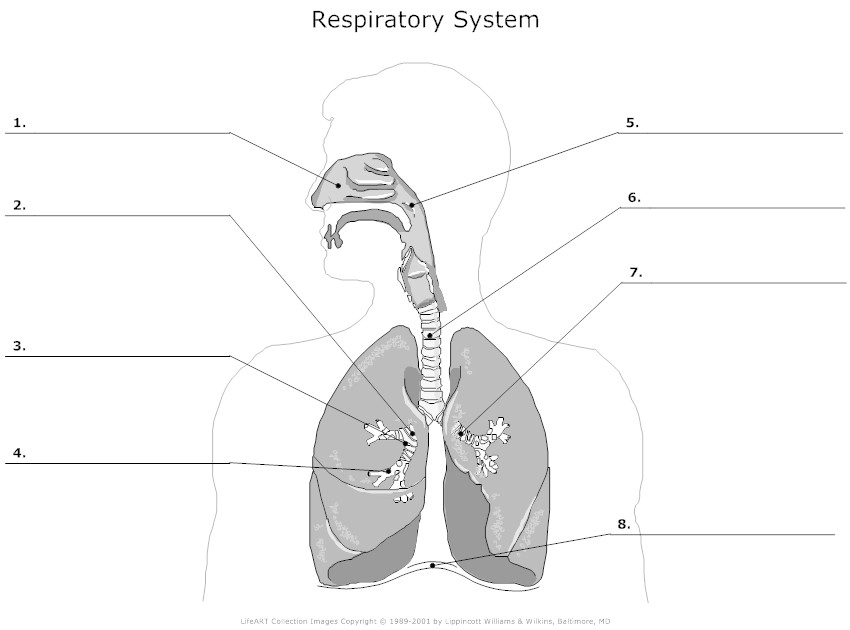
Digestion begins in the ______.
Mouth
Stomach
Small intestine
Gallbladder
Saliva contains a carbohydrate enzyme called ___.
Amylase
Pepsin
Lipase
Maltase
The chewed up food moves from the mouth to the stomach through the ___________.
esophagus
pancreas
liver
small intestine

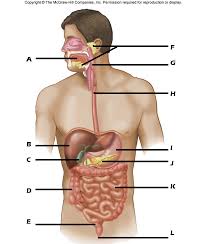
Which digestive organ is represented by the letter B?
Pancreas
Liver
Mouth
Small intestine
The majority of digestion occurs in the:
mouth
stomach
small intestine
large intestine
Absorption of nutrients happens through small finger-like structures called ________.
sphincters
enzymes
lipids
villi

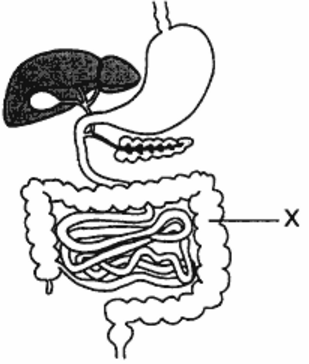
The diagram represents a portion of a human body. The principal function of structure X is to
produce amylase
produce pepsin
absorb water
absorb nutrients
Which letter collects and stores wastes until they are ready to be released from the body?
D
E
K
L

What are these structures call that are found on the lining of the small intestine?
Gallbladder
Villi
Sphincter
Duodenum

Which is the esophagus?
A
B
C
D
E
Where would you expect to find acid?
to break down food and absorb nutrients
Reorder the following. Put these in order that food follows as it passes through the digestive system.
mouth
esophagus
stomach
small intestine
large intestine
The circulatory system revolves around which organ?
heart
lungs
veins
instestines
Which type of blood vessel carries blood away from the heart?
arteries
ventricles
aorta
veins
What is the Circulatory System also known as?
cardiovascular system
blood system
vein system
central system

Which type of blood vessel carries blood TO the heart?
arteries
veins
capillaries



"C" is called ______
Right atrium
Left atrium
Right ventricle
Left ventricle

"E" is called _________
Left atrium
Right atrium
Left ventricle
Right ventricle

"I" is called _______
Left atrium
Right atrium
Left ventricle
Right ventricle