
 Worksheets
Forces Revision
Total questions: 95
Worksheet time: 2hrs 31mins
What instruments are used for measuring force?
Spring balance
Thermometer
Barometer
Voltmeter
Name three types of contact forces.
Friction Force, Normal Force, Spring Force
Gravitational Force, Magnetic Force, Electric Force
Centripetal Force, Tension Force, Buoyant Force
Inertial Force, Friction Force, Drag Force
What is the formula for weight?
Weight (w) = mass (m) × gravitational acceleration (g)
Weight (w) = mass (m) + gravitational acceleration (g)
Weight (w) = mass (m) ÷ gravitational acceleration (g)
Weight (w) = mass (m) - gravitational acceleration (g)
What is the difference between mass and weight?
Mass is the measure of how gravity acts on an object, while weight is the quantity of matter in a material.
Mass is the quantity of matter in a material, while weight is the measure of how gravity acts on that mass.
Mass and weight are the same; they both refer to the amount of matter in an object.
Weight is the measure of an object's volume, while mass is the measure of its density.
What are non-contact forces?
Forces that require physical contact to act on an object.
Forces that act on an object without touching it.
Forces that only occur in a vacuum.
Forces that are always attractive.
What does Newton's Second Law state?
The acceleration produced by the resultant force is proportional to the force and inversely proportional to the mass.
The force acting on an object is equal to the mass of that object multiplied by its velocity.
An object in motion stays in motion unless acted upon by an external force.
The acceleration of an object is constant regardless of the net force acting on it.
What does Newton's First Law state?
An object at rest stays at rest, and an object in motion continues in motion unless acted upon by a resultant force.
An object will always move in a straight line unless acted upon by a force.
For every action, there is an equal and opposite reaction.
An object in motion will eventually come to a stop without any external force.
What are contact forces?
Forces that act on an object when it is touched.
Forces that act at a distance without physical contact.
Forces that are always attractive in nature.
Forces that only occur in fluids.
Give examples of non-contact forces.
Frictional Force
Gravitational Force
Tension Force
Normal Force
What does Newton's Third Law state?
If object A exerts a force on object B, then object B exerts an equal and opposite force on object A.
For every action, there is a reaction of equal magnitude and opposite direction.
An object at rest will remain at rest unless acted upon by an external force.
The acceleration of an object is directly proportional to the net force acting on it and inversely proportional to its mass.
What is a force?
A force is a type of energy.
A force may be described as a 'push', 'pull' or a 'twist'.
A force is a measure of mass.
A force is a unit of speed.
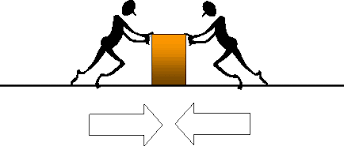


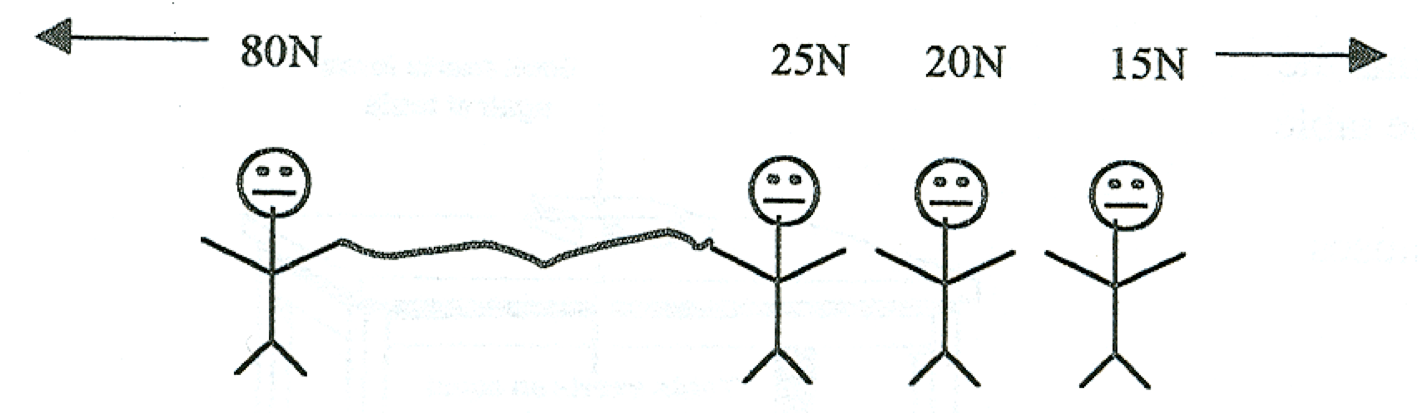
The symbol of the unit Newton is (a)

Two magnets (a) each other when like-poles (two norths or two souths) are near each other.
Drag the correct force to the box where that force is happening.
push or pull that causes an object to move, stop, or change direction
force
unit used to measure force
Newton
something returning to its original shape after being squeezed or stretched
elastic
force transmitted through a rope , string, cable, or wire when it is pulled tight by forces acting from opposite ends
tension
push or pull exerted by a magnet
magnetism
Electrical, gravitational, and magnetism are all (a) forces, while friction, normal force, and applied force are types of (b) forces.
Label the forces acting in this image.
Label the forces acting in this picture.

A force that opposes motion between two surfaces that are in contact
force
drag
friction
applied force

A measure of the force exerted on an object by a gravitational field.
weight
free fall
inertia
gravity
A car driving straight down the interstate at 60 mph is being acted on by a(n) ___________________.
Unbalanced Force
Balanced Force
A car driving slams on its breaks to avoid rear ending a broken down semi and is therefore being acted on by a(n) ___________________.
Unbalanced Force
Balanced Force
A car that is turning right at an intersection is being acted on by a(n) _________________.
Unbalanced Force
Balanced Force
A plane reaches its cruising altitude and is moving at 400 mph, if the captain turns off the "fasten seatbelt" light then you are being acted on by a(n) _______________.
Unbalanced Force
Balanced Force
A car has a net force of 200 N acting on it, therefore it will _________________.
Accelerate
Move at a Constant Speed
When a ball is thrown straight up into the air the only force on it is gravity (which pulls it down), therefore it will ________________.
Accelerate
Move at a Constant Speed
Gravitational force differs based on two things.
It increases with increasing ___________.
It decreases with increasing __________ .
mass
distance
distance
mass
orbit
displacement
displacement
orbit
A planet is discovered that has twice the mass of Earth but the same gravitational acceleration.
If you weigh 700 N on Earth, on the new planet you would weigh ____ N.
700 N
1400 N
7 N
70 N

Look at the picture carefully.
Which screws will be attracted?
iron and steel screws
iron and aluminum screws
steel and aluminum screws
all screws
True or False: All metals are attracted to magnet.
True
False

What would happen when the opposite poles of magnets are placed together?
The force will pull them together (attract).
The force will push them away from each other (repel).
The strength of the magnet is doubled.
Where is the force of attraction the strongest on a magnet?
above the magnet
below the magnet
at the poles
in the middle

What do the lines around this magnet represent?
North Pole
South Pole
Magnetic Declination
Magnetic Field
If you cut a magnet in half, what happens to the poles?
One half gets the North Pole, the other half gets the South Pole.
Both halves get only a South Pole.
Both halves get only a North Pole.
Both halves get a North pole and a South Pole.
How many poles does a magnet have?
1 pole
3 poles
2 poles
o pole
like poles of a magnet attract each other and unlike poles of a magnet repel each other.
true
false
A magnetic force becomes weaker as magnets ________.
repel
attract
move together
move apart
Objects that are attracted to magnets are called...
ferromagnetic
magnet
attraction
repulsion
A magnet created by running an electric current through it
temporary magnet
superconductor
permanent magnet
electromagnet
In order to magnetize an object for electromagnetism, it needs to have iron or steel (ex. a rod or nail).
True
False
Electromagnets can be turned on and off.
True
False

Which of these is a way to make an electromagnet stronger? (a)

The image above shows how iron filings respond to magnetic fields generated by two magnets with ____________ poles facing each other.
opposite
like
positive
negative

The image above shows how iron filings respond to magnetic fields generated by two magnets with ____________ poles facing each other.
like
opposite
positive
negative
A permanent magnet is a material that produces a ___________________ field without any ___________________ magnetic field being present.
electronic, internal
magnetic, internal
magnetic, external
electronic, external
In magnetic materials, all of the ________ are pointing in the same direction.
doors
electrons
domains
orbits

The magnetic ____________ around a bar magnet is shown above.
legs
flowers
field
direction
A device used to observe electric forces is a(n):
galvanometer
compass
electroscope
voltmeter
The negatively charged particle in an atom is a(n)
electron
proton
neutron
nucleus
An object with equal amounts of positive and negative charge is called:
positively charged
negatively charged
electrically charged
neutral
Positive electric charges
repel both positive and negative charges
attract both positive charges and negative charges
repel positive charges and attract negative charges
attract positive charges and repel negative charges
The buildup of static charge on an object is called ____ electricity.
static
inductive
contact
charged
Materials that contain a small number of free electrons are called?
semi-conductor
insulator
conductor
superconductor
Suppose you rub an inflated party balloon on a carpet, hold the balloon next to a wall, and discover that it “sticks” to the wall. Why did the balloon stick to the wall?
The total charge on the balloon and wall
becomes zero, so attraction between
the two can occur
The balloon gains electrons that are attracted to the positively charged particles on the wall
Like charges on the balloon and wall cause an attraction between the two
Balloons contain a special “atomic glue”
that allows them to cling to other
objects
Rubbing a balloon on a person's head is an example of charging by _________________.
friction
induction
convection
conduction
This is when a charge is transferred from one object to another through direct contact.
contact
induction
friction
convection
Opposite charges...
repel each other
are neither attracted nor repelled
attract each other
stabilize each other
Which shows the electric field between two opposite charges?


Based on the arrangement of the electric field lines in the diagram, what are the charges?
both charges are positive
the charges are opposite
both charges are negative

When you walk across a nylon carpet, you become positively charged. When you then touch a metal handle you receive a shock because:
Electrons jump from you to the handle
Protons jump from you to the handle
Electrons jump from the handle to you
What is the main purpose of a seatbelt in a car?
Some safety features are designed to increase the time of a collision because this reduces the maximum force.
True
False
Airbags absorb the inertia of your body in a crash by increasing the __________ it takes to slow your body down.
Time
Pressure
Acceleration
Momentum
Seatbelts save thousands of lives every year.
True
False
Crumple zones are designed to deform to absorb forces. What safety feature prevents the area around the people from deforming with the crumple zone?
Airbags
Crumple zone
Seatbelts
Safety Cage
Breaks
What is the primary purpose of crumple zones in vehicles?
To increase the speed of the vehicle
To improve fuel efficiency
To absorb impact energy during a collision
To enhance the vehicle's aerodynamics
Which of the following safety features is designed to prevent the wheels from locking during braking?
Airbags
Anti-lock Braking System (ABS)
Traction Control System
Electronic Stability Control
True or False: Seat belts are designed to stretch slightly during a collision to reduce the impact force on the body.
True
False
What is the scientific basis for the use of laminated glass in car windshields?
It increases the transparency of the glass
It prevents the glass from shattering into sharp pieces
It reduces the weight of the vehicle
It enhances the aesthetic appeal of the car
What is the primary function of side-impact bars in vehicles?
To improve the vehicle's speed
To enhance the car's appearance
To protect passengers during a side collision
To increase fuel efficiency
Rough surfaces have _________
greater friction
less friction
the same level of friction
The factors on which friction depends
nature of the surfaces
how hard the objects are pressed together
both (a) and (b)
none of these
A toy car released with the same initial speed will travel farthest on
Muddy surface
polished marble surface
cement surface
brick surface
In a large commercial complex, there are four ways to reach the main road. One of the paths has loose soil, the second is laid with polished marble, the third is laid with bricks and the fourth has a gravel surface. It is raining heavily and Paheli wishes to reach the main road. The path on which she is least likely to slip is
polished marble
bricks
gravel
loose soil
Which of the following statements is true?
Friction pulls objects towards the centre of the earth
Friction primarily affects the objects that contain iron
Friction slows down or stops objects in motion
Friction does not affect objects in motion
Earth magnetic field protects us from ___________.
the heat
the Solar wind
the moon
the stars
What device uses Earth's magnetic field to determine direction?
compass
gyroscope
altimeter
barometer
What is the phenomenon where the Earth's magnetic poles reverse?
Magnetic inversion
Pole shift
Earth's magnetic flip
Geomagnetic reversal
Which part of the Earth is believed to generate its magnetic field?
Inner core
Crust
Outer core
Mantle
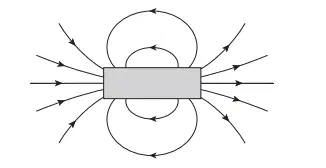
Look at the magnetic field pattern around this magnet.
Write the letters N and S on the diagram to show the poles of
the magnet.
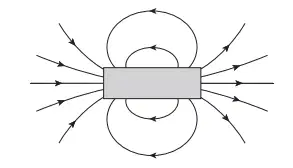
Mark, with the letter X on the diagram, one position where the magnetic field is strong.
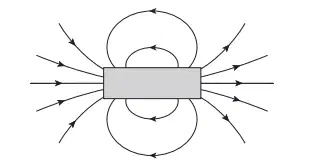
Mark, with the letter W on the diagram, one position where the magnetic field is weak.
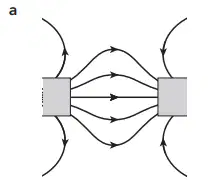
The diagrams show the magnetic field lines between two magnets.
Write the letters N or S in each diagram to show the poles of the magnets
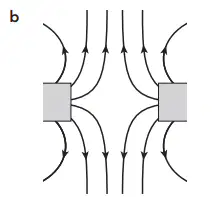
The diagrams show the magnetic field lines between two magnets.
Write the letters N or S in each diagram to show the poles of the magnets

What is happening in this position-time graph?
moving away at a constant speed
moving towards at a constant speed
moving away increasing speed
moving towards increasing speed
To find net force, you ________ the forces of opposite directions
add
subtract
multiply
divide

