
Font size
 Worksheets
Year 9 End of Year
Total questions: 140
Worksheet time: 1hrs 10mins
What is the process called when material and sediment are dropped due to a lack of energy?
Erosion
Weathering
Deposition
Transport
What is longshore drift?
The process of rocks being broken down by wind
The process in which sand is transported down the coastline through waves
The process of defending a coastline from erosion
The process of forming headlands and bays
Who are considered stakeholders in coastal management?
Only local government officials
Only environmental groups
People invested in an area, including residents, businesses, local government, and environmental groups
Only residents
Which landform is created when the coast left jutting out to sea is formed?
Bay
Spit
Headland
Bar
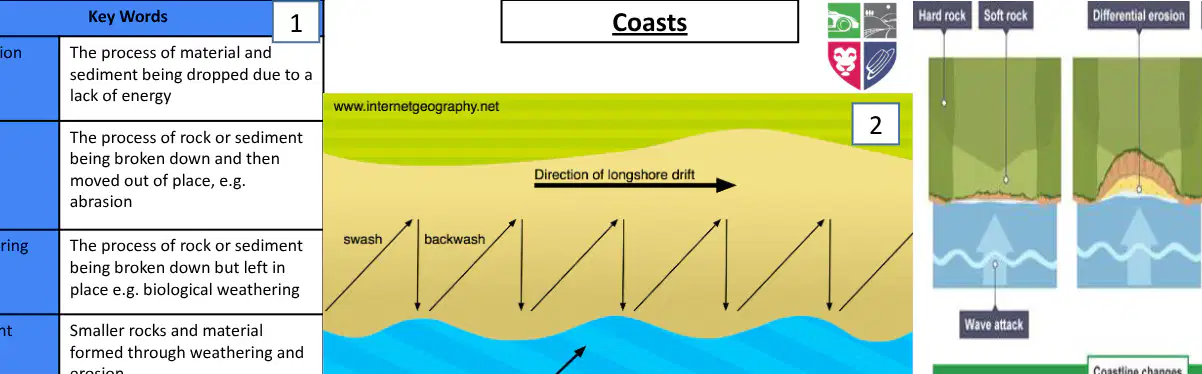
What does the diagram of longshore drift illustrate?
The movement of sediment parallel to the coastline due to angled waves
The formation of mountains
The process of weathering by rain
The creation of rivers
What is hydraulic action in the context of coastal erosion?
The process where pebbles grind along a rock platform
The sheer power of waves smashing against cliffs, trapping air in cracks and causing the rock to break apart
The process where rocks carried by the sea knock against each other and break apart
The process where sea water dissolves certain types of rocks
What happens during the process of freeze-thaw weathering?
Roots break rocks apart as they grow
Water enters cracks, freezes and expands, then melts and goes deeper, repeating until the rock splits
Pebbles grind along a rock platform
Sea water dissolves minerals in rocks
How can corrupt governments influence development?
By improving education
By influencing where money is spent, often on war and government members
By building more hospitals
By increasing natural resources
Which of the following best describes "Bottom Up Development"?
Development strategies aimed at the poorest, most vulnerable people, often done by charities or small local groups.
Development strategies aimed at nationwide level, often large and expensive projects.
Development strategies focused only on urban areas.
Development strategies that only involve external agencies.
Which statement is true about rural areas in Brazil?
Rural areas are more developed than urban areas.
Rural areas tend to be very poor, relying on subsistence farming to survive.
Rural areas have a higher GDP per capita than urban areas.
Rural areas have no environmental issues.
What is a con of "Bottom Up Development"?
It is too expensive for local groups.
It often does not make massive changes and is too small to make a massive difference to the whole country.
It always causes environmental damage.
It only benefits the richest people.
Which of the following is a tax imposed on imported goods?
Quotas
Tariffs
Containerisation
Migration
What is one example of an international or regional form of government that accelerates globalisation?
The Silk Road
The United Nations
Tariffs
Containerisation
What is one positive impact of Coca Cola’s global influence?
Investment in new markets drives economic growth
Exhaustion of local water supplies
Harsh working conditions in some bottling plants
Long working hours for little pay
Which of the following is a criticism of Amazon mentioned in the material?
Creates excessive packaging waste
Offers generous family paid leave
Helps small businesses reach millions of customers
Donates to charities through AmazonSmile
What is a potential threat of globalisation to the environment?
Higher standards of living
Spread of technology
Threats to the global environment
Access to new talent
What is a Eurasian country?
A country found in both Europe and Asia.
A country found only in Asia.
A country found only in Europe.
A country found in Africa and Asia.
What does a choropleth map show?
Trends of data using colors and shapes, especially population data.
The locations of mountains.
The types of plants in a region.
The weather patterns of a country.
What is the capital city of Russia?
Moscow
St. Petersburg
Kiev
London
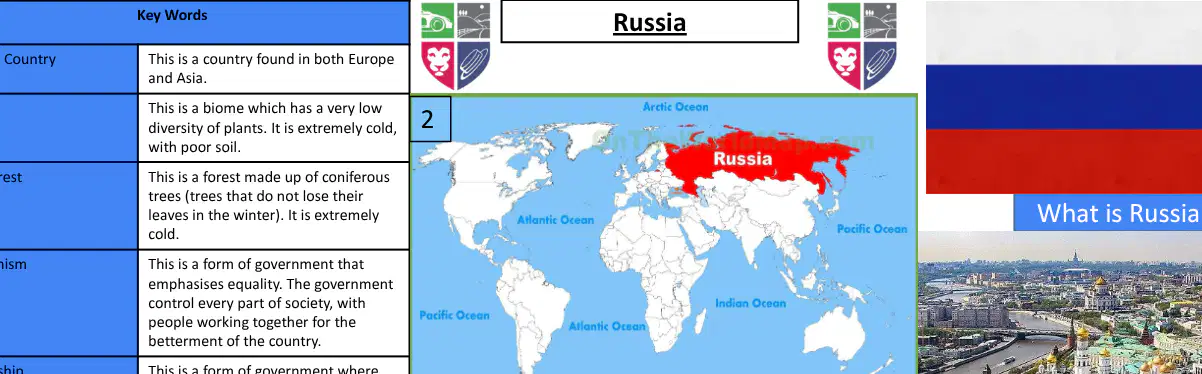
Which country is highlighted in red on the map?
Russia
China
Canada
Brazil
Which river is the longest in Europe?
Lena River
Yenisei River
Volga River
Ob River
What is the Kremlin?
A famous river in Russia
The location of the government of Russia in Moscow
The largest lake in Russia
A mountain range in Russia
What is a common economic activity in rural areas?
Farming, fishing, forestry, mining
Many jobs – shops, offices, factories
Metropolis, conurbation, city, large
High and staying high, over 200 people per km²
Which age structure is typical in rural areas?
Many older people, some single people
Many young adults, many single people
Many children, many single people
Many middle-aged people, many single people
Which of the following best describes the population density in rural areas?
Low, 1–100 people per km²
High and staying high, over 200 people per km²
Over 10 million people
Many jobs – shops, offices, factories
Which of the following is considered a benefit of living in a megacity?
Quality of life is higher as services are better
Large inequalities are created between the rich and poor
Slums are created, increasing the risk of disease
Unplanned development can damage the environment
Which of the following is a challenge London faces?
Air pollution from burning fossil fuels
Only half of the children continue their education before the age of 14
37% of water is lost through leaky pipes
Robbery and violent crime occur regularly
What is one solution implemented in Rio to address health issues?
Medical staff have been able to take health kits to people's homes and test them for illnesses
Only half of the city has a local family health clinic
School grants have been given to poor families
Police units were established to reclaim favelas from drug dealers
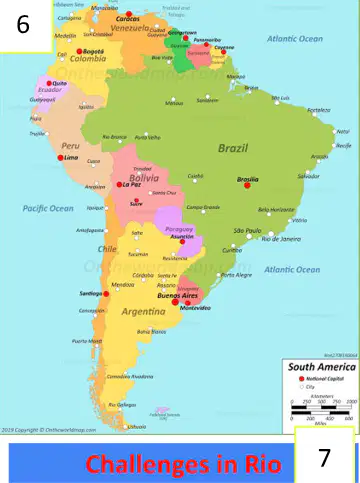
Where is Rio de Janeiro located?
Brazil, South America
Mexico, North America
Argentina, South America
Peru, South America
The Arctic Circle runs through the north of Russia. True or False?
True
False
The Tatras mountains run from the north to south of Russia and divide Europe and Asia. True or False?
True
False
Vladivostok is the capital city of Russia. True or False?
True
False
One of Russia's largest exports is...
Oil and natural gas
Sweetcorn
Coffee
What is the population of Russia?
9 million
28 million
145 million
The more densely populated area of Russia is in the ...
East
West
The environment in Siberia, northern Russia is ...
Hot desert
Tundra
Tropical Rainforest
Russia has many warm water ports. True or False?
True
False
Where have most of the major cities developed in Russia?
Eastern Russia
Western Russia
Which of the following is not a main biome in Russia?
Hot desert
Tundra
Taiga
Which biome has dense, evergreen trees?
Tundra
Steppe
Taiga
Where in Russia is the tundra found?
North
South
Temperate deciduous forests lose their leaves in winter. True or False?
True
False
How does temperature change as you move from Moscow to the north east of Russia?
It increases
It decreases
Which of the following describes the tundra biome?
Temperatures are as high as 30 degrees C, with high rainfall all year
Temperatures dip as low as -30 degrees C, with low rainfall all year
Temperatures dip as low as 30 degrees C, with high rainfall all year
Russia's low temperatures are due to its northern latitudes. True or False?
True
False
Which continent doe the westerly winds cross before reaching Russia?
Asia
Africa
Europe
North America
Which THREE of the following are characteristics of the taiga forest?
Low temperatures
High temperatures
Limited sunlight in winter
Lack of nutrients deep within the soil
This resource in Russia is fought over in the Caspian Sea and the Arctic Ocean
(a)
The largest and most important river in Russia used for trading
(a)
This mountain range divides European Russia from Asian Russia
(a)
The average number of people living in an area.
population density
population zone
polder
peninsula
True or False: Siberia has long, hot summers.
True
False
Both Europe and Russia have a great deal of ______.
Iron ore
Timber/Forests
Hydroelectricity
Fossil Fuels
Which of the following natural resources are found in Russia?
Oil
Natural Gas
Coal
All of these
True or False
Russia is bigger than Pluto.
True
False
Chernobyl used to be in the Soviet Union but now chernobyl located ....
In russia
In china
In nepal
In ukraine
What happened in Chernobyl??
The fourth reactor exploded during a safety test
Tsunami
Nothing
A huge eartquake
Was it a natural disaster or a human mistake??
Human mistake
Natural disaster
Many people got ...... after the catastrophe
Covid
Heart attack
Cancer
Cold
How long did it take to put out the fire
15 days
10 days
What year did the Chernobyl Disaster occur in?
1991
2019
1986
44 BCE
The Chernobyl plant provided power for the city of
London
Pripyat
Moscow
Washington DC
What is the primary cause of the Chernobyl disaster?
Natural disaster
Human error
Equipment failure
Sabotage
Which city was most affected by the Chernobyl disaster?
Kiev
Pripyat
Minsk
Moscow
What are the top 5 most populated countries?
Japan, England, China, USA, Canada
Australia, Tokyo, Brazil, India, Russia
China, India, United States, Indonesia, Pakistan
What are the characteristics of urbanisation?
Lots of services & industries, dominated by natural and managed features
Dominated by human features, lots of services & industries
Animals and cities
Low population density, fewer services & industries
What percentage of the world will be urbanised by 2050?
90%
68%
72%
26%
What is NOT considered a pull factor?
Better jobs
More education opportnities
Higher standards of living
Conflict and war
What does GDP stand for?
Gross Domestic Population
Growth Development Product
Gross Domestic Product
What is NOT considered a push factor?
Poverty
Natural Disasters
Medical Facilities
Food and Water Shortages
What is the most populous megacity?
Sao Paulo
Tokyo
New York
Mumbai

On which continent are the majority of the megacities located?
South America
North America
Europe
Asia

Is this rural or urban?: Dominated by natural or managed features such as grasslands, forests, crop fields
Urban
Rural

Is this rural or urban?: High population density
Rural
Urban
Define 'megacity'
A city with a large population, usually over 10 million people
A city with a large population, usually over 1 million people
A large city with a population over 100 million people
A large city spread out over an area covering 10 million sq km
What is a favela?
A Brazilian food made with rice
A slum or shantytown
An area of a city where rich people live
A Brazilian storm with high winds
How do Favelas get electricity?
Giant batteries
Wind farms
In most cases it is illegally tapped from the public grid
Hydro electricity
What does 'population density mean'?
Lots of people live in a country.
How many people live per km2 in a country or area.
The people in that country live a long time.
The towns and cities in that country are very crowded.

What is not an advantage of living in favelas?
Strong community spirit
Better access to education
Waste dumped in the street
Able to improve homes due to more regular work
What is the capital city of Brazil?
Salvador
Brasilia
Rio de Janeiro
Sao Paulo


Which statement about Rio is false?
Rio has a major port exporting coffee, sugar and iron ore.
Banking, finance and insurance is an important part of Rio's economy.
Rio is one of the most visited cities in the northern hemisphere.
Rio hosted the 2014 World Cup and 2016 Olympics.
What % of Rio's population has access to healthcare facilities?
100%
28%
75%
55%
What is one of the major issues facing many of the favelas in Brazil
Major pollution issues
Powerful crime gangs
Poor investment in roads
Lack of affordable housing
What is a strategy that has been used to improve Rio?
Provide more jobs for people through selective hiring of people from favelas
Used the world cup to bring awareness to life in the favelas
Banned people throwing waste in the sea
The police have been more active in the favela's reducing the crime rate
Why might someone move from rural Brazil to Rio?
Better quality of life compared to the rest of the country
More opportunity for jobs and higher paying work
Improved access to services like education
All of the above
Why do people live in the Favelas?
Lack of available housing elsewhere - there are too many people and not enough legal houses
For the rich and vibrant culture
For the opportunities offered such as better education
For the high quality housing in the area
Development of a country can generally be determined by its:
per capita income
average literacy level
health status of its people
none of these
Proportion of literate population in the 7 and above age group is called as:
Knowledge rate
Literacy rate
Attendance rate
Excellence Rate
Resources which will get exhausted after years of use are:
Renewable resources
Non-durable resources
Non-renewable resources
Competing resources

Development is the process of change which affect's people's standard of living and (a)
Which of these statements is the most accurate definition for people who are economically active?
People employed between the ages of 16-65.
People employed between the ages of 25-45.
People unemployed between the ages of 16-25.
People over 65 receiving a pension.

Sustainable Development is that development which satisfies the need of:
Present generation only
future generation only
both (a) & (b)
none of these
Which of the following is a necessary condition for sustainable development?
Increase in the quality of life
Reduction in the level of pollution
conservation of stock of natural capital
All of these
Which one of these is an example of a developed country?
China
India
Japan
North America
Which is the correct definition of a developed country?
A country with a well established economy and infrastructure. Typically with a high HDI
A country with a well established economy and infrastructure. Typically with a low HDI
A country without a well established economy and infrastructure. Typically with a high HDI
A country with a poorly established economy but well established infrastructure. Typically with a high HDI
Which of the following includes farming?
Primary Industry
Secondary Industry
Tertiary Industry
None of the above
Which of the following is a factory worker?
Primary Industry
Secondary Industry
Tertiary Industry
None of the above
What is the capital city of the Russian Federation?
St. Petersburg
Berlin
Moscow
Geneva

Russia's location can be described as?
East of Europe and most of North Asia.
South of China and North of Asia.
West of Europe and most of South Asia.
North of China and South of Asia.
Most of Russian live in
Europe
Asia
North America
Africa

When does it rain the most in Russia
Winter
Spring
Summer
Fall
The small population in Russia can be explained by
harsh climate, lack of freedom
radiation
lack of food
they're too busy.

What is a favela?
A Mexican tortilla wrap with strips of chicken or beef and guacamole and cheese and sour cream and...
A Venetian boat that takes tourists on romantic rides along the canals
A slum or shanty town

Rocinha is the biggest...?
dog food manufacturer in the Amazon rainforest
favela in Rio de Janeiro
of the Russian nesting dolls

How many favelas does Rio de Janeiro have?
Nearly 142
Nearly 1,000,000
Nearly 1000
How do Favelas get electricity?
Giant batteries
Wind farms
In most cases it is illegally tapped from the public grid
Hydro electricity
What is life like in Favelas?
Delicious because of the rice and beans.
Cramped, crowded and diseased.
Comfortable and cozy.
Just like living in Kirkham.
Are Favela's at risk from fires and why?
Yes as they are cramped and close together and often built from flammable materials
No as they have an excellent fire service.
Yes because there are few roads for the excellent fire service to get their fire engines to fires.
No because it has regular monsoons.
What does 'population density mean'?
Lots of people live in a country.
How many people live per km2 in a country or area.
The people in that country live a long time.
The towns and cities in that country are very crowded.
How is cyclone caused
cyclone is caused due to global warming
When warm, moist air over the ocean rises upward from near the surface
When hot breeze
rises upward to the surface
When warm, cold air over the ocean rises upward from near the surface
In which continent is Typhoon known as cyclone
Africa
Antarctica
Asia
Europe
pick odd one out
Monsoon
Cyclone
Hurricane
Typhoon
What type of air pressure is associated with tropical cyclones?
land breeze
High pressure
Low pressure
none of the above
what is the temperature needed for a cyclone
37.5 °C
35.5 °C
26.5 °C
27.5 °C
Which country is the odd one out in terms of level of development?
USA
UK
Haiti
Japan
Which country would you expect to have the longest life expectancy?
Haiti
Mexico
Japan
Many people die when young -
LEDC
MEDC
Type of country where incomes are low and people often lack access to healthcare, education and often experience poverty. Includes many countries in South America, Africa and South Asia.
MEDC
LEDC
A type of country where people have good access to healthcare and education and there is a high life expectancy. Includes most of Europe, Australia and North America.
LEDC
MEDC

This image is an example of...?
MEDC
LEDC
a city
development
Brazil
LEDC
NIC
MEDC
Switzerland
LEDC
NIC
MEDC
What is the infant mortality rate?
babies under 1 year old who die per 1000
children under 5 years old who die per 100
babies under 1 year old who die per 100
children under 5 years old who die per 1000
What is the GNI per capita?
people who can read and write
the jobs people do
average income per person
children per woman
The jobs people do in a place divided into primary, secondary and tertiary is the...?
GNI per capita
imports and exports
unemployment rate
employment structure
Which is NOT a good indicator of development?
population growth
birth rate
death rate
population density
What does calorie consumption per day tell us?
whether people have a healthy diet
whether people have enough to eat
how well educated people are
how much electricity people use

