
 Worksheets
Understanding External Factors Affecting Organisations
Total questions: 23
Worksheet time: 12mins
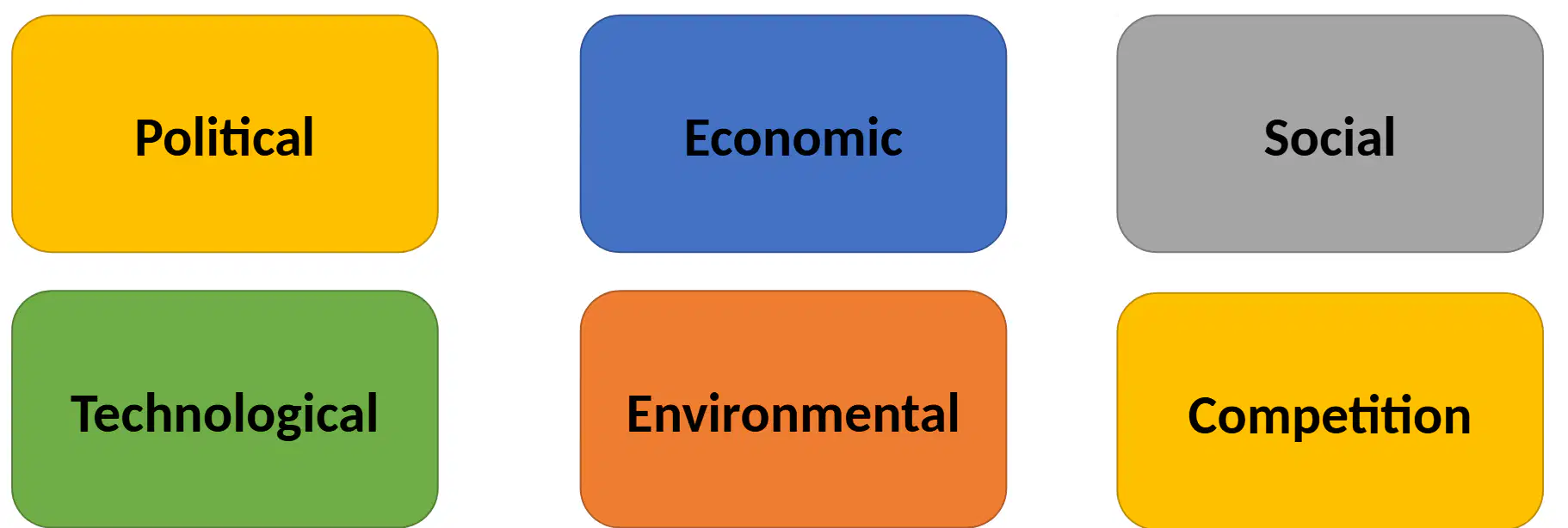
Which of the following best describes external factors in the context of a business?
Things within the control of a business that impact how it operates.
Things outside the control of a business that impact how it operates.
Only the financial aspects of a business.
Only the internal management of a business.
Which of the following is NOT listed as an external factor affecting a business in the provided material?
Political
Economic
Marketing
Environmental

Which of the following is an example of a law introduced by the government that could affect businesses in the UK?
Banning advertising of tobacco on television
Allowing unlimited advertising of tobacco
Reducing the price of tobacco products
Encouraging businesses to ignore laws

Which of the following best describes an economic influence?
Anything that encourages people to spend or not spend money
Only the amount of money people save
The weather conditions in a country
The number of holidays in a year
What happens when interest rates are low?
It becomes more expensive to borrow money from a bank
People are discouraged from spending money
It is cheaper to borrow money, encouraging people to spend
Banks stop lending money
Which of the following best describes social influences?
Factors related to technology and innovation
Influences concerned with changing opinions, values, and people's beliefs
Economic trends affecting businesses
Legal regulations imposed by governments
Why must businesses try to keep up with what consumers want?
Because consumer preferences can change rapidly
Because laws require them to do so
Because technology never changes
Because prices are always stable
Which of the following is an example of a social influence affecting businesses?
The introduction of new tax laws
The growing number of working practices offered to help employees balance work and life
The development of new machinery
The fluctuation of currency exchange rates
How can technological factors impact businesses according to the material?
By introducing new practices and equipment
By increasing employee salaries
By reducing the need for any technology
By focusing only on traditional methods
Which of the following best describes the role of research and development as a technological factor in business?
It helps businesses innovate and improve their products or services.
It only focuses on hiring new employees.
It is unrelated to technology.
It is about reducing the number of products.
Which technological factor involves buying and selling goods or services over the internet?
E-commerce
Automation
ICT
Research and development
Explain how research and development can lead to the decline of a previously successful business, using Kodak as an example.
Research and development can introduce new technologies, such as digital cameras, which can make older products, like camera film, less necessary, causing successful businesses like Kodak to lose market share.
Research and development always increases the sales of traditional products.
Research and development only affects new businesses, not established ones.
Research and development has no impact on the market for traditional products.

Which of the following is a direct result of more firms moving online in the context of ecommerce?
The number of customers is widened and production costs are lowered, but competition increases.
The number of customers decreases and production costs rise.
Firms become less competitive and have fewer customers.
Production costs increase and competition decreases.
How can natural disasters affect companies?
They can have a devastating impact on companies due to damage caused to property/stock
They always increase company profits
They have no effect on companies
They only affect small businesses
Explain how seasonal changes can influence the sales of certain products or services. Use evidence from the material to support your answer.
Seasonal changes can increase sales of products like sun tan lotion during good summers, as these products are often in higher demand during specific weather conditions.
Seasonal changes have no effect on product sales.
Seasonal changes only affect the prices, not the sales.
Seasonal changes always decrease sales of all products.

Which of the following actions is most likely to attract customers who are interested in environmentally friendly companies?
Recycling goods
Increasing carbon emissions
Using more plastic packaging
Ignoring pollution controls
Explain how causing environmental damage can negatively impact a business, using the BP oil spill as an example.
It can lead to higher profits and better public image.
It can cause extensive damage to wildlife and harm the company’s public image.
It can increase the company’s market share.
It can reduce the company’s operating costs.
A company is deciding whether to invest in pollution control technology. Using strategic thinking, what are some potential long-term benefits of this investment for the company?
Increased pollution and lower costs
Improved public image and attraction of environmentally conscious customers
Decreased product quality
Reduced employee satisfaction
If two companies continuously lower their prices to attract more customers, what is this situation called?
Product differentiation
Imitators
Price wars
Brand loyalty

What is a common strategy used by rival organizations when a successful product is introduced to the market?
They ignore the new product completely.
They try to undercut it by quickly producing cheaper alternative versions.
They increase the price of their own products.
They stop producing their own products.
Explain how the concept of "imitators" in a competitive market can affect consumer choices.
Imitators make it harder for consumers to find alternatives.
Imitators provide consumers with more affordable options, increasing competition and potentially lowering prices.
Imitators reduce the number of products available in the market.
Imitators always produce higher quality products than the original.
What is a possible negative outcome of a price war for companies?
Prices can drop so low that none of the competing companies can make much of a profit
Companies will always make more profit
Customers will stop buying goods
The quality of goods will always improve
How can a price war benefit customers?
Customers can get the goods and services they want at lower prices
Customers have to pay higher prices
Customers receive fewer choices
Customers have to wait longer for goods

