
 Worksheets
GRAMMAR / VOCABULARY
Total questions: 20
Worksheet time: 3mins
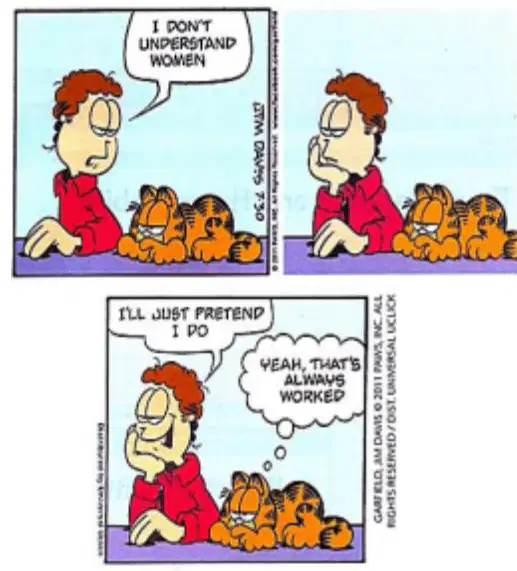
Considerando o diálogo do 1º quadrinho, assinale a opção que a frase está em sua forma afirmativa do simple present.
Do I understand women?
I don’t understand women.
I understand women.
I understand women?
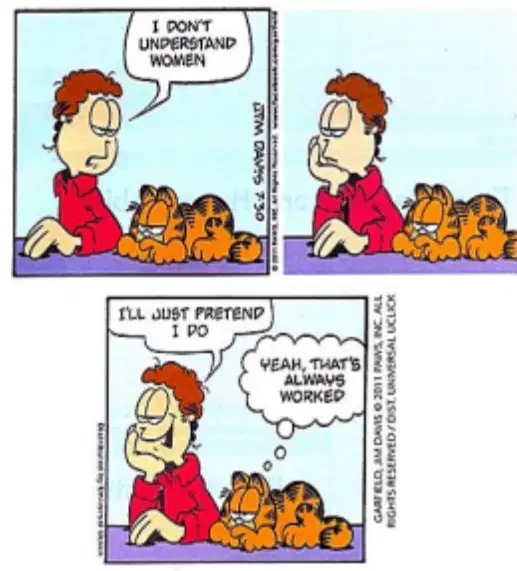
Considerando a fala do homem do 3º quadrinho, assinale a opção onde a frase está em sua forma afirmativa do simple present.
I don’t pretend I do.
I will just pretend I do.
I’ll just pretend I do.
I just pretend I do.
Sobre a forma negativa do simple present, marque a alternativa que completa a frase corretamente. Helena __________ enjoy going to the gym
do not / don’t
does not / doesn’t
does
do
Marque a alternativa para deixar a frase na forma negativa corretamente. Helena and Mary _______________ watch horror movies
do not / don’t
does not / doesn’t
does
do
Para alguns verbos, é necessário utilizar um verbo auxiliar para indicar uma pergunta. Levando em consideração o exemplo abaixo, marque a opção que indica uma pergunta direta no Presente Simples. __________ your friends like your new haircut?
Do not / Don’t
Does not / Doesn’t
Does
Do
Considerando o sujeito da frase a seguir, escolha a opção com o verbo auxiliar correto para essa interrogação. __________ it rain a lot in your city?
Do not / Don’t
Does not / Doesn’t
Does
Do
O verbo "to be" é um verbo especial em inglês, pois ele pode ser utilizado como verbo principal ou como auxiliar para formar tempos verbais compostos. Na forma interrogativa do Simple Present, o verbo "to be" não precisa de auxiliares "do" ou "does". Diante disso, assinale a frase que se encontra gramaticalmente correta na forma interrogativa com esse verbo em particular.
Does the sun rise in the east?
Am I late for the meeting?
I am late for the meeting
I am late for the meeting.
Assinale a opção gramaticalmente correta na forma interrogativa do simple present.
You are hungry?
Do you are hungry?
You are hungry
Are you hungry?
Na frase: “He lives in a small apartment in the city with his girlfriend”. Marque a alternativa abaixo que esse trecho está na forma negativa corretamente.
He does not live in a small apartment in the city with his girlfriend.
He do not lives in a small apartment in the city with his girlfriend.
He not lives in a small apartment in the city with his girlfriend.
He does not lives in a small apartment in the city with his girlfriend.
Choose the correct sentence:
He does not lives in a small apartment in the city with his girlfriend.
He does not live in a small apartment in the city with his girlfriend.
He do not live in a small apartment in the city with his girlfriend.
He do not lives in a small apartment in the city with his girlfriend.
Observe the following sentence: “John and Sarah like to explore the city”. Considering the verb “LIKE” in an affirmative sentence in the 3rd person singular, mark the correct option.
Jonh like to explore the city.
Sarah doesn’t like to explore the city.
Sarah likes to explore the city.
Jonh doesn’t like to explore the city.
Mark the alternative where the following sentence is in its grammatically correct interrogative form: “He lives in a small apartment”.
Does he live in a small apartment?
Do he live in a small apartment?
He lives in a small apartment?
He lives in a small apartment.
Mark the alternative where the following sentence is in its grammatically correct interrogative form: “They cook dinner together”.
They cook dinner together?
Does they cook dinner together?
They cook dinner together.
Do they cook dinner together?
GRAMMAR
A: ______ you work in an office?
B: No, I work in a restaurant.
DOES
DO
ARE
GRAMMAR
A: They’re new students.
B: No, they ______ new students. They’re old students.
ARE
ISN´T
AREN´T
GRAMMAR
A: ______ are they?
B: They cost $80.
HOW MUCH
HOW MANY
HOW OFTEN
GRAMMAR
Which sentence has the correct word order?
ARE YOU HOW OLD?
HOW OLD ARE YOU?
OLD HOW YOU ARE?
Vocabulary
A: What’s the opposite of “cheap”?
B: ______
EXPENSIVE
BEAUTIFUL
INTERESTING
VOCABULARY
The thing you use to write and draw with is a ______.
PEN
CLASS
BOOK
VOCABULARY
“Teacher”, "doctor", "manager" are types of ______.
BUILDING
CLOTHES
JOB

