
 Worksheets
Mostly Biology for 9J2
Total questions: 136
Worksheet time: 3hrs 30mins
What is the definition of communicable?
Can be passed from organism to another
Communication between individuals
Can be easily passed from one organism to another
The ability of bacteria and viruses to link together
"Diseasing causing micro-organism" is the definition of which of these words?
Infection
Disease
Pathogen
Fungus
Which of these is NOT a pathogen?
Bacteria
Virus
Fungus
Mosquito
What do bacteria do that makes us feel unwell?
Enter our cells
Release toxins
Reproduce slowly
Burst our cells
How do viruses make us feel unwell?
Enter our cells and cause damage
Release toxins
Reproduce slowly
Which of these is NOT a viral disease?
HIV
Measles
Tobacco mosaic virus
Salmonella
How is measles spread?
Contaminated food
Air droplets from coughs and sneezes
Sexual contact
Contaminated soil
What has happened if a person has developed AIDS?
You get it automatically when you get HIV
They have picked up an infection while having HIV
HIV has damaged their immune system so badly they can no longer fight off simple imfections
It is a disease you can get on its own
What are the characteristic symptoms of TMV (tobacco mosaic virus)?
Mottled leaves
Yellow leaves
Grey leaves
Black leaves
Which of these are symptoms of salmonella?
Diarrhoea and vomiting
Yellow/green discharge
Burning sensation when urinating
Fever
Gonorrhea is a sexually transmitted bacterial disease. Which of these will prevent the spread of the disease?
Contraceptive pill
Condoms
Antibiotics
Rose black spot is caused by which pathogen?
Fungus
Bacteria
Virus
Protist
In rose black spot the leaves are purple/black before turning yellow and dropping off. What causes this?
Not carrying out photosynthesis properly
Not enough water
Not enough sunlight
Malaria is our final communicable disease...what is is caused by?
Bacterium
Virus
Yeast fungus
Plasmodium protist
Mosquitos cause the spread of malaria by biting an infected person and then biting another person to carry the protist. What do you call organisms that help spread disease?
Pathogen
Vector
Carrier
Infectious
How can we prevent the spread of malaria?
Mosquito nets
Anti-malaria tablets
Insect repellant
Vaccines
Which micro organisms cause communicable diseases?
Pathogens
Pathogerms
Partitions
_________ are diseases that can be transmitted from one person to another
Non communicable diseases
Communicable diseases
Goiter
Diseases can be classified into two types, ___________ diseases and ________ diseases
Pathogens and Microorganisms
Communication and non communication
Communicable and non communicable

Which of the following is a good way to stop the spread of the Covid-19?
cough in your sleeve
wash your hands often
stand at least 2 meters away from people
All of the above
The Covid-19 disease is caused by a _________.
virus
bacteria
fungi
Which is not a type of pathogen?
Virus
Bacteria
Diabetes
Fungus
A viral disease found in humans?
Rose black spot
Tobacco mosaic virus
AIDS
Malaria
A bacterial disease spread by contaminated food?
Malaria
Salmonella
Measles
Gonorrhoea
A pathogen that can be controlled by giving people vaccines.
Malaria
Salmonella
Measles
Gonorrhoea
A pathogen that causes a yellow or green discharge from the vagina or penis.
Malaria
Salmonella
Measles
Gonorrhoea
2 pathogens that infect plants
Rose black spot
Tobacco mosaic virus
Malaria
Salmonella
Which of these is a non-specific defence against disease
antibodies
skin
white blood cells
antigens

Diseases caused by pathogens are called...
communicable diseases
non communicable diseases

What is in our stomach that helps to kill pathogens that we have eaten?
Bile
Citric acid
Hydrochloric acid
Glycogen

If pathogens get past our body's first line of defence then our immune system is our second line of defence. Which cells make up our immune system?
Red Blood Cells
Cilia Cells
White Blood Cells
Sperm Cells
Which of the following do white blood cells NOT DO?
Produce antibodies
Engulf the pathogen
Make antigens
Release Antitoxins

White Blood Cells, specifically lymphocytes, produce antibodies. Where do antibodies attach to on the pathogen?
Antigens
Antitoxins
Nucleus
Cell membrane
Bacteria can produce toxins that make us feel ill. How do antitoxins help with this?
They engulf the toxins
They neutralise the toxins
They make antibodies

Anything that increases a chance of developing a disease is called a risk factor. Some risk factors have been proved to cause a disease. Which of the following do you think are risk factors?
All of them
Alcohol
Obesity
Smoking
Which 3 things do our white blood cells do?
Engulf the pathogen
Produce antibodies
Make antigens
Release antitoxins

Why do cells in our nose produce mucus?
To trap pathogens before they can enter our lungs
To tell us when we have have a cold
To kill pathogens
There is no reason for mucus
Which organelle controls the actitivies of the cell and contains DNA?
Cell Membrane
Cytoplasm
Nucleus
Mitochondria
Which organelle is where aerobic respiration occurs?
Mitochondria
Chloroplast
Cytoplasm
Ribosome
Which organelle is where protein synthesis happens?
Chloroplast
Mitochondria
Ribosome
Nucleus
What is the function of the cytoplasm?
To control what enters and exits a cell.
It is where chemical reactions occur.
To control the activities of a cell.
It is where photosynthesis happens.
Which organelles do you find in a plant cell but not an animal cell?
Cell Membrane
Vacuole
Cytoplasm
Chloroplasts
Cell Wall
What is the name of the process where particles move from a high concentration to a low concentration (down a concentration gradient)?
Diffusion
Osmosis
Active Transport
If an image is blurry under a microscope, how do you make it clearer?
Change the objective lens to a higher magnification.
Turn on the light or adjust the mirror.
Turn the focusing wheel until the image is focused.
Use a different eyepiece lens.
What is the equation to work out overall magnification from eyepiece magnification and objective lens magnification?
Overall= Objective x Eyepiece
Overall= Objective/Eyepiece
Overall= Eyepiece/Objective
How do you calculate actual specimen size from magnification and image size?
Actual = Magnification / Image Size
Actual =Image Size / Magnification
Actual = Image Size x Magnification
What is meant by a prokaryotic cell?
A cell without a nucleus
A cell with a nucleus
A cell without a cell membrane
A cell with two nuclei.
Which statement is false about eukaryotic cells?
They can have mitochondria, chloroplasts and vacuoles.
They have a nucleus
They are much smaller than prokaryotic cells.
Animal and plant cells are examples of eukaryotic cells.
What is a specialized cell?
A cell suited to a particular job/function
A cell which has no job/function
A cell without a nucleus.
A cell with no DNA.
What is a solute?
The dissolved substance in a solution, e.g. sugar or salt.
The liquid in which the solute dissolves.
Mixture formed by a solute and a solvent.
What is a solution?
The dissolved substance in a solution, e.g. sugar or salt.
The liquid in which the solute dissolves.
Mixture formed by a solute and a solvent.
What is a solvent?
The dissolved substance in a solution, e.g. sugar or salt.
The liquid in which the solute dissolves.
Mixture formed by a solute and a solvent.
Which cell absorbs minerals and water?
Guard cells
Xylem
Phloem
Root Hair Cell
Which cell transports water around the plant?
Xylem
Stem
Root Hair Cell
Phloem
Which cell type transports sugars around the cell?
Root Hair Cell
Xylem
Phloem
Guard
What cell is packed with chloroplasts?
Phloem
Guard
Stem
Palisade
What cell type has no chloroplasts?
Guard cells
Root hair cells
Palisade
Xylem
How confident are you in your understanding of cell specialisation of Plant cells?
I don't understand any of it
I understand some of it
I understand most of it
I understand it all
What is the function of the cell membrane?
control what enters or leaves the cell
Cell division and replication.
Nerve impulse transmission.
Energy release and storage.
Which organelle is responsible for protein synthesis?
nucleus
mitochondria
lysosome
ribosome
What is the function of the nucleus?
Produce proteins.
Generate energy for the cell.
Store and protect DNA
Control cell division.
What is the function of the cytoplasm?
The function of the cytoplasm is to store genetic information.
The function of the cytoplasm is to produce energy for the cell.
The function of the cytoplasm is to regulate cell division.
The function of the cytoplasm is to provide a medium for cellular activities and support the organelles.
Which organelle is responsible for photosynthesis?
mitochondria
nucleus
endoplasmic reticulum
chloroplast
What is the function of the ribosomes?
Cell division.
Energy release.
DNA replication.
Protein synthesis
What is the Cytoplasm?
Cell sap that gives the cell structure.
Where photosynthesis occurs.
Gel-like substance where most chemical reactions happen.
Where proteins are produced.
What features do animal cells contain? (select all that apply)
Nucleus
Ribosomes
Cytoplasm
Cell Membrane
Mitochondria
In addition to features found in animal cells, what elements are only found in plant cells?
Cell Wall
Vacuole
Plasmids
Chloroplasts
Mibosomes
What happens in the Mitochondria?
Aerobic respiration takes place.
Anaerobic respiration takes place.
Genetic material is stored.
Chemical reactions take place.
Which of these are found in bacteria cells?
Cytoplasm
Cell Membrane
Vacuole
Cell Wall
Plasmids
What is the equation to figure out magnification?
Magnification = Strength of lens/ image size
Magnification = image size/ real size
Magnification = image size x real size
Magnification = real size/ image size
To convert mm into micrometers
multiply by 100
divide by 1000
multiply by 1000
multiply by 100,000

What type of cell is an animal cell?
Prokaryotic
Eukaryotic
What type of cell is a bacterial cell?
Prokaryotic
Eukaryotic


Calculate the density of the cube.
2 g/cm3
4 g/cm3
6 g/cm3
8 g/cm3

what is the volume of the cube?
123
144
244
150


What would be the effect on the particles if more heat is supplied to the system? (a)

Water has a specific heat of 4184 J/kgºC. Wood has a specific heat of 1760 J/kgºC. What material needs more energy to raise the temperature 1ºC (a)
it requires more energy to change temperature
it requires less energy to change temperature
You heat up 2 pans of water; one has 100 mL in it, and the other has 1000 mL. Which one heats up the fastest?
100 mL
1000 mL
They both heat up at the same speed

Which will heat up the fastest? (a)

Rank the materials in order of slowest to heat up to fastest to heat up.
water
1
lead
2
granite
3
iron
4
Which of the following best explains why the sand at the beach is hotter than the water?
Sand has a higher specific heat than water, requiring more energy to heat up than water.
Sand has a lower specific heat than water, requiring less energy to heat up than water.
Sand has a greater mass than water.
Water has a greater mass than sand.
(a) is the amount of energy required to raise the temperature of 1 kg of mass by 1 oC

Copper, Stainless Steel, Carbon Steel, and Zinc were all heated using the same amount of thermal energy. What material would be the coolest after being heated?
Copper
Carbon Steel
Zinc
Stainless Steel
Object A, it has a lower specific heat
Object B, it has a lower specific heat
Object A, it has a higher specific heat
Object B, it has a higher specific heat
Which one will have the SMALLEST change in temperature?
Heat will always transfer from the ___________ object to the ________ object.
The hottest object to the coolest object.
The coolest object to the hottest object.
The solid object to the liquid object.
The liquid object to the solid object.

Thermal energy
Temperature
Heat
Convection
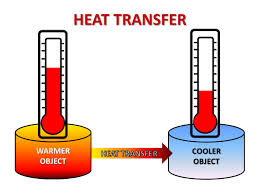
Heat flows from an area of (a) temperature to an area of (b) temperature.
Car A has their AC set to 72oF. Car B has their AC set to 67oF. If it is 98oF outside, which car will heat flow into faster?
Car A
Car B
Heat will flow into the cars at the same rate.

