
 Worksheets
Software Development Models Quiz
Total questions: 65
Worksheet time: 33mins
Which software development model is most suitable for projects with stable and well-defined requirements, where changes are minimal?
Waterfall Model
Incremental Model
Spiral Model
Agile Model
What is a key characteristic of the Incremental Model in software development?
All phases are completed before moving to the next
Development is done in smaller, functional increments
It is only used for low-risk projects
Requirements must be fully understood before starting
In which scenario is the Incremental Model particularly useful?
When requirements are stable and well-defined
When system requirements are not fully understood or are subject to change
For projects with no risk
When only maintenance is required
Which software development model combines elements of the Waterfall model with an iterative approach and is suitable for high-risk or complex projects?
Waterfall Model
Incremental Model
Spiral Model
V-Model
What is a primary advantage of the Spiral Model in software development?
It requires all requirements to be known upfront
It allows for gradual and iterative development with risk assessment
It is only suitable for small projects
It does not include validation phases
Which of the following is NOT a phase typically included in the Waterfall Model?
Specification of requirements
Project design
Risk evaluation
Maintenance
Which of the following best describes Agile development methods such as Scrum and XP (Extreme Programming)?
They emphasize strict documentation and long development cycles.
They focus on collaboration and continuous delivery of functional software.
They require no interaction with the client during development.
They discourage changes during the development process.
In Agile development, what is the main purpose of dividing work into short iterations called sprints?
To reduce the number of team meetings.
To prioritize the needs of the client and deliver value quickly.
To avoid any changes during the project.
To focus only on technical documentation.
Which characteristic is most associated with Agile development?
Inflexibility to changes
Adaptability and quick response to user demands
Focus on individual work over collaboration
Long, uninterrupted development cycles
Suppose a software team is using Agile methods and receives new user requirements halfway through a project. What should the team do according to Agile principles?
Ignore the new requirements until the next project.
Adapt to the changes and incorporate them in the next sprint.
Cancel the project and start over.
Finish the current plan without any changes.
What is the main focus of the "Modelo em Cascata" (Waterfall Model) in software development?
Iterative development and rapid prototyping
Sequential phases with clear milestones
Continuous integration and deployment
Agile team collaboration
According to Sommerville's Waterfall Model, which phase comes immediately after "Definição de Requisitos" (Requirements Definition)?
Codificação e testes unitários (Coding and unit testing)
Integração e testes de sistema (Integration and system testing)
Projeto de SW e Sistema (Software and System Design)
Operação e Manutenção (Operation and Maintenance)
In Pressman's Waterfall Model, which activity is associated with the "Planejamento" (Planning) phase?
Codificação (Coding)
Estimativas, Cronograma, Monitoramento (Estimates, Scheduling, Monitoring)
Análise (Analysis)
Entrega (Delivery)
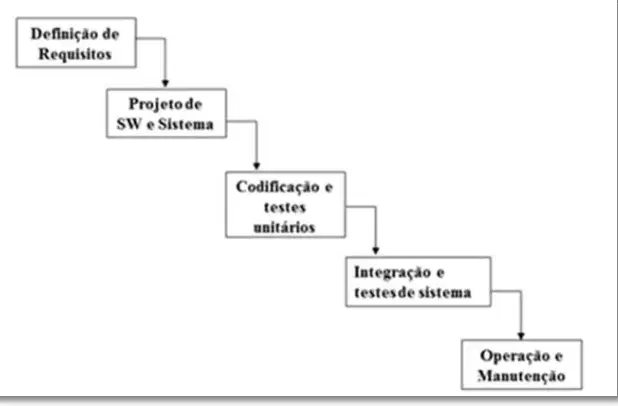
Which of the following best describes the flow of activities in Sommerville's Waterfall Model?
Activities are performed in parallel with frequent feedback loops.
Each activity is completed before the next one begins, with little overlap.
Activities are repeated in cycles until the software is complete.
Activities are chosen randomly based on project needs.

How does Pressman's Waterfall Model emphasize the importance of communication in the software development process?
By placing communication at the end of the process
By integrating communication throughout all phases
By starting the process with a dedicated communication phase
By eliminating the need for communication
Which of the following is a key characteristic of the Waterfall Model in software development?
Iterative feedback loops
Sequential structure
Continuous integration
High flexibility
In the Waterfall Model, how are the phases typically organized?
Overlapping and iterative
Isolated and sequential
Random and flexible
Parallel and dynamic
Why is the Waterfall Model considered to have "pouca flexibilidade" (little flexibility)?
Because it allows frequent changes during development
Because requirements can be modified at any stage
Because changes are difficult once a phase is completed
Because it uses agile practices
What is emphasized in the Waterfall Model according to the learning material?
Rapid prototyping
Documentation
User feedback
Continuous deployment
At what stage are tests typically performed in the Waterfall Model?
At the beginning of the project
Continuously throughout the project
Only at the final stage
After each phase
Given the characteristics of the Waterfall Model, what is a potential risk when using this model for projects with evolving requirements?
The model easily adapts to changes
Requirements can be updated at any time
The project may fail to meet user needs due to inflexible structure
Testing is performed early and often
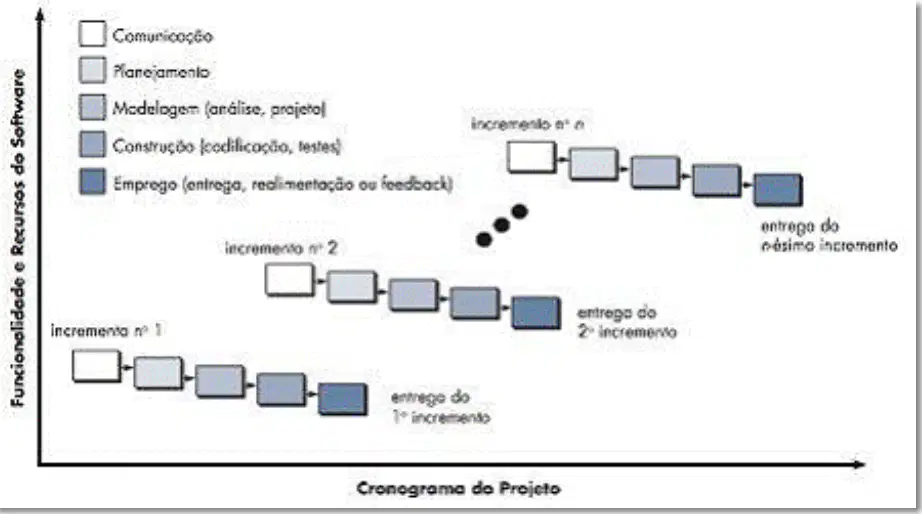
What is the main focus of the Incremental Model in the software life cycle?
Delivering the entire software at once
Delivering software in small, functional increments
Skipping the planning phase
Focusing only on testing

Which of the following is NOT a phase typically included in the Incremental Model as shown in the diagram?
Communication
Planning
Marketing
Construction
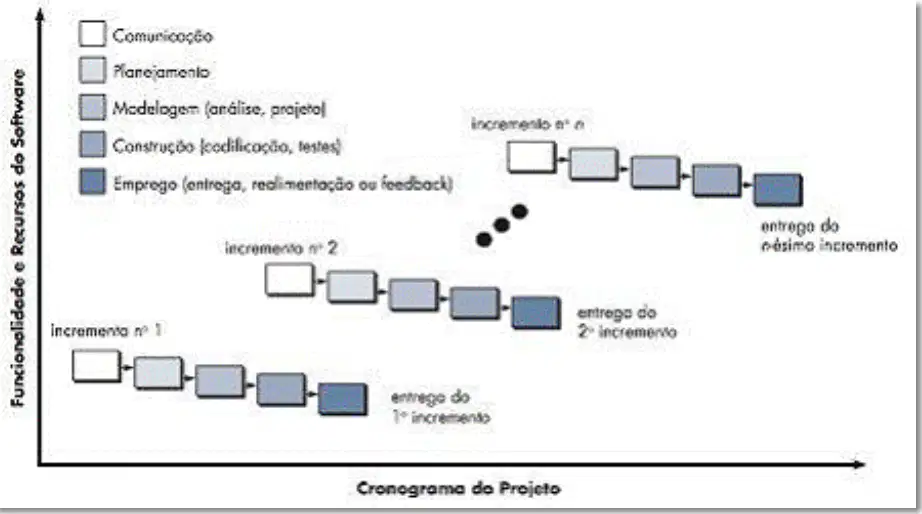
According to the Incremental Model, what happens after the completion of each increment?
The project is abandoned
The next increment begins and more functionality is added
The software is fully deployed and no further work is done
Only testing is performed
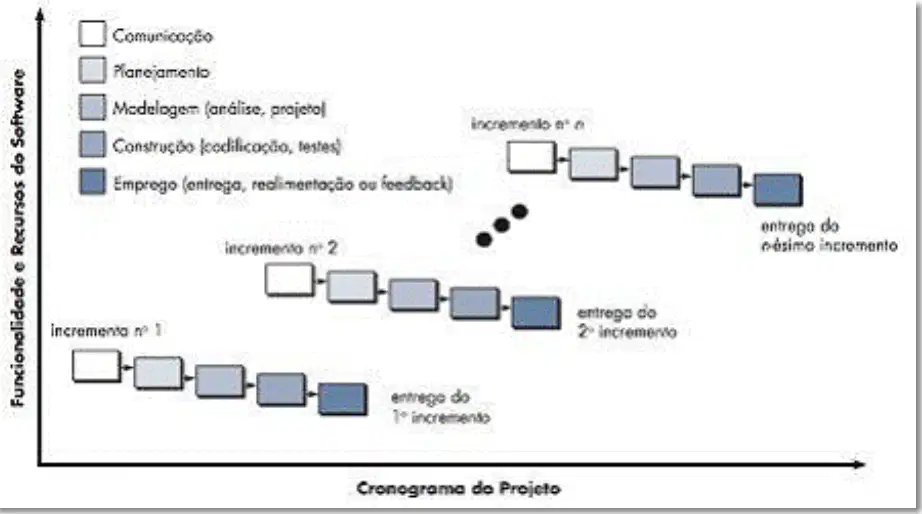
How does the Incremental Model improve the software development process compared to delivering the entire product at once?
It allows for early delivery of partial functionality and feedback, reducing risk and improving adaptability.
It eliminates the need for planning and communication.
It focuses only on coding and testing.
It requires all features to be delivered at the end.
Which of the following is a key characteristic of the Incremental Model in the software life cycle?
Development in increments
Single delivery at the end
No feedback during development
Fixed requirements from the start
What does "Entrega Iterativa" refer to in the context of the Incremental Model?
Delivering the entire product at once
Delivering the product in repeated cycles
Delivering only after all requirements are met
Delivering without any feedback
How does the Incremental Model handle changes in requirements?
It is flexible and allows for changes
It does not allow any changes
It requires all changes to be made at the end
It ignores changes in requirements
Which process in the Incremental Model ensures that the software meets requirements throughout development?
Continuous validation
Final testing only
No validation
Validation after deployment
Explain how progressive integration benefits the software development process in the Incremental Model.
It allows components to be integrated step by step, reducing integration risks.
It delays integration until the end, increasing risk.
It ignores integration until deployment.
It integrates all components at once without testing.
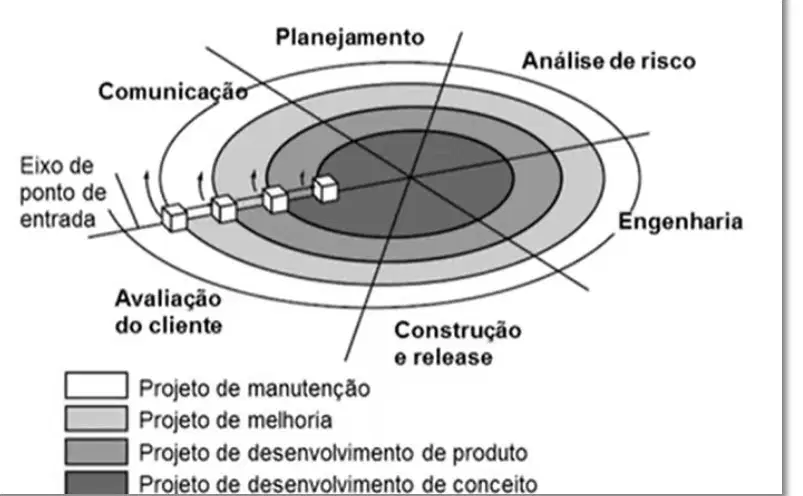
What is the main focus of the Spiral Model in software development?
Iterative development with risk analysis at each phase
Linear progression through fixed stages
Rapid prototyping without risk consideration
Waterfall approach with no feedback loops

Which of the following is NOT a phase explicitly shown in the Spiral Model diagram?
Communication
Analysis of risk
Engineering
Testing only
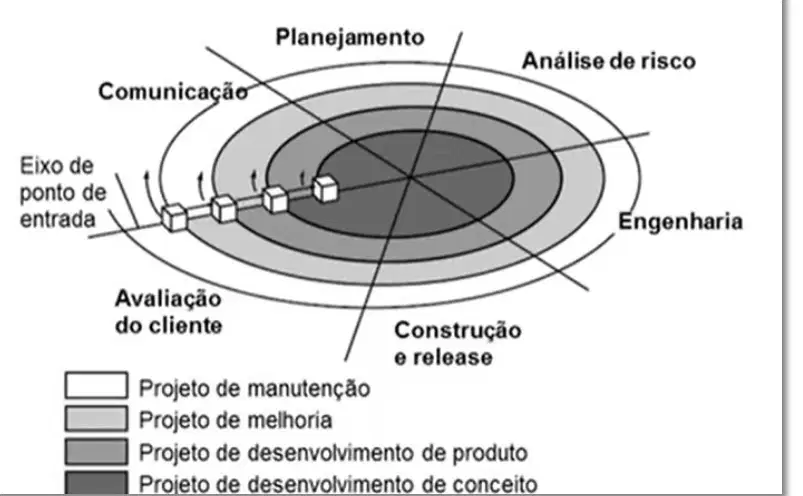
According to the Spiral Model, what is the purpose of the "Eixo de ponto de entrada" (Entry Point Axis)?
To indicate where a project can begin in the spiral process
To show the final release of the software
To represent the timeline of the project
To display the number of developers involved

How does the Spiral Model address customer involvement in the software development process?
By including a customer evaluation phase in each cycle
By excluding customers until the final release
By only involving customers during maintenance
By allowing customers to design the software

Which type of project is NOT explicitly listed in the Spiral Model diagram's legend?
Maintenance project
Improvement project
Research project
Product development project
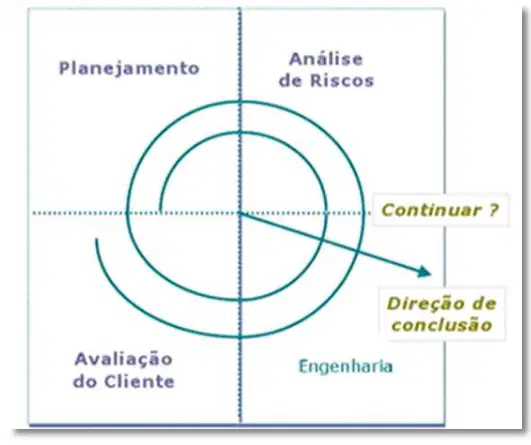
Which software development model is characterized by an iterative and incremental approach, risk analysis, and continuous monitoring?
Waterfall Model
Spiral Model
V-Model
Agile Model
What is the primary purpose of risk analysis in the Spiral Model of software development?
To create user documentation
To identify and address potential problems early in the process
To finalize the software requirements
To reduce the cost of hardware
Which of the following is NOT a characteristic of the Spiral Model?
Prototyping
Four Quadrants
Linear progression without iteration
Continuous monitoring
In the Spiral Model, what is the significance of the four quadrants?
They represent different programming languages
They divide the project into unrelated tasks
They structure the development process into planning, risk analysis, customer evaluation, and engineering
They are used only for documentation purposes
How does the Spiral Model handle changes during the software development process?
Changes are not allowed after the initial phase
Changes are controlled and managed throughout the process
Changes are only made at the end of the project
Changes are ignored to maintain the schedule
Why is continuous monitoring important in the Spiral Model?
It ensures that the software is delivered on time
It allows for ongoing assessment and management of risks and progress
It reduces the need for documentation
It eliminates the need for customer feedback
Which software development model is described as a sequential approach with distinct phases?
Waterfall
Incremental
Spiral
Agile
What is a key advantage of the Incremental software development model?
Quick delivery of value to the customer
Easy to understand and use
Allows risk mitigation and adaptation to changes
Little flexibility for changes
Which model allows for risk mitigation and adaptation to changes during the software development process?
Spiral
Waterfall
Incremental
RAD
What is a disadvantage of the Waterfall model?
Little flexibility for changes
Higher complexity and cost
Requires clear definition of increments
Quick delivery of value to the customer
Compare the disadvantages of the Incremental and Spiral models. How do they differ in terms of project requirements and complexity?
Incremental requires clear definition of increments, while Spiral has higher complexity and cost.
Both require clear definition of increments.
Incremental has higher complexity and cost, while Spiral requires clear definition of increments.
Both have low flexibility for changes.
If a client needs a software solution that can quickly deliver value and adapt to changes, which model would be least suitable and why?
Waterfall, because it has little flexibility for changes.
Incremental, because it requires good definition of increments.
Spiral, because it is too complex.
Incremental, because it is hard to understand.
What is one of the disadvantages of the Waterfall model in software development?
Difficulty in dealing with volatile requirements.
High dependence on prototypes to validate requirements.
Low emphasis on documentation throughout the project life cycle.
Ease in responding to changes in client requirements.
It may be difficult for developers to understand client requirements.
What characterizes the incremental model in terms of software delivery?
Delivery of the entire system at once at the end of the project.
Delivery of functional parts of the system in successive increments.
Delivery of software prototypes to obtain initial feedback.
Delivery of extensive documentation before the source code.
What are the benefits of the incremental model compared to the Waterfall model?
Greater difficulty in managing risks.
Rapid delivery of a fully functional system.
Greater control over requirements changes.
Higher probability of schedule delays.
Reduced need for communication with stakeholders.
What is the correct order of activities executed in the spiral model of software development, given the following activities: Construction, Implementation, Communication, Planning, and Modeling?
Communication, Planning, Modeling, Construction, and Implementation.
Construction, Implementation, Communication, Modeling, and Planning.
Modeling, Planning, Construction, Implementation, and Communication.
Planning, Construction, Implementation, Communication, and Modeling.
Planning, Modeling, Communication, Construction, and Implementation.
Regarding the traditional waterfall model used for software development, which of the following statements is correct?
It starts with the preparation of the schedule and ends with testing.
It starts with the specification of requirements and ends with implementation.
It does not include the coding phase.
It requires a team of no more than 5 professionals.
It only applies to projects with a duration longer than 12 months.
According to the incremental software development model, which statement is correct?
The testing phase of each increment has a maximum duration of 3 days.
There is no need for any requirements specification for this type of development model.
Requirement reviews are not accepted for the increment under development, but only for subsequent increments.
It does not apply to projects with an expected duration of more than 6 months.
It supports, at most, a total of 5 increments for each new project.
Based on Sommerville (2011), what happens to requirement changes during the development of the current increment in the incremental model?
Requirement changes for the current increment are accepted at any time.
Requirement changes for the current increment are not accepted, but can occur for subsequent increments.
Requirement changes are never accepted in any increment.
Requirement changes are only accepted after the project is completed.
Consider the spiral model of the software life cycle in which the phases are: 1. Modeling, 2. Implementation, 3. Communication, 4. Planning, 5. Construction. What is the recommended chronological order for executing these 5 phases?
2, 3, 1, 5, 4.
3, 1, 2, 5, 4.
3, 4, 1, 5, 2.
4, 1, 2, 5, 3.
4, 3, 2, 5, 1.
According to Frederick Brooks, what is the most difficult part of building software systems?
Writing the code
Deciding what to build
Testing the software
Designing the user interface
Why is the establishment of detailed technical requirements considered challenging in software development?
It requires a lot of documentation
It is as difficult as deciding what to build
It involves only coding skills
It is not important for the final product
What can happen if the conceptual work in software development is done incorrectly?
The system will run faster
The resulting system may be mutilated
The software will be easier to maintain
The user interface will improve
Based on the quote, which part of software development is the hardest to fix later if done incorrectly?
Coding errors
Incorrect requirements
User documentation
Deployment scripts
How does Frederick Brooks describe the impact of errors in the requirements phase of software development?
They are easy to correct later
They do not affect the final system
They are the most difficult to correct afterwards
They only affect the user interface
What is the main purpose of requirements engineering?
To discover, analyze, document, and verify services and restrictions
To design the user interface of a system
To implement the software code
To test the final product
According to Sommerville (2011), what can a requirement be in some cases?
An abstract statement of a service or a restriction applied to a system
A detailed implementation plan
A list of programming languages to use
A marketing strategy
Which of the following best describes a detailed and formal definition of a system function?
A requirement
A prototype
A test case
A user manual

Based on the requirements engineering process diagram, which step comes immediately after "Elicitação e Análise de Requisitos"?
Especificação de Requisitos
Validação de Requisitos
Estudo de Viabilidade
Documento de Requisitos
Why is it important to validate requirements in the requirements engineering process?
To ensure the requirements accurately reflect the needs and constraints of the stakeholders
To speed up the coding process
To reduce the cost of hardware
To create marketing materials

