
 Worksheets
Nutrition in Animals
Total questions: 161
Worksheet time: 2hrs 34mins
The total number of incisors in our jaws is -
8
4
12
24
Peristaltic movement helps in the -
movement of food
digestion of food
absorption of food
assimilation of food
Hydrochloric acid is secreted in the -
stomach
small intestine
large intestine
oesophagus
Which of the following is not a gland?
Pancreas
Liver
Villi
Salivary gland
The enzyme which converts starch into maltose -
pepsin
amylase
trypsin
lipase
Digested food is mainly absorbed in the -
stomach
small intestine
large intestine
oesophagus
Absorption of water from undigested food mainly occurs in -
stomach
oesophagus
large intestine
pancreas
Proteins are ultimately converted to -
glucose
amino acids
starch
glycerol
Undigested food is thrown out through the -
rectum
bile ducts
anus
villi
Which enzyme digests fats?
Protease
Lipase
Carbohydrase
Amylase
Enzymes in the stomach act in which type of medium?
Alkaline
Neutral
Acidic
Basic
During digestion what do large insoluble molecules get broken down into?
Large soluble molecules
Small soluble molecules
Medium soluble molecules
Small insoluble molecules
Which is the first enzyme to mix with food in the digestive tract?
Pepsin
Cellulase
Amylase
Trypsin
If salivary amylase is lacking in the saliva, which of the following events in the mouth cavity will be affected?
Proteins breaking down into amino acids.
Starch breaking down into sugars.
Fats breaking down into fatty acids and glycerol.
Absorption
The inner lining of stomach is protected from hydrochloric acid by one of the following. Choose the correct one.
Pepsin
Mucus
Salivary amylase
Bile
Which part of the alimentary canal receives bile from the liver?
Stomach
Small intestine
Large intestine
Oesophagus
In which part of the alimentary canal food is finally digested?
Stomach
Mouth cavities
Large intestine
Small intestine
Choose the function of the pancreatic juice from the following statements.
Trypsin digests proteins and lipase digests carbohydrates.
Trypsin digests emulsified fats and lipase digests proteins
Trypsin and lipase digest fats
Trypsin digests proteins and lipase digests emulsified fats
Bile is produced by -
kidney
pancreas
spleen
liver
The main function of intestinal villi is -
stimulate peristalsis
prevent antiperistalsis
provide large surface area for absorption
distribute digestive enzymes uniformly
Major function of HCl of gastric juice is to -
providing acidic medium for pepsin
dissolve food
facilitate absorption of food
none of these
The end product of fat digestion is -
glucose
fatty acids and glycerol
amino acids
alkaloids
The action of bile on fats can be called -
oxidation
emulsification
esterification
dehydrogenation
Saliva converts -
proteins into amino acids
glycogen into glucose
starch into maltose
fats into vitamins
Which set is mixed with the food in small intestine?
Saliva, gastric juice, bile
Gastric juice, bile, pancreatic juice
Bile, pancreatic juice, intestinal juice
Bile, pancreatic juice and saliva
A good source of lipase is -
saliva
gastric juice
bile
pancreatic juice
Ptyalin is an enzyme present in -
gastric juice
pancreatic juice
intestinal juice
saliva
Which one does not produce any digestive enzyme?
Pancreas
Liver
Stomach
Small intestine
Largest gland in the body is -
liver
pancreas
gastric gland
adrenal
Which combination of statements is correct?
i. Hydra uses its tentacles to catch food. ii. Mosquito sucks up the blood of animals with its proboscis. iii. The food moves in the alimentary canal by the process of peristalsis. iv. The body of amoeba has finger-like projections called villi.
ii, iii and iv
i, ii and iv
ii, iii, iv and v
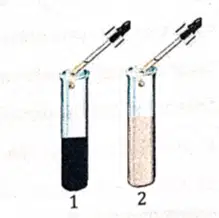
Ridhima took two test tubes labelled as 1 and 2 as shown in the figure. In test tube 1, she put one tablespoon of boiled rice and in test tube 2, she put one tablespoon of boiled rice after chewing it for 3-5 minutes. Then she added 3-4 mL of water in both the test tubes. Thereafter, she poured 2-3 drops of iodine solution in each of the test tubes. Which of the following would be the expected observation by Ridhima?
Colour changes to blue-black in test tube 1 as rice is rich in starch.
Colour changes to blue-black in test tube 2 as saliva breaks down the starch into sugars.
Colour changes to blue-black in both the test tubes.
Colour does not change in either of the test tubes.
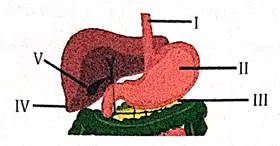
Refer to the given diagram which shows various parts of human digestive system labelled as I, II, III, IV and V. Identify the organs and select the incorrect statement regarding them.
Organ-V is involved in storage of bile not its production.
Organ-II secretes digestive juice which contains mucus, hydrochloric acid and digestive enzymes.
Organ-IV is the largest gland of the body.
Organ-I is involved in the absorption of water from food.
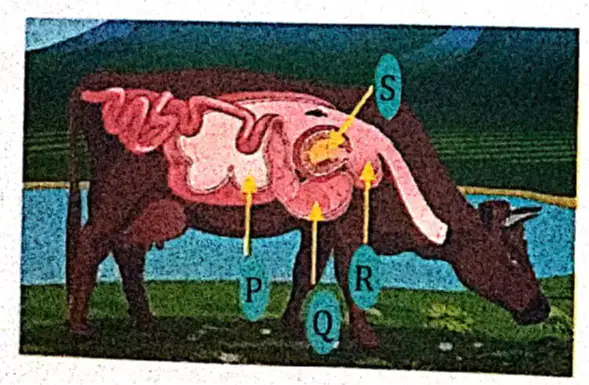
Refer to the given diagram of stomach of ruminant mammal with its parts labelled as P, Q, R and S and select the correct option.
The parts labelled P, Q, R and S are called reticulum, rumen, abomasum and omasum, respectively.
The part labelled Q is true stomach.
Food is completely digested in chambers P and R.
Digestion of cellulose takes place in P, S and R
Fill in the blanks with the correct combination of words. The role of L in the M is to N the surface area for the rapid O of P.
L-villi, M-large intestine, N-decrease, O-absorption, P-digested food
L-cilia, M-small intestine, N-increase, O-assimilation, P-digested food
L-villi, M-small intestine, N-increase, O-absorption, P-digested food
L-villi, M-small intestine, N-increase, O-assimilation, P-digested food
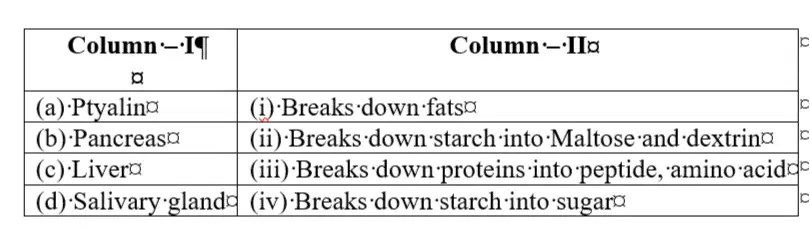
Match Column-I with Column-II and select the correct option from the codes given below.
(a) - (iv), (b) - (iii), (c) - (ii), (d) - (i)
(a) - (i), (b) - (ii), (c) - (iii), (d) - (iv)
(a) - (ii), (b) - (iii), (c) - (i), (d) - (iv)
(a) - (iv), (b) - (ii), (c) - (iii), (d) - (i)
Organisms that feed on dead animals are called -
parasites
scavengers
carnivores
herbivores
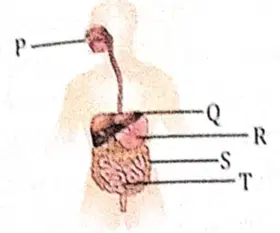
Identify P, Q, R, S and T in the given figure and select the correct statement regarding them.
S is the organ where starch is broken down into sugar by the action of saliva.
Digestive juice secreted by Q gets stored in P.
Many bacteria that enter out body along with the food get killed in the organ R.
Organ T absorbs water and also some salts from the undigested food materials.
Read the given statements and select the option that correctly fills the blanks in any two of them.
(i) ______ are the tiny out-growths on the inner surface of small intestine. (ii) Mucus, hydrochloric acid and digestive juice are secreted by ______. (iii) Length of small intestine in an adult human being is about ______. (iv) ______ mainly absorbs water from the undigested food.
(i) villi (ii) stomach
(iii) 5 m (iv) small intestine
(i) buds (iii) 7 m
(i) small intestine (iii) large intestine
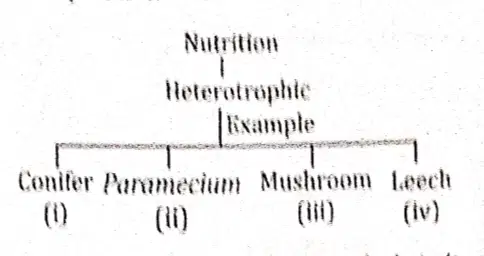
Refer to the given flow chart and answer the question - Which of the following example/s is/are wrongly placed?
(i) only
(ii), (iii) and (v) only
(i), (iv) and (v) only
(ii), (iv) and (vi) only
Read the given paragraph and answer the question that follows. In human beings, four different types of teeth are present. X type of teeth is used for biting and cutting, Y type of teeth is used for crushing and grinding while Z type of teeth is used for tearing the food. Select the option that correctly identifies X, Y and Z.
X - Incisor, Y - Canine, Z - Molar
X - Incisor, Y - Molar, Z - Canine
X - Canine, Y - Incisor, Z - Molar
X - Canine, Y - Molar, Z - Incisor
Nutrition in animals does not include -
nutrient requirements
mode of food intake
(3) utilization of digested food in the body
(4) mode of oxygen intake
Some aquatic animals like sponges feed on small particles of food suspended in water. This is called -
swallowing
scraping
gnawing
filter feeding
Read the given statements.
(i) Paramecium has stiff hair-like structures called ______.
(ii) Hydra has a number of ___ around its mouth, that entangle small aquatic animals and kill them with their _______ cells.
(iii) Frog uses its long, sticky ______ to catch insects.
(iv) Mosquito sucks up the blood of animals with its _______.
Select the option which correctly fills the blanks in any two of these statements.
(1) (ii) cilia, absorptive (iii) forelimbs
(2) (i) tentacles (iv) feeding tube
(3) (i) – cilia (ii) tentacles, stinging
(4) (iii) – tongue; (pseudopodia)
Which enzyme is likely to act first on the baked potatoes eaten by a man, starting from the mouth itself?
Salivary amylase
Pancreatic amylase
Salivary Maltase
Trypsin

Refer to the given figure of human digestive system and select the incorrect statements regarding parts labelled as M, N, O and P.
44. (i) M and O secrete and pour their digestive enzymes in N for digestion whereas N secretes HCl which kills germs in food.
(ii) Digestion of both carbohydrates and proteins takes place in N whereas digestion of only fats takes place in P.
(iii) N, O and P secrete digestive enzymes but M only stores a digestive juice that emulsifies fats.
(iv) P does not secrete any digestive enzyme but receives digestive enzymes from M, N and O for complete digestion of food.
(v) If M is removed in a person, then he can find difficulty in digesting fats present in his food.
(vi) N secretes digestive enzymes and mucus and O secretes digestive enzymes and hormones.
(i), (ii) and (iv) only
(iii) and (iv) only
(i), (ii), (v) and (vi) only
(i), (ii) and (v) only
Varun got his gall bladder removed surgically as he was diagnosed with stone in his gall bladder. Which of the following problems is Varun most likely to face after surgery?
Varun would not be able to digest carbohydrates and proteins properly because gall bladder stores bile which consists of amylase and pepsin enzymes.
Varun would not be able to digest fats properly because gall bladder stores bile juice which helps in emulsification of fats.
Varun would not be able to digest fats properly because gall bladder secretes bile juice which helps in digestion of fats.
Varun would not be able to absorb vitamin B and C properly because gall bladder secretes bile which helps in absorption of these vitamins.
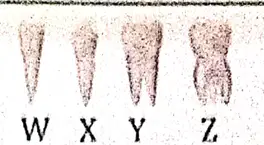
The given figures show different types of teeth. Which of these is modified in elephant tusks?
X
W
Both W and Y
Both Y and Z
Liver secretes bile in which one of the following parts of digestive system?
Oesophagus
Stomach
Small intestine
Large intestine
Name the part of the tooth which contains nerves and blood vessels.
Enamel
Dentine
Pulp cavity
All of these
Replace the question mark (?) with the correct option. Bronchus : Respiratory system :: Rectum : ?
Nervous system
Skeletal system
Circulatory system
Digestive system
1. __________ is the process in which complex food is taken into a specialised digestive system and broken down into small pieces.
Autotrophic nutrition
Holozoic nutrition
Heterotrophic nutrition
None of the above
2 ____________ is the process in which food is taken in by the organisms.
Digestion
Ingestion
Assimilation
Absorption
3. _____________ animals filter tiny food particles floating nearby and feed upon them.
Aquatic
Terrestrial
Both (1) and (2)
None of the above
Write the name of missing steps. 1. Ingestion,_____________, Absorption ,__________ Egestion.
(a)
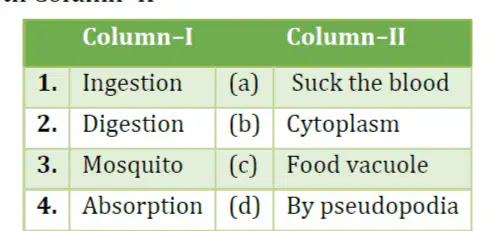
Match the column
1-d, 2-c 3-a, 4-b
Complete the following series. (a) Human: hand : : butterfly : ________ (b) Mosquito: suck the blood : : python : _________
(a)
Read the following statements and give your answer as true or false. 7. Assimilation is the process of breaking down complex food molecules into simpler molecules.
True
Read the following statements and fill in the blanks - 8. (a) is the process by which undigested food is removed from the body.
9. When the tips of encircling pseudopodia touch each other, the food is encaptured into a bag called (a) .
1. Choose the correct statement about a watery fluid named 'saliva'.
It makes the food slippery.
It contains enzyme called amylase.
It also contains antiseptic property as it kills germs.
All of the above.
2. The function of canines is -
biting food
tearing food
grinding and crushing
mixing the food with saliva
3. The process of digestion initiates in -
buccal cavity
stomach
small intestine
large intestine
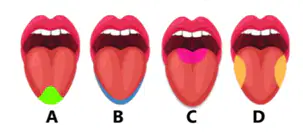
Label the location of taste buds on the given tongue diagram-
(a)
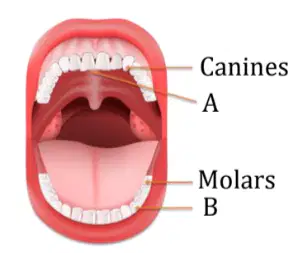
Label the diagram
(a)
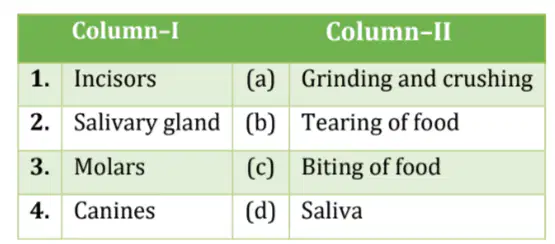
Match the column
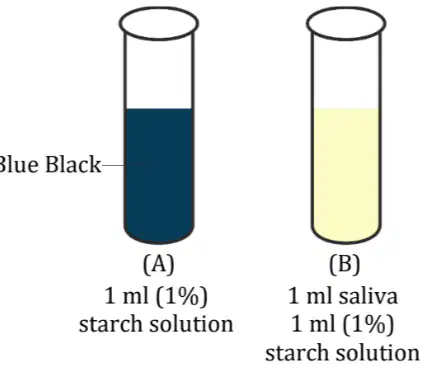
7. Write the action of saliva on starch in both test tube A and test tube B
Test tube A – Iodine solution reacts with starch present in test tube and gives blue black
colour.
Test tube B – Starch is digested by enzymes present in saliva. Due to absence of starch in test
tube, Iodine solution does not produce any blue–black colour. Saliva breakdown the starch.
Read the following statements and give your answer as true or false. 8. The process of digestion starts in the buccal cavity.
Read the following statements and fill in the blanks. 9. A watery material called (a) is secreted by salivary glands.
1. The digestive tract runs from -
mouth to rectum
mouth to anus
gullet to stomach
stomach to anus
2. ___________ is a long, muscular coiled tube which starts from mouth and ends at anus.
alimentary canal
large intestine
stomach
small intestine
3. Human digestive system consists of -
alimentary canal
associated glands
stomach
both (1) and (2)
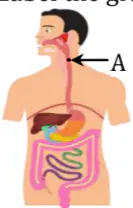
4. Label the given diagram.
(a)
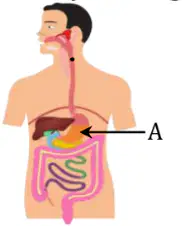
5. Identify the diagram and name the acid and the components present in it.
6. Unscramble the word - 1. chmasto 2. sucum
(a)
7. Identify 'X' and 'Y' Oesophagus no enzyme ___________X___________ Stomach ___________Y___________ for protein digestion
(a)
Read the following statements and give your answer as true or false. 8. The rhythmic contraction and expansion of muscles that takes place all along the alimentary canal is referred to as peristaltic movements.
Read the following statements and fill in the blanks. 9. The (a) protects the lining of the stomach.
Q.1 to Q.3 are multiple choice questions. Each has four options (1), (2), (3) and (4) out of which only one option is correct. 1. The process of digestion is completed in -
mouth
buccal cavity
stomach
small intestine
2. Large fat droplets are converted to smaller droplet by the action of which substance -
saliva
bile juice
pancreatic juice
blood
3. Which is the longest part of alimentary canal?
Liver
Large Intestine
Small Intestine
Stomach
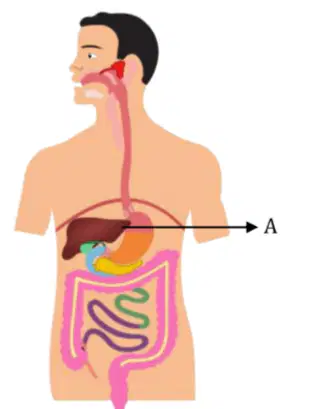
4. Label the structure in given diagram and write it's function.
liver
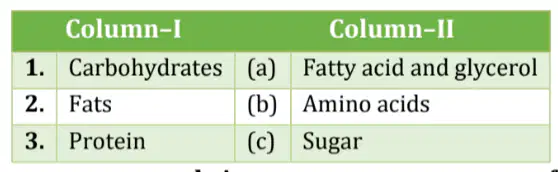
5. Match the column-I with column-II.
Read the following statements and give your answer as true or false. 6. The inner walls of the small intestines have thousands of fingers like outgrowths called cilia.
Read the following statements and fill in the blanks. 7. (a) is the largest gland of the body.
8. The (a) acts on carbohydrates, proteins and fats and changes them into simpler forms.
Q.1 to Q.3 are multiple choice questions. Each has four options (1), (2), (3) and (4) out of which only one option is correct. 1. Glands associated with alimentary canal is -
salivary glands
pituitary glands
liver
both (1) and (3)
2. The waste material of digestive system is stored in which part of alimentary canal before egestion -
Stomach
Rectum
Anus
Large Intestine
3. _______ is the largest chamber of the ruminant's stomach.
Rumen
Reticulum
Omasum
Abomasum
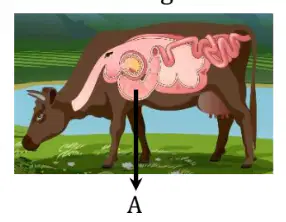
4. Label the diagram -
(a)
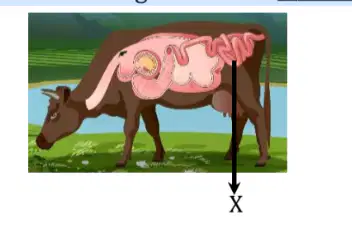
5. Given diagram shows (a)
6. Unscramble the following words (a) cmuter (b) uenrm (c) ulleseclo
(a)
Read the following statements and give your answer as true or false. 7. Oral Rehydration Solution (ORS) should be given to the diarrhoea patient.
False
8. Anterior opening of the alimentary canal through which the faecal matter is removed from time to time is called anus.
True
False
Read the following statements and fill in the blanks. 9. The large intestine is ___________ and ___________ than small intestine.
(a)
Which one of the following organisms show ingestion with the help of pseudopodia?
Frog
Amoeba
Hydra
Cockroach
When Amoeba comes in contact with food particle it sends out ___(i)__ which engulf the food by forming a ___(ii)___. This process is called ___(iii)___.
(i) tentacle (ii) food cup (iii) ingestion
(i) tentacle (ii) food cup (iii) digestion
(i) pseudopodia (ii) food vacuole (iii) ingestion
(i) pseudopodia (ii) food vacuole (iii) egestion
Food moves in forward direction into alimentary tract because of -
emulsification
peristaltic movement
metabolism
digestion
Total number of molar teeth present in an adult human are -
10
12
4
9
Read the following sentences and identify the organ. • It is a fleshy muscular organ attached at the back to the floor of the buccal cavity. • It is free at the front and can be moved in all directions. • It helps in mixing of chewed food with saliva and swallowing the food.
Teeth
Gums
Tongue
food pipe
The glands situated around the mouth that secrete juice containing amylase enzyme are called -
salivary glands
pituitary glands
liver
pancreas
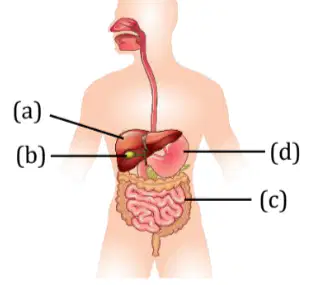
Examine the figure given below. Which of the given labelled part helps in the storage of bile juice?
(a)
(b)
(c)
(d)
Choose an option that contains glands associated with digestive system
Liver, Pancreas, Tongue
Liver, Oesophagus, Stomach
Liver, Pancreas, Salivary glands
There are no glands associated with digestive system
Which of the following enzyme is responsible for digestion of egg?
Pepsin
Rennin
Bile juice
Amylase
The process by which food is crushed and grind into small pieces by teeth is called
digestion
assimilation
salivation
mastication
Which component of food gets digested in buccal cavity and which enzyme is responsible for this in buccal cavity?
Starch, Lipase
Protein, Amylase
Starch, Amylase
Fats, Amylase
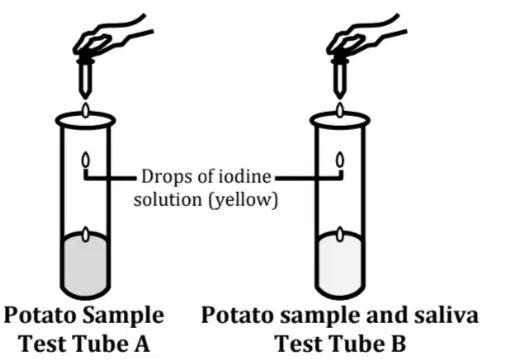
Observe the given figure showing an experiment. What results do you expect on adding iodine solution in test tube A and test tube B?
Blue black colour will be observed in test tube B only.
Blue black colour will be observed in test tube A only.
Both test tubes will show blue black colour.
There will be no colour change in both test tubes.
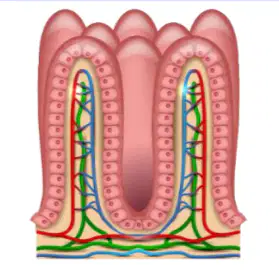
The given figure shows a part of the digestive system. Identify it and select its main function.
Gall bladder: Carries the digested food to all parts of the body.
Part of pancreas: Produces digestive juices to digest the food in small intestine.
Villus: provides a large surface area for the effective absorption of digested food.
Oesophagus: Helps the movement of undigested food into the large intestine.
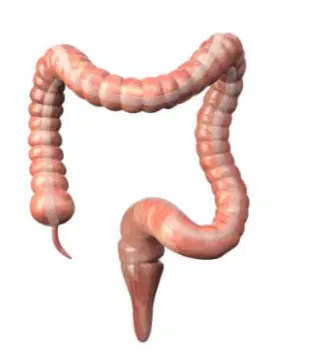
Figure shown below represents one of the parts of alimentary canal. Choose the correct description for it.
It is longer than small intestine.
Digestion of food completes in this part.
Its function is to absorb water and salts from undigested food.
Villi are present for absorption of food.
Which of the following enzyme is present in ruminants that helps in digestion of cellulose?
Cud
Cellulase
Pepsin
Ptyalin
Which chamber of the stomach of ruminants help in storing large quantities of food that has been quickly consumed?
Reticulum
Abomasum
Omasum
Rumen
Partially digested food in ruminants is -
chyme
cud
bolus
all of these
Which of the following part of alimentary canal is known as 'site of complete digestion'?
Stomach
Large intestine
Small intestine
Rectum
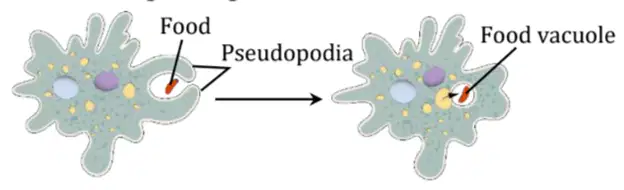
Refer to the given figure. It illustrates ______.
Autotrophic nutrition
Parasitic nutrition
Holozoic nutrition
Saprophytic nutrition
After digestion, proteins, carbohydrates and fats are respectively converted into
Glucose, fatty acids and glycerol
Fatty acids, glucose, amino acids and glycerol
Amino acids, glucose, fatty acids and glycerol
Glucose, glycerol and fatty acids
Fill in the blanks: (a) The main steps of nutrition in humans are _________,___________,___________,______ and ___________.
(a)
(b) The largest gland in the human body is (a) .
(c) The stomach releases hydrochloric acid and (a) juices which act on food.
(d) The inner wall of the small intestine has many finger-like outgrowths called (a) .
(e) Amoeba digests its food in the (a) .
Mark 'T' if the statement is true and 'F' if it is false - (a) Digestion of starch starts in the stomach. (T/F)
T
F
(b) The tongue helps in mixing food with saliva. (T/F)
T
F
(c) The gall bladder temporarily stores bile. (T/F)
T
F
(d) The ruminants bring back swallowed grass into their mouth and chew it for some time. (T/F)
T
F
(a) Fat is completely digested in the -
stomach
mouth
small intestine
large intestine
(b) Water from the undigested food is absorbed mainly in the -
stomach
food pipe
small intestine
large intestine
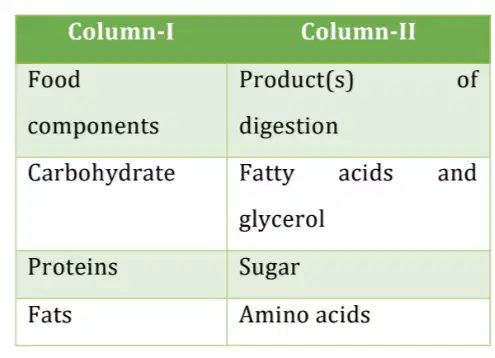
Match the column
a,c,d,b
a,b,c,d
d,b,a,c
c,d,b,a
Which of these is not a part of nutrition?
Digestion
Absorption
Egestion
Excretion
The pointed teeth in your mouth are -
premolars
incisors
molars
canines
The teeth that are used for biting an apple are -
incisors
canines
pre-molars
molars
What kind of teeth do you think are especially developed in carnivores?
Incisors
Canines
Pre-molars
Molars
Which of the following helps in the digestion of food?
Nutrients
Hormones
Enzymes
All of the above
The teeth adapted for flesh eating are -
incisors
premolars
canines
molars
Saliva contains an enzyme called -
amylase
trypsin
pepsin
none of these
What will happen if chewed boiled rice are kept in the test tube and poured iodine solution on it?
Solution will turn violet
Solution will turn purple
Solution will turn blue - black
No change in colour
During digestion, fats are changed into -
amino acids
fatty acids and glycerol
sugar
glucose
Bile is produced in the
stomach
small intestine
pancreas
liver
Absorption of food takes place in -
small intestine
pancreas
large intestine
liver
Absorption of water takes place mainly in -
small intestine
large intestine
stomach
none of the above
Which of the following organs does not secrete digestive juices?
Stomach
Small intestine
liver
Oesophagus
The greatest amount of digestion of food in humans takes place in the -
mouth
stomach
small intestine
large intestine
Finger-like projections called villi are present in -
stomach
large intestine
small intestine
liver
Mouth cavity is also known as the food pipe.
True
False
The first set of teeth are known as milk teeth.
True
False
Tongue helps in mixing food with saliva.
True
False
Canines are meant for tearing flesh.
True
False
Digestion of starch occur in the stomach.
True
False
In humans, there are 14 teeth in each jaw.
True
False
Food is mostly digested in the stomach.
True
False
Digestion of proteins start in buccal cavity.
True
False
Hydrochloric acid is secreted in the stomach.
True
False
The ruminants bring back swallowed
grass into their mouth and chew it for
some time.
T
F
Taking in of food from outside is called
(a) .
The teeth which help in biting the food in
humans are the (a) .
Number of molar teeth present in an adult
human are (a) .
Saliva is secreted by the (a) in the
mouth cavity.
Amoeba digests its food in the (a) .
The largest gland in the human body is
(a) .
The longest part of the digestive tract in
humans is the (a) intestine.
Absorption of food takes place through
(a) in the small intestine.
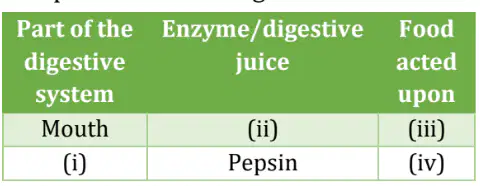
Complete the following table:
(a)
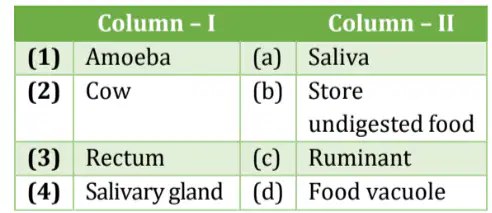
Match
(1) → b; (2) → c; (3) → d; (4) → a
(1) → d; (2) → a; (3) → b; (4) → c
(1) → b; (2) → c; (3) → d; (4) → a

