
 Worksheets
Objectives - Quality Control and Process Improvement
Total questions: 69
Worksheet time: 35mins
The main principles, purposes, and outcomes of quality control (QC) include:
Ensuring products meet specified standards and identifying defects
Maximizing production speed regardless of quality
Focusing only on cost reduction without quality checks
Ignoring customer requirements in the production process
The function and purpose of inspection in engineering and manufacturing is to:
Ensure products meet quality and specification standards.
Increase the speed of production regardless of quality.
Reduce the cost of raw materials.
Eliminate the need for skilled labor.
Process capability in the context of manufacturing is:
A measure of a process's ability to produce output within specification limits.
A method for increasing production speed.
A technique for reducing labor costs.
A tool for designing new products.
Which of the following best describes an advantage of 100% sampling compared to statistical process control (SPC)?
It ensures every item is inspected, reducing the chance of defective products escaping detection.
It is less time-consuming than SPC.
It requires less labor and resources than SPC.
It is more effective at identifying process trends than SPC.
Six Sigma is used for high volume manufacture by:
Reducing defects and improving process consistency
Increasing the number of product variants
Focusing only on manual inspection
Eliminating all automation in production
What does Quality Control (QC) implement in the manufacturing process?
Marketing strategies
Quality assurance inspection and testing requirements
Financial audits
Product design
Fill in the blank: An organisation will often begin by testing ________, pulling samples from along the manufacturing line and testing the finished product.
raw materials
packaging labels
employee schedules
shipping routes
Why is testing at various stages of the manufacturing process important?
To increase marketing reach
To identify where a production problem is occurring and the remedial steps required to prevent it happening in the future
To reduce the number of employees
To improve packaging design
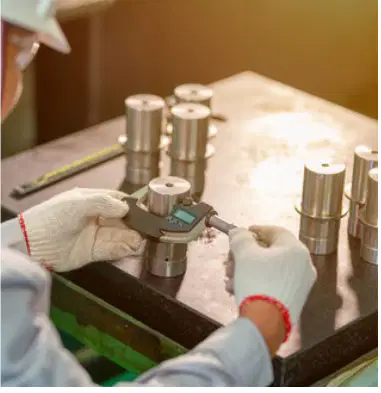
The purpose of measuring manufactured parts in the context of Quality Control (QC) is to:
ensure the parts meet specified standards and tolerances
increase the speed of production
reduce the cost of raw materials
improve the appearance of the parts
Select a product on your person or in this room.
A product on your person or in this room
A product outside the building
A product in another city
A product from a different country
The features that would have been assessed in the QC of this product include:
Appearance, weight, and packaging integrity
Marketing strategy and sales data
Customer reviews and feedback
Distribution channels and logistics
Measuring these can be done using which of the following methods?
Using appropriate measuring instruments
By guessing the values
By asking someone else
By using random numbers
Fill in the blank: One purpose of inspection is to distinguish ______ lots from bad lots.
good
average
large
old
Fill in the blank: Inspection helps to distinguish good pieces from ______ pieces.
bad
new
old
shiny
Fill in the blank: Inspection is used to determine if the ______ is changing.
process
temperature
color
location
Fill in the blank: Inspection is used to determine if the process is approaching the ______ limits.
specification
temperature
pressure
time
Fill in the blank: Inspection is used to rate the ______ of the product.
quality
price
weight
color
Fill in the blank: Inspection is used to rate the accuracy of ______.
inspectors
machines
products
procedures
Fill in the blank: Inspection is used to measure the precision of the ______ instrument.
measuring
cooking
writing
drawing
Fill in the blank: Inspection is used to secure products – ______ information.
design
financial
marketing
customer
Fill in the blank: Inspection is used to measure ______ capability.
process
employee
machine
product
What is the first stage of inspection in engineering and manufacturing, which involves inspecting and checking all the purchased raw materials and parts before they are taken into stock or used in actual manufacturing?
Inspection of incoming materials (also called receiving inspection)
Final product inspection
In-process inspection
Quality audit
During which stage of inspection is the work of inspection done during the production process at various work centres and critical production points?
Inspection of the production process
Final inspection
Incoming material inspection
Pre-dispatch inspection
What is the last stage of inspection, where finished goods are inspected and tested before marketing to ensure poor quality products are either rejected or sold at reduced prices?
Inspection of finished goods
Raw material inspection
In-process inspection
Pre-production inspection
What are the two methods of inspection mentioned in the 'Types of inspection' section?
100% sampling and statistical process control (SPC)
Visual and mechanical inspection
Random and periodic inspection
Manual and automated inspection
Which method of inspection involves checking every item in a batch?
100% sampling (or 100% inspection)
Random sampling
Spot checking
Stratified sampling
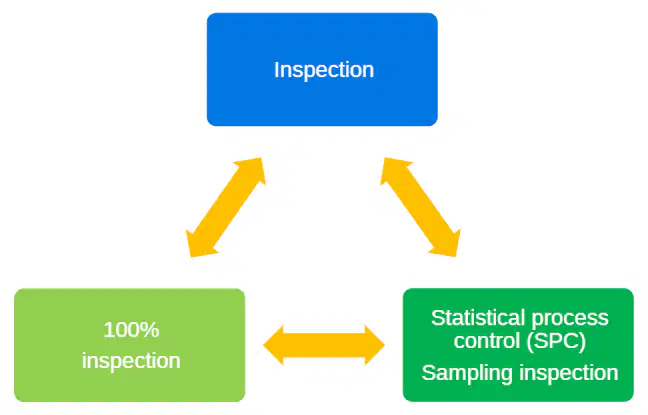
Refer to the diagram showing 'Inspection' leading to '100% inspection' and 'Statistical process control (SPC) / Sampling inspection'. Which two methods are shown as types of inspection?
100% inspection and Statistical process control (SPC) / Sampling inspection
Visual inspection and Automated inspection
Random inspection and Final inspection
Initial inspection and Continuous inspection
What is 100% sampling?
A method where only a sample of pieces is inspected
A method where every piece is separately inspected at each strategic point or stage of manufacture
A method where only defective pieces are inspected
A method where no inspection is done
Fill in the blank: 100% sampling requires more inspectors and hence is a ______ method.
costly
simple
quick
easy
100% sampling has no sampling error but inspector fatigue may be a weakness.
True
False
100% sampling is suitable when:
the number of items is very small
the population is very large
sampling is always preferred
it is too costly to sample all items
100% sampling is used in which of the following situations?
When testing life-saving drugs and in critical safety equipment manufacturing
When conducting random surveys and in opinion polls
When sampling large populations for general trends
When analyzing customer preferences in marketing
What is Statistical Process Control (SPC)?
A) A method of quality control using statistical methods to measure, monitor, and control a process
B) A method of increasing production speed
C) A way to reduce employee numbers
D) A type of financial auditing
Fill in the blank: Statistical Process Control (SPC) helps to ensure that the process operates efficiently, producing more specification-conforming products with less ______.
waste
energy
labor
time
Which of the following is an advantage of Statistical Process Control (SPC)?
It emphasizes early detection and prevention of problems
It increases the correction of problems after they have occurred
It reduces the need for quality control
It focuses on financial management
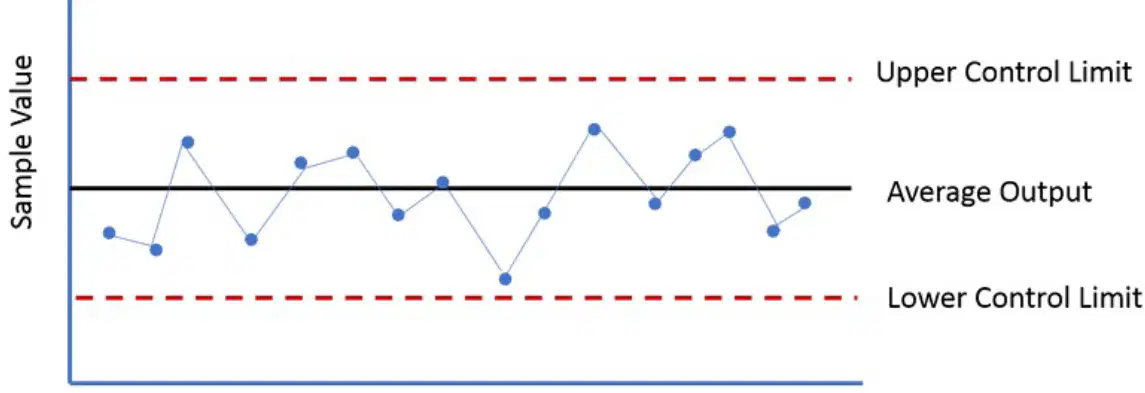
What does a control chart show in the context of SPC (Statistical Process Control)?
A) How product sample values vary over time
B) The cost of manufacturing
C) The number of employees
D) The type of materials used
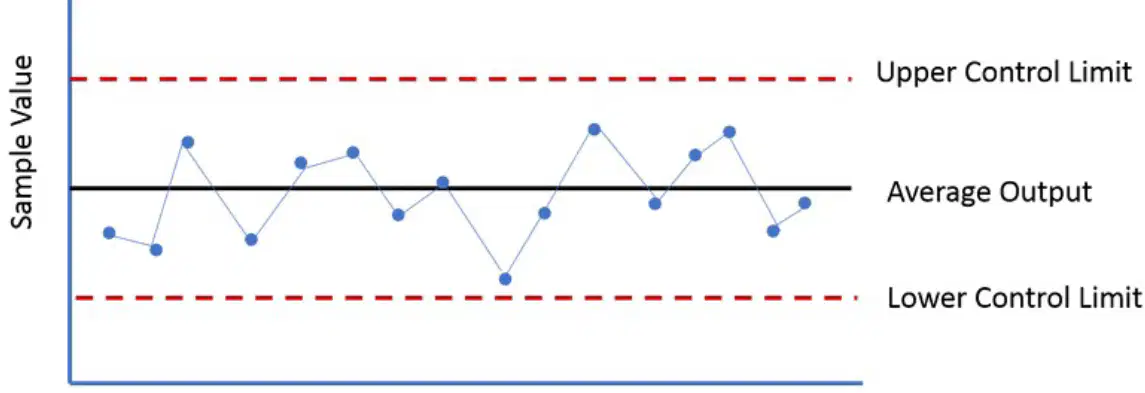
In a control chart, what does the centre line represent?
Upper control limit
Average output
Lower control limit
Maximum value
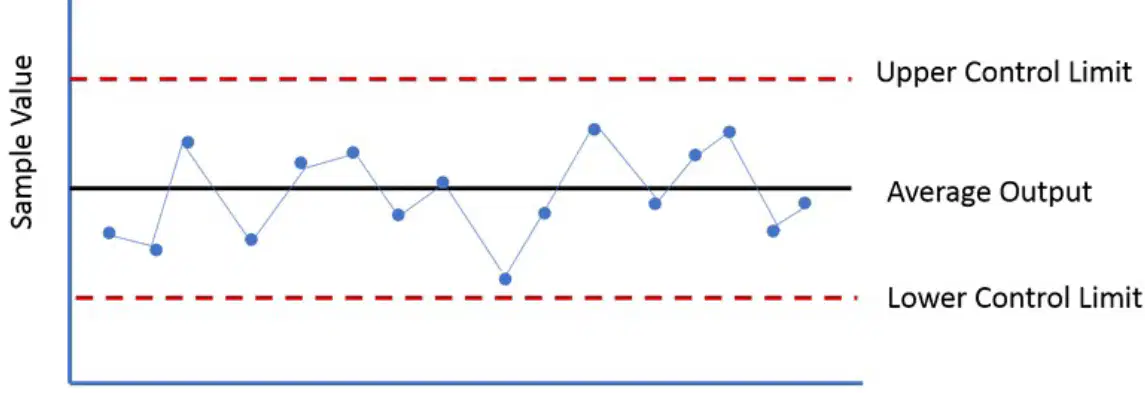
Fill in the blank: The upper and lower dashed red lines in a control chart represent the ________ and ________ control limits.
upper, lower
mean, median
center, range
start, end
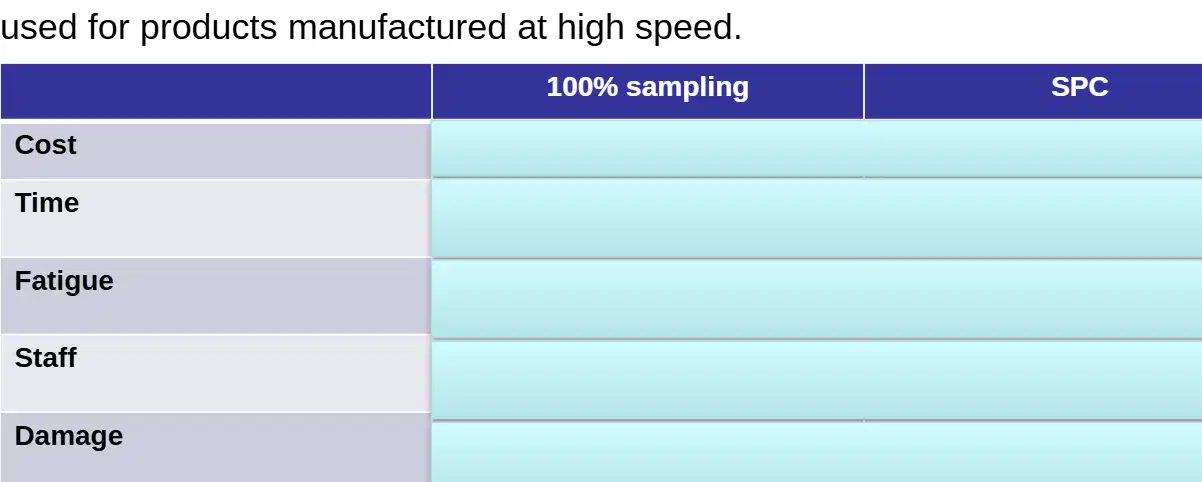
The difference in cost between 100% sampling and SPC is:
100% sampling is generally more expensive than SPC.
SPC is always more expensive than 100% sampling.
Both methods have the same cost.
100% sampling is always cheaper than SPC.
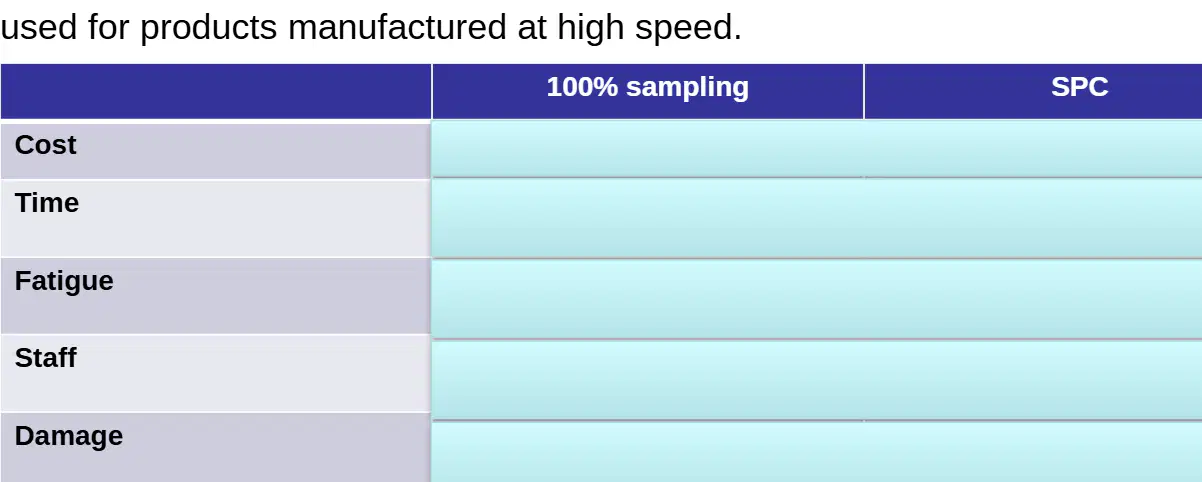
The difference in time required between 100% sampling and SPC is:
100% sampling requires more time than SPC.
SPC requires more time than 100% sampling.
Both require the same amount of time.
100% sampling is faster than SPC.
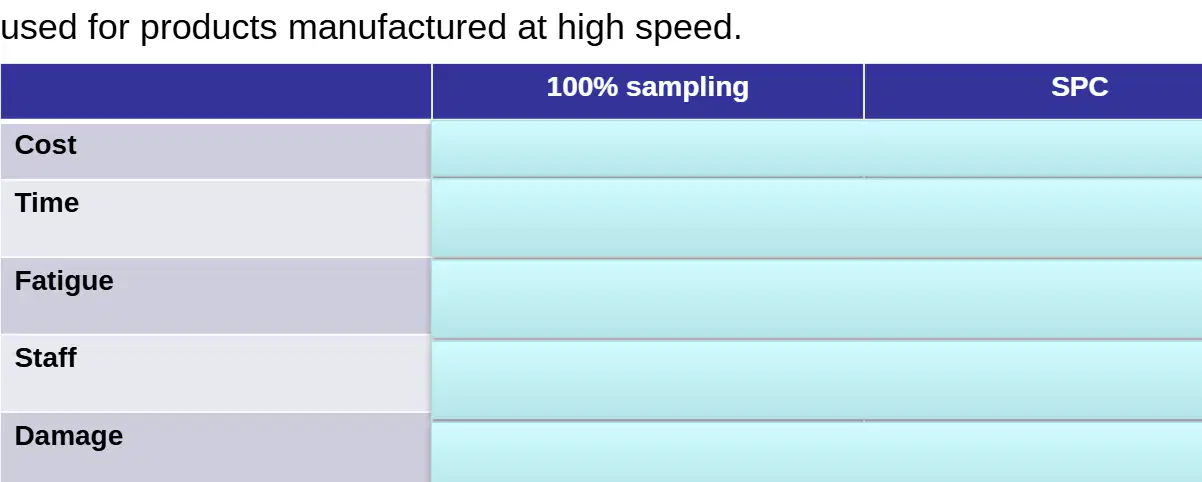
The difference in fatigue for staff between 100% sampling and SPC is:
100% sampling causes more fatigue than SPC.
SPC causes more fatigue than 100% sampling.
Both methods cause the same level of fatigue.
Neither method causes any fatigue.
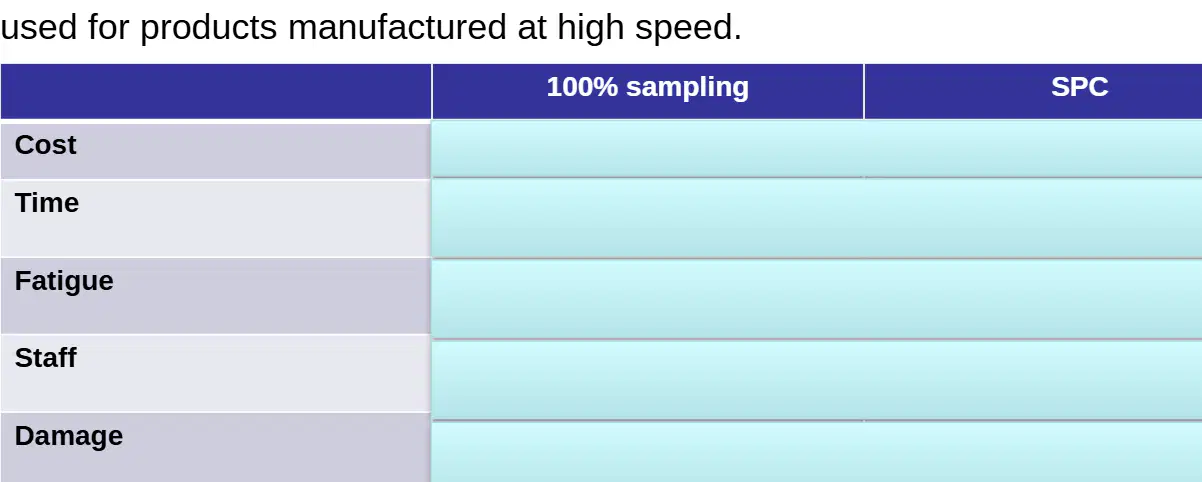
The difference in staff requirements between 100% sampling and SPC is:
100% sampling requires more staff than SPC.
SPC requires more staff than 100% sampling.
Both require the same number of staff.
Neither requires any staff.
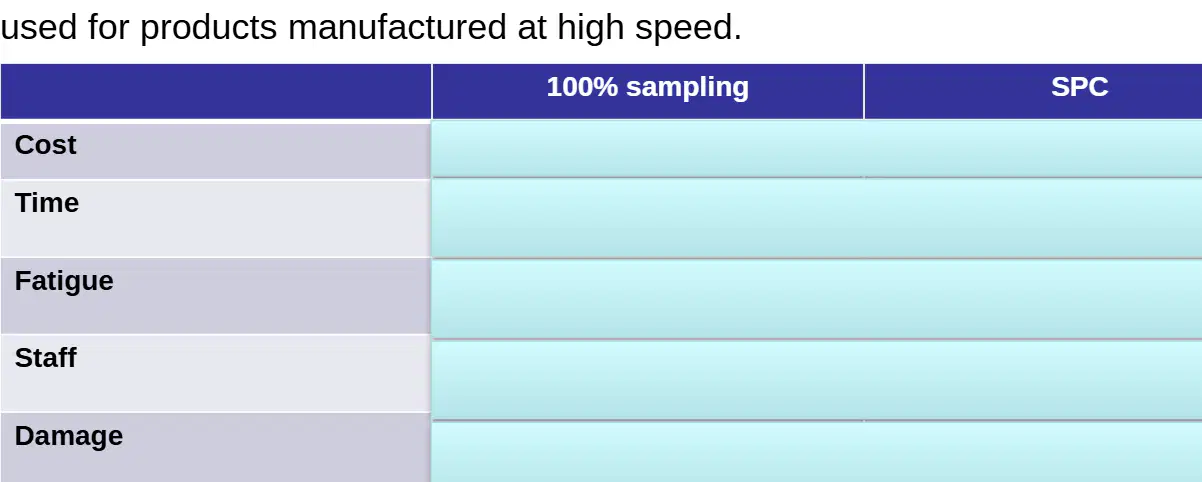
The difference in potential for damage between 100% sampling and SPC is:
100% sampling detects all defects, while SPC aims to prevent defects through process control.
SPC inspects every item, while 100% sampling uses statistical methods.
100% sampling is less likely to find defects than SPC.
SPC is more likely to cause damage than 100% sampling.
The difference in destructive testing between 100% sampling and SPC is:
100% sampling tests every item, while SPC uses statistical methods to monitor quality.
SPC tests every item, while 100% sampling uses statistical methods.
Both methods test every item destructively.
SPC is only used for non-destructive testing.
The difference in product lot handling between 100% sampling and SPC is:
100% sampling inspects every item, while SPC uses statistical methods to monitor and control the process.
100% sampling uses statistical charts, while SPC inspects every item.
SPC is only used for finished products, while 100% sampling is used during production.
100% sampling is less time-consuming than SPC.
What is process capability?
A measure of the speed of a manufacturing process
A statistical measure of the repeatability and consistency of a manufacturing process relative to customer requirements
The cost of producing a product
The number of products produced per hour
Process capability defines specification limits by using a lower specification limit (______) and an upper specification limit (______).
LSL, USL
USL, LSL
LSL, UCL
LCL, USL
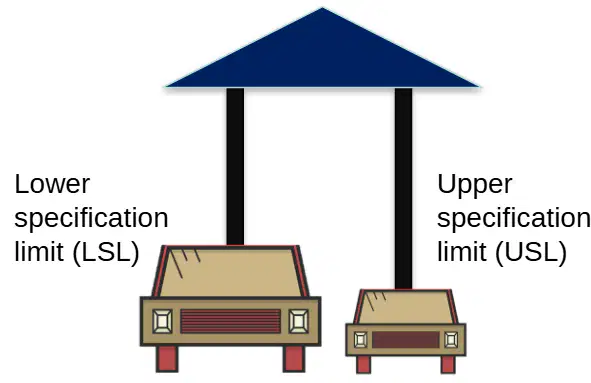
In the given example, what do the garage and the car represent?
The garage represents process limits and the car represents customer specification limits
The garage represents customer specification limits and the car represents process limits
Both the garage and the car represent process limits
Both the garage and the car represent customer specification limits
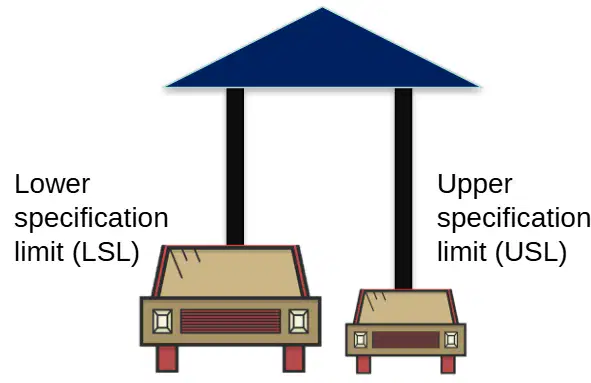
If the car is smaller than the garage, it means the car will fit in the garage.
True
False
When the data (car) is smaller than the specification limits (garage), the process is ________.
capable
unstable
unpredictable
defective
What is Six Sigma?
Six Sigma is a method for reducing defects of any kind in a given process.
Six Sigma is a financial accounting standard.
Six Sigma is a type of computer programming language.
Six Sigma is a marketing strategy for social media.
Where did Six Sigma originate?
Six Sigma originated at Motorola in the 1980s.
Six Sigma originated at Toyota in the 1970s.
Six Sigma originated at General Electric in the 1990s.
Six Sigma originated at IBM in the 1980s.
Six Sigma has been adopted in which types of organisations?
Manufacturing, engineering, construction, and supply chain management organisations.
Only educational institutions.
Only government agencies.
Only healthcare organisations.
Six Sigma has been highly successful in reducing costs in large manufacturing companies globally.
True
False
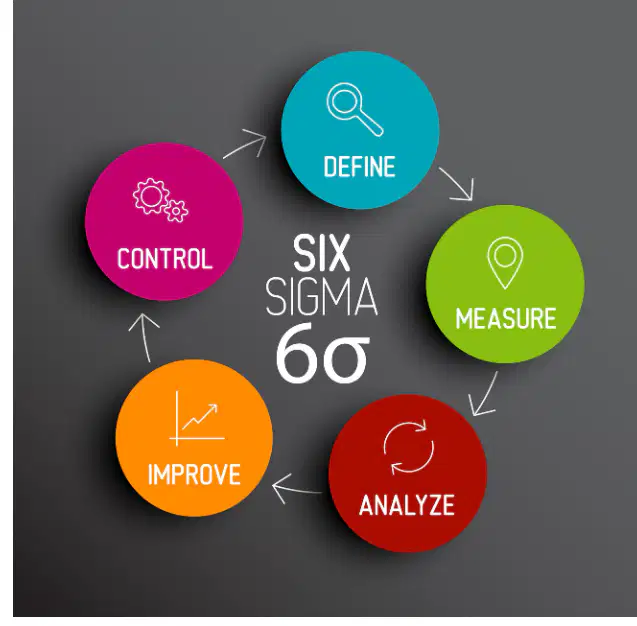
Which of the following is NOT one of the five phases of Six Sigma?
Improve
Analyze
Measure
Define
Design
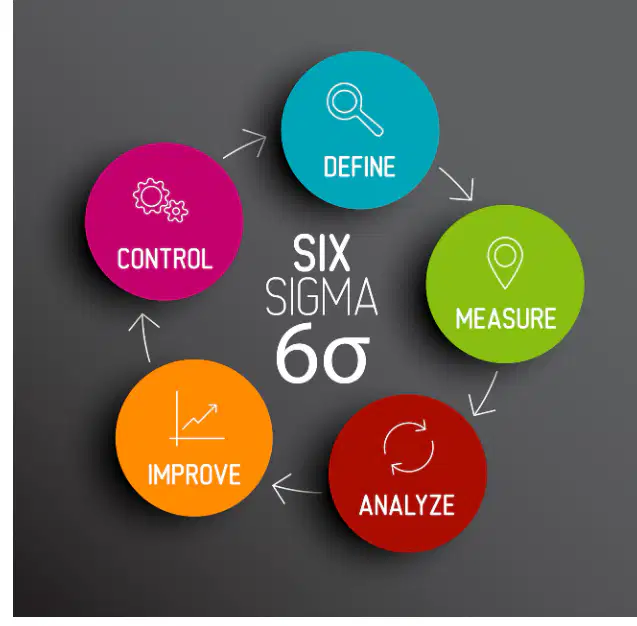
Match the following Six Sigma phases to their names:
Define
Define
Measure
Measure
Analyze
Analyze
Improve
Improve
Control
Control
Fill in the blank: One of the benefits of Six Sigma is reducing the ______, to improve the output of products.
time
cost
color
weight
Fill in the blank: Six Sigma helps reduce the ______, so the business can reduce waste, produce more products and increase profit.
defects
costs
employees
machines
Fill in the blank: By reducing ______ in the process, businesses can provide products that meet the customer’s specifications every time.
variation
cost
inventory
marketing
Fill in the blank: The first step in the DMAIC methodology is _______.
Define
Measure
Analyze
Improve
Fill in the blank: The second step in the DMAIC methodology is _______.
Measure
Analyze
Control
Improve
Fill in the blank: The third step in the DMAIC methodology is _______.
Analyse
Define
Improve
Control
Fill in the blank: The fourth step in the DMAIC methodology is _______.
Improve
Define
Control
Analyze
Fill in the blank: The fifth step in the DMAIC methodology is _______.
Control
Analyze
Measure
Improve
Fill in the blank: The first step in the DMAIC methodology is to ______ the problem.
Define
Measure
Analyze
Control
Fill in the blank: The second step in the DMAIC methodology is to ______ the problem.
Measure
Design
Analyze
Control
Fill in the blank: The third step in the DMAIC methodology is to ______ the root cause.
Analyse
Ignore
Celebrate
Delay
Fill in the blank: The fourth step in the DMAIC methodology is to ______ the process.
Improve
Define
Measure
Control
Fill in the blank: The fifth step in the DMAIC methodology is to ______ the process.
Control
Measure
Analyze
Improve

