
 Worksheets
Understanding Atrial Fibrillation Treatment
Total questions: 21
Worksheet time: 13mins
What is the most common type of sustained cardiac arrhythmia encountered in adults?
Ventricular fibrillation
Atrial fibrillation
Sinus tachycardia
Supraventricular tachycardia
Atrial fibrillation lasting more than seven days is known as
Paroxysmal
Persistent
Acute
Subacute
Which medication is commonly used by paramedics to control ventricular rate in atrial fibrillation?
Amiodarone
Metoprolol
Atropine
Epinephrine
What is the most common cause of atrial fibrillation?
Advanced age
Alcohol
Smoking
Congenital heart disease
Family history
Atrial fibrillation with Rapid Ventricular Response typically has a heart rate greater than
80
100
110
151
Typically, an initiating trigger excites an ectopic focus in the atria, most commonly around the area of the
Appendage
Pulmonary veins
Carotid arteries
Great arch
Tricuspid valve
Which ECG finding is most characteristic of atrial fibrillation?
Regularly spaced QRS complexes
Absence of P waves and irregularly irregular rhythm
Presence of delta waves
Prolonged QT interval
A 70-year-old female with a history of hypertension and diabetes presents with sudden onset palpitations, dizziness, and shortness of breath. Her ECG shows an irregularly irregular rhythm without discernible P waves, indicative of atrial fibrillation. As a critical care paramedic, what is the most appropriate initial intervention for this patient?
Administer Epinephrine 1mg IV push.
Start an IV and administer Amiodarone 150mg IV push
Perform synchronized cardioversion with 50-200 joules.
Consider administering Diltiazem 0.25 mg/kg IV over 2 minutes.
Administer aspirin 81 mg
Which of the following is an appropriate initial step for a paramedic treating a stable patient with new-onset atrial fibrillation?
Immediate defibrillation
Obtain a 12-lead ECG
Administer epinephrine
Start chest compressions
A paramedic is called to treat a patient with rapid atrial fibrillation. Which medication should be considered to slow the ventricular rate if the patient is stable?
Adenosine
Diltiazem
Lidocaine
Atropine
When preparing for synchronized cardioversion in a patient with atrial fibrillation, what is the most important safety step?
Ensure the patient is fasting
Confirm synchronization mode is selected on the defibrillator
Administer aspirin
Place the patient in a prone position
A patient with atrial fibrillation is experiencing hypotension and altered mental status. What is the most appropriate paramedic intervention?
Administer oral beta-blockers
Prepare for immediate synchronized cardioversion
Give sublingual nitroglycerin
Observe and monitor
Which of the following best explains why atrial fibrillation increases the risk of stroke?
It causes high blood pressure
It leads to blood pooling and clot formation in the atria
It increases heart rate
It causes dehydration
A paramedic is treating a patient with atrial fibrillation and a rapid ventricular response. The patient is allergic to beta-blockers. Which class of medication is an alternative for rate control?
Calcium channel blockers
Nitrates
Antiplatelet agents
Diuretics
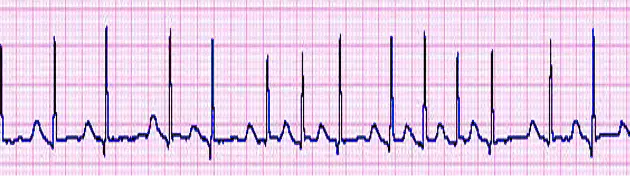
A 71-year-old man with chronic non-ischemic cardiomyopathy and hypertension presents to the emergency department with shortness of breath that started 2 days ago. His last known ejection fraction is 40%. His vitals are blood pressure 110/60 mm Hg, heart rate 125 bpm, respiratory rate 20 breaths/min, and oxygen saturation 94% on ambient air. An ECG rhythm strip is shown below. What is the most appropriate treatment for this patient's arrhythmia at this time?
Diltiazem
Amiodarone
Digoxin
Metoprolol
A paramedic is called to a patient with palpitations and an irregularly irregular pulse. The ECG shows no discernible P waves. What is the most likely diagnosis, and what evidence supports this conclusion?
Sinus tachycardia; regular rhythm and visible P waves
Atrial fibrillation; irregular rhythm and absence of P waves
Ventricular tachycardia; wide QRS complexes
Atrial flutter; sawtooth P waves
A patient with atrial fibrillation is hemodynamically unstable. The paramedic must decide between pharmacological and electrical cardioversion. What factors should guide this decision?
Patient’s age and gender
Hemodynamic status and duration of arrhythmia
Patient’s weight and height
Time of day
A paramedic is treating a patient with atrial fibrillation who is on anticoagulation therapy. The patient develops sudden shortness of breath and chest pain. What should the paramedic suspect, and what evidence supports this?
Pulmonary embolism; atrial fibrillation increases risk of thromboembolism
Asthma attack; history of respiratory issues
Myocardial infarction; chest pain only
Pneumonia; shortness of breath only
Explain how the loss of atrial contraction in atrial fibrillation can affect cardiac output, especially in elderly patients or those with heart failure.
It increases cardiac output by improving ventricular filling
It decreases cardiac output due to loss of atrial kick, which is more significant in compromised hearts
It has no effect on cardiac output
It causes bradycardia, which increases output
Which of the following medical disorders increases the risk of developing atrial fibrillation?
Diabetes insipidus
Hyperthyroidism
Renal failure
Hyperkalemia
Which of the following is an antiarrhythmic drug that has a predominant Class III effect and impacts the SA and AV nodes, as well as the His-Purkinje system?
Epinephrine
Metoprolol
Amiodarone
Diltiazem
Digoxin

