
 Worksheets
Summer School Unit 1 Test
Total questions: 50
Worksheet time: 5hrs 9mins


This tool is used to measure...
volume
mass
density
moles
Matter consists of
electrons
protons
atoms
molecules
all of the above
The state of matter in which the molecules/atoms are FURTHEST apart
solid
liquid
gas
This state of matter has no definite shape
gas
solid
liquid
both gas and liquid
When a gas molecules lose energy and become a liquid it is known as
vaporization
condensation
melting
freezing
A substance that requires a LOT of energy to vaporize has a relatively ______________________boiling point/ temperature
low
high
moderate (neither low nor high, middle of the road)
A substance that requires a LOT of energy to melt (solid to liquid) has a relatively ___________________ melting point
high
low
moderate (neither high nor low, average)
0.00345
1290
130
1300
1.29 x 10³
(12.470)(271)
3366.9
3.37x10³
3400
3370
1421-34
1400
Which of the following is responsible for the generation of heat energy?
Gravitational force
Electromagnetic waves
Photons
Movement of atoms
By nature, HEAT flows...
from higher temperature to lower temperature.
from lower temperature to lower temperature.
from one place to another place with the same temperature.
from vacuum to matter.
When heat is absorbed during chemical reaction, this process is called...
Synthesis reaction
Decomposition reaction
Exothermic reaction
Endothermic reaction
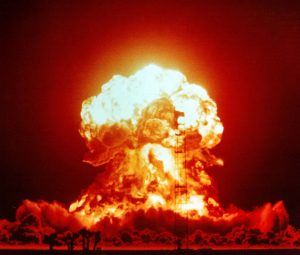
What does catalyst do to a reaction?
Slows down the reaction
Nothing changes
Speeds up the reaction
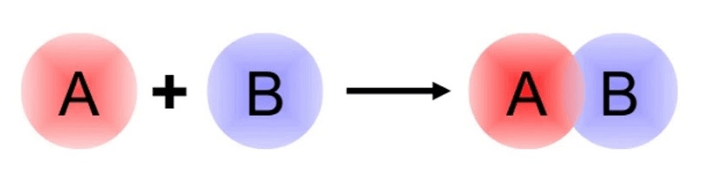
What is the type of reaction shown above?
Synthesis
Decomposition
Single Replacement
Double Replacement
A decomposition reaction can be recognized because it has...
only one product
only one reactant
2 or more reactants and 2 or more products
the presence of a catalyst
What is an example of exothermic?
firework
ice pack
coal
wood
Temperature is...
A measure of the potential energy stored in a substance
The same as heat
A measure of the random motions of the components of a substance

Which material needs the MOST energy to increase the temperature by 1 °C?
Helium
Water
Diamond
Glass
A pot of water is boiled from 20 °C to 100 °C. What is the ΔT ?
20 °C
100 °C
40 °C
80 °C
What does Q represent in:
Q=m*c*ΔT
Energy Flow
Mass
Specific Heat Capacity
Change in temperature
How many joules of heat are needed to raise the temperature of 10.0 g of aluminum from 22 °C to 55 °C, if the specific heat of aluminum is 0.90 J/g°C
297 J
450 J
698 J
802 J
How much heat is required to raise the temperature of 8.0 g of water by 10.0°C? The heat capacity of water is 4.184 J/g°C.
128 J
160 J
250 J
335 J
50 g of a metal absorbs 900 J when it is heated from 25 °C to 85 °C. What is the specific heat of the metal?
0.7 J/g°C
0.3 J/g°C
1.2 J/g°C
2.0 J/°C
A 500 gram cube of lead is heated from 25 °C to 75 °C. How much energy was required to heat the lead? The specific heat of lead is 0.129 J/g°C.
2029 J
555 J
3225 J
5030 J
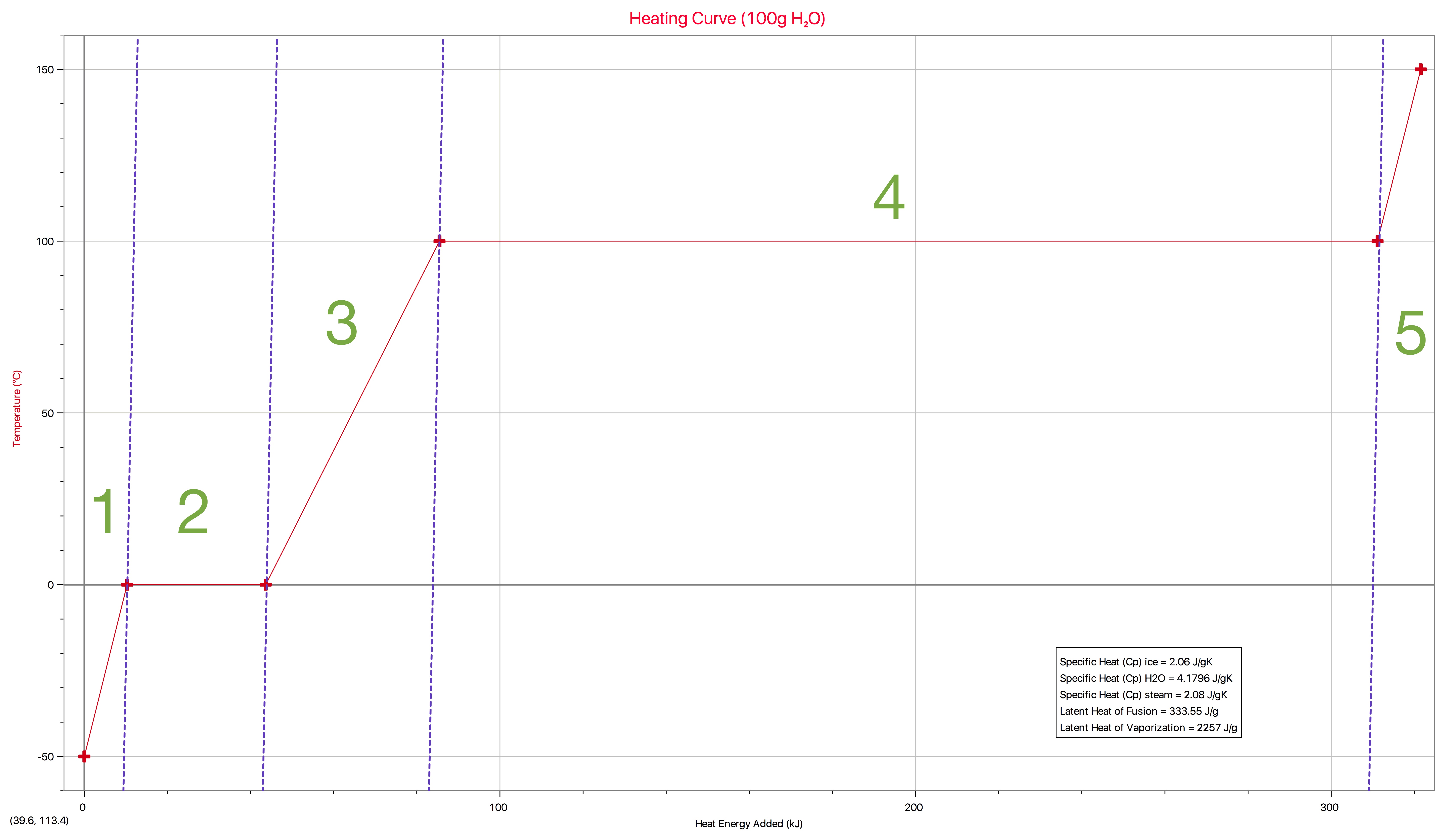
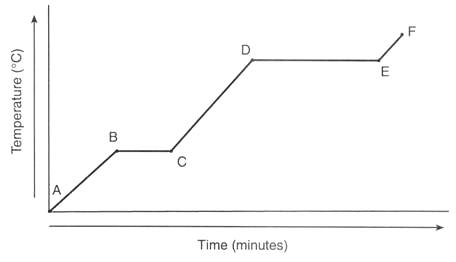

Given the heating curve of a solid being heated at a constant rate, what is the boiling point of this substance?
20°C
50°C
110°C
170°C

Given the heating curve of water, what is happening to potential and kinetic energy during segment CD?
the potential energy and kinetic energy both increase
the potential energy increases while the kinetic energy decreases
the potential energy is constant while the kinetic energy increases
the potential energy increases while the kinetic energy is constant

Given the heating curve of a solid being heated at a constant rate, how much total time was required to boil this substance after it reached its melting point?
3 minutes
4 minutes
10 minutes
14 minutes

What is the freezing point of the substance?
0oC
60oC
120oC
180oC
From point A to point F, the sample is going through an __________ process by __________.
exothermic, releasing heat to the surroundings
exothermic, absorbing heat from the surroundings
endothermic, releasing heat to the surroundings
endothermic, absorbing heat from the surroundings

What letter on the diagram represents the substance only in the gas phase?
A
B
C
D
What letter on the diagram represents a substance only in the liquid?
A
B
C
D
What letter on the diagram represents a substance only in the solid phase?
A
B
C
D

What is the normal boiling point of this substance? (Diagram C)
150 °C
100 °C
-50 °C
0 °C

A substance is a liquid at 120 kPa and 80oC. What happens to the substance if the pressure is dropped to 40 kPa while staying at 800C?
It turns into a solid
It turns into a liquid
It turns into a gas
Charles' Law States...
As Volume goes up temperature goes up
As Pressure goes down volume goes down
As Pressure goes up volume goes down
As Pressure goes up temperature goes up
What does the unit atmosphere, atm, measure?
Pressure
Temperature
Volume
Moles

A sealed container has a pressure of 1.5 atm at 25°C. If the temperature is raised to 125°C, what will be the new pressure?
2
1.12
7.5
0.3

