
 Worksheets
Medieval Art (500-1400) PART 1, Early medieval
Total questions: 25
Worksheet time: 4hrs 12mins
The Period Of Middle Ages: c. 500 - 1500
BEGINNING:
• 476 — the year the last Western Roman Emperor was deposed.
ENDING:
There is no universally agreed-upon end date. Depending on the context, events such as the conquest of Constantinople by the Turks in 1453, Christopher Columbus's first voyage to the Americas in 1492, or the Protestant Reformation in 1517 are sometimes used.
• English historians often use the Battle of Bosworth Field in 1485 to mark the end of the period. For Spain, dates commonly used are the death of King Ferdinand Il in 1516, the death of Queen Isabella ! of Castile in 1504, or the conquest of Granada in 1492.
TRUE
FALSE

The Period Of Middle Ages (c. 500 - 1500): Late Antiques and Early Christian Art (200-500):
• During the decades of the Constantinian and Valentinian dynasties, the empire was divided along an east-west axis, with dual power centers in Constantinople and Rome.
• Theodosius I Emperor from 374 to 395 was the last to rule over both the eastern and the western halves of the Roman Empire.
• At his death (395) the Empire was divided once again and no more reunited.
• 313: Edict of Milan: stated that Christians should be allowed to follow the faith without oppression.
• 325: Council of Nicaea: stated that Jesus was equal to God the Father, one with the Father, and of the same substance, or "co-essential".
• 330: Foundation of Constantinople.
• 380: Edict of Thessalonica: Christianism proclaimed religion of the Empire.
TRUE
FALSE
The Period Of Middle Ages (c. 500 - 1500): Late Antiques and Early Christian Art (200-500):
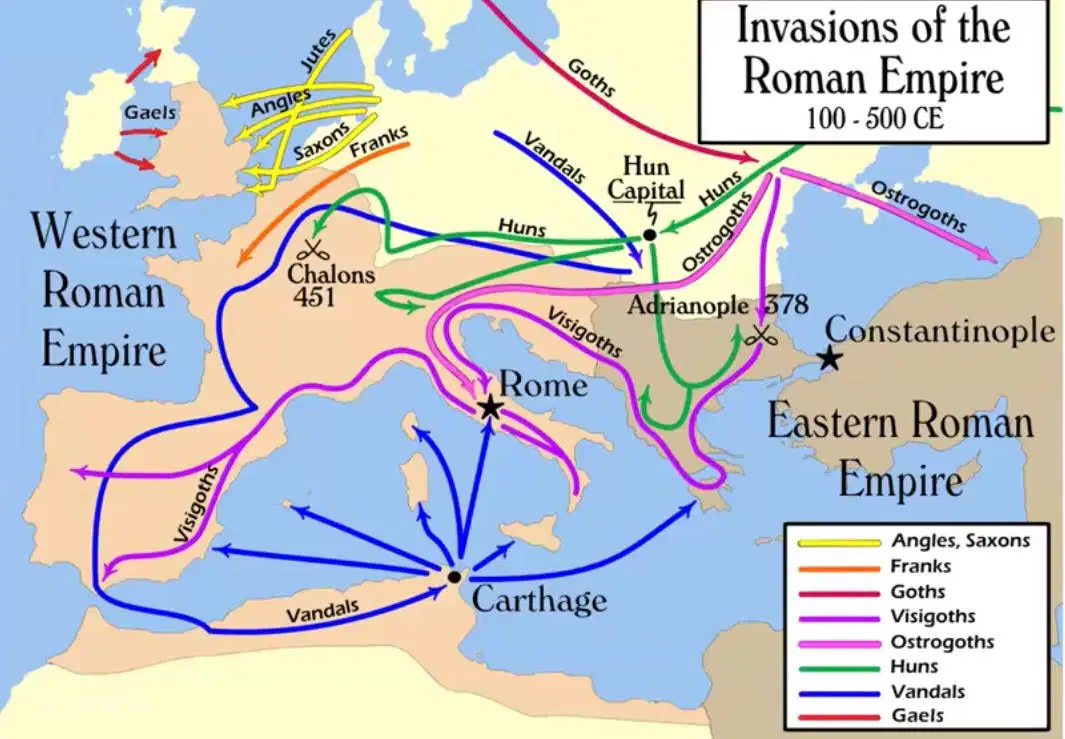
Gothic Wars (249 - 554) and The Migration Period (Barbarian Invasion) (375 - 568)
Long series of conflicts between the Goths and the Roman Empire:
• Gothic war: 367 - 369
• Gothic war: 376 - 378
• Gothic war: 436 - 439
• Gothic war: 535 - 554 (Emperor Justinian I and the Ostrogothic Kingdom of Italy.)
("Renovatio imperii Romanorum".)
The term refers to the important role played by the migration, invasion, and settlement of various tribes:
• Franks
• Goths
• Alemanni
• Alans
• Huns
• early Slavs
• Pannonian Avars
• Bulgars
• Magyars
TRUE
FALSE
The Period Of Middle Ages (c. 500 - 1500): Early Christian Art: The Catacombs
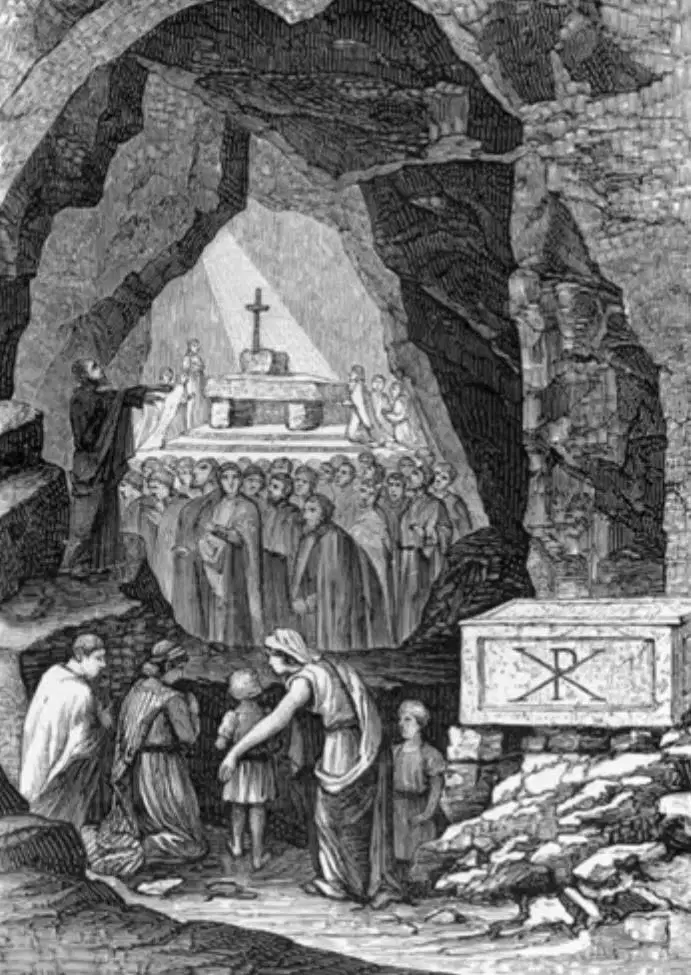
• Catacombs: Underground burial places under Rome.
• The first large-scale catacombs in the vicinity of Rome were excavated from the 2nd century onwards. They were carved through tufo, a soft volcanic rock, outside the walls of the city, because Roman law forbade burial places within city limits. The pagan custom was to incinerate corpses, while early Christians and Jews buried the dead.
• Catacombs were dug from the earth in a maze of passageways that radiated out endlessly from the starting point.
TRUE
FALSE
The Period Of Middle Ages (c. 500 - 1500): Early Christian Art: The Catacombs
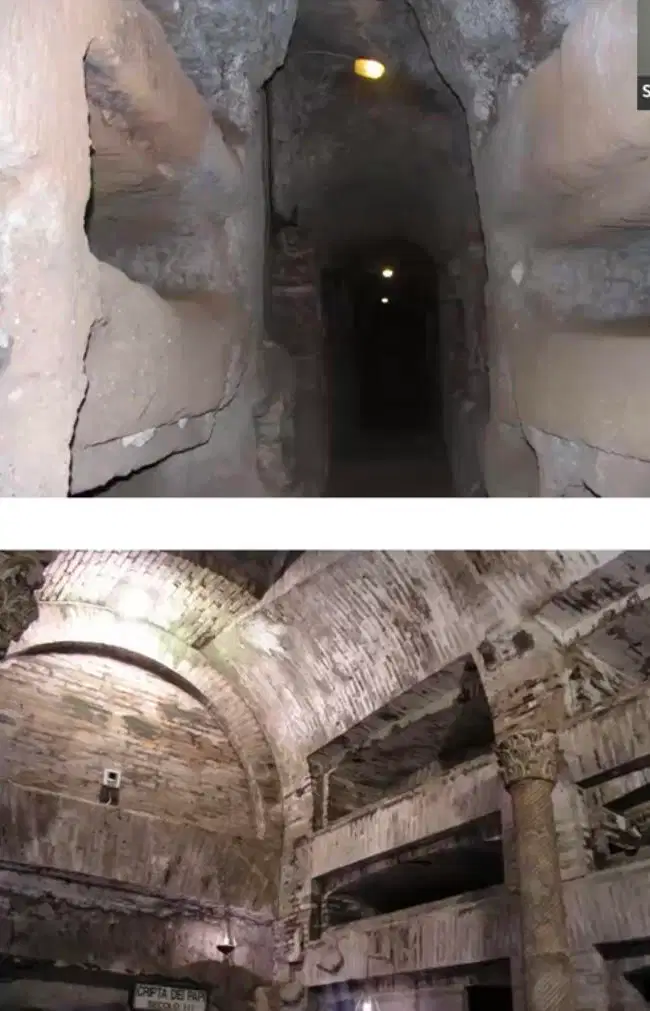
• Poor placed in loculi, while wealthy people had their burial in mortuary chapels, called cubicula.
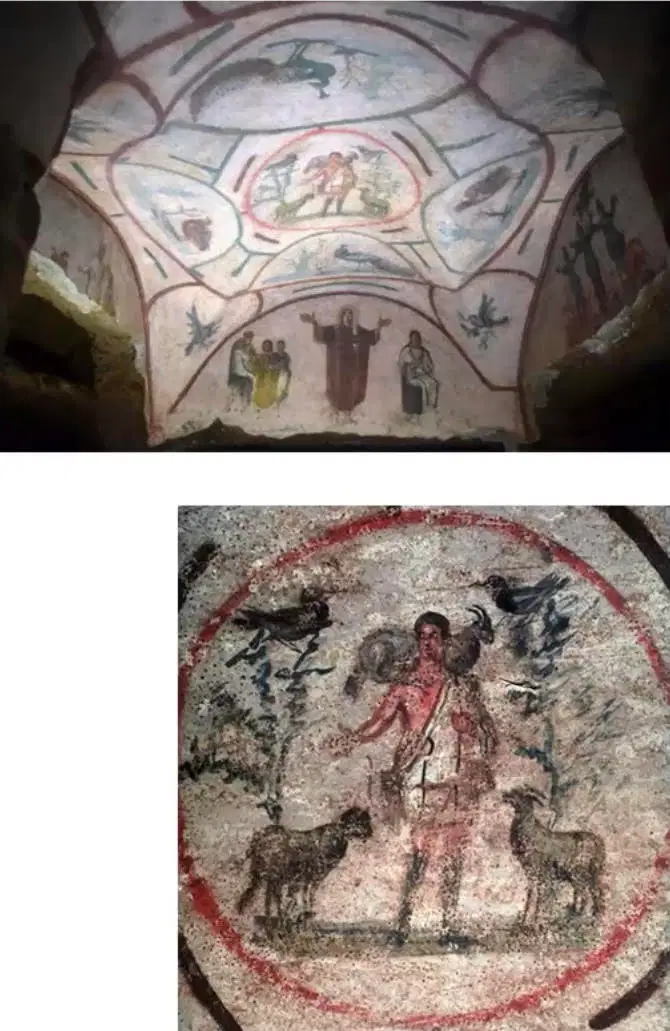
• Most Christian art in the early centuries survives here.
• Paintings from the 4th century show a sensitivity toward artistic programs rather than random images.
• Since 380 (Edict of Thessalonica), Christ was no longer depicted as the humble Good Shepard, instead took on imperial imagery.
TRUE
FALSE

The Period Of Middle Ages (c. 500 - 1500): Early Christian Art: The Catacombs
This is the Catacomb of Priscilla, Rome, 2nd and 4th century. Which place was for the wealthy (cubiculum) and which one was for the poor (loculi)?
The one on the left is for the poor
The two on the right are for the poor
The one on the left is for the wealthy
The two on the right are for the wealthy
The Period Of Middle Ages (c. 500 - 1500): Late Antiques and Early Christian Art (200-500):
First steps to the traditional Christian art
• Christ represented in between heaven and earth.
• Symbolism: peacocks, doves with olive branches.
• Christ represented as The Good Shepherd.
• Reminiscent of contrapposto.
• Symmetrical.
TRUE
FALSE

The Period Of Middle Ages (c. 500 - 1500): Late Antiques and Early Christian Art (200-500):
This is the (a) , marble, 359 C.E. a coffin, most commonly carved in stone, and usually displayed above ground, though it may also be buried.

The Period Of Middle Ages (c. 500 - 1500): Late Antiques and Early Christian Art (200-500):
Sarcophagus of Junius Bassus:
TRUE
FALSE

The Period Of Middle Ages (c. 500 - 1500): Late Antiques and Early Christian Art (200-500):
TRUE
FALSE
The Period Of Middle Ages (c. 500 - 1500): Early Christian Architecture;
What should be the phisical form of the church?
Centrally planned:
Inspired by the Roman buildings such as The Pantheon
Radially planned:
Inspired by nomadic tent circles
• Circular seating focused on a central bonfire
• Interior divided by hanging fabrics rather than walls
• Roof supported by tall central pole
• Open-air ceiling for ventilation
• Temporary wooden platforms for sermons
• Structure meant to be easily dismantled and moved
Vertically stacked:
Modeled after early ziggurats
• Multi-level worship floors stacked on top of each other
• Staircases lead congregants upwards during the service
• Top level reserved for clergy, bottom for commoners
• Thick mudbrick walls instead of stone
• Flat roofs with altars exposed to the sky
• No windows; illumination through rooftop openings only
Axially planned:
Basilica
• Long nave focusing on an apse
• Nave usually flanked by side aisles
• 1st floor: columns lining the nave
• 2nd floor: space decorated with mosaics
• 3rd floor: clerestory
• Wooden roofs with coffered ceilings
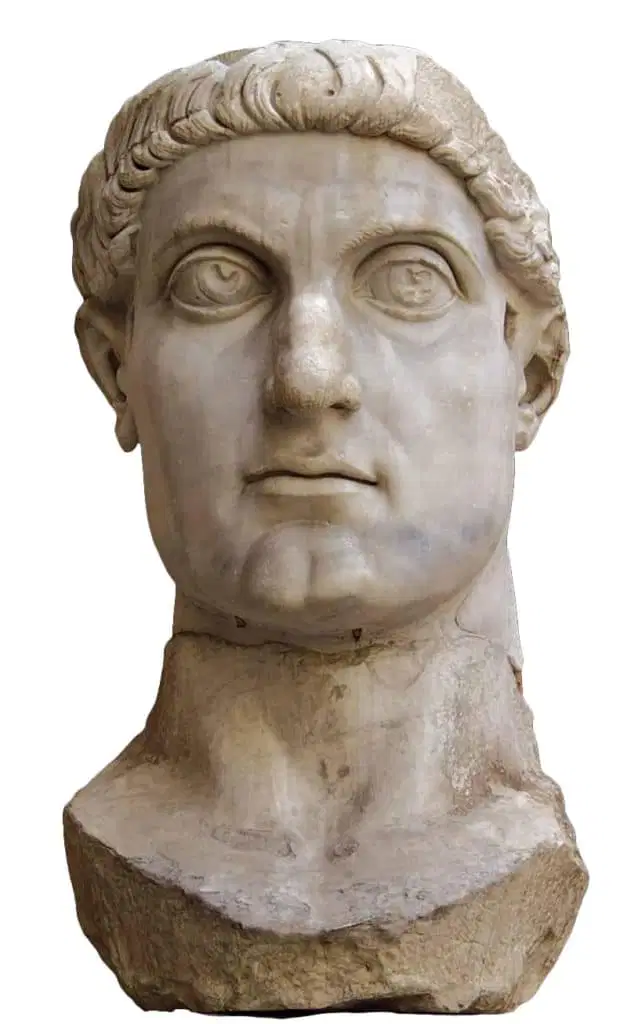
The Period Of Middle Ages (c. 500 - 1500): Early Christian Architecture:
Who is this? He (reigned 306–337 CE) legalised the Christian worship, created a lasting impact on the Roman Empire, and was the first to build buildings dedicated for Christianity, such as Major Churches, or even The City of Constantinople (Founded in 330 CE as the new capital of the Roman Empire).
Charlemagne (Emperor)
Constantine The Great (Emperor)
Julius Caesar (Dictator)
Nero (Emperor)

The Period Of Middle Ages (c. 500 - 1500): Early Christian Architecture:
Didn't Romans have religious buildings? They did, but it did not serve the purpose of Christian worship for 2 reasons: What are they?
The Roman temples were made entirely of gold, which made them too sacred to be used by common worshippers. Christian leaders rejected them because they believed churches had to be built underground to avoid divine judgment.
The space inside isn't designed to house many people for a prolonged activity. A temple is usually a small space and its main purpose is to provide a place for a sculpture for a god/goddess (like a gift/sacrifice).
It is heavely associated with polythetic culture (aka the belief of multiple gods), which is contrary to the Christian belief.
Roman religious buildings floated above the ground and could only be accessed during solstices. Since Christianity required daily worship, this made Roman architecture incompatible with Christian practices.
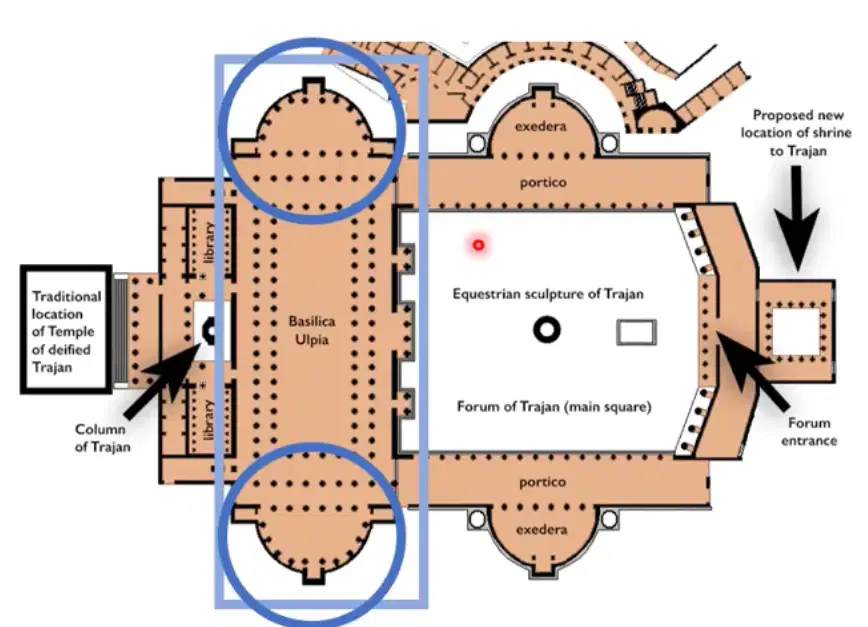
The Period Of Middle Ages (c. 500 - 1500): Early Christian Architecture:
What is the place called?
It was a formal meeting place, in which the 'public speaker' would be placed in the circular places (called 'apses' that provide a vocal space). Moreover. there is a rectangular area in the center of a it, known as the nave ( typically the largest and tallest part of the (a) , flanked by side aisles and often featuring a higher ceiling to accommodate clerestory windows).
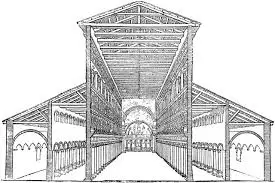
The Period Of Middle Ages (c. 500 - 1500): Early Christian Architecture:
This basilica is called (a) , constructed 318-322, with its consecration many years later. An old version of the current one in Vatican. This one was built with a wide center called 'nave', and double isles in both sides.

The Period Of Middle Ages (c. 500 - 1500): Early Christian Architecture:
What does 'Bema' mean? (An exemple can be seen in the plan of Old Peter's Basilica).
Refers to a type of ancient Roman indoor garden filled with olive trees, often placed in the center of a temple to symbolize eternal peace.
A sacred underground chamber used for storing scrolls and relics, typically only accessible to the highest-ranking clergy during lunar ceremonies.
An elevated platform used as an orator's podium in ancient Athens.
Means "holy water basin" and was located at the entrance of early churches, where worshippers would bathe their feet before entering the nave.

The Period Of Middle Ages (c. 500 - 1500): Early Christian Architecture:
What does 'Cathedra' mean? (An exemple can be seen in the plan of Old Peter's Basilica).
A type of underground storage chamber used for preserving communion wine during the early Christian period.
An architectural term for the bell tower found at the entrance of every basilica, used to signal the start of mass.
Means “sacred curtain” and was the large decorative cloth used to separate the altar from the congregation in early Christian churches.
The raised throne of a bishop in the early Christian basilica.

The Period Of Middle Ages (c. 500 - 1500): Early Christian Architecture:
What does 'Narthex' mean? (An exemple can be seen in the plan of Old Peter's Basilica).
The entrance or vestibule of the church.
The sacred incense burner suspended above the altar, used exclusively during Easter celebrations in early Christian churches.
The name of a choir loft located at the highest point of the basilica, reserved for angelic hymns and royal visitors.
Means “holy drainage system,” a hidden passage beneath the church used to carry away rainwater and protect relics from flooding.

The Period Of Middle Ages (c. 500 - 1500): Early Christian Architecture:
What does 'Atrium' mean? (An exemple can be seen in the plan of Old Peter's Basilica).
A tall ceremonial hat worn by bishops during special liturgical processions in early Christian churches.
An open-roofed courtyard, often surrounded by covered walkways or arcades, located at the entrance of a building.
The term for a sacred underground crypt used exclusively for the burial of saints and high-ranking clergy members.
Means “sacred tapestry” — a large decorative cloth hung above the altar to symbolize the heavens and protect the congregation from divine light.
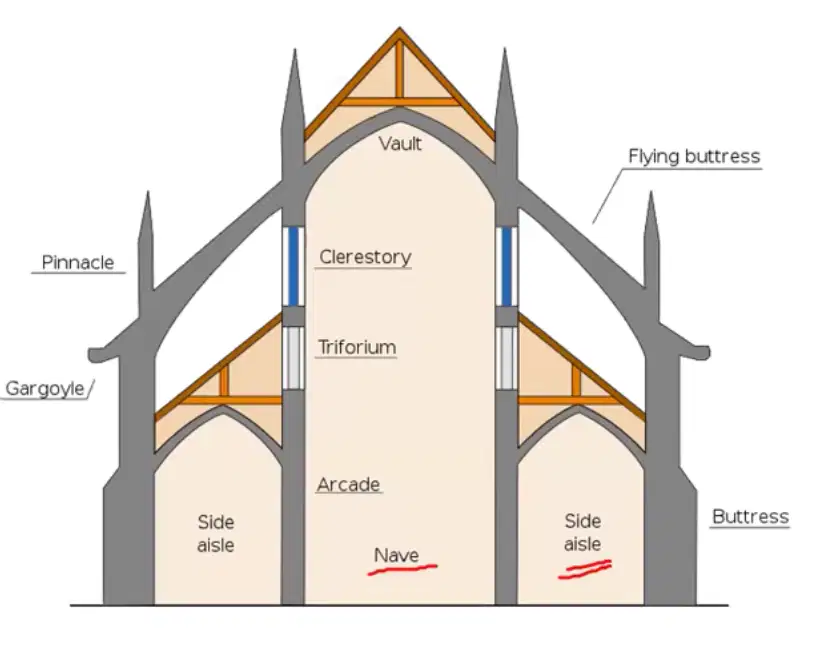
The Period Of Middle Ages (c. 500 - 1500): Early Christian Architecture:
Just for clarity...
TRUE
FALSE

The Period Of Middle Ages (c. 500 - 1500): Early Christian Architecture:
Just for clarity...
TRUE
FALSE

The Period Of Middle Ages (c. 500 - 1500): Early Christian Architecture:
How is this Basilica called? Also called 'The Basilica at Trier' or 'Aula Palatina', 4th century.
Built during the division of the Empire. Trier at that time was the capitol of one of the best Empires in Germany and the basilica was built to serve as a grand audience hall within the imperial palace complex. Constantine used it as a space to receive dignitaries, display imperial power, and hold court. The interior of the church is basic, but powerful sizewise. It's been throught a lot of destructions and changes, such as:
- 1615-1676: incorporated into the Electrical Palace; east and south wall largely removed.
- 1794: occupied by french troops
- 1841-1862: restored as a 'Roman' building
- 1856: consecrated as a protestant church
- 1944: bombed, burned
- postwar: reconstructed
(a)
The Period Of Middle Ages (c. 500 - 1500): Early Christian Architecture:
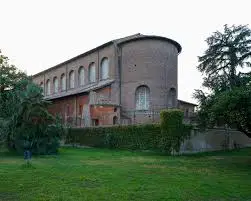
How is this Basilica called? Aventine Hill, Rome, 422-432
Built during the early Christian period in Rome, under Pope Celestine I. The basilica was constructed on the Aventine Hill, one of Rome’s ancient sacred sites, and served as an important early Christian church and symbol of the growing power of the Christian faith in the capital of the former Empire. (a) was designed as a liturgical space for worship and processions, reflecting the transition from Roman civic architecture to Christian sacred architecture. The interior of the basilica is notable for its simple, elegant design and preservation of early Christian architectural elements.
The Period Of Middle Ages (c. 500 - 1500): Early Christian Architecture:
What is 'spolia'? (Can be seen in Basilica of Santa Sabina- its collumns)
The re-use of architectural elements or materials from older buildings in new constructions.
A type of decorative mosaic made exclusively from precious stones, used only in royal palaces during the Middle Ages.
The ritual burning of old manuscripts to symbolize the end of pagan beliefs in early Christian communities.
Means the underground tunnels beneath basilicas, used for secret meetings and storing sacred relics.

The Period Of Middle Ages (c. 500 - 1500): Early Christian Architecture:
What kind of chruch is the Basilica of Santa Pudenzia (Rome, 4th century)? The basilica is filled with mosaics (=Christian Rome)=symbolises coming from dark, going towards the light.
Cruciform Church- a church whose floor plan is shaped like a cross, or "cruciform".
Circular Church – a church built entirely in a perfect circle with no aisles or altar, designed for 360-degree worship without a focal point.
Labyrinthine Church – a church designed like a maze, where worshippers would wander through complex corridors as a form of spiritual pilgrimage.
Floating Church – a church constructed on a platform over water, meant to symbolize the journey of faith across the sea of life.

