
 Worksheets
M2.1 - Matter
Total questions: 20
Worksheet time: 14mins
Name
Class
Date
1.

When a solid is turned into a liquid, the solid _______________.
a)
melts
b)
freezes
c)
turns into a gas
d)
floats
2.
What is an example of sublimation?
a)
Ice cream melting
b)
Dry ice
3.
Sublimation is
a)
when solid turns into gas
b)
when gas turns into plasma
c)
when liquid turns into gas
d)
when gas turns into solid
4.

What are the three states of matter?
a)
solid, liquid, and gas
b)
solid, water, and gas
c)
wood, liquid, and gas
d)
solid, liquid, and helium
5.

Solids have a definite _______________.
a)
smell
b)
shape
c)
picture
d)
sound
6.
Adding HEAT to matter causes its particles to:
a)
move faster and farther apart
b)
Move slower and farther apart
c)
Move faster and closer together
d)
Move slower and closer together
7.
What causes a change in the state of matter?
a)
physical properties
b)
chemical energy
c)
temperature
8.
Isotopes of an element have a different number of...
a)
Protons
b)
Neutrons
c)
Electrons
d)
Mass
9.

One hot summer, you remember you left a cup of water outside. A few weeks later, you saw that the cup was empty and you remember the cup having water. What happened to the water?
a)
It evaporated
b)
It underwent deposition
c)
It melted
10.
Change from Gas to Solid is called........
a)
Sublimation
b)
Deposition
c)
Fusion
d)
condensation
11.
Which is the opposite of condensation?
a)
runoff
b)
evaporation
c)
precipitation
d)
transpiration
12.
A(n) ION is a neutral group of atoms joined by covalent bonds.
a)
True
b)
False
13.

In a correctly written symbol representing an isotope, what would be located in the "A" position?
a)
number of neutrons
b)
atomic number
c)
number of electrons
d)
mass number
14.
Explain why chlorine and fluorine form covalent bonds
a)
They are both metals
b)
They are both non-metals
c)
One is a metal and one is a non-metal
d)
They are both semi-metals
15.
An example of an ionic compound is Sodium Chloride, which is made from Na+ and Cl- ions. Why do these ions form an ionic bond?
a)
They have like charges
b)
They are from the same group
c)
They are from the same period
d)
They have opposite charges
16.

Which state of matter has particles that are tightly packed?
a)
liquid
b)
gas
c)
solid
17.
How is an ionic bond formed?
a)
Sharing of electrons
b)
Delocalised electrons
c)
Transfer of electrons
18.
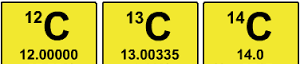
What do these isotopes of carbon all have in common?
a)
neutrons & mass number
b)
atomic number and neutrons
c)
atomic number and electrons
d)
protons, atomic number, and mass number
19.
Ionic bonds are formed between...
a)
Non - metals
b)
A metal and a non-metal
c)
Metals
20.
If the number of electrons in an atom changes you make a(n) __________________.
a)
ion
b)
isotope
c)
new element
d)
isomer
100 %

