
Font size
 Worksheets
5th science MIxed 1
Total questions: 200
Worksheet time: 5hrs 14mins
Which one is an inherited trait?
eye color
speaking Spanish
a raccoon that digs for food in a trash can
Which one is a learned behavior?
scales on an alligator
spines on a cactus
teaching a dog tricks
Which one is an inherited trait?
reading a book
brightly colored feathers on a parrot
a tree trunk scarred by lightning
Which one is a learned behavior?
black tongue on a Chow dog
snowboarding
straight hair
Which one is an inherited trait?
a dog begging for food
cooking a meal
breathing when a baby is born
Which one is a learned behavior?
a dog rolling over
curly hair
skunk spray
Which one is an inherited trait?
roller skating
riding a bike
the taste of an apple
Which one is an inherited trait?
reading a book
a chick pecking out of its shell
a dog playing dead
Which one is a learned behavior?
reading a book
beak shape
rolling your tongue
Which one is an inherited trait?
a bee flying from flower to flower to find pollen
a seal balancing a ball
tying your shoe
Which one is a learned behavior?
migrating south for the winter
playing football
shape of a nose
Which one is a learned behavior?
stripes on a tiger
skunk spray
manners
Which one is an inherited trait?
doing your homework
a bear hibernating in the winter
a parrot saying hello
Which one is a learned behavior?
webbed feet
types of earlobes
how to use a calculator
Which one is a learned behavior?
webbed feet
types of earlobes
how to use a calculator
Which one is an inherited trait?
a dog catching a frisbee
setting up a tent
a turtle laying eggs on a beach
Which one is a learned behavior?
cats having a tail
bears catching salmon
number of eyes
Which one is an inherited trait?
speaking Chinese
cleaning dishes
curly hair
Which one is a learned behavior?
playing the piano
webbed feet
bat wings
Which one is an inherited trait?
swimming
sharp teeth on a fox
catching a fish

Students observe a gerbil in a cage. They write their observations as shown. Which of these observations is most likely a learned behavior?
Twitching its whiskers
Burrowing in the bedding
Drinking water from a metal tube
Walking on four legs
A student raises a parrot from the time it hatches. Which of these behaviors did the parrot most likely learn from living in the student’s home?
The parrot flaps its wings while sitting on a perch.
The parrot has a loud scream that hurts the student’s ears.
The parrot imitates the family dog barking.
The parrot tucks its head under its wing when it sleeps.

A bright-red male cardinal comes to a school bird feeder every morning. Like other cardinals, this bird makes a sharp chirping sound as it hops around the bird feeder. Which of these is a learned behavior of this bird?
Having red feathers
Eating seeds during the day
Coming to the bird feeder each morning
Making a chirping sound
A characteristic that is passed from parents to offspring-
inherited trait
learned behavior
organism
A behavior that develops from observation or instruction rather than being passed down by heredity?
inherited trait
learned behavior
offspring

Mr. Reincke has a pet dog named Tech. Which of the following characteristics did Tech most likely inherit from his parents?
his weight
his favorite food
the color of his fur
the place where he lives
The passing of characteristics from one generation to another?
heredity
offspring
organism
A group of students visited a park and collected leaves from many different trees in order to study them. They recorded their observations about the leaves. Which of these observations does NOT describe an inherited trait?
The leaves vary in shape and size.
Some leaves have holes made by insects chewing on them.
Some leaves are smooth on one side and rough on the other.
The colors of the leaves range from light green to dark green.

Plants cannot have inherited traits.
True
False

A farmer keeps bees to pollinate crops. The farmer makes several observations about the bees. Which of these observations describes a learned behavior? (5.10B)
Bees make return trips to sugar water from a bowl placed 40 meters from their hive.
Bees have dark eyes and black-and-yellow stripes.
Bees produce honey from the nectar they collect.
Bees will sting when threatened or disturbed.
A farmer keeps bees to pollinate crops. The farmer makes several observations about the bees. Which of these observations describes a learned behavior? (5.10B)
Bees make return trips to sugar water from a bowl placed 40 meters from their hive.
Bees have dark eyes and black-and-yellow stripes.
Bees produce honey from the nectar they collect.
Bees will sting when threatened or disturbed.

Fox squirrels live in the trees of city parks throughout Texas. Each spring they build nests of twigs and leaves in the tops of the trees. Fox squirrels are often found near park benches, waiting to be fed by visitors. For fox squirrels, which of these is a learned behavior? (5.10B)
Building a nest each spring
Taking food from people
Having a long, bushy tail
Having sharp claws

A scientist observes sea otters using rocks to break open clamshells. Which of these investigations would best help the scientist determine whether this skill is a learned or an inherited behavior? (5.10B)
Determining what sizes and kinds of rocks are used most often by sea otters
Determining whether shellfish are an important food source in the diet of sea otters
Raising young sea otters away from adult otters that use rocks and observing whether the young otters use rocks
Observing families of sea otters over time to see whether adults that use rocks have offspring that use rocks

For a science assignment a student was asked to observe some organisms and then make a table to classify the organisms' traits as inherited or learned. The student's table is shown. How many of these observations describe learned behaviors and how many describe inherited traits? (5.10B)
1 learned behavior, 7 inherited traits
2 learned behaviors, 6 inherited traits
3 learned behaviors, 5 inherited traits
4 learned behaviors, 4 inherited traits

A group of students made the observations listed in the table about the size, shape, and appearance of their hands. Which of the students' observations describe inherited traits? (5.10B)
Observations 2 and 5 only
Observations 1, 3, and 4 only
Observations 2, 3, and 5 only
All the observations

The diagram below shows a flower.Which choice below is most likely an offspring of this flower?


The energy created by the movement of electrons
(a)
A pathway that allows an electric current to flow freely
(a)

A student builds a circuit made up of a battery, two light bulbs, and a switch. What will the student most likely observe in this circuit?
Light bulb 1 and light bulb 2 will both be on
Light bulb 1 will be off, but light bulb 2 will be on
Light bulb 1 and light bulb 2 will both be off
Light bulb 1 will be on, but light bulb 2 will be off

This circuit has five LED lights. It also has one battery and one switch. Which LEDs produce light when the switch is in the position shown?
LEDs 1, 3, and 4 only
LEDs 1, 2, 3, and 4
LEDs 3 and 4 only
LEDs 1, 3, 4, and 5

Some students built this circuit, but the bulb does not glow? Why doesn't the bulb glow?
The battery is not charged.
The bulb is not part of a complete circuit.
The circuit does not have a switch.
The bell uses most of the energy from the battery.

When the switch is closed, all bulbs light up. If light bulbs B and C are removed, what will happen to bulbs A and D?
A and D will stay on
A and D will go out
A goes out, D stays on
A stays on, D goes out

When the switch is closed the buzzer will sound because -

To complete the circuit, a wire should be placed from —


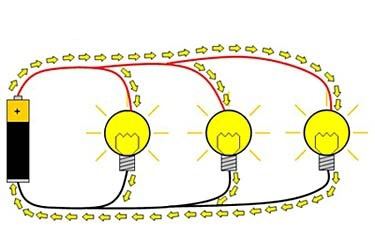
What type of circuit is shown in the picture?
Series Circuit
Broken Circuit
Parallel Circuit
Open Circuit

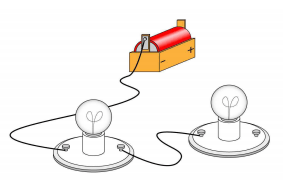
What is missing from this circuit? Why would the light bulbs be off?
The battery, there is no power for the circuit to work.
The switch is open, so the circuit is broken.
The third light bulb, that is needed to complete the circuit.
The wires are not connected properly.

The diagram shows a series circuit with three lit bulbs. How many of the bulbs will remain lit if the wire is cut a the point shown by the arrow?
0
1
2
3
A student builds a circuit made up of a battery, two light bulbs, and a switch. What will the student most likely observe in this circuit?
Light bulb 1 and light bulb 2 will both be on
Light bulb 1 will be off, but light bulb 2 will be on
Light bulb 1 and light bulb 2 will both be off
Light bulb 1 will be on, but light bulb 2 will be off

A group of students built the circuit shown above. The lightbulb does not glow. Which statement explains this observation?
The battery is not charged
The lightbulb is not part of a complete circuit
The circuit does not have a switch
The bell uses most of the energy from the battery

Students constructed a circuit using different-colored lightbulbs. What will happen if Switch 3 is closed and the other switches are left open?
Only the white bulb will operate
None of the bulbs will operate
Only the white and yellow bulbs will operate
Only the red and blue bulbs will operate

The diagram shows an electric circuit with four bells that a student plans to build. When the student connects the wire as shown, which of the bells will ring?
Bell 1 only
Bells 1 and 4 only
Bells 3 and 4 only
Bells 1, 2, 3, and 4



What is the name of this science tool?
Spring scale
Two pan balance
Triple beam balance
Microscope

What is the name of this science tool?
Graduated cylinder
Beaker
Measuring cups
Measuring spoons

What is the name of these science tools?
Graduated cylinder
Beakers
Measuring cups
Measuring spoons

What is this scientific tool?
beaker
tube
graduated cylinder
balance


What is the name of this tool?
Tape Measure
Scale
Ruler
Yardstick


What is the name of this science tool?
Spring scale
Two pan balance
Triple beam balance
Microscope

According to this thermometer, what is the temperature?
74 °F
24 °C
20 °C
80 °F

What is the mass of this object?
500 g
533.1 kg
533.1 g
530 g

What is the length of this rectangle?
6.5 in
6 cm
6.5 cm
6 in

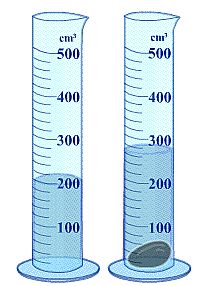
What is the volume of the rock?
100 mL
200 mL
200 L
150 mL
How many centimeters are in 1 meter?
100 m
90 cm
90m
100 cm

spring scale


A Microscope is a
tool to help you see objects that are far away
tool to see bacteria and germs
tool to help you weigh an object
tool to protect your eyes

Which quantity is measured using this tool?
weight
mass
volume
length


Which best describes climate
Yesterday , it was rainy
Summer was hot and dry
It rained last week
Weather changes
Every Day
Every week
Twice a week
Pick all examples of a living thing
A human
A rock
A dog
Sand


Cars need gas so they can move. Are they living or non living?
living
non living
I am not sure.

DOG
HETEROTROPH
AUTOTROPH
An organism that can make its own food by using energy from sunlight is a:
autotroph
heterotroph
An organism that cannot produce their own food:
autotroph
heterotroph


Grass > Grasshopper > Bird > Snake
Which organism type makes up the bottom layer of the an energy pyramid?
producer
tertiary consumer
Secondary consumer
primary consumer
What does an energy pyramid show?
Energy flow in an ecosystem
Longest lifespans
The stronger animal the higher it is on the pyramid

In an energy pyramid, how much of the energy is passed from level to level (i.e. producers to herbivores)?
10%
20%
80%
90%
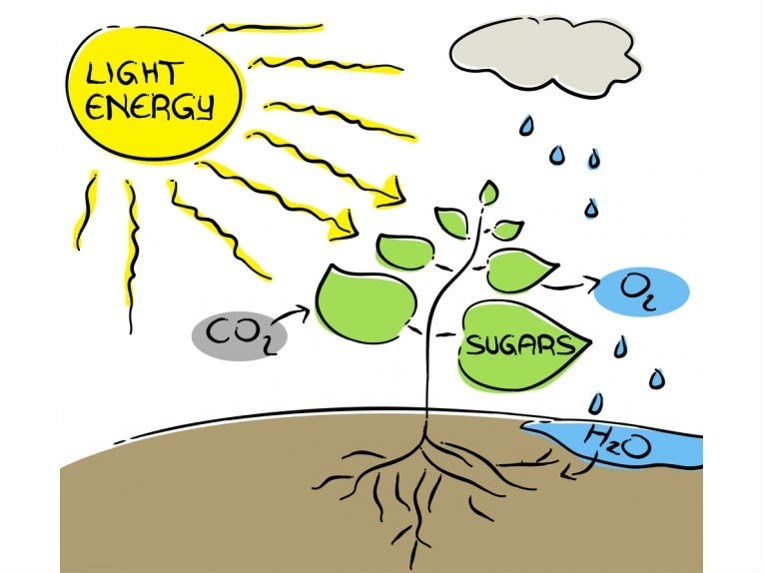
What are the reactants in Photosynthesis?
Sun, CO2, glucose
glucose and oxygen
sun, carbon dioxide, water
water, glucose
Photosynthesis occurs in:
Mitochondria
Chloroplasts
Humans
Animals

How much energy is moved from one trophic level to the next trophic level?
100%
1/2
10%
25%
How many calories will be passed on from 250 to the next trophic level?
2,500
25
2.5
10%


What is a food chain?
The flow of energy from one thing to another
The way animals eat each other
The way the sun makes everything
How the plants grow
The two REACTANTS of photosynthesis are
Water and Carbon Dioxide
Water and Oxygen
Glucose and Oxygen
Glucose and Water
The two PRODUCTS of photosynthesis are
Water and Oxygen
Water and Carbon Dioxide
Glucose and Oxygen
Glucose and Carbon Dioxide
Photosynthesis takes place in a plant's...
Flowers
Stem
Roots
Leaves
Glucose (C6H12O6) is made of...
Carbon
Hydrogen
Oxygen
All of the above
Photosynthesis is an example of a chemical reaction
True
False
Which elements are used in Photosynthesis?
6H2O + 6CO2 ---> C6H12O6 + 6O2
Carbon
Hydrogen
Oxygen
All of the above
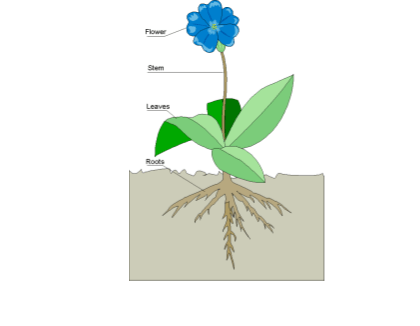
Carbon dioxide enters the plant through pores called_________.
Stomata
Eukaryote
Eczema
Stratus


What kind of heat transfer?
convection
conduction
radiation


The Sun rises in the ___________ and sets in the ____________.
East, West
West, East
North, South
South, North
Seasons are a result of...........
The moon blocking the sunlight from Earth.
The Earth's rotation on its axis
The tilt of the Earth on its axis and the revolution of Earth around the sun.
Earth's distance from the Sun.
The rotation of Earth causes
Leap Year
summer and winter
fall and spring
day and night
Which is the first step in the formation of oil?
Marine organisms die in the ocean and get buried.
Ocean currents carry organic matter to deeper waters.
Marine animals eat smaller ones.
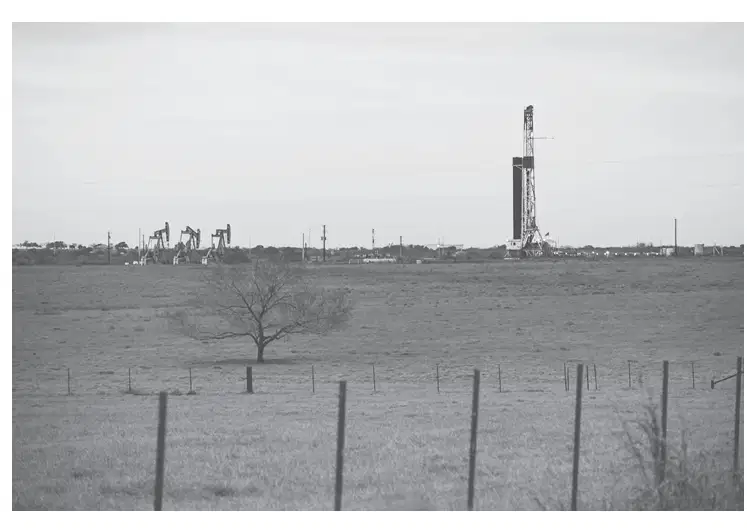
Many of America’s large oil fields are found underground at the Permian Basin in West Texas. An area of the Permian Basin is shown. How did these oil fields form?
Dead plants and animals were buried for millions of years.
Plants were eaten by consumers that left fossilized remains.
Heat caused underground rocks to undergo chemical changes.
Rocks at the surface of Earth melted and then solidified.
Fossil fuels need this to form-
heat and time
heat, pressure, and time
pressure and time
Fossil fuels form in sedimentary rocks when-
sediments turn into oil
organic matter is squeezed by heat and pressure over time
rivers deposit organic matter downstream
Both sedimentary rocks and fossil fuels...
require heat and pressure to form.
are found near volcanoes.
have many layers of sediment.

Which event began the formation of oil?
the mixing of sea water with minerals
the buildup of sea shells
the eruption of a volcano
the death of anciet marine (ocean) animals

How many elements are in this compound?
13
6
4
3
How many atoms of Hydrogen are in H2O
1
2
3
more than 3

Look at the data table. Which graph below best represents the most abundant elements in the Earth's crust?


What is the chemical symbol for GOLD?
Al
Ag
Ar
Au

What is the chemical symbol for COPPER?
C
Ca
Cu
Cl


The diagram represents a stream valley. Which diagram below best shows how this valley might be modified after a glacier has moved through it?


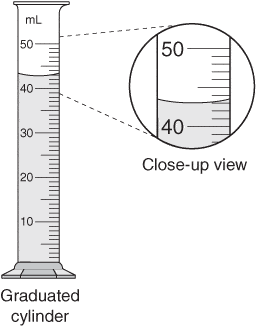


Which of these is a plant adaptation to survive in deserts?
Large leaves
Bright flowers
Thick stems to store water
Thin roots
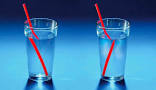
Which word best describes how light reacts when passing from air through water?
refraction
reflection
reconstroction
retraction


When light hits an area and bounces back it is called:
echo
refraction
reflection
absorbing
Light travels through air, water, glass and many other materials. What path does it travel to get from one place to another?
sideways
back and forth
straight
up and down
Light bends as it passes through a lens. This is called what?
Reflection
Diffraction
Refraction
Dilation


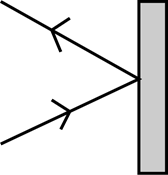
In the illustration, the light ray striking the object is-
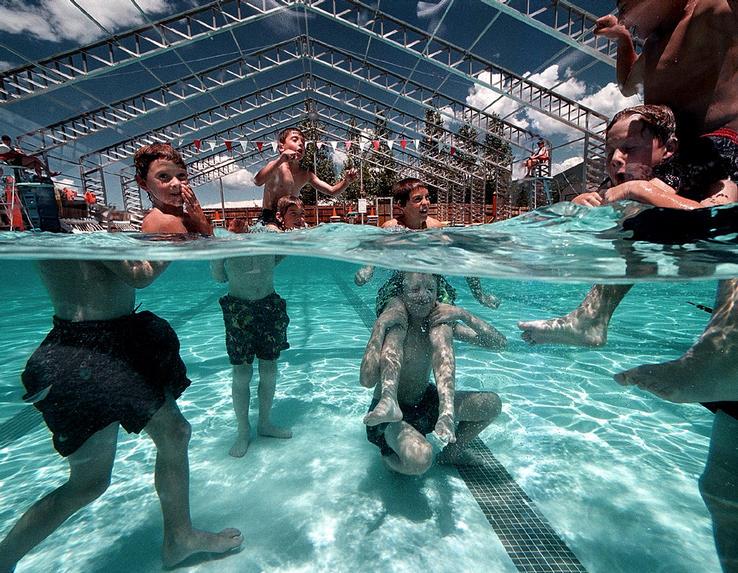
A body part or behavior that helps a living thing survive
adaption
behavior
learned behavior
instinct
To go into a deep sleep to stay alive during the winter
hibernate
migrate
nap
mimicry
When an animal looks like an animals that is poisonous or that taste bad to avoid being eaten (Think about the Monarch butterfly and the Viceroy Butterfly)
hiberate
migrate
camouflage
mimicry
An adaptation where color allows an organism to blend in with its environment
talons
Offspring
Webbed Feet
Camouflage
The type of stem on a plant that helps to protect it from herbivores
Camouflage
thorns
talons
mimicry
Type of leaves that help protect plants from the sun by preventing water loss and to protect from consumers.
talons
spines/needle like leaves
mimicry
thorns

Plants have different needs depending on where they live. In what kind of environment would you find a plant that has an adaptation for storing water?
rainforest
grasslands
tundra
desert

Desert plants have a coat of wax on their leaves to
keep water from escaping
protect them from animals eating them
absorb water from the air
release scent to attract animals
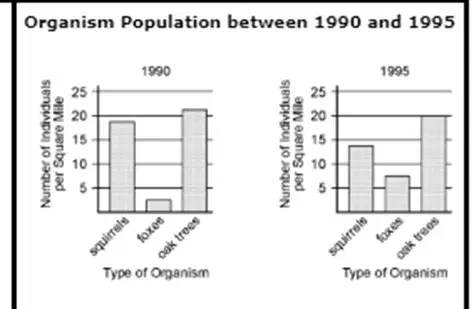
The fox population increased in 1995 because -
more food was available
more shelter was available
less food was available
less shelter was available
A food chain shows the flow of
food
energy
organisms
The arrows in a food chain represent
the direction an organism moves
the size of the organisms
the flow of energy

