
Font size
 Worksheets
Ceramics Properties and Applications Quiz
Total questions: 52
Worksheet time: 36mins
Why are ceramics often selected for use in high-temperature and chemically aggressive environments such as turbine coatings or kiln linings?
They are highly ductile and easily reshaped under heat
They have high electrical conductivity and tensile strength
They are chemically inert, thermally stable, and have low thermal conductivity
They possess metallic bonding and resist compressive forces through plastic deformation
What are ceramics primarily composed of?
Metallic elements with metallic bonding
Non-metallic elements with metallic bonding
Compounds of metals and non-metals with ionic and covalent bonding
Carbon polymers with Van der Waals bonding
Which of the following is a common property of ceramics?
High tensile strength and ductility
Low melting point and good electrical conductivity
Hardness and brittleness
High thermal expansion and elasticity
Why are ceramics typically poor conductors of heat and electricity?
Because of free electron flow
Because of tightly bound electrons in ionic and covalent bonds
Due to their porous structure
Because they have metallic bonding
Which property makes ceramics useful in corrosive environments?
Elasticity
Metallic bonding
Chemical inertness
High density
Which of the following correctly pairs a ceramic type with an example?
Traditional ceramic – silicon carbide
Engineering ceramic – clay tile
Traditional ceramic – pottery
Engineering ceramic – terracotta
Why are ceramics commonly used as thermal barrier coatings in turbines?
High elasticity and ductility
Low melting point and thermal expansion
High thermal conductivity
Low thermal conductivity and high thermal stability
What type of bonding is responsible for the brittle nature of ceramics?
Metallic bonding
Hydrogen bonding
Ionic and covalent bonding
Van der Waals bonding
In ceramic manufacturing, what typically occurs during the firing process?
Metals are extracted from ores
Electrical conductivity increases
Structural changes occur, forming a glassy phase
Ceramics become ductile and elastic
Which property explains why ceramics perform well under compression but poorly under tension?
High ductility
High thermal expansion
Strong directional bonding and brittle structure
Presence of metallic bonding
What is required during the manufacture of advanced ceramics?
Cooling at room temperature
Random atmospheric conditions
Controlled atmospheres and precise firing temperatures
Melting and casting processes
What causes ceramics to be highly resistant to scratching or indentation?
Flexible crystal lattice
Strong ionic and covalent bonding
High levels of porosity
Presence of metallic bonding
Why are ceramics generally considered brittle materials?
Ceramics contain free-moving dislocations
Ceramics atomic structure restricts plastic deformation
Ceramics atoms are arranged in layers
Ceramics are composed of soft elements
Which of the following correctly describes ionic bonding in ceramics?
Electrons are transferred from a metal to a non-metal
Electrons are shared between non-metals
Atoms form a sea of delocalised electrons
Electrons are repelled by neighbouring ions
Why are covalently bonded ceramics often harder than ionically bonded ceramics?
Lower melting points
Bonds are strong and directional
More metallic character
Bonds can flex and absorb impact
Which feature of ceramic bonding contributes most to their brittleness?
Metallic bonding and delocalised electrons
Weak secondary forces that allow easy slip
Flexible molecular chains that absorb energy
Strong, directional covalent or ionic bonds that resist deformation
Why are ceramics typically used as electrical and thermal insulators?
Tightly bound electrons restrict the flow of charge and heat
Metallic bonding allows heat to spread evenly
High thermal conductivity due to atomic mobility
Contain free-moving electrons in a crystal lattice
Which of the following best explains why ceramics are used in high-temperature environments like kilns or turbines?
Ceramics soften under stress to absorb heat
Ceramics ductility allows for thermal expansion
Ceramics strong atomic bonding allows them to resist heat and chemical attack
Ceramics contain moisture that cools the surface
Which of the following is a structural difference between metals and ceramics that explains their different properties?
Metals and ceramics both have non-directional bonding
Ceramics have ionic/covalent bonds, metals have metallic bonding
Ceramics have free electrons, metals do not
Metals are made of long molecular chains, ceramics are not
What is the main reason ceramics are harder than most metals?
Strong, directional bonding that resists atom movement
Atoms are spaced further apart
More dense and heavier
Structures contain slip planes for stress absorption
Why don’t ceramics conduct electricity like metals?
Ionic structure allows electrons to pass only under compression
Have no atoms that vibrate to produce a charge
Bonds contain negative ions that reflect electricity
Electrons are tightly bound in bonds and cannot move freely
Which statement best explains why ceramics are chemically resistant?
Atoms are strongly bonded, making them inert to most chemicals
Dissolve easily and neutralise acids
Metallic grains oxidise quickly
Contain ions that attract corrosive compounds
Classification of Ceramics
1. Engineering Ceramics
Composition: Pure, crystalline sintered compounds
Examples:
Alumina (Al₂O₃) – biomedical implants, cutting tools
Silicon Carbide (SiC) – turbine components, abrasives
Zirconia (ZrO₂) – thermal barrier coatings, dental ceramics
Structure:
Highly ordered crystalline structure
Strong ionic and covalent bonding
Properties:
Very hard and strong
Chemically inert
Low thermal and electrical conductivity
High temperature resistance
Brittle under tensile stress
HSC-Relevant Focus:
Engineering Studies Module: Engineering Materials (HSC)
Engineering ceramics are used in aeronautical and biomedical engineering applications due to their high-temperature performance and biocompatibility.
Understanding their structure-property relationships is critical when evaluating material selection for engineering design and product development.
2. Clay Ceramics
Composition: Natural clays, mainly aluminosilicates
Examples: Bricks, tiles, terracotta, porcelain
Structure:
Partially vitrified (some glassy phase)
Typically porous
Mixed crystalline and amorphous phases
Properties:
Low tensile strength
Hard and brittle
Good thermal resistance
Economical and mass-producible
HSC-Relevant Focus:
Engineering Studies Module: Engineering Materials (Preliminary & HSC)
Students must understand traditional ceramic processes, including shaping and firing.
Used in civil engineering (bricks, pipes) and domestic applications (sanitary ware, pottery).
Emphasises processing-structure-property relationships.
3. Glasses (Including Glass Ceramics)
Composition: Silica-based (SiO₂) with modifiers (e.g., Na₂O, CaO)
Examples:
Soda-lime glass – windows
Borosilicate glass – laboratory and cookware (e.g., Pyrex)
Glass ceramics – cooktops, telescope mirrors
Structure:
Amorphous (no long-range order)
Some glass ceramics are partially crystalline
Properties:
Transparent
Poor conductors of heat and electricity
Good chemical stability
Excellent thermal shock resistance (in glass ceramics)
HSC-Relevant Focus:
Engineering Studies Module: Engineering Materials (HSC)
Compare amorphous (glass) and crystalline (engineering ceramic) structures.
Applications in transport, communication, and biomedical industries.
Real-world examples: laminated and toughened glass in buildings and transport, illustrating structure–property–application links.
4. Cements
Composition: Calcium silicates and aluminates
Examples: Portland cement (used in concrete)
Structure:
Microcrystalline and amorphous phases
Forms a hydrated matrix when mixed with water
Properties:
Hardens over time (hydration)
Strong in compression
Low tensile strength
Low cost, excellent for large-scale use
HSC-Relevant Focus:
Engineering Studies Module: Civil Structures (HSC)
Understanding cement’s role as a composite material in concrete is crucial for analysing structural design and load-bearing capacity.
Industry example: use of reinforced concrete in bridge construction and infrastructure projects.
5. Electronic Ceramics
Composition: Oxide ceramics like barium titanate (BaTiO₃), zinc oxide (ZnO)
Examples: Capacitors, thermistors, piezoelectric devices
Structure:
Crystalline structures (e.g., perovskite)
Engineered to exhibit specific electrical behaviours
Properties:
Electrical insulation
Piezoelectric and ferroelectric effects
Chemically stable
Temperature resistant
HSC-Relevant Focus:
Engineering Studies Module: Engineering Materials (HSC)
Applications in communication and electronics industries, such as sensors, capacitors, and ceramic insulators in power systems.
Supports student understanding of functional materials and their performance in real-world systems.
Which type of ceramic is typically amorphous and used in transparent products?
Clay ceramics
Cements
Engineering ceramics
Glasses
Which of the following is an example of an engineering ceramic?
Glass
Alumina
Concrete
Clay tile
Which classification of ceramics includes materials used as a binder in concrete?
Cements
Glasses
Electronic ceramics
Clay ceramics
What distinguishes clay ceramics from other ceramic types?
They are made using glass powders
They are used in electronic components
They are clay-based and vitrified
They are pure crystalline compounds
Which ceramic category is most closely associated with bridge construction materials?
Electronic ceramics
Engineering ceramics
Glass ceramics
Cements
Electronic ceramics are selected for electronic applications due to which of the following?
Their piezoelectric and insulating properties
Their ability to conduct heat
Their amorphous structure and flexibility
Their ductility and electrical conductivity
Which ceramic type undergoes partial vitrification during firing to become hard and durable?
Clay ceramics
Cement
Electronic ceramics
Engineering ceramics
Glass ceramics are preferred over traditional glasses in cooktops because they:
Are transparent and chemically inert
Contain high water content
Have improved thermal shock resistance
Are elastic and electrically conductive
Portland cement is classified as a ceramic because:
It reacts with water to form a solid crystalline matrix
It is made of plastic polymers
It melts at low temperature and can be remoulded
It is organic and flexible
Which engineering ceramic is commonly used for thermal barrier coatings in turbines?
Soda-lime glass
Zirconia (ZrO₂)
Barium titanate (BaTiO₃)
Portland cement
Why are clay ceramics typically porous compared to engineering ceramics?
Fired at lower temperatures and undergo partial vitrification
Contain metallic bonding
Undergo sintering under vacuum
Made from glass powders
Which property makes engineering ceramics suitable for aerospace applications?
Amorphous structure
High ductility
Metallic bonding
High temperature resistance and chemical inertness
D)
Which ceramic is engineered to exhibit piezoelectric or ferroelectric behaviour?
Alumina
Zirconia
Barium titanate
Borosilicate glass
Which property of alumina (Al₂O₃) makes it suitable for use in cutting tools and abrasives?
Low density
High hardness
Electrical conductivity
Transparency
Zirconia (ZrO₂) is commonly used as a thermal barrier coating in jet and diesel engines because of its:
High electrical conductivity
High thermal expansion
Low thermal conductivity
High porosity
Which property of zirconia makes it suitable for use in thermal barrier coatings in high-performance engines and brake systems in transport engineering?
High ductility
Low thermal conductivity
High electrical conductivity
High porosity
What is one reason ceramics like zirconia are used in jet turbines in aircraft?
Flexible and can bend easily
Withstands high heat without breaking down
Dissolves in fuel
Allow electricity to pass through safely
Why are ceramic materials like alumina used in insulators for telecommunications equipment?
High thermal conductivity
Dissolve when wet
Free electrons for electrical flow
Block electricity due to tightly bound electrons
Why are ceramic materials used in high-performance brake pads in transport systems?
Resist heat and wear during braking
Conduct electricity to prevent overheating
Flexible under load
Melt at low temperatures
Tungsten carbide cutting tools are made by embedding ceramic particles in:
Metal matrix (e.g., cobalt)
Polymer matrix
Glass matrix
Rubber layer
An aerospace company is manufacturing turbine engines, precision fuel injector nozzles, and high-wear landing gear joints. These components require a material with extreme hardness, scratch resistance, and the ability to withstand friction and thermal stress.
Which non-oxide ceramic is most appropriate for coatings or tools in these aerospace applications?
Titanium carbide
Hydroxyapatite
Silicon nitride
Glass ceramic
Which engineering ceramic is commonly used in scratch-resistant watch faces?
Glass ceramic
Silicon nitride
Titanium carbide
Cubic boron nitride
Silicon nitride ceramic balls are best suited for which application?
Precision ball bearings
Heat exchangers
Electrical insulators
Biomedical implants

Which ceramic is used in abrasive paper and cutting tools due to its extreme hardness?
Zirconia
Alumina
Hydroxyapatite
Silicon carbide
What are the 4 main categories of materials?
Polymers, composites, ceramics, metals
Polymers, alloys, ceramics, metals
Polymers, composites, alloys, metals
Polymers, composites, ceramics, alloys
Ceramics are able to withstand high temperatures without softening and deforming under normal service conditions. These properties make ceramics a good choice for:
(Choose Two Answers)
Electric insulators
Water bottles
Electric conductors
Furnace lining
Ceramics have the ability to resist chemical attack however, they lack these two properties:
Ductility
Brittleness
Hardness
Electric conductivity
Materials used for electric insulators must have a low degree of: (choose two answers)
Thermal conductivity
Hardness
Electric conductivity
Compressive strength
Why does the atomic structure of silicon nitride contribute to its use in engineering applications?
Contains free electrons for conduction
Atomic bonds allow plastic deformation
Strong covalent bonding that resists wear and heat
Loosely packed atoms that allow for vibration absorption
What is a primary reason cracks may form in buildings due to clay-based foundations?
Clay contains high levels of metal oxides
Clay absorbs water and shrinks when it dries
Clay lacks plasticity after forming
Clay is too rigid after firing

During the firing of clay ceramics, what happens in the vitrification stage?
Mullite crystals grow, strengthening the ceramic
Water is removed from the clay surface
Organic impurities are oxidised
Heat causes explosive expansion of trapped water
What is the role of the glassy phase formed during the vitrification stage in clay ceramics?
Causes the ceramic to expand and become porous
Binds particles together, increasing strength and reducing porosity
increases electrical conductivity in ceramic materials
Allows trapped water to escape before structural breakdown
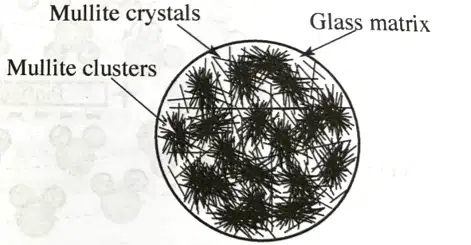
What is the role of mullite crystals in the microstructure of a fired ceramic?
Reduce porosity and strengthen the ceramic within the glassy matrix
Increase the water content and flexibility of the ceramic
Help form a more porous structure to allow gas release
Melt completely and remove structural support during vitrification
Which of the following correctly matches the clay ceramic types with their firing temperatures and applications?
Earthenware – Fired at 800–1000°C, porous (5–20%), used in Roman aqueducts
Stoneware – Fired at ~1250°C, <5% porosity, used in roof tiles and ovenware
China (Fine China) – Fired at ~1250°C, vitrified, used in early telecommunication insulators
Porcelain – Fired at 1300–1450°C, fully vitrified, used in spark plug insulators
Porcelain – Fired at 800–1000°C, porous (5–20%), used in early water pipes
Earthenware – Fired at 1300–1450°C, used in lab equipment
China (Fine China) – Fired at ~1250°C, <5% porosity, used in ovenware
Stoneware – Fired at ~1250°C, vitrified, used in insulators
Stoneware – Fired at 800–1000°C, porous (5–20%), used in aqueducts
Porcelain – Fired at ~1250°C, vitrified, used in tableware
China (Fine China) – Fired at 1300–1450°C, dense and strong, used in kilns
Earthenware – Fired at ~1250°C, <5% porosity, used in cookware
China (Fine China) – Fired at 800–1000°C, porous, early domestic use
Stoneware – Fired at 1300–1450°C, no porosity, used in spark plug insulators
Porcelain – Fired at ~1250°C, vitrified, used in aqueducts
Earthenware – Fired at ~1250°C, used in roofing tiles
Which of the following correctly matches each ceramic type with a key example and its typical use?
Clay Ceramics – Barium titanate – Capacitors and sensors
Engineering Ceramics – Pyrex – Lab equipment
Glasses – Porcelain – Plumbing fixtures
Glass Ceramics – Telescope mirrors – High wear tools
Electronic Ceramics – Alumina – Cutting tools
Cements – Glass ceramic – Kitchenware
Clay Ceramics – Alumina – Turbine blades
Engineering Ceramics – Zirconia – Windowpanes
Glasses – Portland cement – Roads and bridges
Glass Ceramics – Bricks – Houses
Electronic Ceramics – Pyrex – Cooktops
Cements – Barium titanate – Piezoelectric sensors
Clay Ceramics – Bricks, tiles, porcelain – Buildings, plumbing, dishes
Engineering Ceramics – Alumina, Zirconia – Turbines, implants, insulators
Glasses – Window glass, Pyrex – Windows, cookware, lab equipment
Glass Ceramics – Cooktops, telescope mirrors – Thermal shock resistance tools
Electronic Ceramics – Barium titanate – Capacitors, sensors, piezoelectric devices
Cements – Portland cement – Concrete structures, roads, bridges
Clay Ceramics – Pyrex – High voltage insulators
Engineering Ceramics – Bricks – Dishes
Glasses – Zirconia – Turbine components
Glass Ceramics – Portland cement – Flooring
Electronic Ceramics – Telescope mirrors – Space applications
Cements – Barium titanate – Sensors
Why is glass still considered a ceramic material in engineering studies?
Glass is metallic in composition and has free-moving electrons
Glass undergoes plastic deformation before fracturing
Glass is an inorganic, non-metallic material with strong ionic/covalent bonds
Glass has a crystalline structure and exhibits ductile behaviour
Which of the following statements about glass and ceramics is NOT true?
Glass is considered a ceramic because it is inorganic, non-metallic, and has similar insulating and brittle properties.
Glass is classified as a ceramic even though its atoms are arranged in an amorphous (non-crystalline) structure.
Glass has excellent thermal and electrical conductivity due to the presence of free electrons.
Like other ceramics, glass can resist chemical attack and is used in applications such as cookware and lab equipment.
Which of the following statements about cement and ceramics is NOT true?
Cement is used in engineering applications due to its compressive strength and low cost.
Cement forms a strong crystalline structure when hydrated, similar to sintered ceramics.
Cement is considered a ceramic because it is an inorganic, non-metallic material that hardens through chemical reactions.
Cement is classified as a ceramic because it melts easily and can be reshaped like metals.
Why is cement classified as a ceramic material?
Metallic compound that softens and flows when heated
An inorganic, non-metallic material that hardens through chemical reactions
An organic polymer with high ductility
Made from glass particles and melted at high temperatures
What does a high Young’s Modulus indicate about a ceramic material?
High stiffness and resists deformation
Can withstand large tensile forces without breaking
Deforms easily under stress
Highly ductile
Which of the following statements about materials with a high Young’s Modulus is NOT correct?
Stiff and resist elastic deformation under load
Always break easily and are therefore brittle
Experience small strain under stress
Can be either brittle or tough depending on their internal structure
Which statement best explains the role of covalent bonding in the properties of ceramic materials?
Covalent bonds allow atoms to slide, making ceramics ductile
Covalent bonds create a flexible structure, helping ceramics deform plastically
Covalent bonds form a rigid and strong lattice, giving ceramics high hardness and stiffness
Covalent bonds result in a metallic lattice with free electrons, allowing electrical conductivity

