wayground logo

Free Printable Worksheets

Font size

S
M
L
XL
Worksheets

8 UNIT TEST 4 (G)

Total questions: 171

Worksheet time: 8hrs 13mins

Name
Class
Date
1.

A point A(3,4)A(3, 4) is dilated by a scale factor of 2 with the center of dilation at the origin. What are the coordinates of the image of point AA after the dilation?

a)

(6,8)(6, 8)

b)

(1.5,2)(1.5, 2)

c)

(3,8)(3, 8)

d)

(6,4)(6, 4)

2.

A triangle has vertices at A(1,2)A(1, 2) , B(3,4)B(3, 4) , and C(5,6)C(5, 6) . If the triangle is translated by the vector (2,1)(2, -1) , what are the new coordinates of vertex BB ?

a)

(5,3)(5, 3)

b)

(1,3)(1, 3)

c)

(3,5)(3, 5)

d)

(5,4)(5, 4)

3.

A square with vertices at P(0,0)P(0, 0) , Q(0,2)Q(0, 2) , R(2,2)R(2, 2) , and S(2,0)S(2, 0) is rotated 9090^\circ counterclockwise about the origin. What are the new coordinates of vertex RR ?

a)

(2,2)(-2, 2)

b)

(2,0)(2, 0)

c)

(0,2)(0, 2)

d)

(2,0)(-2, 0)

4.
What is the rule for the dilation pictured?
a)
(x, y) → (½x, ½y)
b)
(x, y) → (x + 2, y + 2)
c)
(x, y) → (2x, 2y)
d)
(x, y) → (2x, 3y)
5.

Point (7,2) is translated -5 units horizontally and 2 units vertically.

Where is the new point located?

a)
(9,-3)
b)
(2,4)
c)
(2,0)
d)
12,4)
6.
Point (-5,2) is reflected over the y axis.  Where is the new point located?
a)
(5,2)
b)
(-5,-2)
c)
(-5,2)
d)
(5,-2)
7.

Which of the following shows a translation?

a)
b)
c)
d)
8.

Which of the following shows a rotation?

a)
b)
c)
d)
9.

Which of the following shows a dilation?

a)
b)
c)
d)
10.
What is the rule for the dilation pictured?
a)
(x, y) → (½x, ½y)
b)
(x, y) → (x + 2, y + 2)
c)
(x, y) → (2x, 2y)
d)
(x, y) → (2x, 3y)
11.

Point (7,2) is translated -5 units horizontally and 2 units vertically.

Where is the new point located?

a)
(9,-3)
b)
(2,4)
c)
(2,0)
d)
12,4)
12.
Point (-5,2) is reflected over the y axis.  Where is the new point located?
a)
(5,2)
b)
(-5,-2)
c)
(-5,2)
d)
(5,-2)
13.

A dilation is

a)

Has a central point that stays fixed and everything else moves around that point

b)

a transformation that changes the size of a figure

c)

a transformation in which the preimage is flipped across a line

d)

a function that moves an object a certain distance. The object is not altered in any other way.

14.

Which of the following shows a translation?

a)
b)
c)
d)
15.

Which of the following shows a rotation?

a)
b)
c)
d)
16.

Which of the following shows a dilation?

a)
b)
c)
d)
17.

Which shows point (3, 6) rotated COUNTER-CLOCKWISE by 90 degrees?

a)

(6, -3)

b)

(-6, 3)

c)

(-3, -6)

d)

(3, 6)

18.

Which shows point (3, 6) rotated COUNTER-CLOCKWISE by 180 degrees?

a)

(6, -3)

b)

(-6, 3)

c)

(-3, -6)

d)

((3, 6)

19.

Which shows point (4, 5) TRANSLATED by (-5, -2)

a)

(10, 9)

b)

(-9, -10)

c)

(3, 1)

d)

(-1, 3)

20.

What is coordinate R?

a)

(2,5)

b)

(0,1)

c)

(2,3)

d)

(1,0)

21.
What letter is located at (8, 5)?
a)
A
b)
B
c)
C
d)
D
22.
What letter is located at (5, 7)
a)
A
b)
B
c)
C
d)
D
23.

How is the blue triangle rotated to the red triangle?

a)

90 clockwise

b)

90 counterclockwise

c)

180 clockwise

d)

180 counterclockwise

24.

Identify this transformation.

a)

Dilation

b)

Rotation

c)

Translation

d)

Reflection

25.
a)
b)
c)
d)
26.

What sequence of transformations will map trapezoid A to its image A'?

a)

A translation 6 units up then a reflection across the y-axis

b)

A Rotation 90 degrees counter-clockwise then a reflection across the x-axis

c)

A Reflection across the x axis then a rotation 90 degrees counterclockwise

d)

A reflection across the y-axis then a rotation 180 degrees

27.

Which graph shows a translation?

a)
b)
c)
d)
28.

Describe the Transformation

a)

Translation

b)

Reflection

c)

Rotation

d)

Dilation

29.
How many degrees was the figure rotated?
a)
90 degrees counterclockwise 
b)
180 degrees
c)
270 counterclockwise 
30.
Congruent geometric figures have the:
a)
Same size
b)
Sides Equal
c)
Same Size and Same Shape
d)
Angles Equal
31.
∆FGH is congruent to ∆MNB. What side corresponds with line segment HF?
a)
MN
b)
NB
c)
BM
d)
MM
32.
Which of the following statements is true?
a)
∆BCA ≅ ∆DEF
b)
∆EFD ≅ ∆BAC
c)
∆ABC ≅ ∆FED
d)
∆EDF ≅ ∆BAC
33.
Tell whether the two figures are congruent.
a)
Yes, same size and same shape
b)
No, same shape but different sizes
c)
No, different size and different shapes
34.
Quadrilateral QRST  quadrilateral XZWY
Which side corresponds to QT
a)
XZ
b)
ZW
c)
WY
d)
XY
35.
Polygon ABCD ≅ polygon PQRS. What is the value of x?
a)
48
b)
49
c)
52
d)
100
36.
What side corresponds to ED?
a)
TA
b)
NA
c)
TN
d)
RD
37.
PICK THE CORRECT CONGRUENCE STATEMENT
a)
∆TUV ≅ ∆EUV
b)
∆VUT ≅ ∆UVE
c)
∆TUV ≅ ∆UEV
d)
∆UTV ≅ ∆EUV
38.
If ∆LMK ≅ ∆LMT, then
∠K ≅ ____
a)
T
b)
∠T
c)
∠M
d)
∠L
39.
If ∆LMK ≅ ∆LMT, then
MK= ____
a)
LM
b)
K
c)
MT
d)
LT
40.

A right triangle has legs of lengths 3 and 4. What is the length of the hypotenuse?

a)

5

b)

6

c)

7

d)

8

41.

Which of the following statements is the converse of the Pythagorean Theorem?

a)

In a right triangle, the square of the hypotenuse is equal to the sum of the squares of the other two sides.

b)

If the square of one side of a triangle is equal to the sum of the squares of the other two sides, then the triangle is a right triangle.

c)

The sum of the angles in a triangle is 180 degrees.

d)

The area of a triangle is 12×base×height\frac{1}{2} \times \text{base} \times \text{height} .

42.

A triangle has sides of lengths 5, 12, and 13. Is this triangle a right triangle?

a)

Yes, because 52+122=1325^2 + 12^2 = 13^2

b)

No, because 52+1221325^2 + 12^2 \neq 13^2

c)

Yes, because 5+12=135 + 12 = 13

d)

No, because 5+12135 + 12 \neq 13

43.

If a triangle has sides of lengths 8, 15, and 17, verify if it is a right triangle using the Pythagorean Theorem.

a)

Yes, because 82+152=1728^2 + 15^2 = 17^2

b)

No, because 82+1521728^2 + 15^2 \neq 17^2

c)

Yes, because 8+15=178 + 15 = 17

d)

No, because 8+15178 + 15 \neq 17

44.

Which of the following sets of numbers can be the sides of a right triangle?

a)

6, 8, 10

b)

7, 24, 25

c)

9, 12, 15

d)

All of the above

45.

Level 1

The Pythagorean Theorem ONLY works on which triangle?

a)

obtuse

b)

scalene

c)

isosceles

d)

right

46.
An airplane flies 56 miles due north and then 33 miles due east. How many miles is the plane from its starting point?
a)
65 miles
b)
89 miles
c)
45.4 miles
d)
We don't have enough information.
47.
A piece of paper that Brittany has is 11 inches tall and 8 inches wide. She draws a straight line diagonally across the paper. How long is the line she drew?
a)
7.5 in
b)
12.4 in
c)
13.6 in 
d)
14.3 in
48.
The longest side of a right triangle is DIRECTLY ACROSS from the...
a)
right angle.
b)
acute angle.
c)
obtuse angle.
49.
Find the distance.
a)
7.1
b)
7.8
c)
8.7
d)
8.9
50.
Find the distance.
a)
9.7
b)
10.7
c)
11.7
d)
12.7
51.
What is the distance between (-5, 3) and (4, -5)
a)
Square root of -145
b)
Square root of 145
c)
145
d)
-145
52.
Find the perimeter of the triangle 
a)
27
b)
26
c)
28
d)
29
53.
What is the distance between the two points? Round to the nearest tenth.
a)
6.3
b)
6.5
c)
6.7
d)
16
54.
Find the distance between (-4, 5) and (7, 18). Round to the nearest houndredth.
a)
15.96
b)
16.08
c)
16.23
d)
17.03
55.
Find the distance between (-5, -8) and (-1, -16). Round to the nearest tenth.
a)
8.9
b)
9.8
c)
10.3
d)
11
56.

What is the rule for the dilation pictured?

a)

(x, y) → (½x, ½y)

b)

(x, y) → (x + 2, y + 2)

c)

(x, y) → (2x, 2y)

d)

(x, y) → (2x, 3y)

57.

The pair of figures is similar. Find the missing side.

a)

x = 1

b)

x = 3

c)

x = 9

d)

x = 5

58.

Is the function linear or nonlinear?

a)

Linear Function

b)

Nonlinear Function

59.

Which function is linear?

a)

y = 2x + 4

b)

y = 2x2 + 4

c)

y = 2x(4 − 3x)

d)

xy = 15

60.
What transformation is pictured here?
a)
Translation
b)
Rotation
c)
Reflection
d)
Dilation
61.
How is Quadrilateral EFGH translated to E'F'G'H'?
a)
6 down
b)
6 down, 1 right
c)
6 down, 3 left
d)
8 down, 1 right
62.
Is the picture being reflected in the y-axis or x-axis?
a)
y-axis
b)
x-axis
63.

What Transformation is visible?

a)

Translation

b)

Rotation

c)

Dilation

d)

Reflection

64.

Describe the Transformation

a)

Translation

b)

Reflection

c)

Rotation

65.

What transformation is shown?

a)

Reflection

b)

Rotation

c)

Translation

66.
A turn is also called a ___________.
a)
Translation
b)
Reflection
c)
Rotation
d)
Transformation
67.
A slide is also called a _________.
a)
Translation
b)
Reflection
c)
Rotation
d)
Transformation
68.
The rectangle shown has coordinates (3, 2), (-2, 2), (-2, -1), (3, -1)
What is the length of the longest side of the rectangle?
a)
4 units
b)
5 units
5 units
c)
6 units
d)
8 units
69.

Identify the transformation from ABC to A'B'C'.

a)

90o counterclockwise rotation

b)

Reflection across the x-axis

c)

Translation

d)

90o clockwise rotation

70.

Which triangle is a translation of triangle X?

a)

triangle B

b)

triangle A

c)

triangle D

d)

triangle C

71.

Translate the blue shape to the green shape...

a)

3 Left

3 Down

b)

3 Right

3 Up

c)

2 Right

3 Up

d)

2 Left

3 Down

72.

Translate the pink shape to the blue shape...

a)

5 Right

2 Down

b)

5 Left

2 Up

c)

3 Right

1 Down

d)

3 Left

1 Up

73.
Is the picture being reflected in the y-axis or x-axis?
a)
y-axis
b)
x-axis
74.
Describe the transformation shown in the graph.
a)
Reflect over x-axis
b)
Reflect over y-axis
c)
Rotate 180 degrees
d)
Translate 4 units right
75.
Describe the transformation shown on the graph.
a)
Reflect over x-axis
b)
Reflect over y-axis
c)
Rotate 180 degrees
d)
Rotate 90 degrees CCW
76.
Determine how to translate triangle A'B'C' to triangle ABC.
a)
(x+2, y-5)
b)
(x+2, y-9)
c)
(x-2, y-9)
77.
State the line of reflection.
a)
Reflection across y-axis
b)
Reflection across x-axis
c)
Reflection across x = 1
d)
Reflection across y = 1
78.

A flip is also called a ___________.

a)

Translation

b)

Reflection

c)

Rotation

d)

Transformation

79.

Translations are always _______

a)

Congruent

b)

Bigger

c)

Smaller

d)

Rotated

80.

What is the distance between the points (3,4)(3, 4) and (7,1)(7, 1) in a coordinate system?

a)

55

b)

35\sqrt{35}

c)

66

d)

20\sqrt{20}

81.

Using the Pythagorean Theorem, find the distance between the points (2,1)(-2, 1) and (1,5)(1, 5) .

a)

33

b)

55

c)

18\sqrt{18}

d)

15\sqrt{15}

82.

Level 1

The Pythagorean Theorem ONLY works on which triangle?

a)

obtuse

b)

scalene

c)

isosceles

d)

right

83.
An airplane flies 56 miles due north and then 33 miles due east. How many miles is the plane from its starting point?
a)
65 miles
b)
89 miles
c)
45.4 miles
d)
We don't have enough information.
84.
A piece of paper that Brittany has is 11 inches tall and 8 inches wide. She draws a straight line diagonally across the paper. How long is the line she drew?
a)
7.5 in
b)
12.4 in
c)
13.6 in 
d)
14.3 in
85.
The longest side of a right triangle is DIRECTLY ACROSS from the...
a)
right angle.
b)
acute angle.
c)
obtuse angle.
86.
Find the distance.
a)
7.1
b)
7.8
c)
8.7
d)
8.9
87.
Find the distance.
a)
9.7
b)
10.7
c)
11.7
d)
12.7
88.
What is the distance between (-5, 3) and (4, -5)
a)
Square root of -145
b)
Square root of 145
c)
145
d)
-145
89.
Find the perimeter of the triangle 
a)
27
b)
26
c)
28
d)
29
90.
What is the distance between the two points? Round to the nearest tenth.
a)
6.3
b)
6.5
c)
6.7
d)
16
91.
Find the distance between (-4, 5) and (7, 18). Round to the nearest houndredth.
a)
15.96
b)
16.08
c)
16.23
d)
17.03
92.
Find the distance between (-5, -8) and (-1, -16). Round to the nearest tenth.
a)
8.9
b)
9.8
c)
10.3
d)
11
93.

What is the rule for the dilation pictured?

a)

(x, y) → (½x, ½y)

b)

(x, y) → (x + 2, y + 2)

c)

(x, y) → (2x, 2y)

d)

(x, y) → (2x, 3y)

94.

The pair of figures is similar. Find the missing side.

a)

x = 1

b)

x = 3

c)

x = 9

d)

x = 5

95.

Is the function linear or nonlinear?

a)

Linear Function

b)

Nonlinear Function

96.

Which function is linear?

a)

y = 2x + 4

b)

y = 2x2 + 4

c)

y = 2x(4 − 3x)

d)

xy = 15

97.

A cone has a radius of 3 cm and a height of 4 cm. What is the volume of the cone? Use the formula V=13πr2hV = \frac{1}{3} \pi r^2 h .

a)

12πcm312\pi \, \text{cm}^3

b)

36πcm336\pi \, \text{cm}^3

c)

24πcm324\pi \, \text{cm}^3

d)

48πcm348\pi \, \text{cm}^3

98.

A cylinder has a radius of 5 cm and a height of 10 cm. What is the volume of the cylinder? Use the formula V=πr2hV = \pi r^2 h .

a)

250πcm3250\pi \, \text{cm}^3

b)

500πcm3500\pi \, \text{cm}^3

c)

100πcm3100\pi \, \text{cm}^3

d)

750πcm3750\pi \, \text{cm}^3

99.

A sphere has a radius of 6 cm. What is the volume of the sphere? Use the formula V=43πr3V = \frac{4}{3} \pi r^3 .

a)

288πcm3288\pi \, \text{cm}^3

b)

216πcm3216\pi \, \text{cm}^3

c)

432πcm3432\pi \, \text{cm}^3

d)

144πcm3144\pi \, \text{cm}^3

100.
Find the volume
a)
40π m³
b)
160π m³
c)
400π m³
d)
100π m³
101.
Find the missing height of the cone, if the volume is 150.72cm3. (Round to the nearest tenth.)
a)
2.7 cm
b)
12.6 cm
c)
4.0 cm
d)
1.3 cm
102.
What is the formula for the volume of a cylinder?
a)
V = πr²
b)
V = πr²h
c)
V = ½πr²h
d)
V = ½πrh
103.
What is the formula for volume of a sphere?
a)
V =(4/3)πr³h
b)
V =(4/3)πr³
c)
V =(1/3)πr³h
d)
V =(1/3)πr³
104.
A cylinder has a height of 4 m and a diameter of 4 m. What is the volume in cubic meters?
a)
64π m3
b)
16π m3
c)
64π m2
d)
16π m2
105.
A cone has a height of 4 in and a radius of 6 in. What is the volume of the cone in cubic inches?
a)
8π in3
b)
24π in3
c)
48π in3
d)
144π in3
106.
Find the volume of a hemisphere with a radius of 4ft in cubic feet. Round to the nearest tenth.
Use 3.14 for  π
a)
85.3π
b)
62.7π
c)
42.7π
d)
86π
107.

Russell is filling a cylinder-shaped swimming pool that has a diameter of 20 feet. He fills it with water to a depth of 3 feet. What is the volume of the water in the pool, to the nearest cubic foot?

a)

377 cubic feet

b)

942 cubic feet

c)

2,958 cubic feet

d)

3,768 cubic feet

108.
What is the volume of a can of soup with a base radius of 2 inches and a height of 5 inches? (Round to the nearest tenth.)
a)
62.8 in³
b)
31.4 in³
c)
15.7 in³
d)
12.6 in³
109.
Find the volume of the cone. (Round to the nearest integer.)
a)
1810 in³
b)
151 in³
c)
452 in³
d)
276 in
110.
Find the volume to the nearest hundredth using 3.14 instead of Pi.
a)
5572.45 cm3
b)
506.59 cm3
c)
126.65 cm3
d)
1393.11 cm3
111.
Find the volume to the nearest hundredth using 3.14 instead of Pi.
a)
179.50 cm3
b)
205.15 cm3
c)
51.29 cm3
d)
1436.03 cm3
112.
An ice cream cone that is 4 inches tall has an opening that is 8 inches across. Find the volume of the cone.
a)
201.06 inches3
b)
67.02 inches3
c)
50.27 inches3
d)
403.19 inches3
113.
What is this formula used to find?
V=4/3πr3
a)
The volume of a cylinder
b)
The volume of a cone
c)
The volume of a sphere
d)
The area of a circle
114.
What is the height of a cylinder with volume 6,908 cubic feet and with a base radius of 10 feet? (Round to the nearest integer.)
a)
33 ft.
b)
22 ft.
c)
24 ft.
d)
11 ft.
115.
Find the volume to the nearest tenth using 3.14 instead of Pi.
a)
282.6 in3
b)
94.2 in3
c)
235.5 in3
d)
78.5 in3
116.
Find the volume to the nearest hundredth using 3.14 instead of Pi.
a)
418.00 cm3
b)
139.33 cm3
c)
130.62 cm3
d)
1671.98 cm3
117.

A right triangle has legs of lengths 3 cm and 4 cm. What is the length of the hypotenuse?

a)

5 cm

b)

6 cm

c)

7 cm

d)

8 cm

118.

In a right triangle, the hypotenuse is 13 cm and one leg is 5 cm. What is the length of the other leg?

a)

10 cm

b)

12 cm

c)

11 cm

d)

9 cm

119.

A right triangle has a hypotenuse of length 10 m and one leg of length 6 m. Find the length of the other leg.

a)

7 m

b)

8 m

c)

9 m

d)

5 m

120.

A rectangular box has dimensions 3 m, 4 m, and 5 m. What is the length of the diagonal of the box?

a)

7 m

b)

8 m

c)

9 m

d)

10 m

121.

In a right triangle, the legs are 8 cm and 15 cm. What is the length of the hypotenuse?

a)

16 cm

b)

17 cm

c)

18 cm

d)

19 cm

122.
Find the missing side
a)
48
b)
108
c)
83.6
d)
72
123.

Find the length of the missing side.

a)

25 cm

b)

42 cm

c)

52 cm

d)

48 cm

124.
Find the length of the missing side. 
a)
20 in.
b)
68 in.
c)
16 in.
d)
80 in.
125.
A soccer field is a rectangle 90 meters wide and 120 meters long. The coach asks players to run from one corner to the corner diagonally across. What is this distance?
a)
210 m
b)
180 m
c)
150 m
d)
79 m
126.
To get from one side of the pond to the other you must walk 34 meters south and 41 meters east.  To the nearest meter, how many less meters would it take if it were possible to go directly across the pond.  
a)
53
b)
22
c)
75
d)
9
127.
Two joggers run 8 miles north and then 5 miles west.  What is the shortest distance back to their starting point to the nearest tenth of a mile?
a)
13
b)
9.4
c)
6.2
d)
9
128.
Trista's TV screen is 17 inches long. If the diagonal measures 22 inches, how long is the width of Donna's TV? 
a)
5 in
b)
10 in
c)
14 in
d)
28 in
129.
The Pythagorean Theorem ONLY works on which triangle? 
a)
obtuse
b)
scalene
c)
isosceles
d)
right
130.
The Pythagorean Theorem is
a2 + b+ c2
a)
false
b)
true
131.
You need a ladder that will reach up a 25 foot tall house when placed 10 feet away from the house. How tall does the ladder need to be?
a)
25 feet
b)
26 feet
c)
27 feet
d)
28 feet
132.
What is the height of the cone? 
a)
14 cm
b)
8 cm
c)
12 cm
d)
13.9 cm
133.
What type of angles are they?
a)
VERTICAL
b)
ALTERNATE INTERIOR
c)
ALTERNATE EXTERIOR
d)
CORRESPONDING
134.
WHAT TYPE OF ANGLES ARE THEY?
a)
ALTERNATE INTERIOR
b)
SAME SIDE
c)
CONSECUTIVE
d)
CORRESPONDING
135.
WHAT TYPE OF ANGLES ARE THEY
a)
ALTERNATIVE
b)
CONSERVATIVE
c)
CONSECUTIVE (SAME SIDE)
d)
CORRESPONDING
136.
WHAT TYPE OF ANGLES ARE THESE?
a)
CONSERVATIVE
b)
ALTERNATE INTERIOR
c)
ALTERNATE EXTERIOR
d)
SAME SIDE
137.
WHAT TYPE OF ANGLES ARE THESE?
a)
CONSECUTIVE
b)
CORRESPONDING
c)
CORRECTIVE
d)
SAME SIDE
138.
Which of the following terms best describes Angle d? (remember that it's outside)
a)
Remote interior angle
b)
Corresponding angle
c)
Exterior angle
d)
Interior angle
139.
What is the measure of angle b?
a)
36o
b)
56o
c)
63o
d)
117o
140.

What is the measure of angle a?

a)

36o

b)

56o

c)

63o

d)

117o

141.

In the figure, find the measure of angle b.

a)

85

b)

80

c)

75

d)

65

142.

In the figure, find the measure of angle a.

a)

45

b)

20

143.
Find the measure of the missing angle.
a)
90o
b)
100
c)
130o
d)
50o
144.

Lines s and t are parallel and are intersected by transversal u.

What is the value of x?

a)

6

b)

8

c)

15

d)

22

145.
Find the measure of each angle indicated.
a)
50
b)
55
c)
60
d)
70
146.
Find D
a)
∠D=116°
b)
∠D=64°
c)
∠D=180°
d)
∠D=26°
147.
Find the value of x.
a)
A
b)
B
c)
C
d)
D
148.
Find C 
a)
∠C=116°
b)
∠C=64°
c)
∠C=180°
d)
∠C=26°
149.
Which pair of angles add up to 180 degrees?
a)
A and W
b)
C and X
c)
D and X
d)
A and G
150.
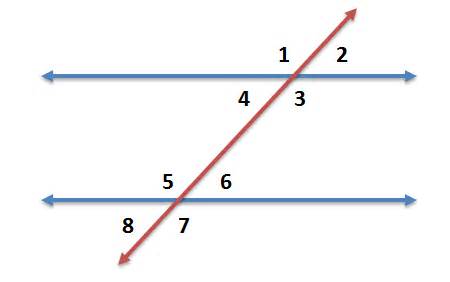
If angle 1 is 135 degrees, how many degrees is angle 3?
a)
45 degrees
b)
65 degrees
c)
135 degrees
d)
225 degrees
151.
If angle 6 is 25 degrees, how many degrees is angle 7?
a)
25 degrees
b)
50 degrees
c)
90 degrees
d)
155 degrees
152.
Two objects that are the same shape but not the same size are _______.
a)
Congruent
b)
Vertical
c)
Similar
d)
Complementary 
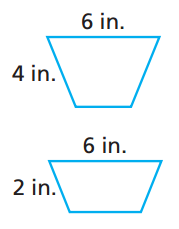
153.
Are the following similar? Why or why not?
a)
Yes
b)
No, the corresponding angles are not equal.
c)
No, the ratios of the corresponding sides are not equal.
154.
Tell whether the two figures are similar. Explain your reasoning.
a)
Yes, similar because they are the same shape and side lengths are proportional.
b)
No, not similar because they are the same shape, but side lengths are not proportional.
c)
Yes, same shape
d)
No, different sizes
155.
The pair of figures is similar. Find the missing side.
a)
x = 1
b)
x = 3
c)
x = 9
d)
x = 5
156.
Line segment AB is reflected across the y-axis to form segment CD. Then, segment CD is rotated 180 degrees clockwise to form segment EF. Which statement is TRUE about this transformation?
a)
Line segment EF is the same length as line segment AB.
b)
Line segment EF is longer than line segment CD.
c)
Line segment EF is shorter than line segment AB.
d)
Line segment CD is shorter than line segment AB.
157.
Suppose two lines are parallel to each other and are also parallel to the y-axis on the coordinate plane. The two lines are both rotated 270 degrees around the origin. Which statement is true about both lines after the rotation?
a)
They will still be parallel to each other.
b)
They will be perpendicular to each other.
c)
They will still be parallel to the y-axis.
d)
The lines will no longer be parallel to each other.
158.
Suppose a rectangle undergoes a reflection across the x-axis and a translation 5 units down. Which of the statements is true?
a)
The resulting rectangle will be congruent to the original rectangle regardless of the order of the rotation and the translation.
b)
The resulting rectangle will be congruent to the original rectangle only if the rotation occurs before the translation.
c)
The resulting rectangle will be congruent to the original rectangle only if the translation occurs before the rotation.
d)
The resulting rectangle will not be congruent to the original rectangle regardless of the order of the rotation and the translation.
159.
One side of a triangle on the coordinate plane is 4 units long. If it undergoes a dilation about the origin with a scale factor of 2, what will the length be?
a)
2
b)
4
c)
8
d)
16
160.
Suppose a triangle with the vertices A(–2, 4), B(–1, –3), and C(4, –2) were dilated, with the center of dilation at the origin and with a scale factor of 2. What will be the coordinates of C'?
a)
(2, -1)
b)
(8, -4)
c)
(8, 4)
d)
(2, 1)
161.
Suppose a triangle with the vertices A(–2, 4), B(–1, –3), and C(4, –2) were dilated, with the center of dilation at the origin and with a scale factor of 2. What will be the coordinates of A'?
a)
(-1, 2)
b)
(-4, 8)
c)
(-4, -8)
d)
(2, -1)
162.
Which of the statements is true about the graphed triangles?
a)
They are similar, because one can be obtained by dilating the other about the origin with a scale factor of 2.
b)
They are similar, because one can be obtained by dilating the other about the origin with a scale factor of 1/2.
c)
They are not similar, because one can be obtained by dilating the other about the origin with a scale factor of 2.
d)
They are not similar, because one can be obtained by dilating the other about the origin with a scale factor of 1/2.
163.
A pentagon graphed on a coordinate plane underwent a rotation about the origin, a reflection across the y–axis, a translation down, and a dilation with a scale factor of 3 from its center to produce another pentagon. Which of these statements is true about the original pentagon and the new pentagon?
a)
They are similar.
b)
They may or may not be similar, depending on the number of units translated.
c)
They may or may not be similar, depending on the number of degrees rotated.
d)
They are not similar.
164.
Choose the correct scale factor:
a)
2
b)
3
c)
1/3
d)
1/2
165.

The point A (8, 12) was dilated to become point A' (2, 3). What was the scale factor?

a)

½

b)

¼

c)

4

d)

2

166.

When A(3, 6) is under a dilation of 2 what are the coordinates of A'?

a)

(3, 6)

b)

(1.5, 3)

c)

(6, 12)

d)

(12, 6)

167.
When a dilation has a scale factor greater than one, the dilation is an enlargement.
a)
True
b)
False
168.
In a dilation what mathematical operation is used with the scale factor?
a)
addition 
b)
subtraction 
c)
multiplication 
d)
division 
169.
What is the scale factor from ABCD to MNOP?
a)
2/3
b)
3/2
c)
2
d)
3
170.

If your SF = 0.8, what type of dilation is it?

a)

Reduction

b)

Enlargement

171.

If your SF = 2.5, what type of dilation is it?

a)

Reduction

b)

Enlargement