
 Worksheets
Literary Analysis and Comprehension Skills
Total questions: 100
Worksheet time: 50mins
According to the passage, what do the K-12 grade-specific standards define?
The full range of metacognitive strategies
End-of-year expectations and a cumulative progression to meet college and career readiness
Only reading and writing skills
The process of communication only
Fill in the blank: The Standards use individual grade levels in kindergarten through grade 8 to provide useful specificity; the Standards use two-year bands in grades ____ to allow schools, districts, and states flexibility in high school course design.
9-12
6-8
7-10
10-11
The Standards mandate that students must use a particular writing process or the full range of metacognitive strategies.
True
False
The main focus of the Standards as described in the section 'A focus on results rather than means' is:
Achieving desired outcomes rather than prescribing specific methods
Following strict procedures for all tasks
Emphasizing traditional teaching methods
Prioritizing resources over results
According to the passage, what is blended into the Standards as a whole to prepare students for college, workforce training, and life in a technological society?
Research and media skills
Physical education techniques
Historical fiction analysis
Foreign language fluency
Which grades are divided into two sections for literacy standards, and what are the two sections?
Grades 6-12 are divided into two sections: one for ELA and the other for history/social studies, science, and technical subjects.
Grades K-5 are divided into two sections: one for math and the other for science.
Grades 3-8 are divided into two sections: one for reading and the other for writing.
Grades 9-12 are divided into two sections: one for literature and the other for mathematics.
The Standards place a special emphasis on informational text, especially as students advance through the grades.
True
False
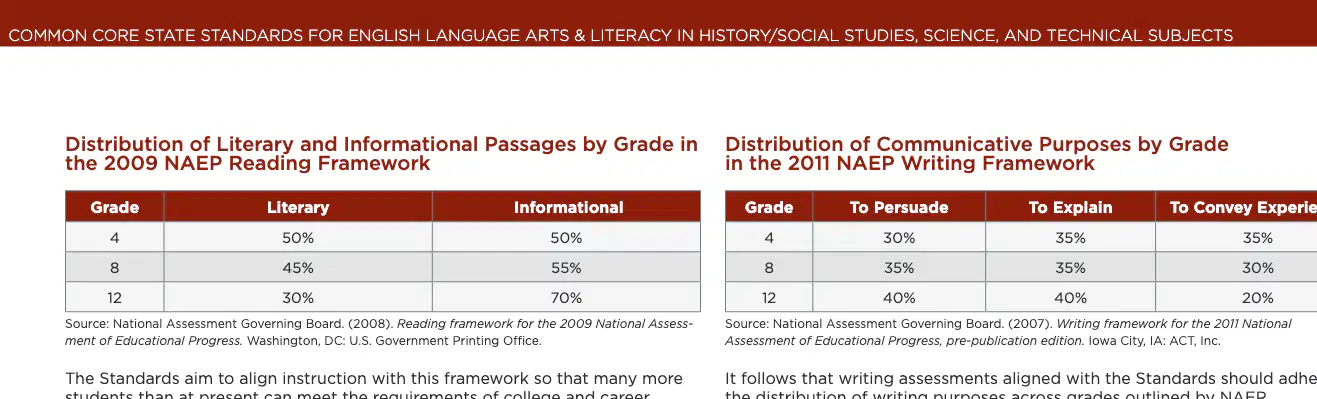
According to the 2009 NAEP Reading Framework, what percentage of passages for grade 4 are literary?
30%
45%
50%
70%
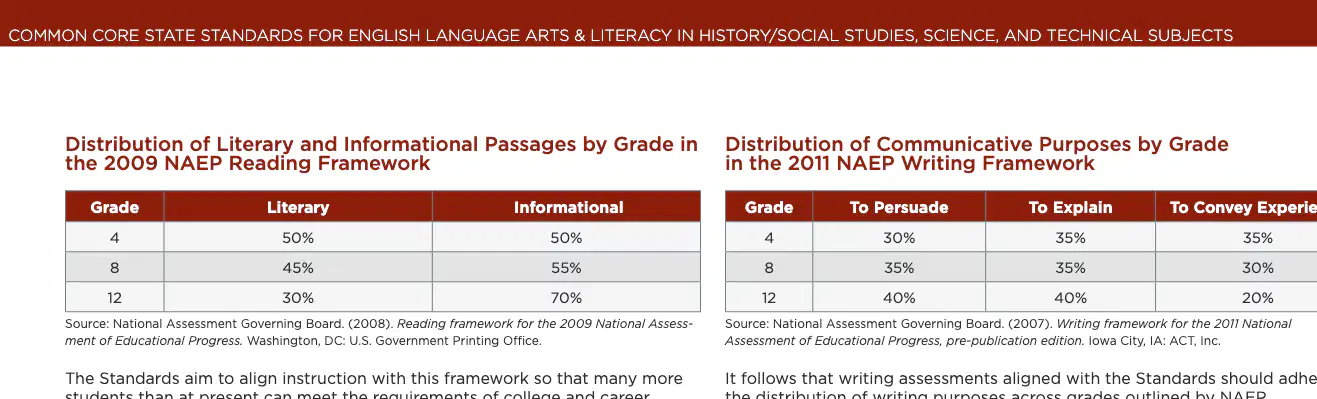
According to the 2009 NAEP Reading Framework, what percentage of passages for grade 12 are informational?
30%
50%
55%
70%
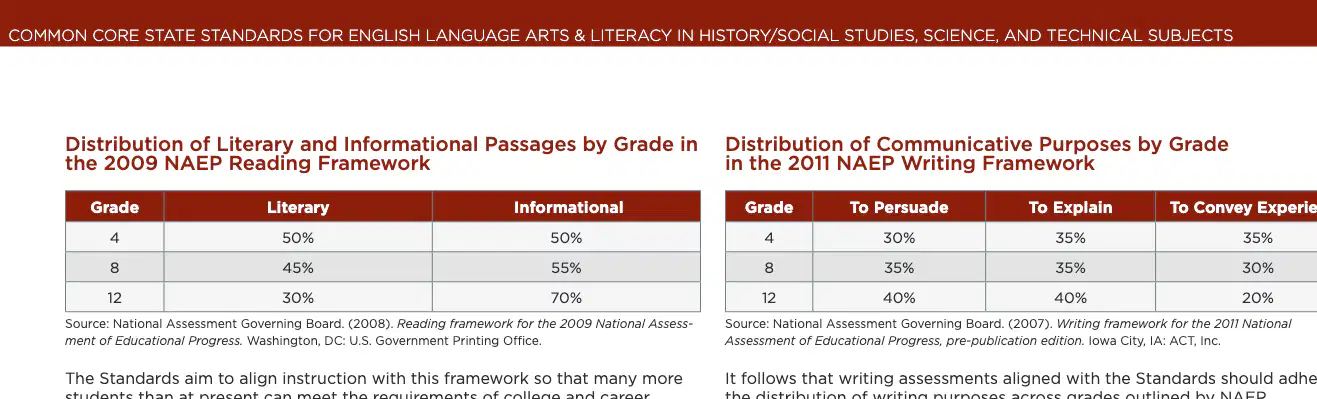
According to the 2011 NAEP Writing Framework, what is the primary purpose of writing for grade 12 students?
To Persuade
To Explain
To Convey Experience
To Entertain
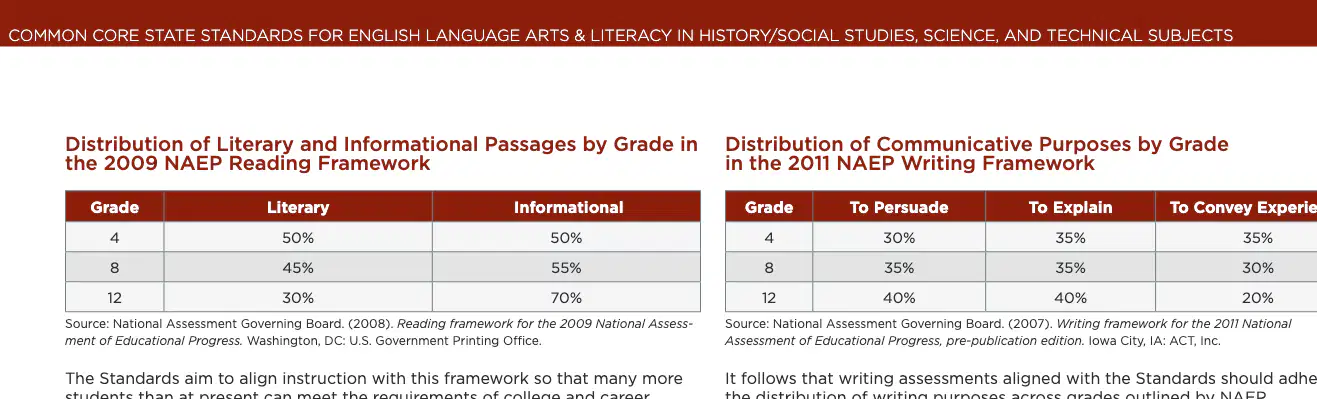
Fill in the blank: In grade 8, the percentage of literary passages according to the 2009 NAEP Reading Framework is __%.
45%
30%
60%
75%
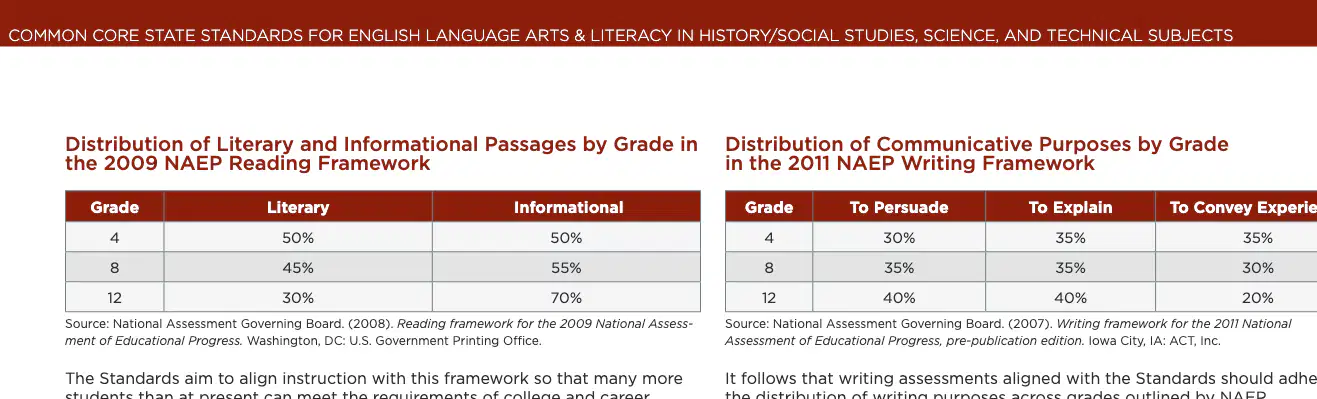
Fill in the blank: In grade 4, the percentage of writing to persuade according to the 2011 NAEP Writing Framework is __%.
30%
10%
50%
70%
The NAEP assessment framework requires that 70 percent of student reading across grades should be informational texts.
True
False
According to the passage, what is the main focus of writing throughout high school?
Arguments and informative/explanatory texts
Poetry and drama
Personal narratives
Fictional stories
According to the passage, which standards apply to both literary and informational texts?
The CCR anchor standards for Reading apply to both literary and informational texts.
Only the writing standards apply to both literary and informational texts.
The speaking and listening standards apply exclusively to literary texts.
The language standards apply only to informational texts.
According to the document, the Standards define what all students are expected to know and be able to do, but do not specify how teachers should teach.
True
False
Who decides what additional content is taught?
Teachers and curriculum developers
Students
Parents
School janitors
The Standards do not define the nature of advanced work for students who meet the Standards prior to the end of high school. What should be available for these students?
Advanced work in areas such as literature, composition, language, and journalism
Remedial classes in basic mathematics
Extended breaks from academic activities
Mandatory physical education courses only
Do the Standards set grade-specific standards but not define intervention methods or materials necessary to support students who are well below or well above grade-level expectations?
True
False
What should reading allow for students with disabilities?
The use of Braille, screen-reader technology, or other assistive devices
Only handwritten notes
Access to printed textbooks only
No additional support
Do the ELA and content area literacy components described in the Standards define the whole of college and career readiness?
True
False
According to the text, what is one way students demonstrate independence in their learning?
By relying on others for answers
By comprehending and evaluating complex texts without significant scaffolding
By ignoring the speaker's key points
By refusing to use digital reference materials
What does it mean for students to build strong content knowledge?
They memorize facts without understanding
They engage with works of quality and substance across a wide range of subject matter
They avoid research and study
They only focus on one subject area
How do students respond to the varying demands of audience, task, purpose, and discipline?
They use the same communication style for every situation
They adapt their communication and set and adjust purpose for reading, writing, speaking, listening, and language use as warranted by the task
They ignore the audience's needs
They avoid using evidence in their work
According to the text, what does it mean to comprehend as well as critique?
To accept everything an author says without question
To be engaged and open-minded, but also discerning, questioning assumptions and assessing reasoning
To ignore the author's or speaker's assumptions
To focus only on the premises of a text
Why do students value evidence, according to the text?
Because it makes their writing longer
Because it helps them support their own points in writing and speaking, making their reasoning clear
Because it is required by teachers
Because it is easier than forming their own opinions
How do students use technology and digital media strategically and capably?
By avoiding technology in their learning
By thoughtfully enhancing their reading, writing, speaking, listening, and language use, and integrating what they learn online with offline learning
By using only one type of technology
By ignoring the strengths and limitations of technological tools
What are the three main sections of the Standards for English Language Arts & Literacy?
A comprehensive K–5 section, two content area–specific sections for grades 6–12 (one for ELA and one for history/social studies, science, and technical subjects).
A K–8 section, a 9–10 section, and a 11–12 section.
A reading section, a writing section, and a mathematics section.
A primary section, a secondary section, and a post-secondary section.
Each section of the Standards is divided into which strands?
K–5 and 6–12 ELA have Reading, Writing, Speaking and Listening, and Language strands; the 6–12 history/social studies, science, and technical subjects section focuses on Reading and Writing.
K–5 and 6–12 ELA have only Reading and Writing strands; the 6–12 history/social studies, science, and technical subjects section focuses on Speaking and Listening.
All sections are divided only by grade level, not by strands.
Each section is divided into Mathematics, Science, and Social Studies strands.
Each grade-specific standard has an accompanying grade-specific standard translating the broader CCR statement into grade-appropriate end-of-year expectations.
True
False
How can individual CCR anchor standards be identified?
By their strand, CCR status, and number (e.g., CCR.6).
By the grade level and subject only.
By the author of the standard.
By the year the standard was published.
Who is responsible for which portion of the Standards in grades K–5?
A single K–5 section lists standards for reading, writing, speaking, listening, and language across the curriculum, reflecting the fact that most or all of the instruction students in these grades receive comes from one teacher.
Each subject has a separate section for standards, with different teachers responsible for each area.
Only reading and writing standards are included in the K–5 section, with other subjects addressed in later grades.
The standards are divided by grade and subject, with specialized teachers for each discipline.
What does Standard 10 define in the Reading standards?
A grade-by-grade 'staircase' of increasing text complexity.
The use of multimedia in reading instruction.
Assessment methods for reading comprehension.
Guidelines for classroom library organization.
Which strand emphasizes the ability to plan, revise, edit, and publish as key skills?
Writing: Text types, responding to reading, and research.
Reading: Key ideas and details.
Speaking and Listening: Comprehension and collaboration.
Language: Conventions and vocabulary.
Appendix A contains supplementary material on which topics?
Reading, writing, speaking and listening, and language usage as well as a glossary of key terms.
Mathematics and statistics only.
Science experiments and lab safety guidelines.
Historical timelines and biographies.
Fill in the blank: To meet the College and Career Readiness Anchor Standards for Reading, students should be able to read closely to determine what the text says explicitly and to make logical inferences from it; cite specific textual evidence when writing or speaking to support conclusions drawn from the text. The skill described here is ________.
reading closely and making logical inferences with textual evidence
summarizing without evidence
memorizing facts only
reading for entertainment only
Fill in the blank: To meet the College and Career Readiness Anchor Standards for Reading, students should be able to determine central ideas or themes of a text and analyze their development; summarize the key supporting details and ideas. The skill described here is ________.
determining central ideas or themes and summarizing key details
identifying the author's tone and mood
making predictions about future events
analyzing figurative language and imagery
Fill in the blank: To meet the College and Career Readiness Anchor Standards for Reading, students should be able to analyze how and why individuals, events, and ideas develop and interact over the course of a text. The skill described here is ________.
analyzing development and interaction of individuals, events, and ideas
summarizing the main idea of the text
identifying the author's purpose
making predictions about the text
Fill in the blank: To meet the College and Career Readiness Anchor Standards for Reading, students should be able to interpret words and phrases as they are used in a text, including determining technical, connotative, and figurative meanings, and analyze how specific word choices shape meaning or tone. The skill described here is ________.
interpreting words and phrases and analyzing word choice
summarizing the main idea of the text
identifying the author's purpose
making predictions about the text
Fill in the blank: To meet the College and Career Readiness Anchor Standards for Reading, students should be able to analyze the structure of texts, including how specific sentences, paragraphs, and larger portions of the text (e.g., a section, chapter, scene, or stanza) relate to each other and the whole. The skill described here is ________.
analyzing the structure of texts
summarizing the main idea
identifying the author's purpose
making personal connections
Fill in the blank: To meet the College and Career Readiness Anchor Standards for Reading, students should be able to assess how point of view or purpose shapes the content and style of a text. The skill described here is ________.
assessing point of view or purpose
summarizing the text
identifying figurative language
analyzing sentence structure
Fill in the blank: To meet the College and Career Readiness Anchor Standards for Reading, students should be able to integrate and evaluate content presented in diverse media and formats, including visually and quantitatively, as well as in words. The skill described here is ________.
integrating and evaluating content in diverse media and formats
summarizing fictional narratives
memorizing vocabulary lists
writing persuasive essays
Fill in the blank: To meet the College and Career Readiness Anchor Standards for Reading, students should be able to delineate and evaluate the argument and specific claims in a text, including the validity of the reasoning as well as the relevance and sufficiency of the evidence. The skill described here is ________.
delineating and evaluating arguments and claims
summarizing the main idea of a text
identifying the author’s purpose
analyzing the structure of a poem
Fill in the blank: To meet the College and Career Readiness Anchor Standards for Reading, students should be able to analyze how two or more texts address similar themes or topics in order to build knowledge or to compare the approaches the authors take. The skill described here is ________.
analyzing and comparing multiple texts
summarizing a single text
memorizing vocabulary words
identifying the main character
Fill in the blank: To meet the College and Career Readiness Anchor Standards for Reading, students should be able to read and comprehend complex literary and informational texts independently and proficiently. The skill described here is ________.
reading and comprehending complex texts independently and proficiently
writing persuasive essays with advanced vocabulary
solving complex mathematical equations quickly
memorizing historical dates and events
Kindergarten: With prompting and support, ask and answer questions about key ______ in a text.
details
colors
numbers
animals
Grade 1: Ask and answer questions about key details in a ______.
text
song
picture
game
Grade 2: Ask and answer such questions as who, what, where, when, why, and how to demonstrate understanding of key details in a ______.
text
picture
song
game
Kindergarten: With prompting and support, retell familiar stories, including key ______.
details
colors
numbers
animals
Grade 1: Retell stories, including key details, and demonstrate understanding of their central ______ or lesson.
message
character
setting
author
Grade 2: Recount stories, including fables and folktales from diverse cultures, and determine their central message, lesson, or ______.
moral
character
setting
author
Kindergarten: With prompting and support, identify characters, settings, and major events in a ______.
story
picture
song
game
Grade 1: Describe characters, settings, and major events in a ______, using key details.
story
picture
song
game
Grade 2: Describe how characters in a story respond to major events and ______.
challenges
books
animals
seasons
Kindergarten: Ask and answer questions about unknown words in a ______.
text
song
picture
game
Grade 1: Identify words and phrases in stories or poems that suggest feelings or appeal to the ______.
senses
numbers
colors
shapes
Grade 2: Describe how words and phrases (e.g., regular beats, alliteration, rhymes, repeated lines) supply rhythm and meaning in a story, poem, or ______.
song
book
picture
game
Kindergarten: Recognize common types of texts (e.g., storybooks, ______).
poems
cars
tables
shoes
Grade 1: Explain major differences between books that tell stories and books that give information, drawing on a wide reading of a range of text ______.
types
colors
authors
covers
Grade 2: Describe the overall structure of a story, including describing how the beginning introduces the story and the ending concludes the ______.
action
setting
character
problem
Kindergarten: With prompting and support, name the author and illustrator of a story and define the role of each in telling the ______.
story
picture
song
game
Grade 1: Identify who is telling the story at various points in a ______.
text
picture
song
game
Grade 2: Acknowledge differences in the points of view of characters, including by speaking in a different voice for each character when reading dialogue ______.
aloud
quietly
silently
quickly
Kindergarten: With prompting and support, describe the relationship between illustrations and the story in which they appear (e.g., what moment in a story an illustration ______).
depicts
writes
reads
sings
Grade 1: Use illustrations and details in a story to describe its characters, setting, or ______.
events
colors
numbers
animals
Grade 2: Use information gained from the illustrations and words in a print or digital text to demonstrate understanding of its characters, setting, or ______.
plot
author
title
cover
Kindergarten: With prompting and support, compare and contrast the adventures and experiences of characters in familiar ______.
stories
songs
games
places
Grade 1: Compare and contrast the adventures and experiences of characters in ______.
stories
numbers
animals
colors
Grade 2: Compare and contrast two or more versions of the same story (e.g., Cinderella stories) by different authors or from different ______.
cultures
animals
planets
colors
Kindergarten: Actively engage in group reading activities with purpose and ______.
understanding
confusion
hesitation
distraction
Grade 1: With prompting and support, read prose and poetry of appropriate complexity for grade ______.
1
2
3
4
Grade 2: By the end of the year, read and comprehend literature, including stories and poetry, in the grades 2–3 text complexity band proficiently, with scaffolding as needed at the high end of the ______.
range
class
subject
lesson
Referring explicitly to the text when answering questions means:
Quoting or mentioning specific parts of the text to support your answer.
Giving your personal opinion without using the text.
Ignoring the text and making up your own answer.
Summarizing the text without any references.
The central message, lesson, or moral of a story you have read recently is:
The main idea or lesson the story conveys
The names of the main characters
The setting of the story
The number of pages in the story
A character's actions in a story can affect the events by:
Changing what happens next in the story
Making the story shorter
Adding more characters to the story
Changing the setting of the story
Grade 3: Determine the meaning of words and phrases as they are used in a text, distinguishing literal from nonliteral language. What is the difference between literal and nonliteral language?
Literal language means exactly what it says, while nonliteral language uses words in a creative or figurative way.
Literal language is always funny, while nonliteral language is always serious.
Literal language is used only in poems, while nonliteral language is used in stories.
Literal language is about animals, while nonliteral language is about people.
A stanza in a poem is:
a group of lines forming a unit
a single word in a poem
the title of the poem
the poet's name
You can tell if your point of view is different from the narrator's by:
Noticing if you have different thoughts or feelings about events in the story.
Agreeing with everything the narrator says.
Ignoring the narrator's opinions.
Only focusing on the main character's actions.
Grade 3: Illustrations in a story help readers understand the story by:
Creating mood, emphasizing aspects of a character or setting
Making the story longer
Replacing the need for words
Showing only the main character
What does it mean to compare and contrast stories written by the same author about the same or similar characters?
It means to find similarities and differences in the themes, settings, and plots of the stories.
It means to read the stories very quickly without understanding them.
It means to only talk about the characters' names in the stories.
It means to rewrite the stories in your own words without comparing them.
Reading independently and proficiently means:
Being able to understand and enjoy stories, dramas, and poetry on your own without help.
Needing help from a teacher to read stories and poems.
Only reading books that are below your grade level.
Reading quickly without understanding the text.
An inference is:
a conclusion drawn from evidence and reasoning
a direct observation
a random guess
a proven fact
Finding the theme of a story involves:
Identifying the underlying message or main idea
Counting the number of characters
Focusing only on the setting
Memorizing all the events
Grade 4: To describe a character in depth, what should you do?
Draw on specific details in the text, such as a character’s thoughts, words, or actions.
Only mention the character’s name.
Guess what the character is like without using the text.
Describe only the setting of the story.
If something is described as 'Herculean', it means:
It requires great strength or effort.
It is very small and insignificant.
It is extremely fast.
It is very old and ancient.
What is one major difference between a poem and a drama?
A poem often uses verse, rhythm, and meter, while a drama includes dialogue and stage directions.
A poem always has a cast of characters, while a drama does not.
A drama is written in paragraphs, while a poem is written in chapters.
A drama uses rhyme in every line, while a poem never does.
The difference between first-person and third-person narration is:
First-person uses 'I' or 'we,' while third-person uses 'he,' 'she,' or 'they.'
First-person uses 'he,' 'she,' or 'they,' while third-person uses 'I' or 'we.'
First-person and third-person both use 'I' and 'we.'
First-person and third-person both use 'he,' 'she,' or 'they.'
A movie version of a story can be different from the book because:
It may change or leave out certain scenes or descriptions from the book.
It always uses the exact same words as the book.
It never shows any visual differences from the book.
It is always longer than the book.
A common theme found in stories from different cultures is:
The struggle between good and evil
The invention of technology
The importance of sports
The discovery of new planets
Scaffolding in reading refers to:
Providing support to help students understand texts
Reading without any assistance
Ignoring difficult words while reading
Memorizing texts without comprehension
It is important to quote accurately from a text because:
it helps explain what the text says and supports inferences.
it makes the text longer and more complicated.
it allows you to change the meaning of the text.
it shows you have memorized the text without understanding it.
Characters' responses to challenges help reveal the theme of a story by:
showing how their actions and choices reflect important ideas or messages
describing the setting in detail
focusing only on the plot twists
ignoring the characters' emotions
Grade 5: Comparing two characters in a story can be done by looking at specific details such as how they interact with each other. Which of the following is a way to compare two characters in a story?
By examining how they interact with each other
By ignoring their actions
By only reading the title of the story
By focusing only on the setting
A metaphor is:
a comparison between two unlike things without using 'like' or 'as'
a direct statement of fact
a question about two objects
a comparison using 'like' or 'as'
Chapters help organize a story by:
Dividing the story into sections that build the overall structure
Introducing new characters in every chapter
Making the story shorter
Removing important events from the story
A narrator’s or speaker’s point of view influences how events are described in a story. How can a narrator's point of view change the way a story is told?
It can change how readers understand characters and events.
It always makes the story longer.
It has no effect on the story.
It only changes the setting of the story.
Pictures in a graphic novel can add to the story by:
Showing emotions and actions that words may not fully describe.
Making the story longer without adding meaning.
Distracting from the main events of the story.
Replacing the need for any written text.
Comparing stories in the same genre means:
Looking at how stories with similar themes and topics are approached differently or similarly.
Reading only one story from a genre.
Ignoring the themes and topics of the stories.
Comparing stories from different genres only.
Reading at the high end of the text complexity band means:
Engaging with texts that are at the most challenging level appropriate for a grade band.
Reading only simple and easy texts.
Choosing books that are below your grade level.
Avoiding complex vocabulary and ideas.
What should a Kindergarten student do with prompting and support when reading a text?
Ask and answer questions about key details in a text.
Draw pictures of the book's cover only.
Skip reading and play outside instead.
Only look at the pictures without talking about them.

