
 Worksheets
The Communication Process
Total questions: 78
Worksheet time: 39mins
What is the communication process?
The exchange of information, feelings, needs, and preferences between two people
The process of writing a letter
The act of reading a book
The process of making a phone call
What is the goal of communication?
To win an argument
To establish a mutual understanding of the meaning of a message
To speak as much as possible
To avoid listening
Fill in the blank: The communication process involves ________, observing, and processing.
listening
talking
writing
drawing
Which of the following is NOT part of the communication process?
Listening
Observing
Processing
Ignoring
Fill in the blank: The communication process includes listening, ________, and processing.
observing
writing
drawing
ignoring
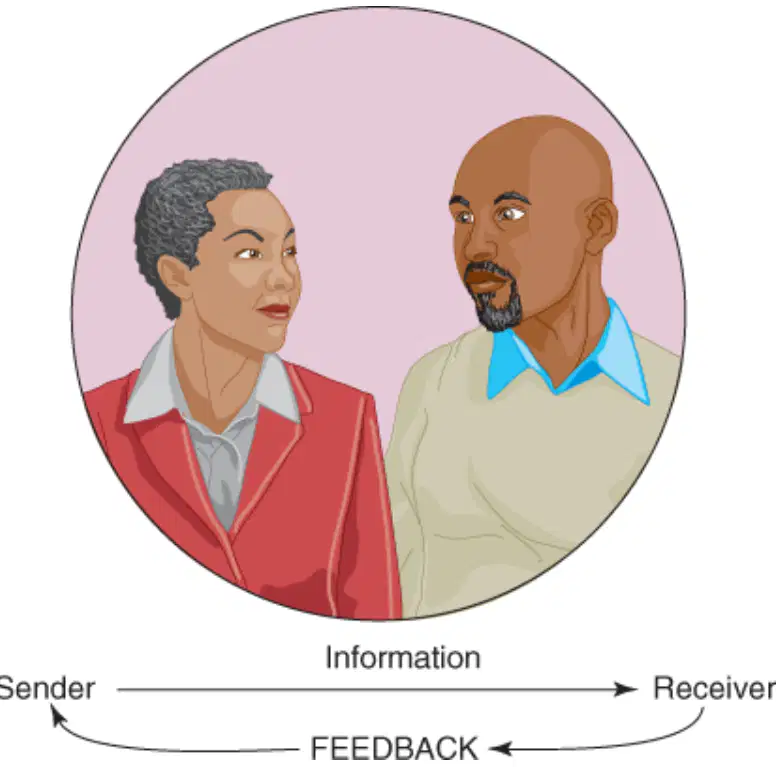
Who is responsible for sending information in the communication process?
Sender
Receiver
Feedback
Channel
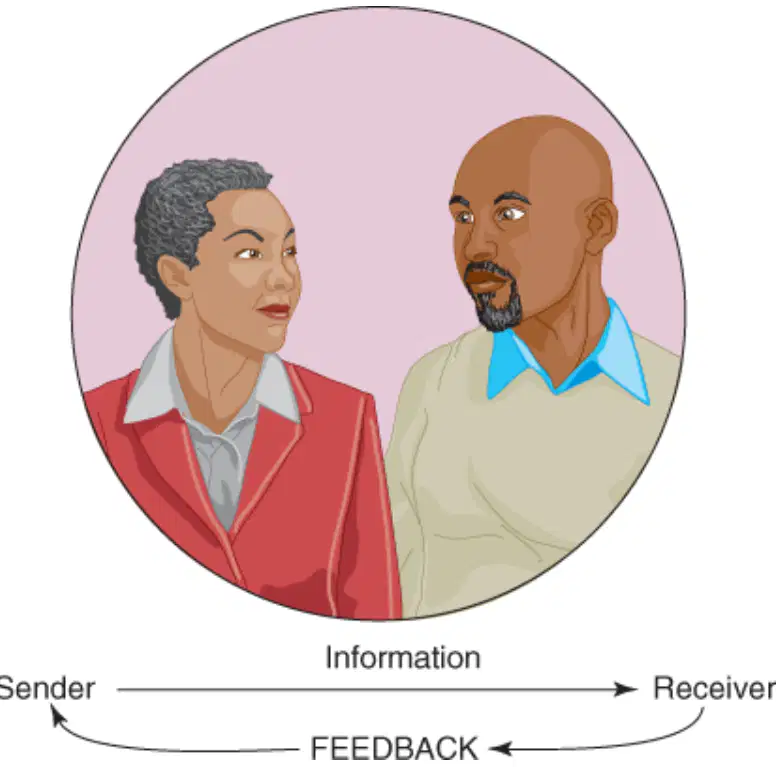
Refer to the diagram of the communication process. What is the term for the response given by the receiver back to the sender?
Information
Feedback
Message
Channel
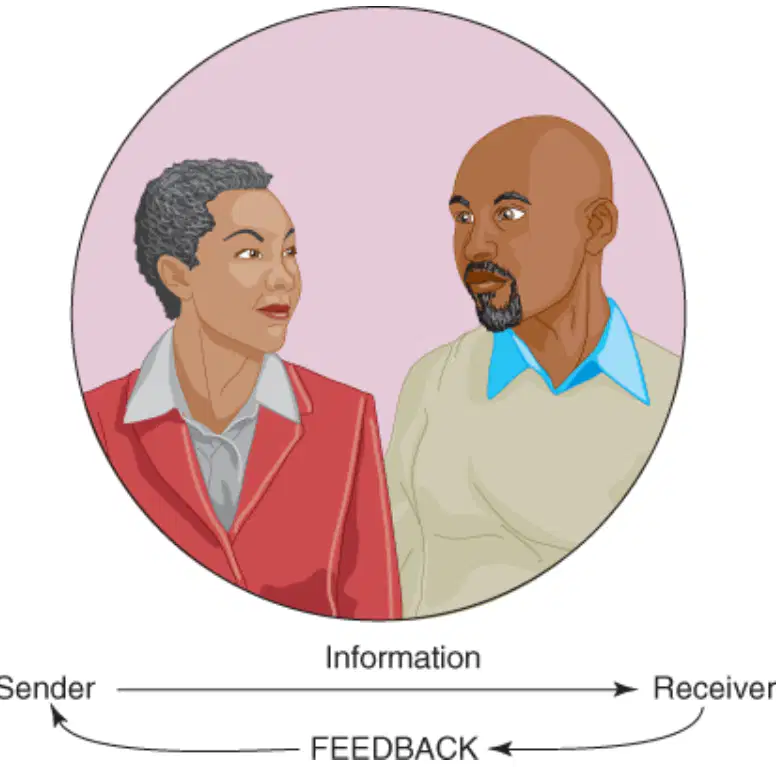
In the communication process, the _______ receives the information from the sender.
receiver
transmitter
channel
encoder
Which of the following is dependent on age, education, developmental level, and culture?
Nonverbal Communication
Verbal Communication
Both A and B
None of the above
Feelings can be expressed verbally by a speaker through changes in ________, pace, and tone of voice.
pitch
volume
gesture
expression
Which of the following are examples of nonverbal communication?
Facial expressions
Posture
Gestures
All of the above
Nonverbal communication is usually less conscious and more ________.
indirect
deliberate
explicit
intentional
Nonverbal communication conveys more of what a person feels, thinks, and means than what is stated in words.
True
False
Fill in the blank: In proxemics, the 'Intimate' personal space ranges from physical contact to _____?
18 inches
3 feet
6 feet
12 inches
Fill in the blank: In proxemics, the 'Casual-personal' personal space ranges from _____ to 4 feet.
18 inches
6 inches
3 feet
5 feet
Fill in the blank: In proxemics, the 'Social-consultative' personal space ranges from _____ to 12 feet.
4 feet
2 feet
8 feet
10 feet
Fill in the blank: In proxemics, the 'Public' personal space is _____ if possible.
12 feet
3 feet
6 inches
2 feet
Which of the following is a factor that affects communication?
Personal space
Body position
Language
All of the above
Fill in the blank: Nurses need to ensure they use language that is clear, is unequivocal, and is free of _____
bias
emotion
humor
complexity
What must you do to be sensitive to an individual's culture in communication? Fill in the blank: To be sensitive to an individual's culture, you must ___.
recognize and respect the accepted patterns of communication in that culture
ignore cultural differences and communicate as you normally would
assume everyone communicates the same way regardless of culture
focus only on your own communication style
What does 'attitude' refer to in the context of communication? Fill in the blank:
the manner, disposition, feeling, or position toward a person or thing
the physical appearance of a person
the language spoken by a person
the volume of a person's voice
What is the denotative meaning of a word?
Emotional association
Literal meaning
Cultural pattern
Attitude
What is the connotative meaning of a word?
A) Emotional association
B) Literal meaning
C) Cultural pattern
D) Attitude
Active listening uses all ________.
senses
words
voices
thoughts
Active listening interprets ________ and ________ messages.
verbal; nonverbal
written; spoken
visual; auditory
direct; indirect
In active listening, the mind focuses on the interaction and detects ________ as well as the spoken words.
feelings
colors
numbers
distances
Active listening builds trusting relationships between the ________ and the ________.
nurse; patient
doctor; nurse
teacher; student
manager; employee
Which of the following terms refer to words that can elicit emotional responses, resulting in a message that is distorted and altered?
Nonverbal communication
Therapeutic communication
Connotative meaning
Shared meaning
Words such as “love,” “death,” and “cancer” are emotionally charged; they can elicit emotional responses that distract the listener because of past experiences, resulting in a message that is distorted and altered. What is this an example of?
Denotative meaning
Literal meaning
Connotative meaning
Figurative meaning
What is the definition of the 'Passive or avoidant' style of communication?
Behaviors that avoid confrontation and the inability to share feelings or needs with others
Behaviors characterized by putting one’s own needs, rights, and feelings before those of others
Behaviors that encourage open and honest communication
Behaviors that focus on teamwork and collaboration
Which style of communication is characterized by putting one’s own needs, rights, and feelings before those of others?
Passive or avoidant
Aggressive
Assertive
Collaborative
Fill in the blank: Assertive behavior style is characterized by standing up for one's self without ______ the basic rights of others.
violating
supporting
ignoring
prioritizing
What is the main focus of therapeutic communication?
Nurse-centered communication
Patient-centered communication
Doctor-centered communication
Family-centered communication
Fill in the blank: The goal of therapeutic communication is to promote a greater understanding of a patient's _______, concerns, and feelings.
needs
medications
appointments
diagnoses
The nurse helps patients explore their own thoughts and feelings as part of therapeutic communication.
True
False
The nurse encourages expression of thoughts and feelings in therapeutic communication by:
actively listening and providing a nonjudgmental environment
giving advice and directing the conversation
interrupting to offer personal opinions
ignoring emotional cues from the patient
Which of the following is a therapeutic communication technique?
Providing general leads
Ignoring the patient
Giving orders
Withholding information
Which of the following is a therapeutic communication technique?
Using silence
Interrupting frequently
Criticizing responses
Giving commands
Which of the following is a therapeutic communication technique?
Offering self
Withdrawing support
Blaming the patient
Avoiding eye contact
Which of the following is a therapeutic communication technique?
Open-ended questions
Yes/no questions only
Making assumptions
Giving ultimatums
Which of the following is a therapeutic communication technique?
Restatement (validation)
Dismissing feelings
Changing the subject
Giving advice
Which of the following is a therapeutic communication technique?
Seeking clarification
Assuming understanding
Ignoring questions
Giving orders
Which of the following is a therapeutic communication technique?
Giving information
Withholding information
Lying to the patient
Avoiding explanations
Which of the following is a therapeutic communication technique?
Reflection
Judging responses
Criticizing choices
Ignoring concerns
Which of the following is a therapeutic communication technique?
Looking at alternatives
Forcing decisions
Limiting options
Ignoring preferences
Which of the following is a therapeutic communication technique?
Summarizing
Overcomplicating explanations
Avoiding closure
Repeating information unnecessarily
Which of the following is a barrier to therapeutic communication?
Asking questions that can be answered with a 'yes' or 'no' response
Listening actively
Encouraging patient expression
Maintaining eye contact
Giving false reassurance is a barrier to therapeutic communication.
True
False
Asking too many personal questions is considered a barrier to therapeutic communication.
True
False
Giving advice is a barrier to therapeutic communication.
True
False
Belittling a patient's feelings is a barrier to therapeutic communication.
True
False
Expressing disapproval is a barrier to therapeutic communication.
True
False
What does the 'I' in ISBARR stand for?
Introduction
Investigation
Instruction
Inspection
What does the 'S' in ISBARR stand for?
Situation
Solution
System
Support
What does the 'B' in ISBARR stand for?
Background
Benefit
Balance
Benchmark
What does the 'A' in ISBARR stand for?
Assessment
Analysis
Action
Assignment
What does the first 'R' in ISBARR stand for?
Recommendation
Report
Review
Response
What does the second 'R' in ISBARR stand for?
Readback or
Report
Respond
Review
What does the 'Q' in ISBARR stand for?
Questions
Quality
Quickness
Query
Fill in the blank: The nurse must use ______ communication, with language that is very clear and concise.
focused
vague
ambiguous
casual
Fill in the blank: Organize thoughts to deliver ______ and ______ information.
clear and concise
vague and lengthy
confusing and scattered
random and incomplete
Anger is a strong emotion made up of ______ and resentment.
guilt
joy
fear
happiness
Which of the following are examples of anger?
Screaming
Sarcasm
Rudeness
All of the above
Incivility is interacting with a lack of ______ and respect toward others.
courtesy
intelligence
wealth
ambition
Incivility can be:
Only verbal
Only nonverbal
Both verbal and nonverbal
None of the above
According to the slide on 'Anger, Hostility, and Incivility in Communication (continued)', we must establish a culture of respect for one another and our coworkers and use strategies that inhibit incivility. Which organization is mentioned in relation to this statement?
The American Nurses Association (ANA)
The World Health Organization (WHO)
The Centers for Disease Control and Prevention (CDC)
The Joint Commission
Which of the following is a benefit of using humor in communication?
It creates a relaxed and sociable atmosphere
It increases anxiety
It makes nurses less approachable
It is always appropriate in all situations
Fill in the blank: Humor allows patients to step out of their sick role, establish rapport, trust, passes time, and helps to ________ anxiety.
relieve
increase
ignore
cause
Nurses who use humor may appear more approachable.
True
False
According to the passage, is humor appropriate when dealing with highly emotional or difficult issues?
Yes
No
Which of the following groups do nurses communicate with as part of the health-care team?
Patients
Families
Other members of the health-care team
All of the above
Upward communication in the health-care team refers to communication with people in positions of authority, such as _________.
Team leaders, supervisors
Patients and their families
Colleagues at the same level
Support staff
Communication with health-care providers often involves receiving orders. These orders can be:
Written
Over the phone
Both A and B
None of the above
Which of the following is a downward communication technique used by nurses when communicating with those they supervise?
Job instruction
Patient diagnosis
Medication administration
Patient discharge
Fill in the blank: One of the downward communication techniques is ________.
Job rationale
Grapevine communication
Upward appraisal
Peer review
Which of the following is NOT listed as a downward communication technique?
Practices and procedures
Feedback
Patient admission
Role modeling
Fill in the blank: Downward communication techniques include job instruction, job rationale, practices and procedures, feedback, and ________.
Role modeling
Brainstorming
Upward delegation
Peer review
Feedback is considered a downward communication technique for nurses supervising others.
True
False

