
 Worksheets
(Savvas 7.1) Ch 7.1 Describing Reactions
Total questions: 20
Worksheet time: 20mins
The numbers that appear before the formulas in a balanced chemical equation are called
subscripts
mass numbers
atomic numbers
coefficients
Number of sulfur atoms (S) in the formula 2K₂SO₃
The starting materials in a chemical reaction are called the
products
reactants
starters
enders
Balance the equation.
__P4 + __O2 → __P2O3
balanced
1, 2, 3
2, 1, 3
1, 3, 2
What is the arrow in a chemical equation?
H2O → H2 + O2
Reactant
Product
What is the H2O in this chemical equation?
H2O → H2 + O2
Reactant
Product
What is the H2 in this chemical equation?
H2O → H2 + O2
Reactant
Product
What is the O2 in this chemical equation?
H2O → H2 + O2
Reactant
Product
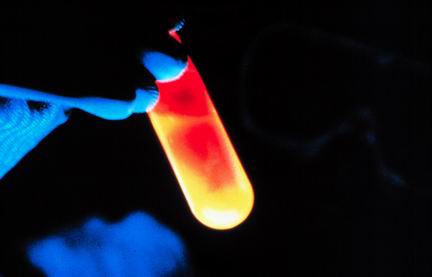
releases energy in the form of light or heat
a solid forms when one liquid is poured into another liquid
The symbol for a substance that is a solid in a chemical reaction is ______
(s)
(l)
(aq)
(g)
The symbol for a substance that is dissolved in water in a chemical reaction is ______
(s)
(l)
(aq)
(g)
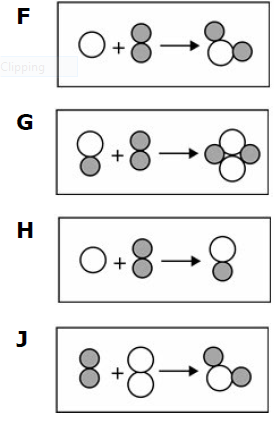
Which of the following models best demonstrates a balanced chemical equation?
F
G
H
J
Balance the equation
__Na + __Cl2 → __NaCl
2, 1, 2
1, 1, 2
already balanced
2, 1, 1
Balance the equation
__H2O2 → __H2O + __O2
A subscript is a number written below and to the right of an element symbol in a chemical formula of the substance. It indicates the number of atoms of that element in the substance. Which law states that a subscript cannot be changed when balancing a chemical equation?
Law of Conservation of Mass
Law of Definite Proportions
Law of Multiple Proportions
Periodic Law
A coefficient is a number that is written before a chemical formula in a balanced chemical equation. Coefficients are used to ensure that the number of atoms of each element is the same on both the reactant and product sides of the chemical equation. Which law states that atoms cannot be created or destroyed in a chemical reaction?
Law of Conservation of Mass
Law of Definite Proportions
Law of Multiple Proportions
Periodic Law

What is the molar mass of one mole of carbon?
6 g/mol
12.011 g/mol
6 amu
12.011 amu

Why is the mole used in chemistry?
The mass of atoms is in AMUs which is too hard to convert to grams.
A dozen is not a scientific amount.
Chemists needed to make chemistry easier to understand.
It makes counting large numbers of small particles easier.
The mole is 6.022 x 10²³ atoms or molecules of any substance. This number is also named after the scientist who calculated it. This was:
Perrin
Avogadro
Einstein
Newton

