
 Worksheets
Oceanography: Ocean Deposits & Others
Total questions: 85
Worksheet time: 1hrs 25mins
The deepest part of the ocean; long, narrow ditches
Tectonic plates
Trenches
Divergent boundary
Continental shelves
True or false : Deep-Ocean Trenches are underwater canyons?
False
True
At subduction zones, a deep (a) forms under the ocean.
When subduction happens, which plate will go under the other plate?
the denser one
the less dense one
the one with magma
the one with mountains
What is the primary geological process occurring at ocean trenches?
Subduction
Sea floor spreading
Volcanism
Erosion
Which ocean trench is the deepest known on Earth?
Mariana Trench
Tonga Trench
Puerto Rico Trench
Java Trench
What type of plate boundary is most commonly associated with ocean trenches?
Convergent
Divergent
Transform
Passive
Which of the following best describes the shape of an ocean trench?
Long, narrow, and deep
Wide and shallow
Circular and deep
Flat and wide
What is a significant consequence of the subduction process at ocean trenches?
Earthquakes
Hurricanes
Tornadoes
Floods
Which scientific instrument is commonly used to measure the depth of ocean trenches?
Sonar
Seismograph
Thermometer
Barometer

Where is the Mariana Trench located?
The north side of China
The Federated States of Micronesia.
The western Pacific east of the Philippines
The Northeastern United States

How do fish in the mariana trench catch their prey?
Light
Biolumenesence
Shallow
No bones.

Why can't people survive going down the mariana trench swimming?
Elephants, oxygen, sunlight.
Hot, no sun, food.
Pressure, darkness, cold temperature.
Your bones would be mush.
Flat, deep, and smooth part of the ocean floor. Cold temperatures are found here.
Continental Shelf
Abyssal Plain
Continental Slope
Seamounts
gently sloping shelf of land extending from the shoreline to the continental edge
Continental Slope
Continental Shelf
Continental Rise
Abyssal Plain
Sharp underwater hill connecting the continent to the ocean floor?
Ocean
Coral Reef
Plankton
Continental Slope
Sand, Mud, and rocks that are found on the ocean floor are called?
Jet Stream
Photosynthesis
Ocean Current
Sediments
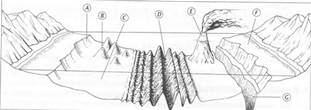
What is letter B?
Cont. Shelf
Mid-Ocean Ridge
Volcanic Island
Seamount
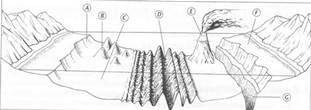
What is letter E?
Volcanic Island
Seamount
Mid-Ocean Ridge
Abyssal Plain
What formations happen at ocean to ocean subduction zones?
Deep oceanic trenches
Mountain Ranges
Coastal Volcanic Mountains
Both mountains and volcanoes
Which of the following is formed at Continent- Continent convergent boundaries?
Volcanic Mountains
Earthquakes
Non-volcanic Mountain Ranges
Both volcanoes and earthquakes
The cascade mountain range, where Mt. St Helens is formed, was created because of a ...
Subduction zone
Ocean - continent boundary
crust melted and magma formed volcanic mountain ranges
All of those above
Which is an example of a plate boundary which has formed the Himalayas Mountain Range (home of Mt. Everest!) ?
Ocean- continent convergent boundary
Ocean- Ocean convergent boundary
Continent - continent Convergent boundary
Transform boundary
Sea-floor Spreading is the theory that new sea floor is added at ________________
Mid-ocean trenches
Deep ocean trenches
Continents
What are Mid-Ocean Ridges?
A chain of underwater waterfalls
A chain of underwater volcanos
A deep canyon in the ocean floor
What is one piece of evidence of seafloor spreading?
scientist found animals at the bottom of the sea
expanding continents
scientist found pillow shaped rocks (made from lava)
Another piece of evidence for sea-floor spreading is the age of rocks. Choose the true statement about this evidence below:
The age of the oceanic crust gets older the further you go from a mid-ocean ridge.
The age of the oceanic crust gets younger the further you go from a mid-ocean ridge.
The age of the oceanic crust is the exactly the same no matter where you go.
Magnetic stripes in the oceanic crust are another piece of evidence that prove the ocean floor....
Was made at the same time
Has different ages throughout the floor (newer crust next to MOR)
Changes the magnetic poles of the earth
The oceanic crust _________ when it reaches the continental crust.
subducts (sinks)
rises
expands
___________ help explain why Earth is not getting any larger even though new oceanic crust is being added from mid-ocean ridges.
earthquakes
subduction zones
fossils
volcanoes
What happens when Subduction occurs?
Parts of the crust fall into the mantle at deep-ocean trench
Parts of the crust fall into the mantle at a mid-ocean ridge
Parts of the crust fall into space
How does sea floor spreading help prove continental drift?
It explains HOW the supercontinent of Pangea formed
It explains HOW the continents broke apart, due to the ocean floor pushed apart at a MOR (mid-ocean ridge)
It explains WHY the seafloor is shrinking & pulling the continent into deep ocean trenches
Why did no one believe Alfred Wegener when he claimed that there was a supercontinent - even though he had evidence such as coastlines fitting together & fossils?
He was not a scientist
He was one weird dude
He had nothing to support that they once fit together
He could not explain HOW the continents moved
Sea-floor Spreading is the theory that new sea floor is added at ________________
Mid-ocean trenches
Deep ocean trenches
Continents
What are Mid-Ocean Ridges?
A chain of underwater waterfalls
A chain of underwater volcanos
A deep canyon in the ocean floor
What is one piece of evidence of seafloor spreading?
scientist found animals at the bottom of the sea
expanding continents
scientist found pillow shaped rocks (made from lava)
Another piece of evidence for sea-floor spreading is the age of rocks. Choose the true statement about this evidence below:
The age of the oceanic crust gets older the further you go from a mid-ocean ridge.
The age of the oceanic crust gets younger the further you go from a mid-ocean ridge.
The age of the oceanic crust is the exactly the same no matter where you go.
Magnetic stripes in the oceanic crust are another piece of evidence that prove the ocean floor....
Was made at the same time
Has different ages throughout the floor (newer crust next to MOR)
Changes the magnetic poles of the earth


Which means the same as lithogenous?
biogenous
authigenous
terrigenous
cosmogenous
Most neritic sediments are ___________: they are eroded from the land and carried to streams, where they are transported to the ocean.
terrigenous
biogenous
hydrogenous
cosmogenous
This type of sediment is the most abundant. They originate on the continents or islands from erosion, volcanic eruptions, and blown dust.
terrigenous
biogenous
hydrogenous
cosmogenous

Radiolarians and diatoms (both microorganisms with silicon based shells) are both examples of
sources of siliceous oozes
near large animals
sources of calcerous oozes
only found on land
Foraminifera (calcium based) shells are likely to be deposited and form
calcerous ooze
silaceous ooze
heavy metal deposits
uranium deposits
What is the effect of El Niño on coastal upwelling?
Coastal upwelling strengthens, leading to increased fish populations
Coastal upwelling weakens, leading to reduced fish populations
Coastal upwelling remains unaffected by El Niño
Coastal upwelling stops completely during El Niño
Which marine environment is the transition between land and ocean?
Intertidal zone
Benthic environment
Pelagic environment
Neritic zone
What is the largest marine environment?
Intertidal zone
Benthic environment
Neritic province
Oceanic province
Which ocean zone is known for having the most biodiversity?
Abyssal zone
Intertidal zone
Neritic zone
Oceanic zone
What is the main reason for the ocean's blue color?
Reflection of the sky
Absorption and scattering of sunlight
Presence of algae
Depth of the ocean
which of the Indian Island lies between India and Srilanka
Elephanta
Nicobar
Rameshawaram
Salsette
McMohan line is an international boundary between
India and Myanmar
India and Pakistan
India and China
India and Bangladesh
Which 5 country boundaries meet at Indira Col
India, Pakistan, Afghanistan, Nepal, Burma
India, Pakistan, Uzbekistan, Nepal, Burma
India, Pakistan, Afghanistan, China, Tajikistan
India, Pakistan, Bhutan, Nepal, China
Which one of the following is a trans himalayan river or Antecedent river
Sutlej
Ganga
Yamuna
Ghaghara
Jog Falls is formed by which river
Tapti
Netravati
Saravati
Ravivati
The largest Fresh water lake in India is
Kolleru
Wular
Pangong Tso
Tso Morari
Which of the following is a nonrenewable resource extracted from the ocean?
Seaweed
Fish
Crude oil
Ocean currents

