
 Worksheets
Neural & Big data
Total questions: 92
Worksheet time: 55mins
_________ type of model, the algorithm learns from a dataset which is labelled, and the algorithm uses the answer keys to evaluate its accuracy on the training data.
Supervised learning
UnSupervised learning
Reinforcement learning
In this type of model, the algorithms work towards accomplishing the goal or try to improve the performance in a particular task. This is used in gaming.
Reinforcement learning
Supervised Learning
UnSupervised Learning
•In this type of model, the algorithm learns and makes sense by extracting features/patterns from the unlabelled dataset provided (The system will evaluate by itself)
Unsupervised learning
supervised learning
Reinforcement learning
Information flows from
Input layer -> Hidden Layer-> Output layer
Feedforward Network
Backpropagation
Every Artificial Neural must have at least ______
two layers.
three layers.
four layers.
The neurons in the human brain regularly change their threshold.
True
False
The current Artificial Neural Networks are part of _____.
Weak Al systems.
Strong Al systems.
Future Al systems.
How many output layers are required for constructing an Artificial Neural Network?
1
3
2
Conventional Computing is deterministic in nature while Neural Computing is Probabilistic in nature.
True
False
Backpropagation calculates the ____ and propagates it back to earlier layers.
value
error
data
Neural network is inspired by .......
Human heart
Human lungs
Human brain
human eyes
Neural Network is type of ........... which is type of machine learning
natural language processing
deep learning
speech
robotics

What is this?
artificial intelligence
algorithm
neural network

How many hidden layers have the following Neural network
4
5
6
7
The most common Neural networks consist of three network layers: input layer, output layer and .............
neuron layer
hidden layer
algorithm layer
The input data travels over the network (propagates) until it reaches the output layer. This is called........
Back propagation
Forward propagation
This is where we insert the initial data for the neural network.
Input
Hidden Layer
Output
_________ type of model, the algorithm learns from a dataset which is labelled, and the algorithm uses the answer keys to evaluate its accuracy on the training data.
Supervised learning
UnSupervised learning
Reinforcement learning
In this type of model, the algorithms work towards accomplishing the goal or try to improve the performance in a particular task. This is used in gaming.
Reinforcement learning
Supervised Learning
UnSupervised Learning
•In this type of model, the algorithm learns and makes sense by extracting features/patterns from the unlabelled dataset provided (The system will evaluate by itself)
Unsupervised learning
supervised learning
Reinforcement learning
Every Artificial Neural must have at least ______
two layers.
three layers.
four layers.
The current Artificial Neural Networks are part of _____.
Weak Al systems.
Strong Al systems.
Future Al systems.
How many output layers are required for constructing an Artificial Neural Network?
1
3
2
A neural network trained with labelled data is an example of . . .
supervised learning
unsupervised learning
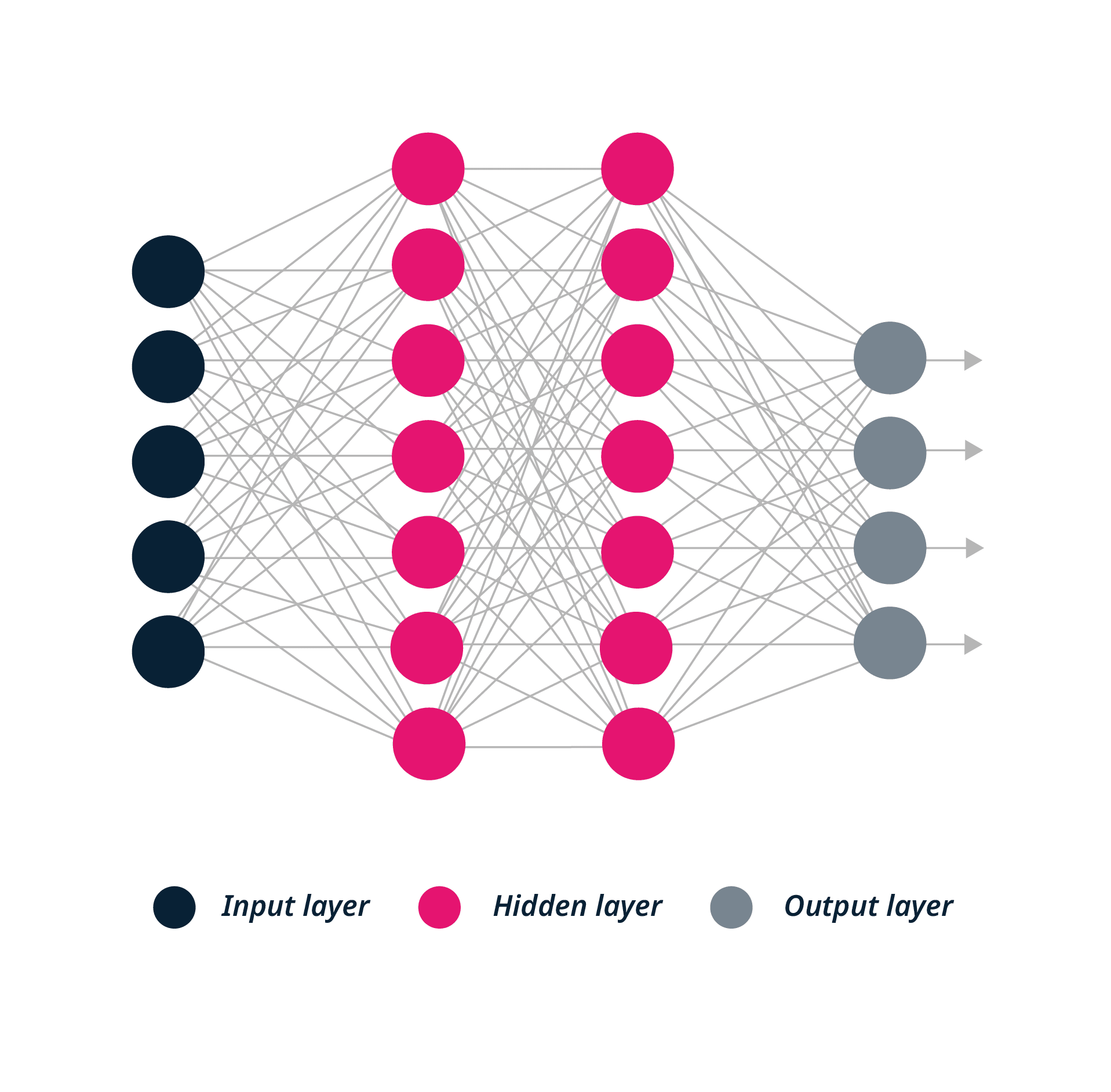
In the neural network shown,
each neuron is connected to a random selection of other neurons in the network
every neuron is connected to every other neuron in the network
every neuron is conected to every neuron in the next layer
each neuron is connected to a random selection of neurons in the next layer
The activation of each neuron in a layer is determined by the __________ of the activations of all the neurons in the previous layer.
weighted sum
sum
level
How many hidden layers have the following Neural network
4
5
6
7

How many output layers have the following Neural network?
1
2
3
4
The most common Neural networks consist of three network layers: input layer, output layer and .............
neuron layer
hidden layer
algorithm layer
Which of the following is the feature of a neural network?
Extract information without any programming
All of these
Learn itself and produced the trained data
Provide the filtered information without input
The actual processing occurs in which of the following layer?
input layers
hidden layers
output layers
None of these
Reinforcement learning relies on output-related information.
True
False
In _________ learning only inputs provided but no output related data.
Supervised
Reinforcement
Un supervised
Semi-Supervised
1) It is the ability of a digital computer or computer-controlled robot to perform tasks commonly associated with intelligent beings
Automated computations
IOT
Artificial Intelligence
None of these
(a) is a domain of AI related to data systems and processes, in which the system collects numerous data, maintains data sets and derives meaning/sense out of
them.
It is a subset of Artificial Intelligence which enables machines to improve at tasks with experience (data).
Machine Learning
AI
Deep Learning
In this model, the machine is trained with huge amounts of data which helps it in training itself around the data. Such machines are intelligent enough to develop algorithms for themselves.
AI
ML
DL
Domain of the game Rock Paper Scissors is
NLP
Data Science
Computer Vision
Domain of the AI used by price comparison websites is
Data Science
NLP
CV
The __________ helps us to summarise all the key points of Problem Scoping.
Problem Statement Template
4 Ws Problem canvas
Data Features
Identify the correct order of the 4Ws problem canvas.
Who? Why? When? Where?
Who? What? Where? Why?
Why? What? Where Who?
Why? What? Who? Where?
Under this block, you also gather evidence to prove that the problem you have selected actually exists. Identify the block of 4W problem canvas.
Who
what
where
why
The AI domain which can be used to predict AIR quality index is
NLP
CV
Data Science
Which of the following is not an AI application?
Google Maps
Writing suggestion in gmail
Face Recognition
Kahoot
4Ws Problem Canvas _______________________.
make many lives better and help our country achieve these goals.
helps in evaluating the solution related to the problem
helps in identifying the key elements related to the problem.
All of these
computational model inspired by the structure and functions of the biological neural network
artificial neural network (ANN)
neuron
weight
bias
collection of 'neurons' operating together at a specific depth within a neural network
Bias
Weight
Neuron
Layers

How many images would you need of a cat, for example, to train a neural network ?
about 10
a few hundred
one image
thousands
Which is the correct structure of a Neural Network?
Output, Hidden Layer, Input
Hidden Layer, Input, Output
Input, Hidden Layer, Output
Which one of these is not an area of AI?
computer vision/image recognition
voice recognition
web design
robotics
This is a system of Programs and Data Structures that mimics the operation of the human brain :
Intelligent Network
Decision Support System
Neural Network
Genetic Programming
Which of the following is a common application of AI in everyday life?
Sending emails
Autonomous vehicles
Printing documents
Automated lawn mowers
What is the primary goal of artificial intelligence?
To replace human workers entirely
To simulate human intelligence and perform tasks that typically require human intelligence
To enhance the emotional capabilities of machines
To process large amounts of data quickly and accurately
What is big data analytics?
D. The process of analyzing data for entertainment purposes
C. The process of analyzing only structured data
B. The process of examining big data to uncover information
A. The process of examining small data sets
Why is big data analytics important?
B. To increase the amount of unstructured data
C. To complicate decision-making processes
A. To make data-driven decisions that can improve business outcomes
D. To reduce operational efficiency
How does big data analytics work?
A. By ignoring unstructured data
B. By analyzing only historical data
C. By collecting, processing, cleaning, and analyzing data
D. By focusing on basic business intelligence queries
What are some benefits of using big data analytics?
D. Improved decision-making, talent shortages, and data accessibility
C. Cost savings, improved decision-making, and real-time intelligence
B. Better customer engagement, optimize risk management strategies, and talent shortages
A. Real-time intelligence, better-informed decisions, and cost increases
What is the primary goal of predictive analytics in big data?
A. To analyze historical data for insights
B. To forecast future trends and outcomes
C. To organize unstructured data efficiently
D. To focus on real-time data processing
What role does machine learning play in big data analytics?
A. Machine learning is not relevant in big data analytics
B. Machine learning helps in automating data analysis tasks
C. Machine learning is only used for data storage in big data analytics
D. Machine learning is limited to basic statistical analysis in big data
What is associated with the three words :velocity, volume and variety
Large Files
Databases
Big Data
Huge Data
Which of the traditional IT systems presents better analytical options when used with Big Data technologies
conventional data
conventional databases
Data warehouses
None of the above
________ is the process of examining very large and varied data sets.
Machine Learning
Data warehousing
Big Data Analytics
Cloud Computing
Point out the wrong statement.
Hardtop processing capabilities are huge and it’s real advantage lies in the ability to process terabytes & petabytes of data
All the programs should confirms to HDFS model in order to work on Hadoop platform
The programming model used by HDFS is difficult to write and test.
All of the mentioned
The characteristics of big data includes __________.
composition
condition
context
All of the above
_____________ deals with the nature of the data as it is static or varied with time.
composition
condition
context
none of the above
Which of the characteristic(s) of big data is relatively more concerned to data science?
Velocity
Variety
Volume
All of the above
Select the wrong statement from the following list of statements:
The big volume indeed represents Big Data
The data growth and social media explosion have changed how we look at the data
Big Data is just about lots of data
All of the mentioned
Comment on the statement: 3V’s are not sufficient to describe big data.
True
False
Which of the language(s) are used to do Big Data Analytics
C
Python
Java
R
SQL
Data Veracity means _______________________.
imprecise data
uncertain data
variety of data
different sources of data
_____________ tells about where the data has been generated.
composition
context
condition
class
Which of the following statement(s) is/are true?
Descriptive analysis can be more useful for defining future studies
Correlation does imply causation
Inference is commonly the goal of statistical model
None of the mentioned
What is Big Data?
Big Data is a type of software used for data storage.
Big Data refers to small data sets that are easy to analyze.
Big Data is only relevant to social media platforms.
Big Data is large and complex data sets that require advanced tools and techniques for processing and analysis.
Name three key technologies used in Big Data.
Excel, PowerPoint, Word
Hadoop, Spark, NoSQL databases
MySQL, PostgreSQL, Oracle
Java, Python, C++
What is the purpose of predictive analytics?
To collect data without any analysis.
The purpose of predictive analytics is to forecast future events and trends based on historical data.
To analyze current market conditions only.
To eliminate the need for data altogether.
Describe one method of predictive analytics.
Decision trees
Cluster analysis
Regression analysis
Time series analysis
What is the difference between data analytics and data analysis?
Data analysis is a broader term encompassing various techniques.
Data analytics and data analysis are interchangeable terms.
Data analytics is a specific process within data analysis.
Data analytics is a broader term encompassing various techniques, while data analysis is a specific process within data analytics.
List two common tools used for data analysis.
Tableau
Microsoft Excel, Python
R
Google Docs
What role does machine learning play in predictive analytics?
Predictive analytics does not involve any data analysis techniques.
Machine learning is only used for image recognition tasks.
Machine learning is primarily focused on hardware improvements.
Machine learning enhances predictive analytics by identifying patterns in data to forecast future events.
Explain the concept of network analysis.
Network analysis is the study of relationships and interactions within a network using nodes and edges.
Network analysis focuses solely on the speed of data transmission.
Network analysis is the process of creating physical network hardware.
Network analysis is a method for designing software applications.
How is network analysis applied in computational social science?
Network analysis focuses solely on the physical infrastructure of the internet.
Network analysis is used to study relationships and interactions in social networks, revealing patterns and influences among individuals or groups.
Network analysis is used to track financial transactions in banking systems.
Network analysis is primarily concerned with the technical performance of computer networks.
What are the challenges associated with Big Data technologies?
Increased reliance on manual data entry
Challenges include data storage, processing speed, data quality, integration, security, and skilled personnel.
Limited use of cloud computing
High cost of traditional storage solutions
Define data mining and its significance in data analytics.
Data mining is the process of discovering patterns and knowledge from large amounts of data, and it is significant in data analytics for transforming raw data into actionable insights.
Data mining is only used for financial forecasting.
Data mining involves only the collection of data without analysis.
Data mining is the same as data entry and has no significance in analytics.
What is the importance of data visualization in data analysis?
Data visualization complicates data analysis.
Data visualization enhances understanding, reveals insights, and improves communication in data analysis.
Data visualization is only useful for large datasets.
Data visualization has no impact on decision-making.
How can Big Data impact decision-making processes?
Big Data has no effect on decision-making as intuition is always more reliable.
Big Data impacts decision-making by providing data-driven insights that improve accuracy and speed.
Big Data only benefits marketing departments and does not influence other areas of decision-making.
Big Data slows down decision-making processes by overwhelming teams with irrelevant information.
What are some ethical considerations in data analytics?
Statistical analysis methods
Data privacy, informed consent, bias avoidance, data security, transparency.
Data visualization techniques
Machine learning algorithms
Describe a real-world application of predictive analytics.
Predictive analytics in finance for stock market analysis.
Predictive analytics in agriculture for crop yield prediction.
Predictive analytics in healthcare for forecasting patient admissions.
Predictive analytics in marketing for customer segmentation.

