
 Worksheets
AP Microeconomics Unit 2
Total questions: 64
Worksheet time: 32mins
Which of the following describes a demand schedule?
The price that a good or service should be set at to maximize revenue
The quantity of a product that consumers are willing and able to buy at each unit price
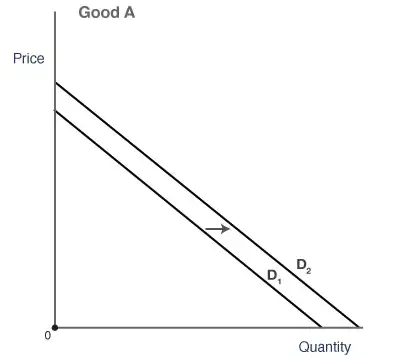
Which of the following would explain the change illustrated in the graph?
The number of buyers has gone down in the market for Good A
Average consumer income has decreased, with Good A being an inferior good
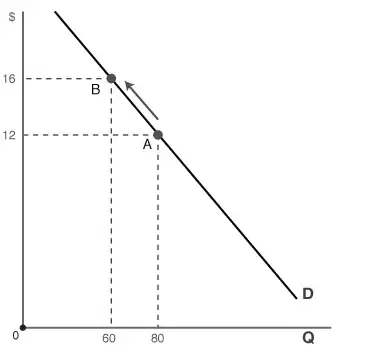
How does this graph illustrate the law of demand?
Quantity demanded has decreased due to an increase in unit price from $12 to $16
Demand has increased in response to incentives
Chips and salsa are complements. What will happen if the price of chips goes up?
The demand for chips and salsa will decrease
The quantity demanded for chips will decrease and the demand for salsa will decrease
Which of the following provides a clear example of the substitution effect?
After the price of bananas is lowered, Andrew goes out and buys two more bunches
Stacy wanted ice cream a bit more than a cupcake but chose the cupcake when the price of ice cream increased
Which of the following is an incentive to buy more of a good or service for nearly everyone?
Regulations make it more difficult to produce
The product has a lower price
What is the primary incentive of each producer to make widgets?
The primary incentive of each producer to make widgets is to bring in revenue and maximize profit
bleh
What would happen to the supply of widgets if there was a technological advance that lowered the cost to make widgets? Explain.
If there were a technological advancement that lowered the cost to make widgets, then the supply of widgets would increase. This is due to the fact that new tech would lower the resource costs so more widgets could be made. If more widgets are made, that is an increase in supply
bleh

Assuming production costs decreased, and that producers will not charge less than $1, would the quantity supplied of widgets be more or less than 11 widgets? Explain
Assuming the market situation from part (b), and that producers will not charge less than $1, the quantity supplied of widgets would be more than 11 widgets. The technological advancement lowered the production costs of the widget, so producers are able to make more at every price level.
bleh

Identify whether the price of widgets from $8 to $7 is elastic, unit elastic, or inelastic. Explain.
The price of widgets from $8 to $7 is elastic because the elasticity coefficient calculated with the point formula is 2.64, which expresses elasticity as it's greater than 1 and the revenue increased significantly when the price decreased
bleh
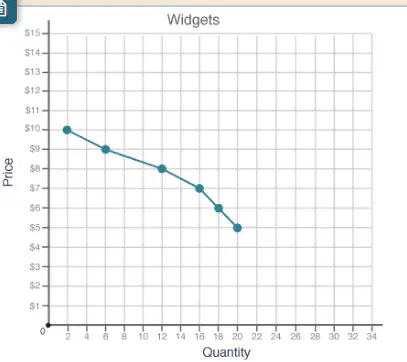
What is the price of widgets that maximizes the hardware store's revenue? Explain.
The price of widgets that maximizes the hardware store's revenue is $7. By creating a demand schedule, then multiplying the demand and price to find the total revenue, it was clear that at $7 the highest amount of money would be made, which is $112
bleh
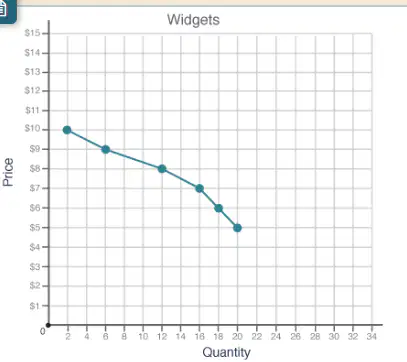
The price of widgets is $9. If the hardware store wants to increase its revenue, how should it change the price? Explain.
If the price of widgets is $9 and the hardware store wants to increase its revenue, then it should lower its price, by two dollars to be exact. The hardware store should lower its price because $7 is the profit-maximizing point and to get closer to that point it'd be necessary to lower the price and decreasing the price will increase revenue in the elastic range
bleh
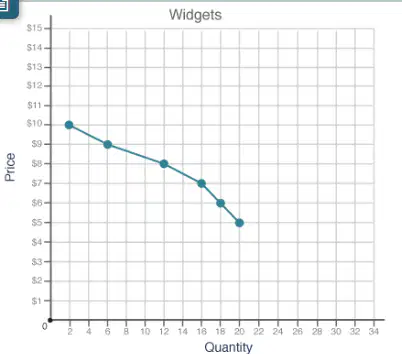
Using the midpoint formula, calculate the price elasticity of demand for widgets when price increases from $7 to $8. Identify the coefficient as elastic, unit elastic, or inelastic.
Using the midpoint formula, the elasticity coefficient when the price increases from $7 to $8 is 2.14. Since the coefficient is greater than 1, it is elastic
bleh
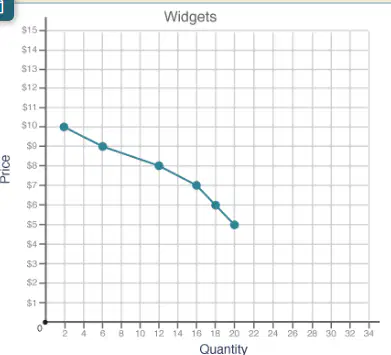
Using the midpoint formula, calculate the price elasticity of demand for widgets when price decreases from $6 to $5. Identify the coefficient as elastic, unit elastic, or inelastic.
Using the midpoint formula, the elasticity coefficient when the price decreases from $6 to $5 is 0.58. Since the coefficient is less than 1, it is inelastic
bleh
If the price of a good increases by 5% and the quantity supplied increases by 10%, which of the following is true for the given range?
The price elasticity of supply is 0.5
The price elasticity of supply is 2

Based on the supply schedule above, which of the following is true of the product's price elasticity of supply?
It is −0.6 when increasing from $1 to $2
It is 0.75 when increasing from $3 to $4
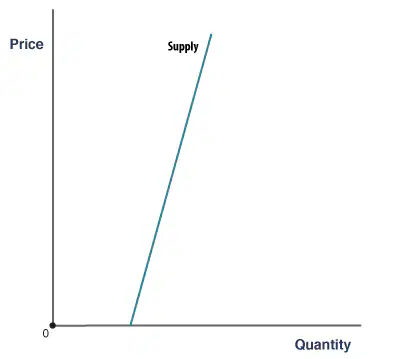
Which of the following must be true of the supply above?
The supply is relatively inelastic
The supply is relatively elastic
The suppliers of Good A are more able to increase production in response to price increases than the suppliers of Good B. This means that the suppliers of Good A
have greater production costs
have a greater price elasticity of supply
If a business increases its supply significantly based on a price increase, its price elasticity of supply is likely
inelastic
elastic
The price of apples increases by 10% and the quantity supplied increases by 5%. What is true of the supply of apples in this scenario?
It is inelastic
It is elastic
Which of the following is essential to measure the elasticity of supply?
A percentage change in quantity
The price of the good
An increase in the price of Good A by 20 percent results in a decrease in the quantity demanded of Good B by 2 percent. Goods A and B
are complements with a cross-price elasticity of demand of −0.1
are unrelated goods
Which statement is true if the quantity demanded of a good decreases by 10% while consumer incomes increase by 2%?
The income elasticity of demand is −20, and the good is inferior
The income elasticity of demand is −5, and the good is inferior
Average consumer income increases by 5%. Which of the following must be true for a normal good?
The demand for the good increases by 5%
The quantity demanded for the good increases
If the cross-price elasticity of demand between goods X and Y is 1, which of the following must be true?
An increase in the price of good X leads to a decrease in the quantity demanded of good Y
They are substitutes
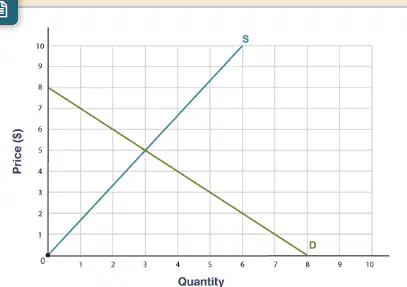
What is the equilibrium price and quantity of the sloths?
The equilibrium price of the sloths is 5 and the equilibrium quantity of the sloths is 3
bleh
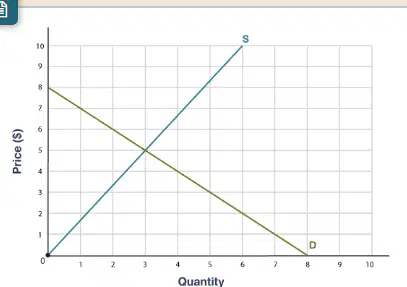
What is the total revenue for businesses at the equilibrium point?
The total revenue for businesses at the equilibrium point is $15
bleh

Calculate the producer and consumer surplus at equilibrium.
bleh
The producer surplus is $7.50 at equilibrium and the consumer surplus is $4.50 at equilibrium
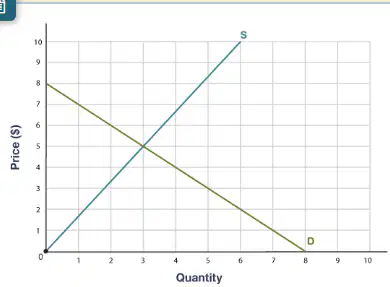
Who is benefiting more, or has a greater surplus, at equilibrium, consumers or producers?
The producer is benefiting more and has a greater surplus at equilibrium. The producer surplus is $1.50 greater than the consumer surplus
bleh
What would happen to the equilibrium price and quantity for llama sculptures as a result of the price decrease of the porcelain sloths?
As a result of the price decrease for porcelain sloths, the equilibrium price and quantity for llama sculptures decreased. Due to porcelain sloths being a substitute for llama sculptures, when the price of sloths went down, the demand for llama sculptures decreased as well. When demand shifts left quantity and price decrease
bleh
If the price decrease for glass happened at the same time as the price decrease for porcelain sloths, how would the equilibrium price and quantity for the glass llamas change? Explain.
bleh
If the price decrease for glass happened at the same time as the price decrease for porcelain sloths, the equilibrium price for glass llamas would decrease while the equilibrium quantity would be indeterminate
An increase in equilibrium price, equilibrium quantity, and producer surplus could be the result of
a decrease in demand
an increase in demand
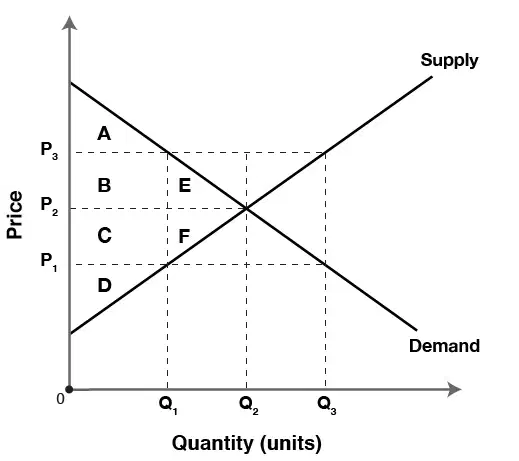
Which of the following would lead to a market surplus?
A price of P2
A price of P3
When market equilibrium shifts, which of the following statements is true about the impact on economic surplus?
Its changes depend on the elasticities of supply and demand
It will not be affected by market changes.

If the price goes from P2 to P1, ceteris paribus, what area represents the lost producer surplus?
C + D
C + F

What will be the quantity demanded if the price is set at P1?
Q3
Q1
Which statement is true about a decrease, or leftward shift, in the market demand curve?
The more elastic the demand curve, the less of a reduction to consumer surplus
The more elastic the demand curve, the greater the increase in total economic surplus
Which of the following is most likely to occur when a competitive market moves from one equilibrium to another?
A decrease in demand and increase in supply causes equilibrium price to increase but makes equilibrium quantity indeterminate
A decrease in demand decreases equilibrium price, quantity, and producer surplus
Which of the following would happen for an imported good if an import quota is imposed?
An increase in domestic consumer surplus
An increase in domestic production
Which of the following groups would benefit most from an import quota?
Foreign suppliers
Domestic suppliers
If the average global price for a good is lower than the domestic equilibrium price, domestic consumer surplus will _____ and domestic producer surplus will ______.
increase; decrease
increase; increase

The graph shows a market for a good traded internationally with an import tariff, A. The world price is B. Which of the following describes the quantity of imports with the tariff?
Q4 – Q3
Q3 – Q2
Mercuria is a producer and an importer of steel. What will happen if Mercuria’s government imposes an import tariff on steel that is above the world price?
The domestic consumption of steel will increase
There will be an increase in domestic producer surplus
Which of the following could increase domestic production of a good for which consumption is partially based on imports?
The introduction of an import tariff
A significant increase to an existing import quota
Ceteris paribus, producers increase their price from $2 to $3. Quantity demanded falls from 100 thousand units to 90 thousand units. What was the price elasticity of demand across this range?
The price elasticity of demand across this range is 0.26
bleh
A business notices that after it lowered its price it saw more quantity demanded but lower total revenue. What does this mean?
It is in the elastic part of the demand curve for its product
It is in the inelastic part of the demand curve for its product
The suppliers of Good A are more able to increase production in response to price increases than the suppliers of Good B. This means that the suppliers of Good A
have greater production costs
have a greater price elasticity of supply
Sprockets are known to have relatively elastic demand when their price increases from $1 to $2. What must be true of the change in quantity demanded over this price range?
It decreases by more than 100 percent.
It increases by more than 100 percent.
Which of the following would increase the quantity a firm would produce at every price, ceteris paribus?
A decrease in the price of a factor of production
A significant increase in opportunity cost
If a good's price elasticity of supply is unit elastic and its quantity supplied increases by 10%, what must be true?
Price must have increased by exactly 10%.
Price must have increased by less than 10%.
Given that the cross-price elasticity of goods Bee and Zee is −20 and the quantity of Bee decreases by 40 percent, which of the following statements is correct?
They are complements, and the price of Zee goes up by 2 percent
They are substitutes, and the price of Zee goes down by 2 percent
Which of the following draws the demand line?
Marginal cost
Marginal benefit
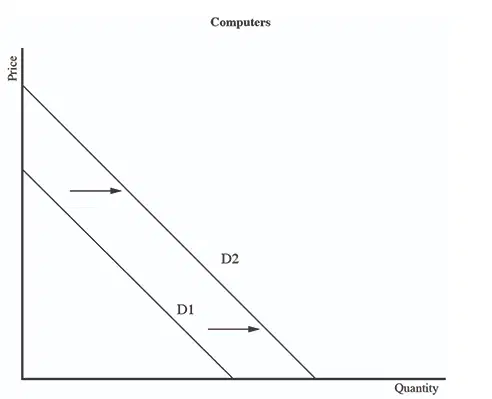
Which of the following could explain the change illustrated in the graph?
A technological breakthrough lowers production costs for computers
The price of a substitute for computers increases
According to the law of supply, a change in the price of a product itself can be represented on a supply curve as a
shift in the product supply curve
movement along the product supply curve
An economy opens itself up to international trade. What would happen if the average global price for a good is lower than the domestic equilibrium price with no government interventions?
Domestic quantity supplied would decrease, and domestic demand would increase
Domestic quantity supplied would decrease, and domestic consumption would increase
If the demand for a product is so great that firms are unable to fulfill all of the orders, what might it conclude?
There is a shortage, and the price is below equilibrium
The product is experiencing diminishing marginal returns

What area represents the producer surplus at the competitive equilibrium in the graph shown above?
A + B + E
C + D + F
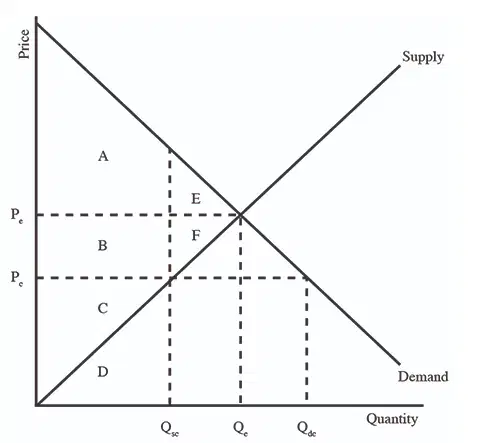
The graph above illustrates a price ceiling. What represents the lost producer surplus after the price ceiling is implemented?
B + E
B + F
Whenever price falls below the equilibrium price, it must be the case that
quantity supplied will be greater than quantity demanded
quantity supplied will be less than quantity demanded

If an import tariff in the economy above is set such that the effective domestic price is A, what represents the deadweight loss?
D + E
G + K
If the income elasticity of demand for a good is -4, then
quantity demanded decreases by 4 percent while income increases by 1 percent
quantity demanded increases by 4 percent while income increases by 1 percent
Which of the following events would correctly describe the outcome in a competitive market?
An increase in demand, ceteris paribus, causes a decrease in equilibrium price and quantity
An increase in demand, ceteris paribus, causes an increase in equilibrium price and quantity
Revenue, profit, and utility represent ________ that play a significant role in determining people's choices.
marginally increasing values
incentives

Consider the following supply schedules for Joseph, Talia, and Shen, who are the only suppliers in the market for cogs:
If the equilibrium price is $4 per cog, what is the market quantity supplied? Assume the market is perfectly competitive and in equilibrium.
8 cogs
24 cogs

