
 Worksheets
AP Microeconomics Unit 6
Total questions: 39
Worksheet time: 20mins
Which of the following accurately describes what makes a monopolistically competitive market allocatively inefficient?
Private businesses have a price in excess of their marginal cost of production
Production occurs where the average total cost is not at its minimum
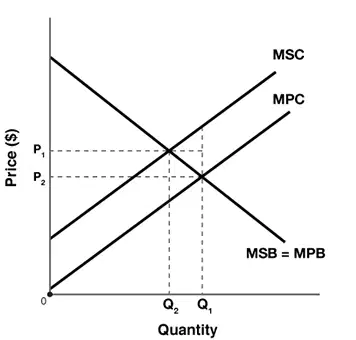
At which of the following price and quantity levels would the unregulated market clear?
P1 and Q2
P2 and Q1
Whenever production costs to a private business do not equal the total costs to the whole community, which of the following will occur without government intervention?
Market disequilibrium
Allocative inefficiency
Which of the following would entail deadweight loss?
Normal profits in a competitive long-run equilibrium
Shortage of a good
What do externalities, oligopolies, and product market surpluses have in common?
Inefficiency or market failure
Normal or zero economic profits
Which of the following would guarantee maximizing total economic surplus?
Profit maximization in a monopoly that does not price discriminate
Consumption at a level at which the marginal benefit equals the marginal production cost of that unit
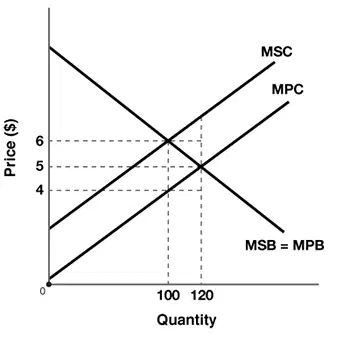
Which of the following government interventions could produce a socially efficient market outcome?
A price floor at $6
A $2 per-unit tax
A perfectly competitive market is in long-run equilibrium. It is allocatively efficient if
the marginal social cost equals the marginal social benefit for the last unit produced
the government intervenes to correct for any possible undesirable outcomes
The market for Easily-Obtainedeum is perfectly competitive. However, its marginal social benefits exceed its marginal private benefits. What type of market failure does Easily-Obtainedeum suffer from? Explain.
Easily-Obtainedum is suffering from a positive externality because its marginal social benefit is greater than its marginal private benefit
bleh
The market for Easily-Obtainedeum is perfectly competitive. However, its marginal social benefits exceed its marginal private benefits. What type of government intervention could achieve allocative efficiency in this market? Explain.
bleh
To achieve allocative efficiency in this market, the government would have to intervene with a per-unit subsidy. A per-unit subsidy would lower the MPC which would allow the firm to produce more, leading to the socially optimal point
Which of the following combinations can lead to the tragedy of the commons?
A rival and non-excludable good
A rival and excludable good
Why might a government supplement a private good’s free market production and offer it without charge?
The good offers a significant positive externality
The good would otherwise suffer the tragedy of the commons
Which of the following characterizes a pure public good?
One person consuming it prevents another’s consumption, and nonpayers cannot be excluded
It is non-excludable and non-rival
A good with a very high social benefit is completely non-excludable. To achieve social efficiency, the government will
make the good artificially scarce to allow supplier profits
either directly provide or regulate the quantity of the good
Which of the following describes a good that is excludable but non-rival in terms of the consumption of the good?
Artificially scarce
Underused by society
Ampstand is a natural monopolist earning economic profits. If Ampstand is earning economic profits, why would other firms not enter the market? Explain.
If Ampstand is earning economic profits, other firms wouldn't enter the market because of a high amount of entrance barriers and/or high start-up costs
bleh
Ampstand is a natural monopolist earning economic profits.What would the government have to do to get Ampstand to produce at the socially optimal quantity and stay in the market in the long run? Explain.
bleh
To get Ampstand to produce at the socially optimal quantity and stay in the market in the long-run, the government would have to put a price ceiling at the socially optimal price, then provide a lump-sum subsidy to offset any losses
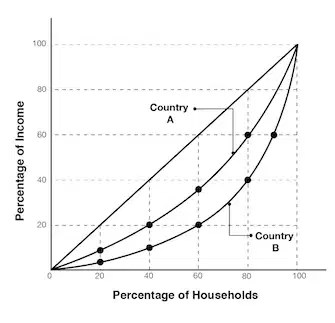
Which of the following is a true statement about this Lorenz curve?
It illustrates an impossible social ideal in income inequality for modern economies
It reveals the relative income inequality of two societies
The primary function of the Gini coefficient is to
explain the cause of income inequality
measure income inequality in an economy
In 1990, the Gini coefficient for the United states was 0.43. In 2018, it was 0.49. What is an accurate interpretation of this data?
Income inequality increased in the United States between 1990 and 2018
Progressive tax policies have been successful in the United States between 1990 and 2018.
A sales tax on common, ordinary items is an example of a
progressive tax
regressive tax
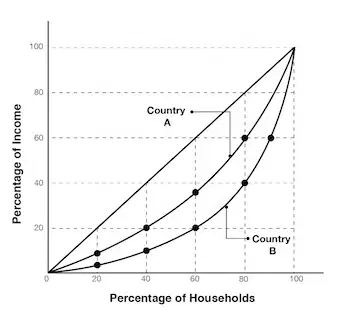
What can be deduced from the Lorenz curve above?
The wealthiest 40 percent of people in both countries possess more than 80 percent of the wealth
Country A has a more equal income distribution than Country B
Which of the following is a true statement about government policy and income inequality?
Proportional tax structures are most effective in a society with a high degree of income inequality
Since higher earners tend to save more than they spend, taxes on savings can help reduce income inequality
Which of the following is a reason for increased income inequality?
Market wages are rising, and so the unemployed are incentivized to find a job
People in a society do not begin with the same human capital, social capital, or bargaining power
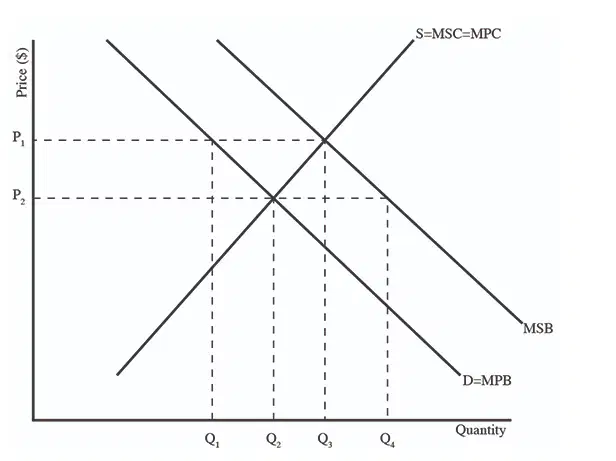
The graph above shows a ________ externality producing ________ than the socially optimal output
Positive; Q3 − Q2 less
Positive; Q3 − Q2 more
Which of the following prevents private market negotiations from adequately addressing an externality?
Unclear property rights
Low or zero transaction costs
Which of the following scenarios best exemplifies an excludable and rivalrous good?
An uncongested river in a state where people can fish
A pair of shoes made by a popular name brand
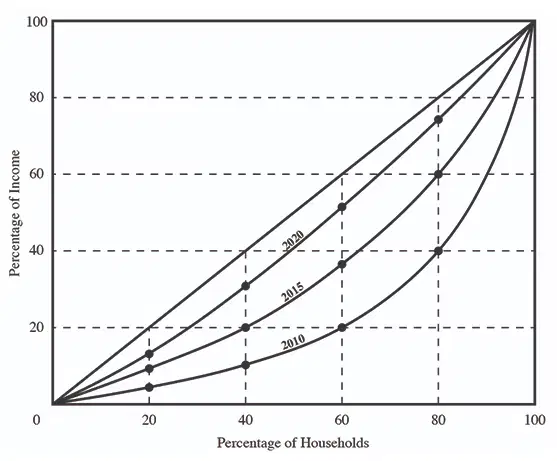
In 2020, ________ of the households earned ________ of the income in this economy.
20 percent; 40 percent
40 percent; 30 percent
The research report of a scientist is only accessible through the purchase of a journal, a magazine for professional academic topics. What type of good best describes this report?
Private good
Artificially scarce good
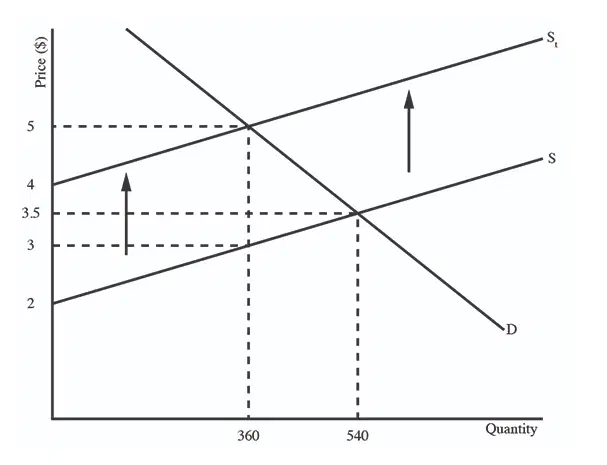
What is the value of the producer burden of the tax in this market?
$180
$540
A per-unit tax on a good with relatively inelastic supply will result in
a higher tax burden on consumers than on producers
a lower tax burden on consumers than on producers
A positive externality, particularly of a good that is non-rival, often leads to what government intervention(s)?
An output quota or other production regulations
A per-unit subsidy or direct provision
A per-unit subsidy would be an effective remedy for
underproduction of a good
overconsumption of a good
Which of the following is true of market social equilibrium if third parties, people outside the market for a good, bear part of the cost of the good's production?
Socially optimal quantity will be less than the private quantity, and the socially optimal price will be greater than the private price
Socially optimal quantity will be greater than the private quantity, and the socially optimal price will be greater than the private price
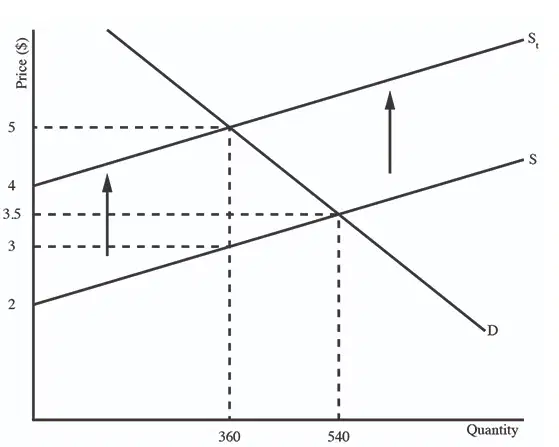
What is the value of the deadweight loss in this market?
$180
$360
What is the most direct effect of a lump-sum production subsidy?
It corrects a positive externality
It increases profit without affecting output
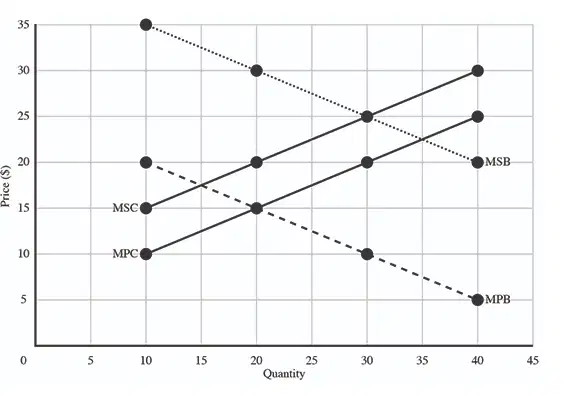
Assuming there is no government regulation, which of the following makes a true statement about this market?
The market output and price levels are lower than the allocatively efficient output and price levels
The market output and price levels are higher than the allocatively efficient output and price levels
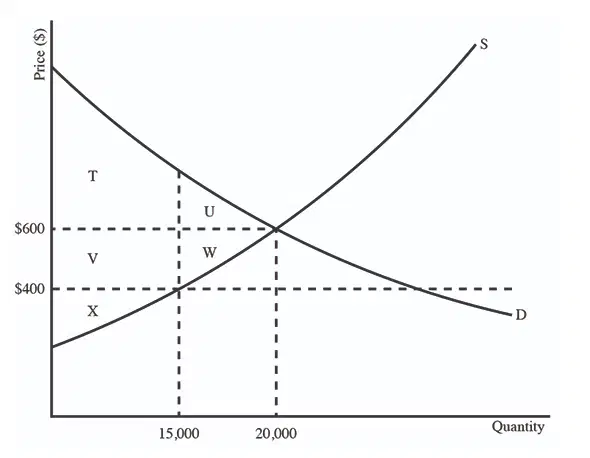
Assume that the market shown is perfectly competitive with no externalities. If the production output is 15,000 units, then the market is
inefficient, and producer surplus is X
inefficient, with a total economic surplus of T + X
If Country S has greater income inequality than Country T, which of the following must be true?
Country S will have a lower Gini coefficient than Country T
Country S will have a higher Gini coefficient than Country T

