
 Worksheets
G8S Music recap
Total questions: 59
Worksheet time: 40mins
What does the symbol "𝄞" at the beginning of the top staff represent in music notation?
Treble clef
Bass clef
Time signature
Key signature
What does the "4/4" symbol indicate in a piece of sheet music?
The tempo of the piece
The key signature
The time signature
The number of sharps
If the tempo marking is "𝅘𝅥𝅮 = 100", what does this tell the musician?
Play 100 notes per measure
Play 100 beats per minute
Play 100 measures per song
Play 100 sharps
How would you identify the key signature in a piece, and what does it indicate?
The number of beats in a measure
The number of sharps or flats, indicating the key of the music
The speed of the music
The type of instrument to play
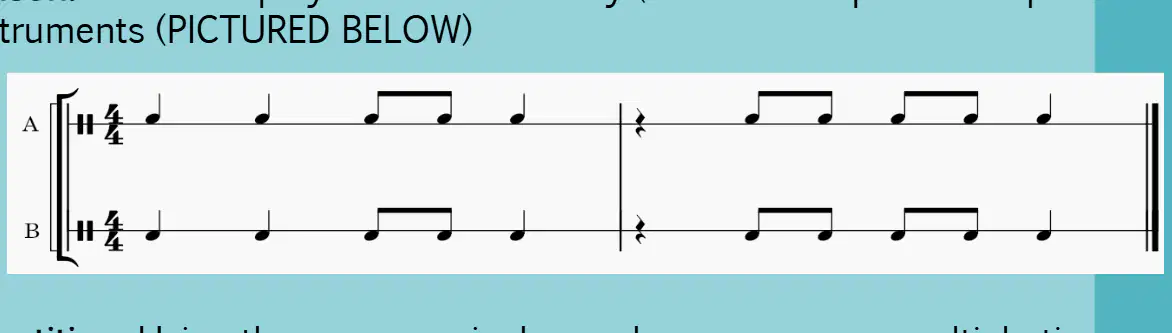
What does the term "unison" mean in music?
Two notes played simultaneously of the same pitch
Two notes played one after another
Two notes played at different pitches
A single note played repeatedly
Which compositional device involves using the same musical sounds or sequences multiple times within a piece?
Repetition
Contrast
Transition
Variation
Why is repetition important in music?
It provides structure and creates familiarity for the listener
It makes the music faster
It increases the volume of the music
It changes the key of the music
Which of the following is NOT listed as a compositional device in the material?
Improvisation
Unison
Repetition
Contrast
What is the definition of "Call & Response" in music?
A compositional device where a musical phrase (the 'call') is followed by a second phrase (the 'response') that is a response to the first.
A technique where all players play the same rhythm at the same time.
A method of changing the key of a piece of music.
A way to speed up the tempo of a song.
Which of the following is NOT listed as a compositional device in the material?
Harmony
Unison
Repetition
Transition
How can "Call & Response" be described in terms of musical interaction?
As a musical conversation between players or between a performer and the audience
As a solo performance with no interaction
As a way to increase the speed of a song
As a method for tuning instruments
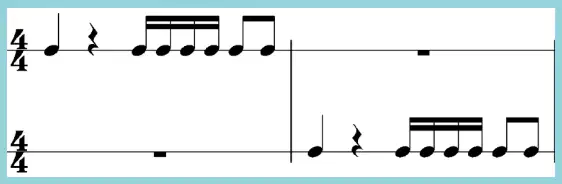
Which example best demonstrates the concept of "Call & Response" in a 2-part rhythm?
Player A plays a rhythm, then Player B repeats or responds to it while Player A rests.
Both players play the same rhythm at the same time.
Player A and Player B play unrelated rhythms.
Player B plays a rhythm, and Player A ignores it.
What is the technique of repeating a musical theme or idea with significant alterations called?
Unison
Variation
Transition
Contrast
Which of the following is a simple way to create rhythmic variation in music?
Changing the color of the notes
Altering the tempo or dynamics
Using only one instrument
Playing in silence
What does the term "retrograde" mean in music?
Playing a melody faster
Presenting a musical phrase in reverse order
Increasing the volume
Repeating the same note
What is an inversion in music?
Playing the notes backwards
Rearranging the notes within an interval, chord, or melodic line while maintaining their structure
Playing the melody louder
Repeating the melody exactly
Which compositional device involves two or more parts performing the same rhythm or melody at the same time?
Unison
Contrast
Transition
Retrograde
How can crescendos and decrescendos be used in music composition?
To change the key signature
To build a smooth transition by increasing or decreasing dynamics
To add more instruments
To speed up the tempo
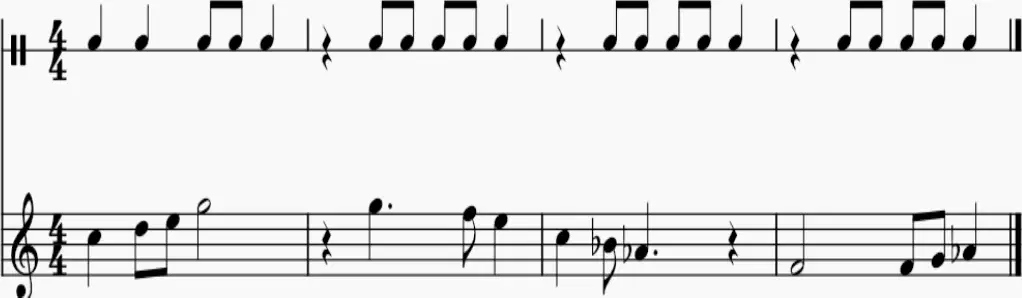
Based on the example provided, what does the rhythm in bars 3-4 represent?
A new melody
A retrograde of the rhythm in bars 1-2
A change in tempo
A repetition of bars 1-2
What is the main purpose of a transition in music?
To connect two distinct sections or phrases smoothly
To repeat the same musical idea
To increase the speed of the music
To introduce lyrics to a song
What does contrast in music achieve?
It introduces significant new musical material or changes to an established pattern
It connects two similar musical sections
It repeats the same rhythm throughout the piece
It only changes the tempo of the music
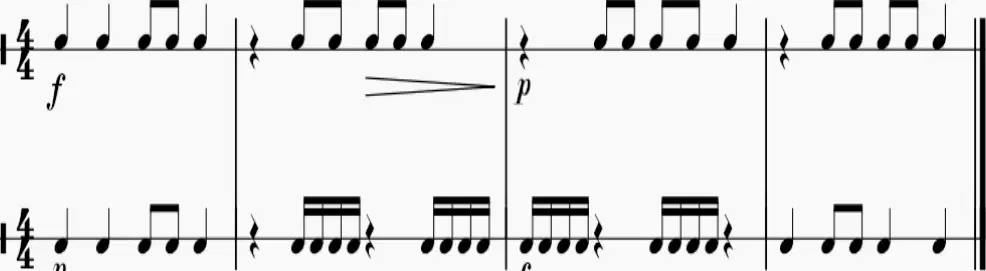
What does the musical example in the image demonstrate?
A minor example of transition using crescendos and decrescendos
A major change in key signature
The use of lyrics in a musical piece
A repeated melody with no changes
Why might a composer use contrast in a musical piece?
To make the music more interesting by introducing new material or significant changes
To keep the music exactly the same throughout
To only increase the volume
To avoid any changes in the musical pattern

Which box has a quarter note / crotchet rest in it?
Which box has a quarter note / crotchet rest in it?


Whole / Semibreve Rest
Quarter note / Crotchet
Half Note / Minim
Whole Note / Semibreve

What are these notes called?
Eighth Notes / Quavers
Half Note / Minims
Quarter Note / Crotchets

How many beats do two quavers (eighth notes) get?


How many beats does this rhythm get?

How many beats does this rhythm get?

Quaver
(Eighth Note)
Crotchet
(Quarter Note)
Semibreve
(Whole Note)
Minim
(Half Note)

Semiquaver
(Sixteenth Note)
Crotchet
(Quarter Note)
Quaver
(Eighth Note)
Minim
(Half Note)
Which rest is a Crotchet rest?


Which rest is a Quaver rest?


How many crotchets equal a semibreve?
How many beats is a minim worth?


How many beats does this image add up to?
1
1/2
2
3
Another name for CHARACTER in Music
(a)

What is the name of a rhythm that fits 3 sounds into 1 beat?
Slur
Tie
Fermata
Triplet
Which of these is the best example of a use of dynamics?
Trumpet
Crescendo
Allegro
Serene

What does the top number of a time signature tell us?
What does the bottom number of a time signature tell us?
Which of these best describes how Fast or Slow a song is?
Dynamics
Tempo
Pitch
Tone Colour

The stem must be in the middle of the notehead...
True
False
Sometimes
It depens on the day

Give the most appropriate time signature for the bar above.
2/4
3/4
6/8
4/4


What is the function of a bar-line? Select all the correct answers
Bar lines break up the musical section into reduced, measurable groups of notes and rests.
A bar line separates notes into readable measures.
Bar lines are used as guidelines for you to follow.
A bar line separates music into measures (also called bars)

What is the function of a double bar-line?
A double bar line allows you to go on to the next measure
A double bar line at the end of a measure means that song is to be repeated
A double bar line allows you to see the end of the music
A double bar line indicates to a musician it's the end of the song
What is articulation in music?
instruments
how you play/sing the notes
orchestra
the ancient art of culation
Staccato means to play/sing the notes...
longer that usual
super fast
short & separated
smooth
Legato means to play/sing the notes...
smooth and connected
bouncy
loud
slowly

A dot after a note adds....
one beat
50% (or half) of the notes value
half of a beat


