
 Worksheets
Term 3 Lesson workbook ‘Welcome to My School’
Total questions: 87
Worksheet time: 45mins
How many years are there in primary schools in Japan?
6 years
4 years
5 years
7 years
Which of the following is NOT a school level in the Japanese education system?
Primary School
Junior High School
Senior High School
Prep
How many terms are there in a Japanese school year?
3 terms
2 terms
4 terms
5 terms
What is the Japanese term for 'Term 1'?
ichi gakki
ni gakki
san gakki
yon gakki
Which honorific suffix is most commonly used for everyone in Japanese to show respect and politeness, regardless of gender or social status?
kun
sensei
san
True or False: The suffix 'kun' is often used to address female individuals who are older than the speaker.
True
False
What suffix would you use to address a teacher in Japanese?
sensei
san
kun
chan
Select the correct suffix for a boy: Takashi _____.
kun
san
sensei
sama
Select the correct suffix for a girl: Tomoko _____
kun
san
sensei
sama
Select the correct suffix for Mr. Suzuki and Mrs. Suzuki: Suzuki _____ to (and) Suzuki _____.
(They are not teachers.)
kun
san
sensei
sama
Select the correct suffix for a teacher Mr. Toyota.
Toyota _____
kun
san
sensei
sama
What is the correct particle to use for 'To (name)' or 'Dear (name)' in Japanese?
へ
え
What is the correct particle to use for 'From (name)' in Japanese?
より (yori)
まで (made)
から (kara)
と (to)
(Watashi wa / boku wa) _____ nensei desu. = I am in grade _____
When you want to say: 'I am in grade 5.' or 'I am in grade 6.' what would be the sentence in Japanese?
go nensei desu. OR roku nensei desu.
ichi nensei desu. OR ni nensei desu.
juu nensei desu. OR juuichi nensei desu.
san nensei desu. OR yon nensei desu.

Translate the following Japanese phrase into English: 'Minasan e, Hajimemashite. Watashi wa Hanako desu.'
Dear / To everyone, Nice to meet you. I am Hanako.
Hello everyone, I am Miki.
Good morning, my name is Ken.
To all, I am pleased to see you. My name is Satoshi.
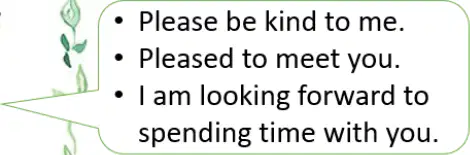
Translate the following Japanese phrase into English: 'Douzo yoroshiku.'
Please be kind to me. / Pleased to meet you. / I am looking forward to spending time with you.
How are you?
Thank you very much.
Goodbye.

Translate the following Japanese phrase into English: 'Hanako yori'
From Hanako
To Hanako
With Hanako
For Hanako
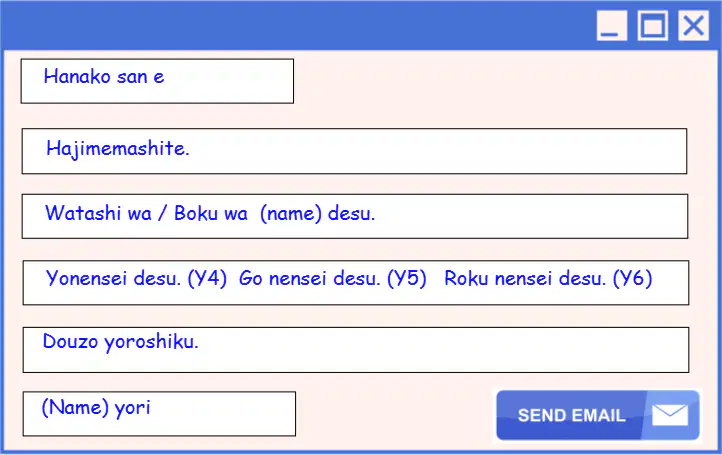
Write an email to Hanako (girl) in Japanese using the template provided.
Hanako san e Hajimemashite. Watashi wa (your name) desu. (Yonensei desu. / Go nensei desu. / Roku nensei desu.) Douzo yoroshiku. (your name) yori
Hanako san e Konnichiwa. Watashi wa (your name) desu. (Sannensei desu. / Shichinensei desu.) Arigatou gozaimasu. (your name) yori
Hanako san e Ohayou gozaimasu. Watashi wa (your name) desu. (Ichinesei desu. / Hachinensei desu.) Yoroshiku onegaishimasu. (your name) yori
Hanako san e Hajimemashite. Watashi wa (your name) desu. (Juunensei desu. / Kyuunensei desu.) Sayonara. (your name) yori

Select the correct Japanese phrase for 'Nice to meet you.' from the word bank.
Hajimemashite.
Sayounara.
Arigatou.
Ohayou.
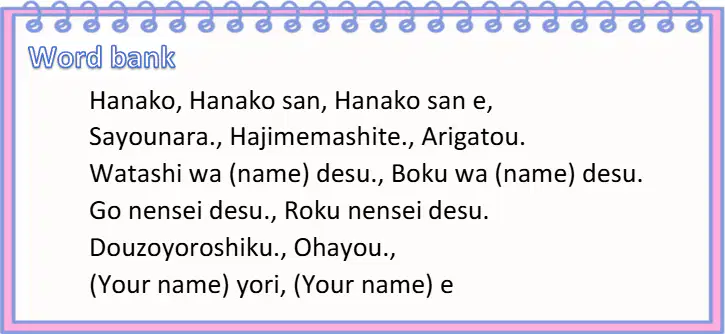
Select the correct Japanese phrase for 'From (your name)' from the word bank.
(Your name) yori
(Your name) e
Watashi wa (name) desu.
Douzoyoroshiku.
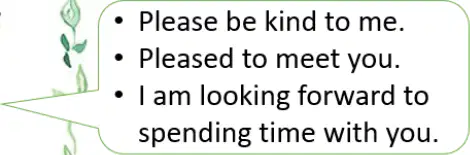
Select the correct Japanese phrase for 'Please be kind to me.' from the word bank.
Douzoyoroshiku.
Sayounara.
Ohayou.
Arigatou.
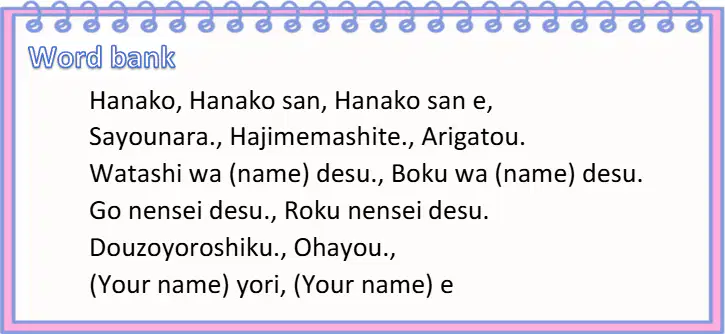
Select the correct Japanese phrase for 'I am in grade 5.' from the word bank.
Go nensei desu.
Yonensei desu.
Roku nensei desu.
Watashi wa (name) desu.
What is the roomaji for the subject 'Japanese'?
nihongo
eigo
suugaku
rekishi
What is the roomaji for the subject 'English'?
eigo
suugaku
rika
bijutsu
What is the roomaji for the subject 'Maths'?
sansuu
rika
kokugo
bijutsu
What is the roomaji for the subject 'Science'?
rika
suugaku
bijutsu
rekishi
What is the roomaji for the subject 'HASS/Social Studies'?
shakai
suugaku
rika
bijutsu
What is the roomaji for the subject 'Music'?
ongaku
bijutsu
suugaku
kagaku
What is the roomaji for the subject 'Arts'?
zukou (zugakousaku)
suugaku
rika
rekishi
What is the roomaji for the subject 'P.E'?
taiiku
bijutsu
rekishi
suugaku
Nihongo o benkyou shimasu. = I study ____________.
Japanese
French
Math
Science
Eigo o benkyou shimasu. = I study ____________.
English
Math
Science
History
Sansuu o benkyou shimasu. = I study ____________.
Maths
History
Science
Music
Rika o benkyou shimasu. = I study ____________.
Science
Math
History
Art
Shakai o benkyou shimasu. = I study ____________.
HASS/Social Studies
Mathematics
Science
Art
Ongaku o benkyou shimasu. = I study ____________.
Music
Math
Science
History
Zukou o benkyou shimasu. = I study ____________.
Arts
Science
Mathematics
History
Taiiku o benkyou shimasu. = I study ____________.
P.E
Math
History
Music
What does the Japanese particle 'to' mean in English?
and
but
or
with
How do you say 'I study Japanese and English' in Japanese using roomaji?
Nihongo to eigo o benkyou shimasu.
Watashi wa eigo to nihongo o tabemasu.
Nihongo to eigo o arukimasu.
Watashi wa eigo to nihongo o nomimasu.
"Nihongo ___ ongaku o benkyou shimasu." (I study Japanese and Music.)
to
ya
ka
mo
"""Nihongo o benkyou shimasu. _____ ongaku o benkyou shimasu."""
Soshite
Dakara
Demo
Matawa
What does the conjunction 'soshite' mean?
but
and
or
because
What does the conjunction 'demo' mean?
and
but
also
so
"Shakai o benkyou shimasu. _____ nihongo o benkyou shimasu."
Soshite
Dakara
Demo
Mata
"Rajio o kikimasu. _____ ongaku o kikimasen." (I listen to the radio but I don’t listen to the music.)
Demo
Soshite
Mata
Dakara
(_____) ga suki desu. = I like (_____).
Subject
Verb
Adjective
Object
(_____) ga suki janai desu. = I don’t like (_____).
(Subject)
(Verb)
(Adjective)
(Object)
What is the Japanese word (Roomaji) for 'Japanese' (school subject)?
nihongo
suugaku
rekishi
eigo
What is the Japanese word (Roomaji) for 'English' (school subject)?
eigo
suugaku
rika
kokugo
What is the Japanese word (Roomaji) for 'Maths' (school subject)?
sansuu
rekishi
bijutsu
ongaku
What is the Japanese word (Roomaji) for 'Science' (school subject)?
rika
bijutsu
rekishi
suugaku
What is the Japanese word (Roomaji) for 'HASS/ Social Studies' (school subject)?
shakai
suugaku
rika
bijutsu
What is the Japanese word (Roomaji) for 'Music' (school subject)?
ongaku
suugaku
bijutsu
taiiku
What is the Japanese word (Roomaji) for 'Arts' (school subject)?
zukou
suugaku
kagaku
rekishi
What is the Japanese word (Roomaji) for 'P.E' (school subject)?
taiiku
suugaku
bijutsu
rekishi
Which conjunction is used to connect sentences about the subjects you like, as shown in the example: "Sansuu ga suki desu. Soshite Taiiku ga suki desu."?
Soshite
Kara
Demo
Dakara
Which conjunction should you use to connect sentences about subjects you don’t like, as shown in the example: Nihongo ga suki desu. ___ Eigo ga suki janai desu?
demo
soshite
kara
dakara
How many years are there at primary schools in Japan?
There are 6 years in Japanese primary schools.
There are 4 years in Japanese primary schools.
There are 5 years in Japanese primary schools.
There are 7 years in Japanese primary schools.
How many terms are there at primary schools in Japan?
There are only 3 terms in a year at Japanese primary schools.
There are only 2 terms in a year at Japanese primary schools.
There are only 4 terms in a year at Japanese primary schools.
There is only 1 term in a year at Japanese primary schools.
What is the purpose of using suffixes such as ‘san’, ‘kun’ and ‘sensei’ after a name?
The purpose of using suffixes is to show the politeness.
They are used to indicate the age of a person.
They are used to show the profession of a person.
They are used to indicate the birthplace of a person.
What does ‘(name) san e’ and ‘(name) yori’ mean in English?
(name) san e means Dear/ To (name). (name) yori means From (name) for the letter format.
(name) san e means Sincerely (name). (name) yori means Best regards (name).
(name) san e means Hello (name). (name) yori means Yours truly (name).
(name) san e means Addressed by (name). (name) yori means Written by (name).
What does ‘Hajimemashite’ mean in English?
'Hajimemashite' means 'Nice to meet you.'
'Hajimemashite' means 'Goodbye.'
'Hajimemashite' means 'Thank you.'
'Hajimemashite' means 'How are you?'
What does ‘Douzo yoroshiku’ mean in English for a self-introduction?
'Douzo yoroshiku' means in English is 'Please be kind to me.' or 'Pleased to meet you.' or 'looking forward to spending time with you.' We use 'Douzo yoroshiku' at the end of the self-introduction.
'Douzo yoroshiku' means 'Goodbye and see you soon.'
'Douzo yoroshiku' means 'Thank you for your help.'
'Douzo yoroshiku' means 'I am sorry for the inconvenience.'
How many days a week do Japanese students go to school?
5 days
6 days
4 days
7 days
What does ‘souji’ mean in English, and what is the purpose of ‘souji’ at schools?
'souji' means 'cleaning' in English. Japanese students and teachers clean their school every day to keep their school clean. Students learn hygiene, how to work as a group, responsibility, and life skills.
'souji' means 'studying' in English. Japanese students and teachers study together every day to improve their knowledge.
'souji' means 'playing' in English. Japanese students and teachers play games every day to build teamwork.
'souji' means 'cooking' in English. Japanese students and teachers cook meals every day to learn about nutrition.
Why do Japanese people change their outdoor shoes to inside shoes when they enter schools?
Japanese people change their outdoor shoes to inside shoes to keep their school clean.
Because it is a fashion trend in Japan.
To show respect to their teachers.
Because outdoor shoes are not comfortable.
What does ‘kyuushoku’ mean in English?
'kyuushoku' means provided lunch at school.
'kyuushoku' means school uniform.
'kyuushoku' means homework.
'kyuushoku' means school bus.
Who serves the ‘kyuushoku’?
A group of students serve lunch for the class.
The principal serves lunch for the class.
Parents come to serve lunch for the class.
Teachers serve lunch for the class.
Where do Japanese students eat their lunch?
Japanese students eat their lunch in their classroom with their teacher(s).
Japanese students eat their lunch in the school cafeteria.
Japanese students eat their lunch at home.
Japanese students eat their lunch in the playground.
______ means 'fun' in Japanese.
tanoshii
kanashii
omoshiroi
sabishii
______ means 'difficult' in Japanese.
muzukashii
yasashii
tanoshii
akarui
______ means 'easy' in Japanese.
kantan
muzukashii
hayai
takai
______ means 'boring' in Japanese.
tsumaranai
omoshiroi
tanoshii
kirei
______ means 'interesting' in Japanese.
omoshiroi
kanashii
atsui
samui
______ means 'Music' in Japanese.
ongaku
tabemono
kuruma
inu
______ means 'Science' in Japanese.
rika
gakkou
hon
tabemono
______ means 'Maths' in Japanese.
sansuu
tabemono
kuruma
inu
Choose the correct sentence structure for saying '(subject) is (adjective)' in Japanese:
(subject) wa (adjective) desu.
(adjective) wa (subject) desu.
(subject) desu (adjective).
(adjective) desu (subject).
True or False: The particle 'to' can connect two adjectives in Japanese.
True
False
What is the correct way to begin a letter to everyone in English?
Dear everyone
Hello everyone
Hi all
Greetings
I am (name). = Watashi wa / Boku wa (name) desu
Translate this sentence: Watashi wa Mia desu
I am Mia.
You are Mia.
I like Mia.
You like Mia.
Which of the following is the correct Japanese (roomaji) translation for 'Good morning.'?
Minasan e
Ohayou gozaimasu
Hajimemashite
Sansuu to rika o benkyou shimasu
What is the Japanese (roomaji) for 'Nice to meet you.'?
Ohayou gozaimasu
Hajimemashite
Minasan e
(Name) yori
I study ( ) and ( ). = ( ) to ( ) o benkyoushimasu.
Translate this sentence into English: Nihongo to eigo o benkyoushimasu
I study ( Japanese ) and ( English ).
I study ( Math ) and ( Science ).
I study ( History ) and ( Geography ).
I study ( Music ) and ( Art ).
Which of the following sentences means 'I like Japanese.'?
Nihongo ga suki desu.
Eigo ga suki desu.
Rika ga suki janai desu.
Ongaku ga suki desu demo zukou ga suki janai desu
From (name)
From (name)
To (name)
By (name)
With (name)