
 Worksheets
8th grade Ch 7 L6
Total questions: 17
Worksheet time: 9mins
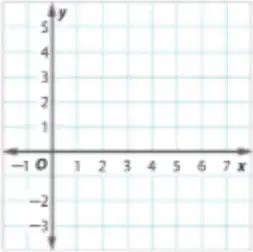
Graph △ACG with vertices A(1, 4), C(3, -2), and G(1, -2), and △BCF with vertices B(2, 1), C(3, -2), and F(2, -2). Which of the following proportions correctly compares the rise to the run for each of the similar slope triangles, and what is the numeric value?
(4 - (-2))/(1 - 1) = (1 - (-2))/(2 - 2), value is undefined
(4 - (-2))/(1 - 3) = (1 - (-2))/(2 - 3), value is -3
(4 - (-2))/(1 - 3) = (1 - (-2))/(2 - 3), value is 3
(4 - (-2))/(1 - 3) = (1 - (-2))/(2 - 2), value is undefined
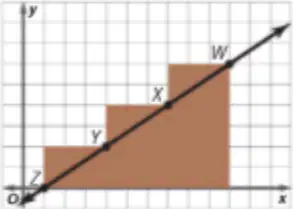
Using points X and Z, what is the slope of the line down the stairs? Verify that the slope is the same at a different location by choosing a different set of points.
The slope is constant and equal to 1.
The slope is constant and equal to 2.
The slope is constant and equal to 0.5.
The slope is not constant.
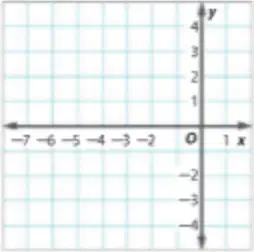
Graph each pair of similar triangles. Then write a proportion comparing the rise to the run for each of the similar slope triangles and find the numeric value.
The proportion comparing the rise to the run for each of the similar slope triangles is equal to the slope of the line.
The proportion comparing the rise to the run for each of the similar slope triangles is always 0.
The proportion comparing the rise to the run for each of the similar slope triangles is always 1.
The proportion comparing the rise to the run for each of the similar slope triangles is always negative.
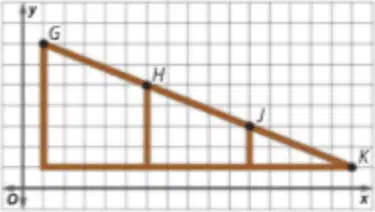
Graph each pair of similar triangles. Then write a proportion comparing the rise to the run for each of the similar slope triangles and find the numeric value.
The proportion of rise to run for each pair of similar triangles is equal to the slope, which is a constant value.
The proportion of rise to run for each pair of similar triangles is always different for each triangle.
The proportion of rise to run for each pair of similar triangles is always zero.
The proportion of rise to run for each pair of similar triangles is always negative.
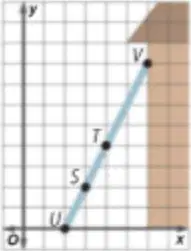
The plans for a skateboard ramp are shown. Use two points to find the slope of the ramp. Then verify that the slope is the same at a different location by choosing a different set of points. What is the slope of the ramp?
2/3
1/2
3/2
1/3
A ladder is leaning up against the side of a house. What is the slope of the ladder if you use two points on the ladder to calculate it?
The slope is the same regardless of which two points are chosen.
The slope changes depending on the points chosen.
The slope is always zero.
The slope is always negative.
Which of the following triangles is similar to and/or a slope triangle with △JKL?
△MNO is similar to and a slope triangle with △JKL.
△MNO is not similar to △JKL but is a slope triangle with △JKL.
△MNO is similar to △JKL but not a slope triangle with △JKL.
△MNO is neither similar to nor a slope triangle with △JKL.
Determine if △MNP: M(3, 1), N(6, 1), P(6, 7) is similar to and/or a slope triangle with △JKL.
△MNP is both similar to and a slope triangle with △JKL.
△MNP is only similar to △JKL, but not a slope triangle.
△MNP is only a slope triangle with △JKL, but not similar.
△MNP is neither similar to nor a slope triangle with △JKL.
Determine if △RST: R(1, 2), S(4, 2), T(4, 5) is similar to and/or a slope triangle with △JKL.
△RST is both similar to and a slope triangle with △JKL.
△RST is only similar to △JKL, but not a slope triangle.
△RST is only a slope triangle with △JKL, but not similar.
△RST is neither similar to nor a slope triangle with △JKL.
Determine if △WXY: W(0, 0), X(-1, -2), Y(0, -2) is similar to and/or a slope triangle with △JKL.
△WXY is similar to and a slope triangle with △JKL.
△WXY is only similar to △JKL, but not a slope triangle.
△WXY is only a slope triangle with △JKL, but not similar.
△WXY is neither similar to nor a slope triangle with △JKL.
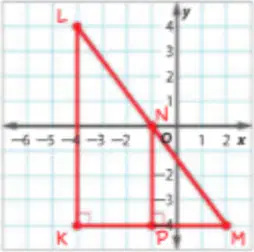
Graph each pair of similar triangles. Then write a proportion comparing the rise to the run for each of the similar slope triangles and find the numeric value. 10. △LKM with vertices L(–4, 4), K(–4, –4), and M(2, –4); △NPM with vertices N(–1, 0), and P(–1, –4). Graph and label each triangle. Write the proportion using the side labels.
LK/KM = NP/PM or –8/6 = –4/3.
LK/KM = NP/PM or 8/6 = 4/3.
LK/KM = NP/PM or –8/–6 = –4/–3.
LK/KM = NP/PM or 6/8 = 3/4.
Graph each pair of similar triangles. Then write a proportion comparing the rise to the run for each of the similar slope triangles and find the numeric value. 11. △ABC with vertices A(–5, –6), B(1, –6), and C(1, 3); △GFD with vertices G(–3, –3), F(–1, –3), and D(–1, 0). Graph and label each triangle. Write the proportion using the side labels.
AB/BC = GF/FD or 6/9 = 2/3
AB/AC = GF/GD or 6/7 = 2/3
BC/AB = FD/GF or 9/6 = 3/2
AC/BC = GD/FD or 7/9 = 3/2
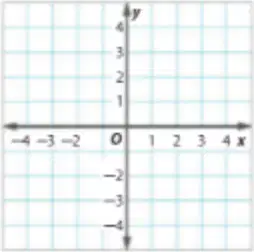
Model with Mathematics: Use a graph to find the missing coordinates for point Z if △MNP ~ △XYZ. 12. M(–2, –3), N(2, –3), P(2, 3), X(0, 0), Y(2, 0), Z(?, ?)
Z(2, 6)
Z(4, 3)
Z(2, 3)
Z(0, 6)
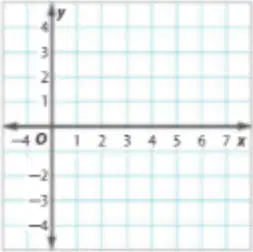
Use a graph to find the missing coordinates for point X if △MNP ~ △XYZ. 13. M(5, 0), N(5, –3), P(2, –3), X(7, 2), Y(1, 2), Z(?, ?)
Z(1, -1)
Z(7, -3)
Z(2, 0)
Z(5, 2)
Find the missing coordinates for point D if △ABC ~ △DEF. Show your work on a separate sheet of paper. A(–1, 3), B(1, 3), C(1, 6), E(–4, –7), F(–4, –1), D(?, ?)
D(–4, –4)
D(–1, –4)
D(–4, –1)
D(–7, –4)
Find the missing coordinates for point D if △ABC ~ △DEF. Show your work on a separate sheet of paper. A(1, 11), B(1, 6), C(3, 6), E(1, 1), F(5, 1), D(?, ?)
D(5, 6)
D(3, 1)
D(1, 6)
D(5, 1)
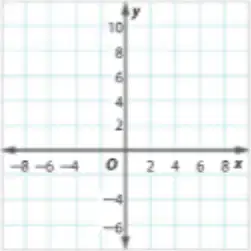
Triangle ABC with vertices A(–3, 7), B(–3, 5), and C(0, 5), and triangle CDE with vertices C(0, 5), D(0, 1), and E(6, 1) are slope triangles. What is the slope of the line represented by these triangles?
2/3
-2/3
-1/2
3/2

