
 Worksheets
Review Chapter 5 and 6
Total questions: 102
Worksheet time: 1hrs 17mins
Name
Class
Date
1.
Student name
4 lines
2.
Student code
4 lines
3.
How do testers add value to iteration and release planning?
a)
Testers determine the priority of the user stories to be developed
b)
Testers focus only on the functional aspects of the system to be tested
c)
Testers participate in the detailed risk identification and risk assessment of user stories
d)
Testers guarantee the release of high-quality software through early test design during the release planning
4.
Which TWO of the following options are the exit criteria for testing a system?
a)
Test environment readiness
b)
The ability to log in to the test object by the tester
c)
Estimated defect density is reached
d)
Requirements are translated into given/when/then format
e)
Regression tests are automated
5.
Your team uses the three-point estimation technique to estimate the test effort for a new high-risk feature. The following estimates were made:
• Most optimistic estimation: 2 person-hours
• Most likely estimation: 11 person-hours
• Most pessimistic estimation: 14 person-hours
What is the final estimate?
a)
9 person-hours
b)
14 person-hours
c)
11 person-hours
d)
10 person-hours
6.

You are testing a mobile application that allows users to find a nearby restaurant based on the type of food they want to eat. Consider the following list of test cases, priorities (i.e., a smaller number means a higher priority), and dependencies:
a)
TC 003
b)
TC 005
c)
TC 002
d)
TC 001
7.
Consider the following test categories (1-4) and agile testing quadrants (A-D):
1. Usability testing
2. Component testing
3. Functional testing
4. Reliability testing
A. Agile testing quadrant Q1: technology facing, supporting the development team
B. Agile testing quadrant Q2: business facing, supporting the development team
C. Agile testing quadrant Q3: business facing, critique the product
D. Agile testing quadrant Q4: technology facing, critique the product
How do the following test categories map onto the agile testing quadrants?
a)
1C, 2A, 3B, 4D
b)
1D, 2A, 3C, 4B
c)
1C, 2B, 3D, 4A
d)
1D, 2B, 3C, 4A
8.
During a risk analysis the following risk was identified and assessed:
• Risk: Response time is too long to generate a report
• Risk likelihood: medium; risk impact: high
• Response to risk:
+ An independent test team performs performance efficiency testing during system testing
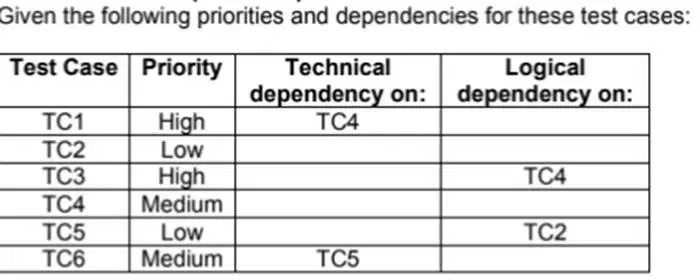
+ A selected sample of end users performs alpha testing and beta testing before the release
What measure is proposed to be taken in response to this analyzed risk?
a)
Risk acceptance
b)
Contingency plan
c)
Risk mitigation
d)
Risk transfer
9.
Which work product can be used by an agile team to show the amount of work that has been completed and the amount of total work remaining for a given iteration?
a)
Acceptance criteria
b)
Defect report
c)
Test completion report
d)
Burndown chart
10.
You need to update one of the automated test scripts to be in line with a new requirement. Which process indicates that you create a new version of the test script in the test repository?
a)
Traceability management
b)
Maintenance testing
c)
Configuration management
d)
Requirements engineering
11.
You received the following defect report from the developers stating that the anomaly described in this test report is not reproducible.
Application hangs up
2022-May-03 – John Doe – Rejected
The application hangs up after entering “Test input: $ä” in the Name field on the new user creation screen. Tried to log off, log in with test_admin01 account, same issue. Tried with other test admin accounts, same issue. No error message received; log (see attached) contains fatal error notification. Based on the test case TC-1305, the application should accept the provided input and create the user. Please fix with high priority, this feature is related to REQ-0012, which is a critical new business requirement.
What critical information is MISSING from this test report that would have been useful for the developers?
a)
Expected result and actual result
b)
References and defect status
c)
Test environment and test item
d)
Priority and severity
12.
Which test activity does a data preparation tool support?
a)
Test monitoring and test control
b)
Test analysis
c)
Test design and test implementation
d)
Test completion
13.
Which item correctly identifies a potential risk of performing test automation?
a)
It may introduce unknown regressions in production
b)
Sufficient efforts to maintain testware may not be properly allocated
c)
Testing tools and associated testware may not be sufficiently relied upon
d)
It may reduce the time allocated for manual testing
14.
Consider the following part of a test plan.
Testing will be performed using component testing and component integration testing. The regulations require to demonstrate that 100% branch coverage is achieved for each component classified as critical.
Which part of the test plan does this part belong to?
a)
Communication
b)
Risk register
c)
Context of testing
d)
Test approach
15.

Your team uses planning poker to estimate the test effort for a newly required feature. There is a rule in your team that if there is no time to reach full agreement and the variation in the results is small, rules like “accept the number with the most votes” can be applied.
After two rounds, the consensus was not reached, so the third round was initiated. You can see the test estimation results in the table below.
a)
The product owner has to step in and make a final decision
b)
Accept 13 as the final test estimate as this has most of the votes
c)
No further action is needed. Consensus has been reached
d)
Remove the new feature from the current release because consensus has not been reached
16.
Which of the following is TRUE regarding the test pyramid?
a)
It emphasizes having far more tests at the lower test levels
b)
It suggests that each low-level test checks a large part of the functionality
c)
It describes distribution of test types across the SDLC
d)
It has no impact on the construction of automated tests
17.
During risk analysis the team considered the following risk: “The system allows too high a discount for a customer”. The team estimated the risk impact to be very high.
What can one say about the risk likelihood?
a)
It is also very high. High risk impact always implies high risk likelihood
b)
It is very low. High risk impact always implies low risk likelihood
c)
One cannot say anything about risk likelihood. Risk impact and risk likelihood are independent.
d)
Risk likelihood is not important with such a high-risk impact. One does not need to define it. Select ONE option.
18.
The following list contains risks that have been identified for a new software product to be developed:
i. Management moves two experienced testers to another project
ii. The system does not comply with security standards
iii. System response time exceeds user requirements
iv. Stakeholders have inaccurate expectations
v. Disabled people have problems when using the system
Which of them are project risks?
a)
i, iv are project risks
b)
iv, v are project risks
c)
i, iii are project risks
d)
ii, v are project risks
19.
Which of the following is an example of how product risk analysis influences thoroughness and scope of testing?
a)
The test manager monitors and reports the level of all known risks on a daily basis so the stakeholders can make an informed decision on the release date
b)
One of the identified risks was "Lack of support of open-source databases", so the team decided to integrate the system with an open-source database
c)
During the quantitative risk analysis, the team estimated the total level of all identified risks and reported it as the total residual risk before testing
d)
Risk assessment revealed a very high level of performance risks, so it was decided to perform detailed performance efficiency testing early in the SDLC
20.
Which TWO of the following options are common metrics used for reporting on the quality level of the test object?
a)
Number of defects found during system testing
b)
Total effort on test design divided by the number of designed test cases
c)
Number of executed test procedures
d)
Number of defects found divided by the size of a work product
e)
Time needed to repair a defect
21.
Which of the following pieces of information contained in a test progress report is the LEAST useful for business representatives?
a)
Impediments to testing
b)
Branch coverage achieved
c)
Test progress
d)
New risks within the test cycle
22.
Your team follows the process that uses the DevOps delivery pipeline. The first three steps of this process are:
(1) Code development
(2) Submit code into a version control system and merge it into the “test” branch
(3) Perform component testing for the submitted code
Which of the following is BEST suited to be the entry criterion for step (2) of this pipeline?
a)
Static analysis returns no high severity warnings for the submitted code
b)
System version control reports no conflicts when merging code into the “test” branch
c)
Component tests are compiled and ready to be executed
d)
Statement coverage is at least 80%
23.

You want to estimate the test effort for the new project using estimation based on ratios. You calculate the test-to-development effort ratio using averaged data for both development effort and test effort from four historical projects similar to the new one. The table shows this historical data.
a)
$40,000
b)
$80,000
c)
$81,250
d)
$82,500
24.

You are testing a web application that allows users to SEARCH for products, VIEW product details, ADD products to a shopping cart, and place an ORDER.
You have prepared the following seven test cases, all of which you want to execute. The tests should be executed in the best order, based on test priority.
a)
TC3
b)
TC1
c)
TC7
d)
TC2
25.
According to the testing quadrants model, which of the following falls into quadrant Q1 (“technology facing” and “support the team”)?
a)
Usability testing
b)
Functional testing
c)
User acceptance testing
d)
Component integration testing
26.
Given the following risks:
1. Ineffective loop implementation causes long system responses
2. Consumers change their preferences
3. Flooding of the server room
4. Patients above a certain age receive inaccurate reports
And the following mitigation activities:
A. Risk acceptance
B. Testing for performance efficiency
C. Using boundary value analysis as the test technique
D. Risk transfer
Which of the following BEST matches the risks with the mitigation activities?
a)
1C, 2D, 3A, 4B
b)
1B, 2D, 3A, 4C
c)
1B, 2A, 3D, 4C
d)
1C, 2A, 3D, 4B
27.
Which of the following is a product quality metric?
a)
Mean time to failure
b)
Number of defects found
c)
Requirements coverage
d)
Defect detection percentage
28.
You are a member of a test team located in North America, developing a product for a client located in Europe. The team is agile and follows the DevOps approach and uses a continuous integration/continuous delivery pipeline.
Which of the following is the LEAST effective way to communicate test progress to the customer?
a)
Face-to-face
b)
Dashboards
c)
Email
d)
Video conferencing
29.
Which of the following BEST describes an example of how configuration management (CM) supports testing?
a)
Having the version number of the environment, the CM tool can retrieve the version numbers of libraries, stubs and drivers used in that environment
b)
Having a record of the values of the inputs, the CM tool can execute the test cases for these configurations and calculate the coverage
c)
Having data about the date of purchase of a software license, the CM tool automatically generates information about the fact that the product license is coming to an end
d)
Having the version number of the test case, the CM tool can automatically generate test data for this test case
30.

You are testing a sort function that gets a set of numbers as input and returns the same set of numbers sorted in ascending order. The log from the test execution looks as follows.
a)
The system fails to sort several sets of numbers. Reference: TC3, TC4, TC5.
b)
The system seems to disregard duplicates while sorting. Reference: TC3, TC4, TC5.
c)
The system fails to sort negative numbers. Reference: TC4, TC5.
d)
TC3, TC4 and TC5 have defects (duplicate input data) and should be corrected. Select ONE option.
31.
Given the following descriptions:
1. Support workflow tracking
2. Facilitate communication
3. Virtual machines
4. Support reviews
And the following test tool categories:
A. Static testing tools
B. Tools supporting scalability and deployment standardization
C. DevOps tools
D. Collaboration tools
Which of the following BEST matches the descriptions and categories?
a)
1A, 2B, 3C, 4D
b)
1B, 2D, 3C, 4A
c)
1C, 2D, 3B, 4A
d)
1D, 2C, 3A, 4B
32.
Which of the following is MOST likely to be a benefit of test automation?
a)
It provides coverage measures that are too complicated for humans to derive
b)
It shares responsibility for the testing with the tool vendor
c)
It removes the need for critical thinking when analyzing test results
d)
It generates test cases from an analysis of the program code
33.
Which of the following is NOT a purpose of a test plan?
a)
To define test data and expected results for component tests and component integration tests
b)
To define as exit criteria from the component test level that “100% statement coverage and 100% branch coverage must be achieved”
c)
To describe what fields the test progress report shall contain and what should be the form of this report
d)
To explain why system integration testing will be excluded from testing, although the test strategy requires this test level
34.
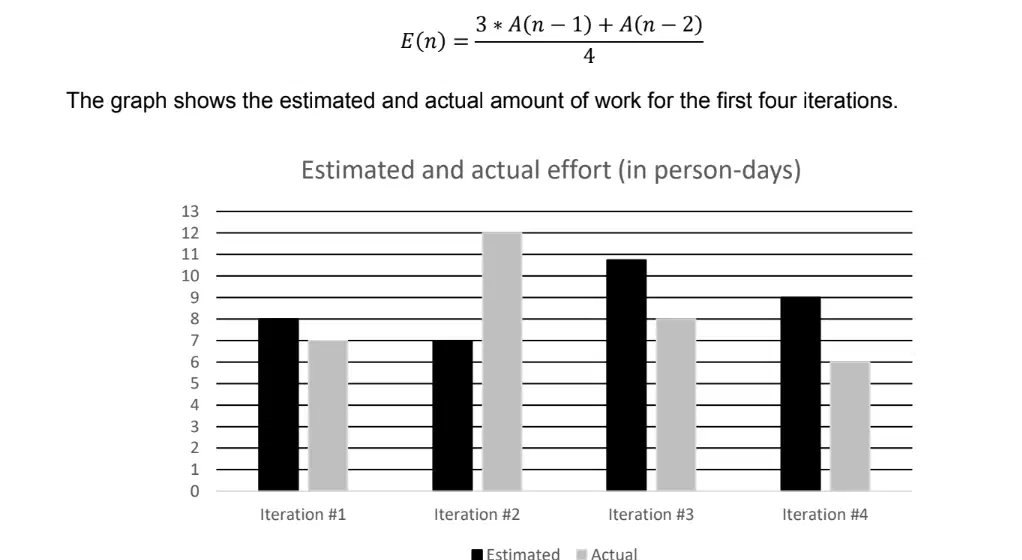
At the beginning of each iteration, the team estimates the amount of work (in person-days) they will need to complete during the iteration. Let E(n) be the estimated amount of work for iteration n, and let A(n) be the actual amount of work done in iteration n. From the third iteration, the team uses the following estimation model based on extrapolation:
What is the estimated amount of work for iteration #5?
a)
10.5 person-days
b)
8.25 person-days
c)
6.5 person-days
d)
9.4 person-days
35.
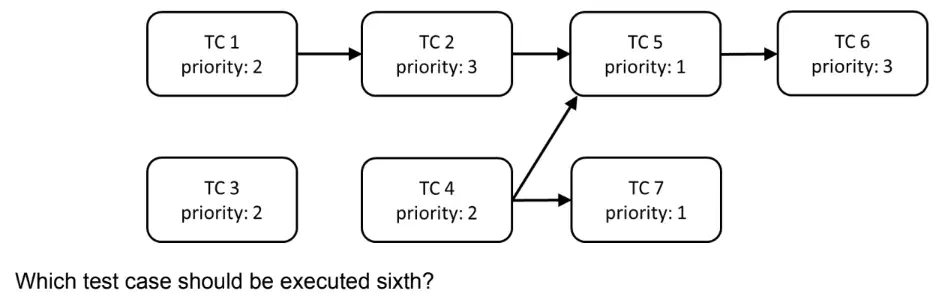
You are preparing a test execution schedule for executing seven test cases TC 1 to TC 7.
The following figure includes the priorities of these test cases (1=highest priority, 3 = lowest
priority).
The figure also shows the dependencies between test cases using arrows. For instance, the arrow
from TC 4 to TC 5 means that TC 5 can only be executed if TC 4 was previously executed.
a)
TC 3
b)
TC 5
c)
TC 6
d)
TC 2
36.
What does the test pyramid model show?
a)
That tests may have different priorities
b)
That tests may have different granularity
c)
That tests may require different coverage criteria
d)
That tests may depend on other tests
37.
What is the relationship between the testing quadrants, test levels and test types?
a)
Testing quadrants represent particular combinations of test levels and test types, defining their location in the software development lifecycle
b)
Testing quadrants describe the degree of granularity of individual test types performed at each test level
c)
Testing quadrants assign the test types that can be performed to the test levels
d)
Testing quadrants group test levels and test types by several criteria such as targeting specific stakeholders
38.
Which of the following is an example of how product risk analysis may influence the thoroughness and scope of testing?
a)
Continuous risk monitoring allows us to identify an emerging risk as soon as possible
b)
Risk identification allows us to implement risk mitigation activities and reduce the risk level
c)
The assessed risk level helps us to select the rigor of testing
d)
Risk analysis allows us to derive coverage items
39.
Which of the following activities in the test process makes the MOST use of test progress reports?
a)
Test design
b)
Test completion
c)
Test analysis
d)
Test planning
40.
Which of the following is NOT an example of how configuration management supports testing?
a)
All commits to the repository are uniquely identified and version controlled
b)
All changes in the test environment elements are tracked
c)
All requirement specifications are referenced unambiguously in test plans
d)
All identified defects have an assigned status
41.
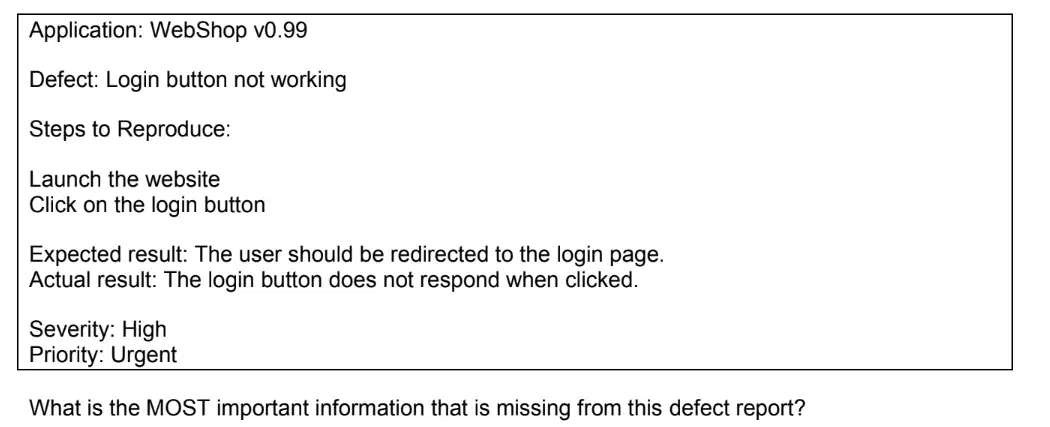
What is the MOST important information that is missing from this defect report?
a)
Name of the tester and date
b)
Test environment elements and their version numbers
c)
Identification of the test object
d)
Impact on the interests of stakeholders
42.
Tools from which of the following categories help with the organization of test cases, detected defects and configuration management?
a)
Test execution and coverage tools
b)
Test design and implementation tools
c)
Defect management tools
d)
Test management tools
43.
Which of the following is MOST likely to be a benefit of test automation?
a)
The capability of generating test cases without access to the test basis
b)
The achievement of increased coverage through more objective assessment
c)
The increase in test execution times available with higher processing power
d)
The prevention of human errors through greater consistency and repeatability
44.
Which of the following BEST define EXIT criteria in a testing project?
Select TWO options.
a)
Budget is approved
b)
Budget runs out
c)
Test basis is available
d)
Test cases achieved at least 80% statement coverage
e)
All test analysts are ISTQB certified at the Foundation Level
45.
The team wants to estimate the time needed for one tester to execute four test cases for a software component. The team has gathered the following measures of the effort used to execute a single test case:
• Best-case scenario: 1 hour
• Worst-case scenario: 8 hours
• Most likely scenario: 3 hours
Given that the three-point estimation technique is being used, what is the final estimate of the time needed to execute all four test cases?
a)
14 hours
b)
3.5 hours
c)
16 hours
d)
12 hours
46.
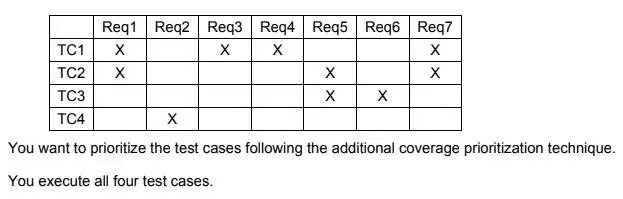
The table shows the traceability matrix from test cases to requirements. “X” means that a given test case covers the corresponding requirement.
Which test case should be executed as the LAST one?
a)
TC1
b)
TC2
c)
TC3
d)
TC4
47.
How can the testing quadrants be beneficial for testing?
a)
They help in test planning by dividing the test process into four phases, corresponding to the four basic test levels: component, integration, system, and acceptance testing
b)
They help in assessing the high-level coverage (e.g., requirements coverage) based on low-level coverage (e.g., code coverage)
c)
They help non-technical stakeholders to understand the different test types and that some test types are more relevant to certain test levels than others
d)
They help agile teams to develop a communication strategy based on classifying people according to four basic psychological types, and on modelling the relations between them
48.
For a given risk, its risk level is $1,000 and its risk likelihood is estimated as 50%.
What is the risk impact?
a)
$500
b)
$2,000
c)
$50,000
d)
$200
49.
Which of the following are product risks?
Select TWO options
a)
Scope creep
b)
Poor architecture
c)
Cost-cutting
d)
Poor tool support
e)
Too long response time
50.
Which of the following is NOT a valid purpose for a test report?
a)
Tracking test progress and identifying areas that require further attention
b)
Providing information on the tests executed, their results, and defects found
c)
Providing information about each defect, such as the steps to reproduce it
d)
Providing information on testing planned for the next period
51.
The user reported a software failure. An engineer from the support team asked the user for the software version number where the failure was observed. Based on the version number, the team reassembled all the files that made up the release. This later allowed a developer to perform analysis, find the defect, and fix it.
Which of the following enabled the above activity to be performed by the team?
a)
Risk management
b)
Test monitoring and control
c)
Whole team approach
d)
Configuration management
52.
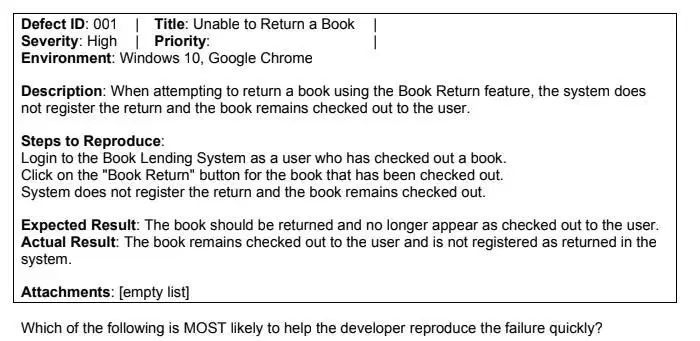
Consider the following defect report for a Book Lending System.
a)
Adding information about which users and which books the failure affects to the “Description” section
b)
Filling in the missing value for the “Priority” field
c)
Adding memory dumps and database snapshots taken after each step described in the “Steps to Reproduce” section to the “Attachments” section.
d)
Repeating the same test case for different environments and writing defect reports for each of them separately
53.
If the developers are releasing code for testing that is not version controlled, what process is missing?
a)
Configuration management
b)
Debugging
c)
Test and defect management
d)
Risk analysis
54.

Your team is using Planning Poker to estimate the effort for a story.
Although three votes were taken to reach consensus, how many story points should be allocated to the story?
a)
10 because that’s the sum of the points
b)
. 8 because that was the highest number
c)
3 because that was the lowest number
d)
5 because that was the consensus
55.

You have been given the following set of test cases to run. You have been instructed to run them in order by risk and to accomplish the testing as quickly as possible to provide feedback to the developers as soon as possible.
Given this information, what is the best order in which to run these tests?
a)
2, 4, 5, 6, 1, 3
b)
4, 3, 2, 5, 6, 1
c)
2, 5, 6, 4, 1, 3
d)
6, 1, 3, 2, 4, 5
56.
You have been testing software that will be used to track credit card purchases. You have found a defect that causes the system to crash, but only if a person has made and voided 10 purchases in a row. What is the proper priority and severity rating for this defect?
a)
Priority high, severity high
b)
Priority high, severity low
c)
Priority low, severity low
d)
Priority low, severity high
57.
Which of the following is an example of a tool that supports static testing?
a)
A tool that assists with tracking the results of reviews
b)
A defect tracking tool
c)
A test automation tool
d)
A tool that helps design test cases for security testing
58.
Which of the following is a benefit of test automation?
a)
Test execution is faster
b)
Manual testing becomes obsolete
c)
ROI is easy to determine
d)
Test implementation is faster
59.
Level of risk is determined by which of the following?
a)
Likelihood and impact
b)
Priority and risk rating
c)
Probability and practicality
d)
Risk identification and mitigation
60.
Which of the following is an example of a good exit criterion from system testing?
a)
All tests should be completed
b)
The project budget should be spent
c)
All defects should be fixed
d)
All severity 1 defects must be resolved
61.
You are working on a project and have determined that exploratory testing is
the best test technique to apply. Which testing quadrant are you using?
a)
Q1
b)
Q2
c)
Q3
d)
Q4
62.
Which of the following is a project risk?
a)
A defect that is causing a performance issue
b)
A duplicate requirement
c)
An issue with a data conversion procedure
d)
A schedule that requires work during Christmas shutdown
63.
You have just completed testing on a major ERP implementation. The project has taken
two years and is now ready for final approval before go-live. What test documentation should be
produced at this time?
a)
Formal test summary report
b)
Testing team task board
c)
Email to the team congratulating them on their success
d)
Burn down chart
64.
You are working on a project that is releasing software to the test team in iterations. In iteration 3 you identified a failure. The developer found and fixed the defect and released the fix in iteration 4. You confirmed the fix and closed the defect report. You are now testing iteration 7 and the failure has occurred again. You have talked to the developer and he doesn’t know how or when the failure came back and has asked you to investigate.
How can configuration management help you gather more information on this failure?
a)
You can see what changed in iteration 4 to fix the problem
b)
You can reload and retest iterations 5 and 6 to see where the problem was re-introduced
c)
You can review all the code changes that have occurred since iteration 4 to see what might have broken it
d)
You can improve the regression testing to ensure the failure is caught earlier
65.
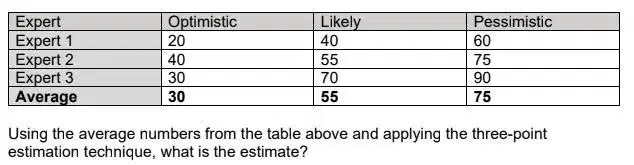
You are estimating the testing time required for a new project. You have gathered information from three experts and they have given you the following numbers in days:
a)
325 ± 45
b)
81.25 ± 8
c)
. 54.17 ± 7.5
d)
40 ± 2
66.
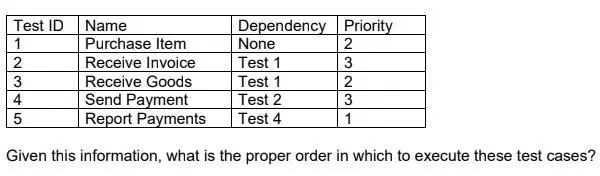
Consider the following test cases that are used to test an accounting system:
a)
5, 1, 3, 2, 4
b)
1, 2, 4, 5, 3
c)
1, 3, 2, 4, 5
d)
3, 4, 5, 1, 2
67.
You have received the following description section in a defect report:
The report executed per the attached steps, but the data was incorrect. For example, the information in column 1 was wrong. See the attached screenshot. This report is critical to the users and they will be unable to do their jobs without this information.
What is the biggest problem with this defect report?
a)
The developer won’t know how important the problem is
b)
The developer won’t know how to repeat the test
c)
The developer won’t be able to see what the tester is saying is wrong
d)
The developer won’t know what the tester expected to see
68.
What is the primary purpose of a test execution tool?
a)
It runs automated test scripts to test the test object
b)
It automatically records defects in the defect tracking system
c)
It analyzes code to determine if there are any coding standard violations
d)
It tracks test cases, defects and requirements traceability
69.
Which of the following is a risk with test automation?
a)
Using an automation tool that will not be supported in the future
b)
. Developing test automation for particularly tedious manual testing areas
c)
Using technical testers to implement the automation
d)
Developing automated reporting
70.
Which of the following statements BEST describes how tasks are divided between the test manager and the tester?
a)
The test manager plans testing activities and chooses the standards to be followed, while the tester chooses the tools and set the tools usage guidelines
b)
The test manager plans, coordinates, and controls the testing activities, while the tester automates the tests
c)
The test manager plans, monitors, and controls the testing activities, while the tester designs tests and decides on the release of the test object
d)
The test manager plans and organizes the testing and specifies the test cases, while the tester executes the tests
71.
Which of the following metrics would be MOST useful to monitor during test execution?
a)
Percentage of executed test cases
b)
Average number of testers involved in the test execution
c)
Coverage of requirements by source code
d)
Percentage of test cases already created and reviewed
72.
Which of the following can affect and be part of the (initial) test planning?
a)
Budget limitations
b)
Test log
c)
Failure rate
d)
Use cases
73.
Which of the following lists contains only typical exit criteria from testing?
a)
Reliability measures, test coverage, schedule and status about fixing defect and remaining risks
b)
Reliability measures, test coverage, degree of tester’s independence and product completeness
c)
Reliability measures, test coverage, test cost, availability of test environment, time to market and product completeness
d)
Time to market, remaining defects, tester qualification, availability of testable use cases, test coverage and test cost
74.
Which one of the following is NOT included in a test summary report?
a)
Defining pass/fail criteria and objectives of testing
b)
Deviations from the test approach
c)
Measurements of actual progress against exit criteria
d)
Evaluation of the quality of the test object
75.
The project develops a "smart" heating thermostat. The control algorithms of the thermostat were modeled as Matlab/Simulink models and run on the internet connected server. The thermostat uses the specifications of the server to trigger the heating valves.
The test manager has defined the following test strategy/approach in the test plan:
1. The acceptance test for the whole system is executed as an experience-based test.
2. The control algorithms on the server are checked against standard of the energy saving regulation.
3. The functional test of the thermostat is performed as risk-based testing.
4. The security tests of data / communication via the internet are executed together with external security experts.
What four common types of test strategies/approaches did the test manager implement in the test plan?
a)
Methodical, analytical, reactive, and regression-averse
b)
Analytical, standard-compliant, consultative, and reactive
c)
Model-based, methodical, analytical, and consultative
d)
Regression-averse, consultative, reactive, and methodical
76.
Which one of the following is the characteristic of a metrics-based approach for test estimation?
a)
Budget which was used by a previous similar test project
b)
Overall experience collected in interviews with test managers
c)
Estimation of effort for test automation agreed in the test team
d)
Average of calculations collected from business experts
77.
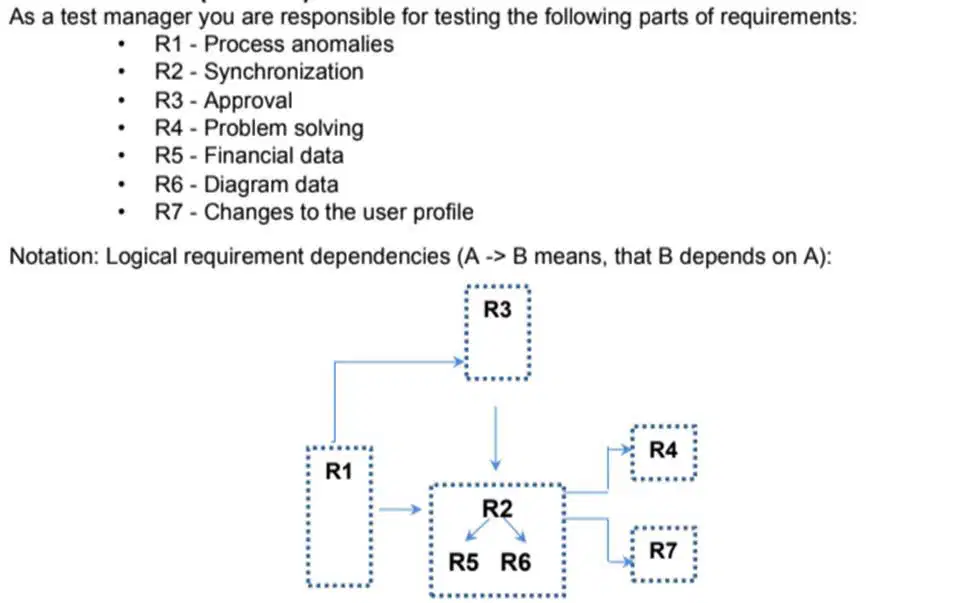
Which one of the following options structures the test execution schedule according to the requirement dependencies?
a)
R1 ; R3 ; R4 ; R7 ; R2 ; R5 ; R6
b)
R1 ; R3 ; R2 ; R4 ; R7 ; R5 ; R6
c)
R1 ; R3 ; R2 ; R5 ; R6 ; R4 ; R7
d)
R1 ; R2 ; R5 ; R6 ; R3 ; R4 ; R7
78.
You are testing a new version of software for a coffee machine. The machine can prepare different types of coffee based on four categories. i.e., coffee size, sugar, milk, and syrup. The criteria are as follows:
• Coffee size (small, medium, large)
• Sugar (none, 1 unit, 2 units, 3 units, 4 units)
• Milk (yes or no)
• Coffee flavor syrup (no syrup, caramel, hazelnut, vanilla)
Now you are writing a defect report with the following information:
• Title: Low coffee temperature.
• Short summary: When you select coffee with milk, the time for preparing coffee is
too long and the temperature of the beverage is too low (less than 40 °C).
• Expected result: The temperature of coffee should be standard (about 75 °C).
• Degree of risk: Medium
• Priority: Normal
What valuable information was omitted in the above defect report?
a)
The actual test results
b)
Identification of the tested software version
c)
Status of the defect
d)
Ideas for improving the test case
79.
Which one of the following is MOST likely to be a benefit of test execution tools?
a)
It is easy to create regression tests
b)
It is easy to maintain version control of test assets
c)
It is easy to design tests for security testing
d)
It is easy to run regression tests
80.
Which one of the following test tools is mostly suitable for developers rather than testers?
a)
Requirement management tools
b)
Configuration management tools
c)
Static analysis tools
d)
Performance testing tools
81.
Which of the following BEST explains a benefit of independent testing?
a)
The use of an independent test team allows project management to assign responsibility for the quality of the final deliverable to the test team, so ensuring everyone is aware that quality is the test team’s overall responsibility
b)
If a test team external to the organization can be afforded, then there are distinct benefits in terms of this external team not being so easily swayed by the delivery concerns of project management and the need to meet strict delivery deadlines
c)
An independent test team can work totally separately from the developers, need not be distracted with changing project requirements, and can restrict communication with the developers to defect reporting through the defect management system
d)
When specifications contain ambiguities and inconsistencies, assumptions are made on their interpretation, and an independent tester can be useful in questioning those assumptions and the interpretation made by the developer
82.
Which of the following tasks is MOST LIKELY to be performed by the test manager?
a)
Write test summary reports based on the information gathered during testing
b)
Review tests developed by others
c)
Prepare and acquire test data
d)
Analyze, review, and assess requirements, specifications, and models for testability
83.
Given the following examples of entry and exit criteria:
1. The original testing budget of $30,000 plus contingency of $7,000 has been spent
2. 96% of planned tests for the drawing package have been executed and the remaining tests
are now out of scope
3. The trading performance test environment has been designed, set-up and verified
4. Current status is no outstanding critical defects and two high-priority ones
5. The autopilot design specifications have been reviewed and reworked
6. The tax rate calculation component has passed unit testing.
Which of the following BEST categorizes them as entry and exit criteria:
a)
Entry criteria – 5, 6; Exit criteria – 1, 2, 3, 4
b)
Entry criteria – 2, 3, 6; Exit criteria – 1, 4, 5
c)
Entry criteria – 1, 3; Exit criteria – 2, 4, 5, 6
d)
Entry criteria – 3, 5, 6; Exit criteria – 1, 2, 4
84.
Which of the following test execution schedules BEST considers the priorities and technical and logical dependencies?
a)
TC1 – TC3 – TC4 – TC6 – TC2 – TC5
b)
TC4 – TC3 – TC1 – TC2 – TC5 – TC6
c)
TC4 – TC1 – TC3 – TC5 – TC6 – TC2
d)
TC4 – TC2 – TC5 – TC1 – TC3 – TC6
85.
Which of the following statements about test estimation approaches is CORRECT?
a)
With the metrics-based approach, the estimate is based on test measures from the project and so this estimate is only available after the testing starts
b)
With the expert-based approach, a group of expert users identified by the client recommends the necessary testing budget
c)
With the expert-based approach, the test managers responsible for the different testing activities predict the expected testing effort
d)
With the metrics-based approach, an average of the testing costs recorded from several past projects is used as the testing budget
86.
Which of the following BEST defines risk level?
a)
Risk level is calculated by adding together the probabilities of all problem situations and the financial harm that results from them
b)
Risk level is estimated by multiplying the likelihood of a threat to the system by the chance that the threat will occur and will result in financial damage
c)
Risk level is determined by a combination of the probability of an undesirable event and the expected impact of that event
d)
Risk level is the sum of all potential hazards to a system multiplied by the sum of all potential losses from that system
87.
Which of the following is MOST likely to be an example of a PRODUCT risk?
a)
The expected security features may not be supported by the system architecture
b)
The developers may not have time to fix all the defects found by the test team
c)
The test cases may not provide full coverage of the specified requirements
d)
The performance test environment may not be ready before the system is due for delivery
88.
Which of the following is LEAST likely to be an example of product risk analysis CORRECTLY influencing the testing?
a)
The potential impact of security flaws has been identified as being particularly high, so security testing has been prioritized ahead of some other testing activities
b)
Testing has found the quality of the network module to be higher than expected, so additional testing will be performed in that area
c)
The users had problems with the user interface of the previous system, so additional usability testing is planned for the replacement system
d)
The time needed to load web pages is crucial to the success of the new website, so an expert in performance testing has been employed for this project
89.
You are performing system testing of a train reservation system. Based on the test cases performed, you have noticed that the system occasionally reports that no trains are available, although this should be the case. You have provided the developers with a summary of the defect and the version of the tested system. They recognize the urgency of the defect and are now waiting for you to provide further details.
In addition to the information already provided, the following additional information is given:
1. Degree of impact (severity) of the defect
2. Identification of the test object
3. Details of the test environment
4. Urgency/priority to fix
5. Actual results
6. Reference to test case specification
Which of this additional information is most useful to include in the defect report?
a)
1, 2, 6
b)
1, 4, 5, 6
c)
2, 3, 4, 5
d)
3, 5, 6
90.
Given the following test activities and test tools:
1. Performance measurement and dynamic analysis
2. Test execution and logging
3. Management of testing and testware
4. Test design
A. Code coverage tools
B. Dynamic analysis tools
C. Test data preparation tools
D. Defect management tools
Which of the following BEST matches the activities and tools?
a)
1 – B, 2 – C, 3 – D, 4 – A
b)
1 – B, 2 – A, 3 – C, 4 – D
c)
1 – B, 2 – A, 3 – D, 4 – C
d)
1 – A, 2 – B, 3 – D, 4 – C
91.
Which of the following is MOST likely to be used as a reason for using a pilot project to introduce a tool into an organization?
a)
The need to evaluate how the tool fits with existing processes and practices and determining what would need to change
b)
The need to evaluate the test automation skills and training, mentoring and coaching needs of the testers who will use the tool
c)
The need to evaluate whether the tool provides the required functionality and does not duplicate existing test tools
d)
The need to evaluate the tool vendor in terms of the training and other support they provide
92.
You are working as a tester on an online banking system. Availability is considered one of the top products (quality) risks for the system. You find a reproducible failure that results in customers losing their connections to the bank Web site when transferring funds between common types of accounts and being unable to reconnect for between three and five minutes.
Which of the following would be a good summary for a defect report for this failure, one that captures both the essence of the failure and its impact on stakeholders?
a)
Web server logs show error 0x44AB27 when running test 07.005, which is not an expected error message in /tmp filesystem
b)
Developers have introduced major availability defect which will seriously upset our customers
c)
Performance is slow and reliability flaky under load
d)
Typical funds-transfer transaction results in termination of customer session, with a delay in availability when attempting to reconnect
93.

Which of the following is a possible test execution schedule that considers both priorities and dependencies?
a)
01.001, 01.002, 01.003, 01.005,
b)
01.001, 01.002, 01.004, 01.003,
c)
01.003, 01.004, 01.002, 01.001,
d)
01.001, 01.002, 01.004, 01.005
94.
Which of the following is a common test metric often used to monitor BOTH test preparation and test execution?
a)
Test case status
b)
Defect find/fix rates
c)
Test environment preparation
d)
Estimated cost to find the next defect
95.
Which of the following are two factors that can be used to determine the level of risk?
a)
Testing and development
b)
Dynamic and reactive
c)
Statement and decision
d)
Likelihood and impact
96.
You are working as a project manager on an in-house banking software project. To prevent rework and excessive find/fix/retest cycles, the following process has been put in place for resolving a defect once it is found in the test lab:
1. The assigned developer finds and fixes the defect, then creates an experimental build
2. A peer developer reviews, unit tests, and confirmation tests the defect fix on his/her desktop
3. A tester – usually the one who found the defect – confirmation tests the defect fix in the development environment
4. Once a day, a new release with all confirmed defect fixes included, is installed in the test environment
5. The same tester from step 3 confirmation tests the defect fix in the test environment
Nevertheless, a large number of defects which the testers confirmed as fixed in the development environment (in step 3) are somehow failing confirmation testing in the test environment, with the resulting rework and cycle time outcomes. You have the highest confidence in your testers and have ruled out mistakes or omissions in step 3.
Which of the following is the MOST likely part of the process to check next?
a)
The activity of developers, who may not be adequately testing in step 2
b)
The activity of testers, who may be confused about what to test in step 5
c)
Configuration management, which may not be maintaining the integrity of the product in step 4
d)
The activity of developers, who may not be fixing defects properly in step 1
97.
You are engaged in planning a test effort for a new mobile banking application. As part of estimation, you first meet with the proposed testers and others on the project. The team is well-coordinated and has already worked on similar projects. To verify the resulting estimate, you then refer to some industry averages for testing effort and costs on similar projects, published by a reputable consultant.
Which statement accurately describes your estimation approach?
a)
A simultaneous expert-based and metrics-based approach
b)
Primarily an expert-based approach, augmented with a metrics-based approach
c)
Primarily a metrics-based approach, augmented with an expert-based approach
d)
Primarily planning poker, checked by velocity from burndown charts
98.
During a project following Agile methods, you find a discrepancy between the developer’s interpretation of an acceptance criteria and the product owner’s interpretation, which you bring up during a user story refinement session. Which of the following is a benefit of test independence exemplified by this situation?
a)
Recognizing different kinds of failures
b)
Taking primary responsibility for quality
c)
Removing a defect early
d)
Challenging stakeholder assumptions
99.
You are defining the process for carrying out product risk analysis as part of each iteration on an Agile project. Which of the following is the proper place to document this process in a test plan?
a)
Scope of testing
b)
Approach of testing
c)
Metrics of testing
d)
Configuration management of the test object
100.
Consider the following list of undesirable outcomes that could occur on a mobile app development effort:
A. Incorrect totals on screens
B. Change to acceptance criteria during acceptance testing
C. Users find the soft keyboard too hard to use with your app
D. System responds too slowly to user input during search string entry
E. Testers not allowed to report test results in daily standup meetings
Which of the following properly classifies these outcomes as project and product risks?
a)
Product risks: B, E; Project risks: A, C, D
b)
Product risks: A, C, D; Project risks: B, E
c)
Product risks: A, C, D, E Project risks: B
d)
Product risks: A, C Project risks: B, D, E
101.
You have just completed a pilot project for a regression testing tool. You understand the tool much better and have tailored your testing process to it. You have standardized an approach to using the tool and its associated work products.
Which of the following is a typical test automation pilot project goal that remains to be carried out?
a)
Learn more details about the tool
b)
See how the tool would fit with existing processes and practices
c)
Decide on standard ways of using, managing, storing, and maintaining the tool and the test assets
d)
Assess whether the benefits will be achieved at reasonable cost
102.
Which of the following tools is most useful for reporting test metrics?
a)
Test management tool
b)
Static analysis tool
c)
Coverage tool
d)
Model-Based testing tools
100 %

