
NEW
Font size
 Worksheets
NSTEMI and NSTE-ACS Quiz
Total questions: 59
Worksheet time: 30mins
What does NSTEMI stand for in the context of acute coronary syndromes?
Non-ST-segment elevation myocardial infarction
Non-specific transient elevation myocardial infarction
Non-sustained tachycardia event myocardial infarction
Non-symptomatic thrombotic event myocardial infarction
Which of the following is NOT a typical feature used in the diagnosis of NSTEMI-ACS?
Occurrence at rest or with minimal exertion, lasting >10 minutes
Relatively recent onset (within the prior 2 weeks)
Crescendo pattern of chest discomfort
Presence of a heart murmur
According to the text, which group of patients is classified as having non-ST-segment elevation acute coronary syndrome (NSTE-ACS)?
Patients with acute myocardial infarction without ST-segment elevation and those with unstable angina
Patients with ST-segment elevation myocardial infarction only
Patients with chronic stable angina
Patients with heart failure but no coronary artery disease
What is the main reason for the increasing incidence of NSTEMI compared to STEMI?
Greater use of aspirin, statins, and less smoking
Increased rates of diabetes and obesity
Improved surgical techniques
More frequent use of beta-blockers
Which of the following best describes the pathophysiology of NSTE-ACS?
Imbalance between myocardial oxygen supply and demand, often due to plaque rupture or erosion
Sudden complete occlusion of a coronary artery by a thrombus
Chronic narrowing of coronary arteries without acute events
Viral infection of the myocardium
According to angiographic studies, what percentage of patients with NSTE-ACS have three-vessel coronary artery disease?
35%
10%
20%
15%
Why is the proportion of NSTEMI increasing relative to STEMI?
Because of the wider use of highly sensitive troponin (hsTn) assays
Because of increased rates of hypertension
Because of improved diet and exercise
Because of more frequent use of angiography
Which of the following is a possible cause of myocardial oxygen demand increase in NSTE-ACS without thrombosis?
Epicardial or microvascular spasm
Viral myocarditis
Congenital heart defect
Aortic stenosis
Which of the following is NOT a parameter used in the initial assessment of patients with suspected acute coronary syndromes?
Clinical presentation (symptoms, vital signs)
12-lead electrocardiogram (ECG)
Circulating troponin levels
Blood glucose measurement
What does NSTEMI stand for in the context of acute coronary syndromes?
Non-ST-segment elevation myocardial infarction
Non-specific transient myocardial injury
New-onset stable tachycardia event
Non-sustained tachyarrhythmia episode
Which of the following is a typical location for chest discomfort in acute coronary syndromes?
Lower abdomen
Substernal region radiating to the left arm, left shoulder, and/or neck and jaw
Right lower leg
Upper back only
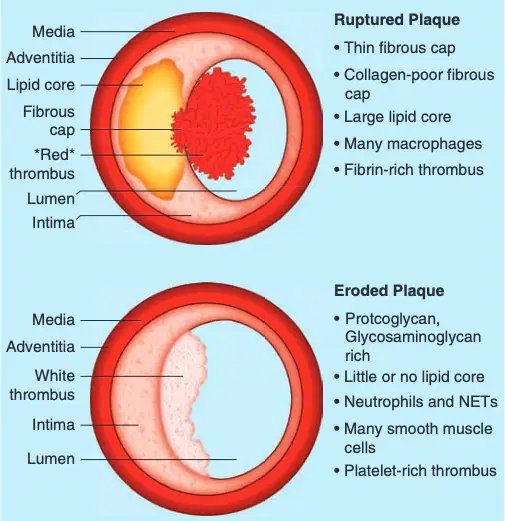
Which of the following is a characteristic of a ruptured plaque in human coronary arteries?
Thin fibrous cap and many macrophages
Many smooth muscle cells and platelet-rich thrombus
Little or no lipid core and neutrophils
Glycosaminoglycan-rich matrix
According to the TIMI Risk Score for NSTE-ACS, which of the following is NOT considered a risk marker?
Age ≥65 years
Known CAD (>50% stenosis)
History of asthma
ST deviation ≥0.5mm on presenting ECG
Which of the following best describes the role of cardiac biomarkers in the diagnosis of NSTE-ACS?
They are used to measure blood pressure
They indicate myocardial necrosis through elevated troponin levels
They are only useful for diagnosing arrhythmias
They are not relevant in acute coronary syndromes
A patient presents with chest discomfort, ST-segment depression on ECG, and elevated troponin. What is the most likely diagnosis?
Non-cardiac chest pain
Unstable angina (UA)
Non-ST-segment elevation myocardial infarction (NSTEMI)
ST-segment elevation myocardial infarction (STEMI)
Which of the following statements about electrocardiogram (ECG) changes in NSTE-ACS is correct?
ST-segment elevation is always present
ST-segment depression may be transient or persistent
ECG changes are not useful in diagnosis
Only T-wave inversion is seen
Which of the following is a reason for the elevation of cardiac troponin values as a result of myocardial injury related to acute myocardial infarction?
Atherosclerotic plaque disruption or erosion with thrombosis
Coronary artery spasm
Sepsis
Defibrillator shocks
Which of the following is NOT listed as a reduced myocardial perfusion cause of myocardial injury?
Coronary artery embolism
Sustained tachyarrhythmia
Coronary artery dissection
Severe anemia
Which systemic condition is mentioned as a cause of myocardial injury?
Sepsis
Coronary artery spasm
Heart failure
Takotsubo syndrome
What is the primary purpose of coronary computed tomographic angiography (CCTA) in the context of acute coronary syndromes?
To improve the accuracy and speed of diagnostic evaluation
To treat myocardial infarction
To monitor heart rate
To administer medication
Patients with documented NSTE-ACS exhibit a wide spectrum of early (30 days) risk of death. What is the approximate range of this risk?
1 to 10%
10 to 20%
5 to 15%
15 to 25%
Which medication is recommended for patients with persistent symptoms or ECG signs of ischemia after initial treatment with full-dose nitrates and beta blockers?
Heart rate–slowing calcium channel blockers
Aspirin
Statins
ACE inhibitors
Why are beta blockers recommended in the treatment of NSTE-ACS?
They reduce myocardial oxygen demands
They increase heart rate
They cause vasoconstriction
They increase blood pressure
A patient with NSTE-ACS is experiencing ischemic discomfort. What is the recommended initial dose of sublingual or buccal nitroglycerin?
0.3–0.6 mg
5–10 μg/min
200 μg/min
50–60 beats/min
Which of the following is a contraindication to the use of nitrates in the treatment of NSTE-ACS?
Hypotension or recent use of a phosphodiesterase type 5 (PDE-5) inhibitor
Sepsis
Chronic kidney disease
Coronary artery spasm
What is the main goal of anti-ischemic treatment in patients with NSTE-ACS?
To provide relief of pain and discomfort
To increase heart rate
To induce arrhythmias
To cause myocardial infarction
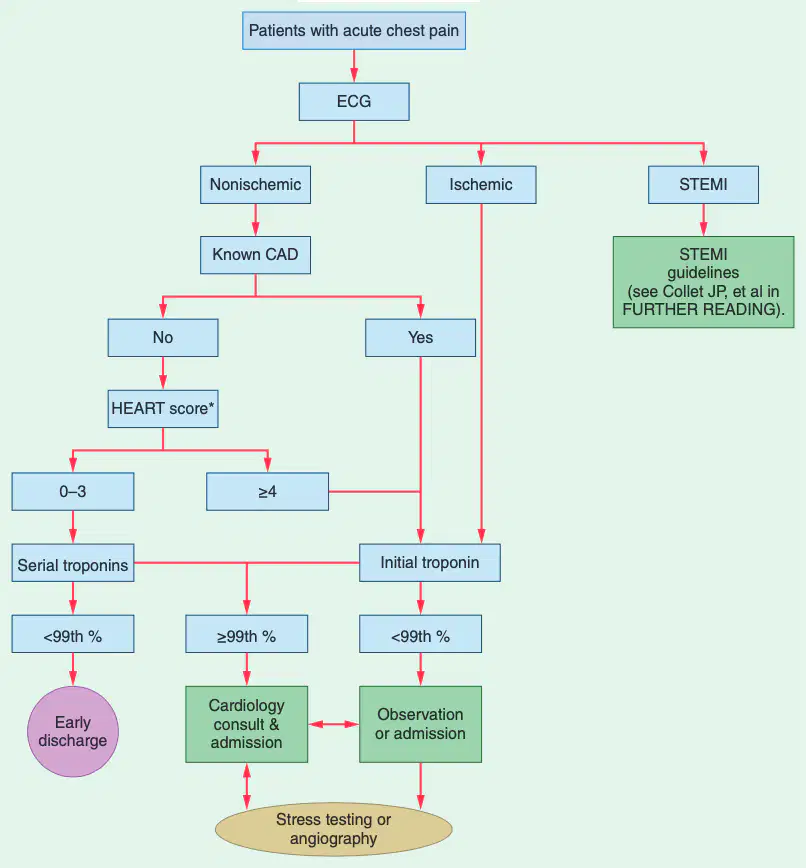
Which of the following is the first step in evaluating a patient with acute chest pain according to the HEART pathway?
Administering antiplatelet therapy
Performing an ECG
Measuring initial troponin
Calculating the HEART score
According to the HEART pathway, what should be done if a patient with acute chest pain has a nonischemic ECG and a HEART score of 0–3?
Early discharge
Cardiology consult and admission
Observation or admission
Immediate PCI
Which of the following is a recommended initial antiplatelet therapy for patients with acute chest pain?
Statins
ACE inhibitors
Clopidogrel with a dose of at least 162 mg of aspirin
Beta-blockers
What is the main goal of early administration of statins in patients with acute coronary syndrome (ACS)?
To increase blood pressure
To reduce periprocedural MI and recurrences of ACS
To prevent arrhythmias
To increase LDL-C levels
A patient with NSTE-ACS is at high risk for bleeding. Which P2Y12 inhibitor is recommended due to its lower risk of major bleeding?
Prasugrel
Ticagrelor
Clopidogrel
Aspirin
Which of the following statements best describes the difference between prasugrel and clopidogrel in the context of ACS treatment?
Prasugrel is associated with a lower risk of bleeding than clopidogrel.
Prasugrel has a more rapid onset and higher level of irreversible platelet inhibition than clopidogrel.
Clopidogrel is only used in STEMI, not NSTE-ACS.
Prasugrel is not approved for use with PCI.
Which of the following is a recommendation for the use of nitrates in patients with Non-ST-segment elevation acute coronary syndrome (NSTE-ACS)?
Use sublingual or intravenous nitrates to relieve angina
Initiate early for ischemic symptoms in all patients
Use only in patients with bradycardia
Avoid in all patients with hypertension
Which condition is a contraindication for the use of beta blockers in NSTE-ACS patients?
PR interval >0.24 s
Systolic pressure >90 mmHg
Heart rate >100 beats/min
Recent use of a PDE-5 inhibitor
When should calcium channel blockers be considered in patients with NSTE-ACS?
In patients with vasospastic angina
In all patients with heart failure
Only in patients with bradycardia
In patients with high potassium levels
Which of the following is a reason to avoid morphine or other narcotic analgesics in NSTE-ACS?
Respiratory depression
Systolic pressure >90 mmHg
Pulmonary edema
High heart rate
Which oral antiplatelet therapy is contraindicated in patients with prior stroke or transient ischemic attack?
Prasugrel
Clopidogrel
Aspirin
Ticagrelor
A patient with NSTE-ACS who develops a new coronary event while receiving clopidogrel and aspirin should be considered for which additional therapy?
P2Y12 blocker (prasugrel or ticagrelor)
Beta blocker
Calcium channel blocker
Morphine
Which intravenous antiplatelet agent is administered as a 30 μg/kg bolus followed by 4 μg/kg/min infusion for 2 hours during PCI?
Cangrelor
Eptifibatide
Tirofiban
Bivalirudin
Which of the following is a correct maintenance dose for Apixaban in patients with atrial fibrillation after PCI?
5 mg twice daily
10 mg once daily
2.5 mg once daily
15 mg twice daily
What is the main risk associated with long-term dual antiplatelet therapy (DAPT) in patients with NSTE-ACS?
Increased risk of bleeding
Increased risk of hypertension
Increased risk of bradycardia
Increased risk of heart failure
Which of the following is a reason for the failure of routine early initiation of glycoprotein IIb/IIIa inhibitor therapy in NSTE-ACS patients?
Increased risk of major bleeding
Lack of efficacy in reducing angina
Increased risk of hypertension
Increased risk of bradycardia
Which of the following is considered the mainstay of therapy among parenteral options available for anticoagulation in NSTE-ACS?
Low-molecular-weight heparin (LMWH) enoxaparin
Unfractionated heparin (UFH)
Bivalirudin
Fondaparinux
Which anticoagulant is associated with a lower risk of major bleeding compared to enoxaparin but requires supplemental UFH to prevent catheter thrombosis?
Bivalirudin
Fondaparinux
Unfractionated heparin (UFH)
Low-molecular-weight heparin (LMWH)
Why is early invasive strategy recommended in patients with NSTE-ACS who have a high risk of recurrent cardiac events?
It reduces the risk of excessive bleeding
It is less expensive than conservative management
It has been shown to be superior in reducing recurrent cardiac events
It eliminates the need for antiplatelet therapy
What is the most important adverse effect of all antithrombotic agents?
Hypertension
Excessive bleeding
Bradycardia
Hyperglycemia
In the context of NSTE-ACS, what does an invasive strategy typically involve?
Immediate administration of oral anticoagulants only
Early coronary angiography and possible revascularization within 48 hours
Delaying all interventions until symptoms resolve
Use of only non-invasive testing
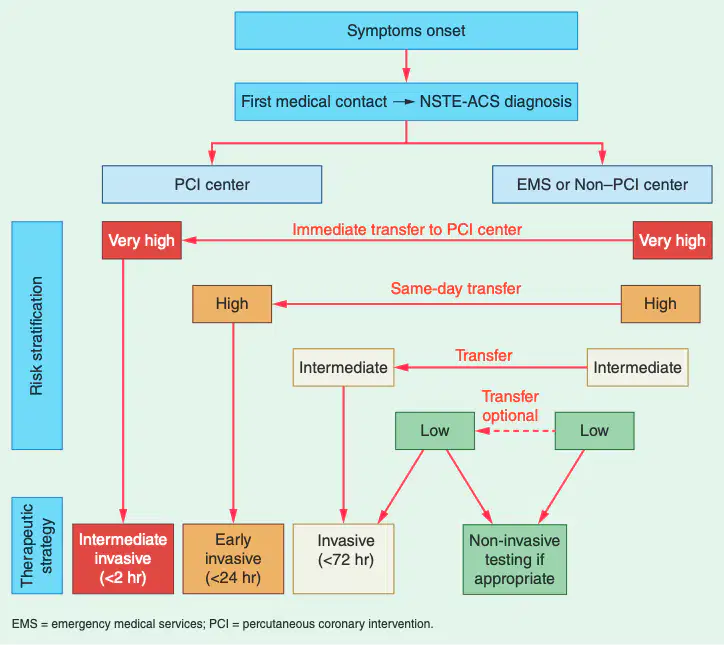
According to the risk stratification flowchart for NSTE-ACS, what is the recommended action for a patient classified as 'very high' risk?
Immediate transfer to PCI center
Non-invasive testing if appropriate
Early invasive strategy within 24 hours
Transfer optional
Which of the following is NOT a criterion for considering a patient at high risk in the context of NSTE-ACS?
Multiple clinical risk factors
ST-segment deviation
Positive biomarkers
Absence of chest pain
Which of the following is emphasized as a key aspect of long-term management for patients with NSTEMI-ACS?
Immediate surgical intervention
Risk factor modification
Avoidance of all medications
Complete bed rest
According to the text, what is the recommended initial antiplatelet regimen for patients with NSTEMI-ACS?
Aspirin and a P2Y₁₂ inhibitor for 12 months
Beta blockers and statins for 6 months
Nitrates and calcium channel blockers for 3 months
Warfarin and aspirin for 24 months
Which of the following statements best describes Prinzmetal’s variant angina (PVA)?
It is caused by atherosclerotic plaque rupture
It is a syndrome of severe ischemic pain due to coronary artery spasm
It is always associated with myocardial infarction
It is only found in elderly patients
What is the main therapeutic approach for Prinzmetal’s variant angina?
Beta blockers and diuretics
Nitrates and calcium channel blockers
Statins and ACE inhibitors
Antiplatelet therapy alone
Which of the following is a reason why patients with PVA may have a lower incidence of cardiac death compared to those with atherosclerotic obstructive lesions?
They are always treated with surgery
They have no risk of arrhythmias
They often have no or mild fixed coronary obstruction
They are not given any medications
Based on the text, what is a major challenge in reducing the burden of ischemic heart disease in low- and middle-income countries?
Lack of effective medications
Socio-economic and healthcare system limitations
Overuse of advanced technology
Excessive physical activity
A patient with NSTEMI-ACS and diabetes is being considered for long-term therapy. According to the text, which additional class of drugs may be recommended for such patients?
SGLT-2 inhibitors or GLP-1 receptor agonists
Thiazide diuretics
Anticoagulants only
Opioid analgesics
Why is the diagnosis of Prinzmetal’s variant angina (PVA) sometimes challenging?
It always presents with classic symptoms
Coronary angiography always shows severe obstruction
Clinical examination is usually unremarkable in the absence of ischemia
It is only seen in elderly patients
Which of the following best describes the prognosis for patients with PVA after an acute episode?
All patients die within 6 months
Survival at 5 years is excellent, but some may develop arrhythmias or cardiac events
No risk of future cardiac events
All patients require heart transplantation
What is a key factor in the global increase in coronary risk factors, as discussed in the text?
Decreased urbanization
Improved childhood nutrition
Urbanization and reduction of physical labor
Universal access to healthcare

