
NEW
Font size
 Worksheets
Mitral Stenosis and mitral regurgitation Quiz
Total questions: 73
Worksheet time: 37mins
Which condition is the leading cause of mitral stenosis worldwide?
Rheumatic fever
Infective endocarditis
Myxoma
Systemic lupus erythematosus
What is the normal area of the mitral valve orifice in adults?
1–1.5 cm²
2–4 cm²
0.5–1 cm²
5–7 cm²
Which of the following is NOT a common etiology of mitral stenosis?
Rheumatic fever
Mitral annular calcification
Aortic valve disease
Infective endocarditis with large vegetations
In patients with severe mitral stenosis, what is the typical cardiac output (CO) at rest?
Normal or almost so
Markedly elevated
Always below 1 L/min
Unmeasurable
Which of the following statements best explains why the left atrial (LA) pressure is elevated in mitral stenosis?
The mitral valve is unable to close during systole
The orifice area is reduced, impeding blood flow from the LA to the LV
The left ventricle contracts more forcefully
The aortic valve is stenotic
A patient with mitral stenosis presents with dyspnea. Which pathophysiological mechanism is most directly responsible for this symptom?
Decreased pulmonary venous pressure
Elevated pulmonary arterial (PA) wedge pressure
Increased right ventricular output
Decreased left atrial pressure
Which of the following is a late complication of mitral stenosis due to chronic inflammation?
Mitral valve prolapse
Calcification and fusion of the commissures
Aortic regurgitation
Tricuspid stenosis
Why does the incidence of mitral stenosis decrease in high-income countries?
Increased prevalence of aortic valve disease
Reduction in acute rheumatic fever
Higher rates of infective endocarditis
More cases of myxoma
Which of the following is a hemodynamic hallmark of mitral stenosis?
Decreased left atrial pressure
Elevated left atrial pressure gradient
Increased right ventricular ejection fraction
Decreased pulmonary venous pressure
What is the effect of an increased heart rate on the severity of mitral stenosis symptoms?
It lengthens diastole, improving symptoms
It shortens diastole, worsening symptoms
It has no effect on symptoms
It increases left ventricular output
Which of the following is NOT a common symptom of severe pulmonary hypertension in patients with mitral stenosis (MS)?
Right-sided heart failure
RV enlargement
Increased oxygen uptake during exercise
Pulmonary regurgitation (PR)
What is the primary cause of pulmonary hypertension in patients with mitral stenosis?
Passive backward transmission of elevated LA pressure
Increased right ventricular contractility
Decreased pulmonary artery compliance
Enhanced oxygen uptake in the lungs
Which physical finding is most likely to be observed in a patient with severe mitral stenosis?
Bounding carotid pulse
Malar flush with pink or blue facies
Clubbing of the fingers
Jugular venous distension during inspiration only
A Graham Steell murmur is associated with which of the following conditions?
Aortic stenosis
Pulmonary regurgitation due to pulmonary hypertension
Tricuspid regurgitation
Mitral valve prolapse
Which laboratory examination is most useful for assessing the severity of mitral stenosis and associated valvular lesions?
Chest X-ray
Echocardiography (TTE)
Complete blood count
Liver function test
A patient with mitral stenosis presents with a loud first heart sound (S1) and an opening snap (OS) that follows the second heart sound (S2). What does a shorter S2-OS interval indicate?
Less severe mitral stenosis
More severe mitral stenosis
Presence of aortic regurgitation
Absence of pulmonary hypertension
Which of the following best describes the changes seen on a chest X-ray in early mitral stenosis?
Straightening of the upper left border of the cardiac silhouette
Hyperinflation of the lungs
Decreased heart size
Calcification of the aortic valve
Which of the following statements about thrombi and emboli in mitral stenosis is correct?
They most commonly form in the right atrium
Systemic embolization is rare in patients with MS
The incidence of embolization increases with age and reduced cardiac output
Thrombi are never found in the left atrial appendage
Which of the following is a distinguishing feature of the murmur associated with mitral stenosis (MS) compared to a murmur caused by mitral regurgitation (MR)?
The murmur in MS is intensified in pre-systole and becomes softer with administration of vasodilators.
The murmur in MS is always accompanied by a loud S3.
The murmur in MS is best heard at the apex during inspiration.
The murmur in MS is associated with a continuous machinery sound.
What is the primary purpose of performing left and right heart catheterization in patients with mitral stenosis?
To measure blood glucose levels
To assess coronary artery disease and evaluate discrepancies between clinical and noninvasive findings
To determine liver function
To diagnose diabetes mellitus
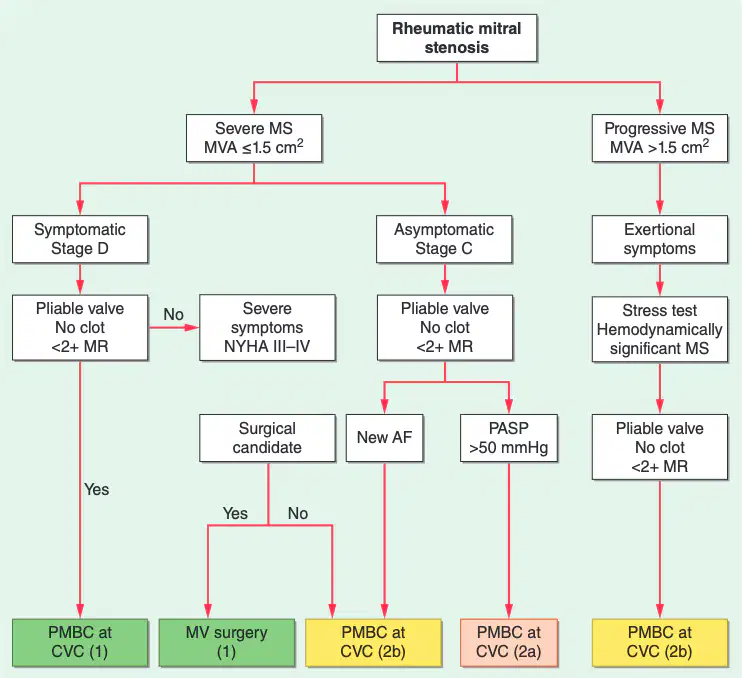
According to the management algorithm for rheumatic mitral stenosis, what is the recommended intervention for a symptomatic patient with severe MS (MVA ≤1.5 cm²), pliable valve, no clot, and less than moderate MR?
Mitral valve replacement surgery
Percutaneous mitral balloon commissurotomy (PMBC) at a comprehensive valve center (CVC)
Heart transplantation
Medical management only
Which of the following is NOT a typical feature of left atrial myxoma that distinguishes it from mitral stenosis?
Systemic emboli
Weight loss
Diastolic murmur identical to MS
Elevated serum IgG and interleukin 6 (IL-6) concentrations
Why is penicillin prophylaxis recommended for patients with a previous episode of rheumatic fever?
To prevent secondary infection by group A β-hemolytic streptococci
To reduce cholesterol levels
To treat acute heart failure
To prevent pulmonary embolism
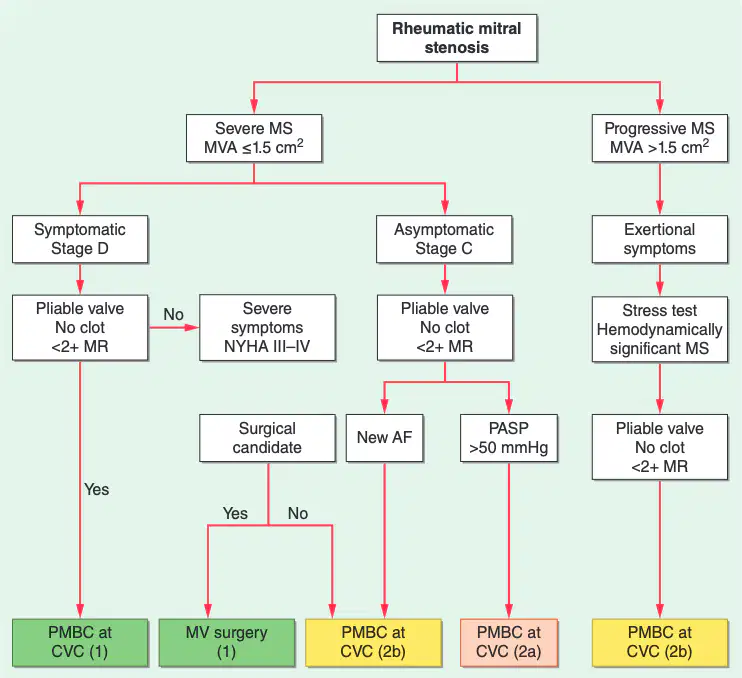
A patient with severe mitral stenosis (MVA ≤1.5 cm²) and new onset atrial fibrillation (AF) but no clot and less than moderate MR should be managed with which intervention according to the flowchart?
Mitral valve surgery
PMBC at CVC (2a)
Heart-lung transplant
Medical therapy only
Which medication is recommended to be administered indefinitely to patients with MS who have AF, a history of thromboembolism, or documented LA thrombus?
Beta blockers
Vitamin K antagonist therapy (such as warfarin)
Digitalis glycosides
Non–vitamin K oral anticoagulants (e.g., apixaban)
What is the main purpose of performing a transesophageal echocardiogram (TEE) before percutaneous mitral balloon commissurotomy (PMBC)?
To measure the mitral valve area
To exclude the presence of LA thrombus and assess the degree of MR
To monitor blood pressure during the procedure
To evaluate the patient's heart rate
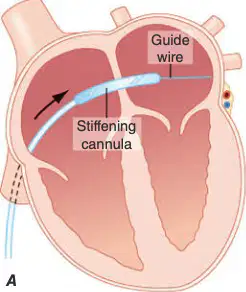
What is the correct sequence of steps in the Inoue balloon technique for percutaneous mitral balloon commissurotomy as shown in the diagram?
Inflate balloon in left atrium, then cross mitral valve, then deflate
Advance guide wire, puncture septum, cross mitral valve, inflate balloon
Insert stiffening cannula, inflate balloon in right atrium, then cross mitral valve
Inflate balloon in left ventricle, then cross mitral valve, then deflate
What is the expected hemodynamic change after a successful percutaneous mitral balloon commissurotomy (PMBC) as shown in the pressure and ECG graphs?
Increase in mean mitral gradient and decrease in mitral valve area
Decrease in mean mitral gradient and increase in mitral valve area
No change in mitral valve area or gradient
Increase in both mean mitral gradient and mitral valve area
Which of the following is NOT a typical indication for mitral commissurotomy?
Severe MS with pliable mitral leaflets and little or no commissural calcium
Severe MS with significant subvalvular thickening and LA thrombus
Severe MS with effective orifice area <1.5 cm²/m² body surface area
Severe MS with normal-sized adults and pliable valves
What is the approximate perioperative mortality rate for mitral valve repair procedures such as commissurotomy?
10%
5%
2%
0.5%
What is the unaudited operative mortality percentage for isolated mitral valve replacement (MVR) according to Table 26-3?
4.5%
9.6%
11.6%
5.4%
Which of the following is NOT a functional component of the mitral valve apparatus?
Leaflets
Annulus
Papillary muscles
Pulmonary veins
Which of the following is a long-term complication of valve replacement mentioned in the text?
Acute myocardial infarction
Systemic embolization
Valve degeneration
Significant comorbidities
Based on Table 26-4, which of the following is classified as a primary (affecting leaflets, chordae) chronic cause of mitral regurgitation?
Ischemic cardiomyopathy
Myxomatous (MVP, Barlow’s, forme fruste)
Blunt trauma
Dilated cardiomyopathy
A patient with mitral stenosis (MS) and significant associated MR is most likely to benefit from which procedure?
Percutaneous transcatheter intervention
Mitral valve replacement (MVR)
Coronary artery bypass grafting (CABG)
Medical therapy only
Why is the prognosis worse in patients over 65 years of age who undergo mitral valve surgery?
They have higher rates of acute myocardial infarction
They are more likely to have significant comorbidities
They have better left ventricular function
They are less likely to require surgery
Which of the following statements best describes the difference between primary and secondary mitral regurgitation?
Primary MR is due to abnormal valve function, while secondary MR is due to abnormal ventricular function.
Primary MR is always acute, while secondary MR is always chronic.
Primary MR is caused by coronary artery disease, while secondary MR is caused by hypertension.
Primary MR is treated with medication, while secondary MR is treated with surgery.
What is the most characteristic auscultatory finding in chronic severe mitral regurgitation (MR)?
Early diastolic murmur at the left sternal border
Systolic murmur of variable intensity at the apex
Holosystolic murmur at the apex radiating to the axilla
Opening snap followed by a diastolic rumble
Which of the following symptoms is most commonly associated with chronic mitral regurgitation (MR)?
Sudden onset of chest pain
Fatigue and exertional dyspnea
Hemoptysis
Syncope
In patients with chronic severe MR, which of the following is typically observed on physical examination?
Loud S2 at the apex
Displaced and hyperdynamic apical impulse
Fixed split S2
Systolic ejection click
Which of the following best describes the compliance of the left atrium (LA) in acute severe mitral regurgitation (MR)?
LA compliance is increased, resulting in low LA pressure
LA compliance is normal or reduced, resulting in markedly elevated LA pressure
LA compliance is always decreased, resulting in low pulmonary venous pressure
LA compliance is increased, resulting in decreased regurgitant volume
Which diagnostic tool is most useful for measuring the effective regurgitant orifice area in mitral regurgitation?
Chest X-ray
Cardiac magnetic resonance (CMR) imaging
Doppler echocardiographic examination
Electrocardiogram (ECG)
What is the primary hemodynamic consequence of severe mitral regurgitation on the left ventricle (LV)?
Decreased LV preload
Increased LV afterload
Increased LV volume overload
Decreased LV contractility
Which of the following is a distinguishing feature of the murmur in acute severe mitral regurgitation compared to chronic MR?
The murmur is holosystolic and radiates to the axilla
The murmur is short, early systolic, and may be soft or absent
The murmur is always accompanied by a loud S1
The murmur is best heard at the right upper sternal border
Which diagnostic tool is primarily used to assess the mechanism and hemodynamic severity of mitral regurgitation (MR)?
Chest X-Ray
Electrocardiogram (ECG)
Transthoracic echocardiography (TTE)
Cardiac catheterization
What is a common ECG finding in patients with sinus rhythm and chronic severe MR?
Right atrial (RA) enlargement
Left atrial (LA) enlargement
Right ventricular (RV) hypertrophy
Left ventricular (LV) hypertrophy
Which of the following is NOT a typical finding on chest X-ray in late chronic MR?
Enlarged left atrium (LA)
Enlarged left ventricle (LV)
Marked calcification of the mitral leaflets
Decreased pulmonary venous congestion

According to the management flowchart for primary MR, what is the recommended intervention for a patient with severe MR, symptoms due to MR (Stage D), and high or prohibitive surgical risk?
MV surgery
Transcatheter edge-to-edge MV repair
Medical management only
Chest X-ray monitoring
Which of the following statements best describes the role of anticoagulation in the management of chronic severe MR?
Anticoagulation should be provided to all patients with MR.
Anticoagulation is only indicated if atrial fibrillation (AF) intervenes or as guided by risk scores.
Anticoagulation is never indicated in MR.
Anticoagulation is indicated only in acute MR.
Why might transesophageal echocardiography (TEE) be preferred over TTE in some cases of MR?
TEE is less invasive than TTE.
TEE provides greater anatomic detail and can assess exercise capacity.
TEE is used only for initial diagnosis.
TEE is not useful for dynamic changes in MR severity.
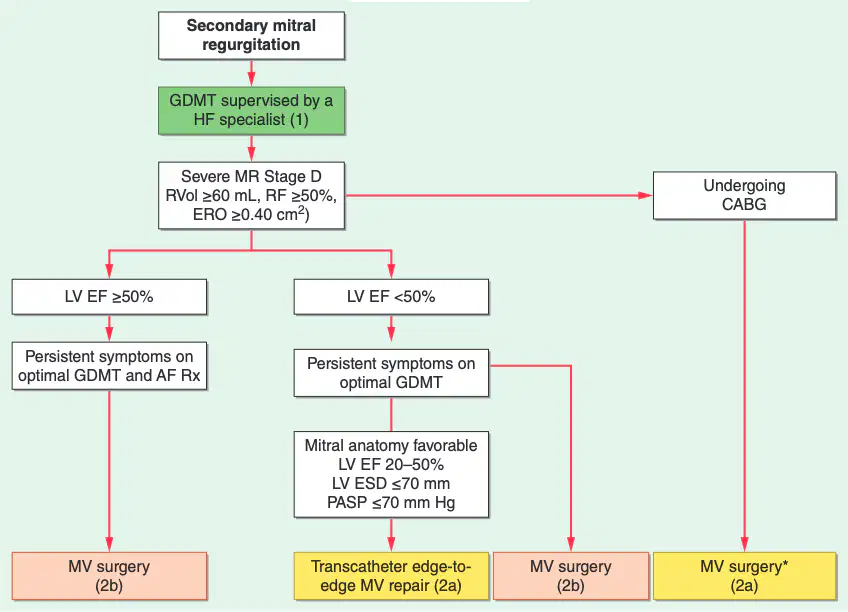
Which of the following is a recommended treatment for patients with secondary mitral regurgitation and left ventricular ejection fraction (LV EF) ≥50% who have persistent symptoms on optimal guideline-directed medical therapy (GDMT) and atrial fibrillation (AF) therapy?
Mitral valve (MV) surgery (2b)
Transcatheter edge-to-edge MV repair (2a)
Undergoing coronary artery bypass grafting (CABG)
No further treatment required
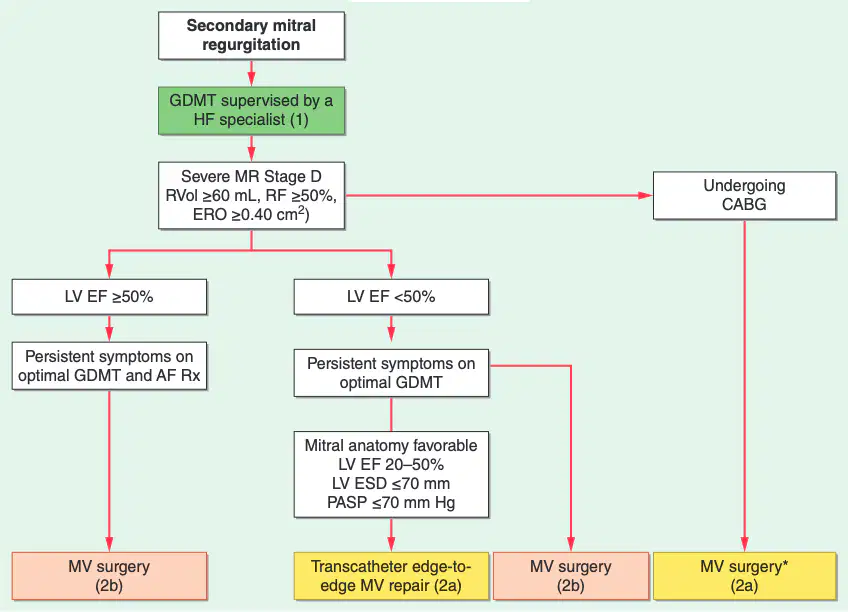
According to the management algorithm, what is the next step for a patient with secondary mitral regurgitation, severe MR Stage D, LV EF <50%, and mitral anatomy favorable for intervention?
MV surgery (2b)
Transcatheter edge-to-edge MV repair (2a)
Undergoing CABG
Continue only with GDMT
Which of the following is NOT a risk associated with mitral valve replacement compared to mitral valve repair?
Higher risk of prosthetic valve complications
Lower risk of late valve failure
Increased risk of endocarditis
Need for lifelong anticoagulation
What is the unadjusted operative mortality rate for isolated mitral valve repair (MVR) according to Table 264-2?
9.6%
4.5%
12.4%
6.3%
Why might transcatheter edge-to-edge repair (TEER) be preferred over mitral valve replacement in some patients with secondary mitral regurgitation?
TEER is less invasive and preserves the integrity of the papillary muscles and subvalvular apparatus.
TEER has a higher long-term mortality rate.
TEER requires open-heart surgery.
TEER is only used for patients with normal left ventricular function.
A patient with secondary mitral regurgitation is asymptomatic but has a history of myocardial infarction and sinus rhythm with normal LV size and systolic function. What is the recommended management?
Immediate mitral valve surgery
Continue guideline-directed medical therapy (GDMT)
Transcatheter edge-to-edge repair
Cardiac transplantation
Which of the following is a benefit of mitral valve repair over replacement in patients with myxomatous mitral regurgitation (MR)?
Lower perioperative mortality rates
Higher risk of stroke
Increased risk of left atrial appendage amputation
Greater need for anticoagulation
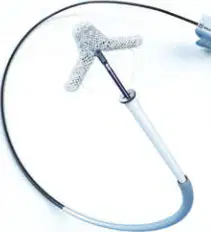
What is the primary purpose of using a clip in transcatheter mitral valve repair?
To grasp the leading edges of the mitral leaflets and reduce regurgitation
To replace the entire mitral valve
To measure the thickness of the mitral valve
To deliver medication directly to the heart
Which of the following is NOT a typical surgical procedure for patients with ischemic mitral regurgitation (MR)?
Simultaneous coronary artery revascularization
Annuloplasty repair with an undersized ring
Mitral valve replacement for patients with moderate or greater degrees of MR
Aortic valve replacement for all patients
Why might left and right heart catheterization and left ventriculography be helpful before surgical treatment of MR?
To confirm the presence of severe MR in patients with inconclusive clinical and TTE findings
To replace the mitral valve
To measure blood sugar levels
To assess kidney function
Which of the following statements best describes the use of transcatheter edge-to-edge repair (TEER) for mitral regurgitation?
TEER is a minimally invasive procedure that uses a clip to grasp the mitral leaflets and is suitable for both primary and secondary MR in selected patients.
TEER is a surgical procedure that replaces the entire mitral valve.
TEER is only used for aortic valve disease.
TEER is a diagnostic imaging technique.
A patient with severe secondary MR and heart failure is being considered for TEER. What is a key factor in determining their suitability for this procedure?
Detailed assessment of surgical risk, comorbidities, and echocardiographic imaging
Blood glucose levels
Family history of hypertension
Age alone
Which of the following is a primary (organic) cause of tricuspid regurgitation?
Rheumatic
Endocarditis
Myxomatous (TVP)
All of the above
What is the most common cause of tricuspid stenosis?
Congenital
Rheumatic
Endocarditis
Radiation
Which physical finding is most likely to be observed in a patient with severe tricuspid stenosis?
Jugular venous distention
Bradycardia
Hypertension
Clubbing of fingers
What is the typical characteristic of the diastolic murmur of tricuspid stenosis?
It is best heard at the left sternal border and increases with inspiration
It is best heard at the apex and increases with expiration
It is best heard at the right upper sternal border and decreases with inspiration
It is best heard at the left lower sternal border and decreases with expiration
Which laboratory examination finding is most suggestive of right atrial enlargement?
Tall, peaked P waves in lead II
Inverted T waves in lead V1
Low voltage QRS complexes
ST segment depression in lead III
What is the most common etiology of secondary (functional) tricuspid regurgitation?
Rheumatic heart disease
Endocarditis
Right ventricular dilation and leaflet tethering
Papillary muscle injury
Which of the following is NOT a typical symptom of mild or moderate tricuspid regurgitation?
Heart failure due to left-sided valve lesions
Fatigue
Edema
Severe hypertension
What is the main hemodynamic consequence of severe tricuspid regurgitation?
Increased left ventricular afterload
Reduced forward cardiac output
Increased pulmonary venous pressure
Decreased right atrial pressure
Which of the following statements about the treatment of tricuspid stenosis is correct?
Surgical relief is best carried out at the time of mitral valve surgery
Medical therapy is always sufficient
Percutaneous tricuspid balloon commissurotomy is the first-line treatment
Mechanical valves are preferred over bioprosthetic valves in all cases
What is the effect of inspiration on the murmur of tricuspid stenosis?
It is augmented
It is reduced
It disappears completely
It becomes a systolic murmur
What does the ECG finding of tall, peaked P waves in lead II most likely indicate?
Right atrial enlargement
Left ventricular hypertrophy
Atrial fibrillation
Myocardial infarction

