
 Worksheets
Aortic Regurgitation Quiz
Total questions: 41
Worksheet time: 21mins
Which of the following is NOT a valvular etiology of aortic regurgitation?
Congenital (Bicuspid)
Endocarditis
Aortic dissection
Rheumatic fever
Which of the following best describes the pathophysiology of aortic regurgitation?
Decreased left ventricular end-diastolic volume
Increased left ventricular end-diastolic volume and pressure
Decreased preload in the left ventricle
Increased right ventricular afterload
Which of the following is a typical symptom in patients with chronic severe aortic regurgitation?
Sudden chest pain
Palpitations during exertion or with emotion
Acute onset of hemiplegia
Severe abdominal pain
A patient with chronic aortic regurgitation is most likely to develop which of the following over time?
Rapid onset of pulmonary edema
Gradual left ventricular dilation and hypertrophy
Acute myocardial infarction
Sudden cardiac tamponade
Which of the following statements about chronic severe aortic regurgitation is TRUE?
Patients usually present with acute symptoms and require immediate surgery.
The left ventricle cannot dilate sufficiently to maintain stroke volume.
Symptoms may be absent for many years before the development of exertional dyspnea.
Coronary blood flow is always increased.
Which of the following is a non-valvular etiology of aortic regurgitation?
Endocarditis
Rheumatic fever
Aortitis
Myxomatous (prolapse)
What is the effect of increased left ventricular end-diastolic volume (preload) in aortic regurgitation?
It decreases the forward stroke volume.
It constitutes the major hemodynamic compensation for aortic regurgitation.
It causes immediate heart failure.
It reduces the need for coronary perfusion.
Which of the following is a common finding in the history of patients with chronic severe aortic regurgitation?
Sudden loss of consciousness
Long latent period with gradual onset of symptoms
Immediate development of pulmonary edema
Acute pericarditis
Which of the following is a possible complication of myocardial ischemia in patients with aortic regurgitation?
Increased coronary blood flow
Decreased oxygen demand by the left ventricle
Coronary blood flow may be compromised
Reduced left ventricular hypertrophy
Which of the following is a characteristic physical finding in chronic severe aortic regurgitation (AR)?
Jarring of the entire body and bobbing motion of the head with each systole
Swelling of the ankles only
Cyanosis of the lips
Clubbing of the fingers
What is the typical quality of the arterial pulse in patients with severe aortic regurgitation?
Slow-rising and weak
Rapidly rising "water-hammer" pulse
Irregularly irregular
Thready and faint
Which heart sound is associated with aortic regurgitation and is best heard at the left sternal border?
Systolic ejection murmur
High-pitched, blowing, decrescendo diastolic murmur
Mid-systolic click
Opening snap
What is the Austin Flint murmur, and in which condition is it heard?
A soft, low-pitched, mid-to-late diastolic murmur heard in aortic regurgitation
A harsh systolic murmur heard in mitral stenosis
A continuous murmur heard in patent ductus arteriosus
A loud S1 heard in tricuspid regurgitation
Which laboratory examination is most useful in detecting the impact of aortic regurgitation on the heart?
Complete blood count
Echocardiogram
Liver function test
Urinalysis
A patient with chronic severe aortic regurgitation is likely to have which of the following findings on chest x-ray?
Displacement of the apex downward and to the left
Pulmonary edema only
Right atrial enlargement
Normal heart size
Which imaging modality is most sensitive for the detection of root and ascending aortic aneurysm in aortic regurgitation?
Chest x-ray
Cardiac magnetic resonance imaging (CMR)
Electrocardiogram (ECG)
Abdominal ultrasound
What is the initial treatment approach for acute aortic regurgitation?
Intravenous diuretics and vasodilators
Beta-blockers only
Immediate surgical valve replacement in all cases
Anticoagulation therapy
Which of the following is a key echocardiographic criterion for diagnosing severe aortic regurgitation (AR)?
LVESD < 50 mm
Regurgitant fraction (RF) ≥ 50%
Ejection fraction (EF) > 60%
ERO < 0.3 cm²

According to the management flowchart, what is the recommended intervention for a symptomatic patient with severe aortic regurgitation and an ejection fraction (EF) ≤ 55%?
AVR (Aortic Valve Replacement)
Observation only
Beta blocker therapy
Diuretic therapy
Which of the following medications is considered relatively contraindicated in patients with chronic aortic regurgitation due to concern that slowing of the heart rate may worsen diastolic regurgitation?
Beta blockers
Angiotensin receptor blockers (ARBs)
Hydralazine
Nitrates
What is the primary goal of medical treatment in patients with chronic aortic regurgitation who are not immediate candidates for surgery?
To increase afterload
To reduce afterload and enhance LV ejection
To increase preload
To induce bradycardia
A patient with chronic aortic regurgitation and Marfan’s syndrome is being considered for medical therapy. Which medication may be useful to retard the rate of aortic root enlargement?
ARBs (Angiotensin receptor blockers)
Nitrates
Digoxin
Diuretics
Why should patients with severe aortic regurgitation and associated aortopathy avoid isometric exercises?
They increase afterload and may worsen regurgitation
They decrease heart rate excessively
They cause hypovolemia
They improve diastolic function
Which of the following is the primary indication for aortic valve replacement (AVR) in patients with chronic severe aortic regurgitation (AR)?
Presence of mild symptoms only
Symptomatic patients irrespective of LV function
Asymptomatic patients with normal LV function
Only after the development of severe symptoms
At what interval is echocardiographic follow-up recommended for patients with chronic severe AR to determine the optimal timing for surgery?
Every 2-3 years
Every 1-2 months
Every 6-12 months
Every 5 years
Which of the following is NOT a criterion for considering surgery in asymptomatic patients with severe AR?
LV ejection fraction <55% on serial studies
LV end-systolic dimension >50 mm
LV diastolic dimension >65 mm
LV ejection fraction >60% on serial studies
What is the main advantage of exercise testing in the management of chronic severe AR?
It replaces the need for echocardiography
It helps to assess effort tolerance more objectively
It eliminates the need for surgery
It is only useful after severe symptoms develop
Which surgical procedure is generally not recommended for patients with severe AR who are at surgical risk?
Transcatheter aortic valve implantation (TAVI)
Valve-sparing aortic root reconstruction
Aortic valve replacement with a mechanical prosthesis
Aortic valve replacement with a biological prosthesis
A patient with AR due to a proximal ascending aorta aneurysm may benefit from which surgical approach to reduce or eliminate regurgitation?
Valve-sparing aortic root reconstruction
Mitral valve repair
Coronary artery bypass grafting
Pacemaker implantation
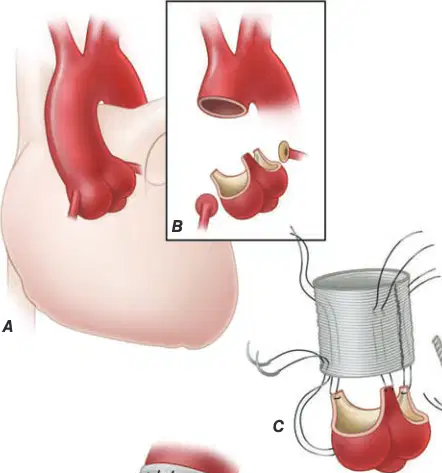
Illustration of the steps involved in valve-sparing aortic root reconstruction (David procedure), showing resection of the aortic root and proximal ascending aorta, mobilization of coronary artery buttons, placement of subannular sutures, and reimplantation of the valve inside the graft.
Diagram of mitral valve repair
Diagram of valve-sparing aortic root reconstruction (David procedure)
Diagram of coronary artery bypass grafting
Diagram of pacemaker implantation
Why might primary surgical repair be possible in cases of AR due to thoracic trauma?
Because the valve is always completely destroyed
Because the lesion is often limited to the attachments of the aortic annulus
Because the patient is always asymptomatic
Because the aorta is never involved
Which condition is the leading cause of mitral stenosis (MS)?
Rheumatic fever
Infective endocarditis
Myxoma
Systemic lupus erythematosus
What is the normal area of the mitral valve orifice in adults?
4–6 cm²
1–2 cm²
7–9 cm²
0.5–1 cm²
Which of the following is NOT a major cause of mitral stenosis listed in Table 26-3?
Rheumatic fever
Severe mitral annular calcification with leaflet involvement
Systemic hypertension
Infective endocarditis with large vegetations
In patients with severe mitral stenosis, what is the typical mitral valve orifice size?
Less than 1.5 cm²
2–3 cm²
4–6 cm²
Greater than 6 cm²
Which of the following statements best explains why patients with mitral stenosis may develop pulmonary congestion?
Elevated left atrial pressure leads to increased pulmonary venous pressure.
Decreased right ventricular output causes blood to back up in the lungs.
Increased aortic pressure forces fluid into the lungs.
Reduced mitral valve area increases systemic vascular resistance.
Why does the left atrial (LA) pressure increase in mitral stenosis?
The mitral valve orifice is narrowed, impeding blood flow from the LA to the LV.
The aortic valve is stenotic, causing backflow into the LA.
The right ventricle is hypertrophied, compressing the LA.
The pulmonary veins are dilated, increasing LA inflow.
A patient with mitral stenosis is found to have a left atrial pressure of 25 mmHg. What does this finding most likely indicate?
Severe mitral stenosis
Mild mitral stenosis
Normal mitral valve function
Aortic regurgitation
Which of the following is a common late complication of mitral stenosis due to chronic inflammation?
Calcification of the mitral valve leaflets
Aortic aneurysm
Left ventricular hypertrophy
Pulmonary embolism
What is the effect of an increase in heart rate on the pressure gradient across the mitral valve in mitral stenosis?
It increases the pressure gradient and reduces the time for flow across the mitral valve.
It decreases the pressure gradient and increases the time for flow.
It has no effect on the pressure gradient.
It only affects the right atrial pressure.
Which of the following best describes the pathophysiology of mitral stenosis?
Obstruction of blood flow from the left atrium to the left ventricle due to a narrowed mitral valve orifice.
Regurgitation of blood from the left ventricle to the left atrium during systole.
Obstruction of blood flow from the right atrium to the right ventricle.
Regurgitation of blood from the aorta to the left ventricle.

