
 Worksheets
Exploring the Central Nervous System
Total questions: 42
Worksheet time: 22mins
What are the main parts of the brain and their functions?
Temporal lobe - digestion control
Occipital lobe - speech production
Frontal lobe - vision processing
Main parts of the brain include: 1. Cerebrum - higher functions (thought, action), 2. Cerebellum - movement coordination, 3. Brainstem - basic life functions (breathing, heartbeat), 4. Limbic system - emotions and memory.
Describe the structure and function of the spinal cord.
The spinal cord only transmits signals from the body to the brain.
The spinal cord is a cylindrical structure of nervous tissue that transmits signals between the brain and body, coordinates reflexes, and processes sensory information.
The spinal cord is responsible for producing hormones in the body.
The spinal cord is a solid bone structure that protects the brain.
What role do neurotransmitters play in the nervous system?
Neurotransmitters facilitate communication between neurons in the nervous system.
Neurotransmitters act as hormones in the bloodstream.
Neurotransmitters store genetic information in neurons.
Neurotransmitters are responsible for muscle contraction.
Explain the process of synaptic transmission.
Signaling molecules are absorbed by the neuron instead of binding to receptors.
Synaptic transmission is the process by which signaling molecules are released by a neuron and bind to receptors on another neuron, facilitating communication between them.
Synaptic transmission occurs only in the spinal cord and not in the brain.
Neurons communicate solely through electrical impulses without chemical signals.
What are the four main lobes of the cerebral hemispheres?
cerebellum
brainstem
hippocampus
frontal lobe, parietal lobe, temporal lobe, occipital lobe
How does the brainstem contribute to basic life functions?
The brainstem regulates emotions and memory.
The brainstem is responsible for voluntary muscle movements.
The brainstem controls basic life functions like heart rate, breathing, and blood pressure.
The brainstem processes visual and auditory information.
What is the function of the cerebellum?
The cerebellum regulates emotions and mood.
The cerebellum processes visual information.
The cerebellum controls breathing and heart rate.
The cerebellum coordinates movement and balance.
Describe the role of the thalamus in sensory processing.
The thalamus is responsible for producing hormones.
The thalamus processes and relays sensory information to the cerebral cortex.
The thalamus controls motor functions in the body.
The thalamus is primarily involved in memory storage.
What is the significance of the corpus callosum?
It regulates blood flow in the brain.
The corpus callosum is significant for interhemispheric communication and coordination of brain functions.
It is responsible for producing hormones.
It controls the body's immune response.
What are the differences between gray matter and white matter?
Gray matter is found only in the spinal cord, while white matter is in the brain.
Gray matter contains neuronal cell bodies and is involved in processing, while white matter consists of myelinated axons and facilitates communication.
White matter processes information while gray matter facilitates communication.
Gray matter is primarily composed of myelinated axons.
What is the gap between two neurons called?
Impulse
Synapse
CNS
Inter neuron
Which statement best describes a reflex arc?
Slow response that you have to think about
Rapid response to protect body from harm

Which part of the brain controls your blood pressure and heart rate?
brain stem
cerebrum
cerebellum
adrenal gland
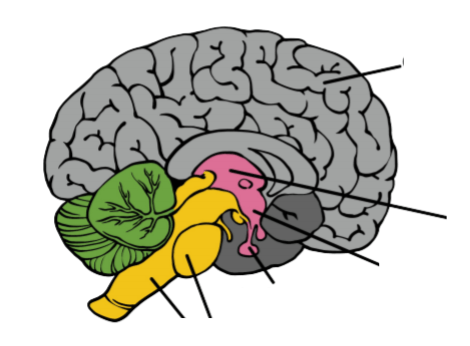
What structure is grey in this picture. It controls conscious thought and memory?
Cerebrum
Cerebellum
Brain Stem

What is this? It coordinates muscle movements.
Cerebrum
Cerebellum
Brain Stem
Diencephalon

_____ neurons carry messages away from the central nervous system and out to muscles or glands. The RED neuron in diagram.
sensory
motor
inter
central

Where would the nerve impulse start in this reflex arc?
A
C
D
E

The long, fiber like part of a neuron which the cell sends information to receiving neurons. Labelled D in diagram.
Synapse
Axon
Axon Terminal
Dendrite
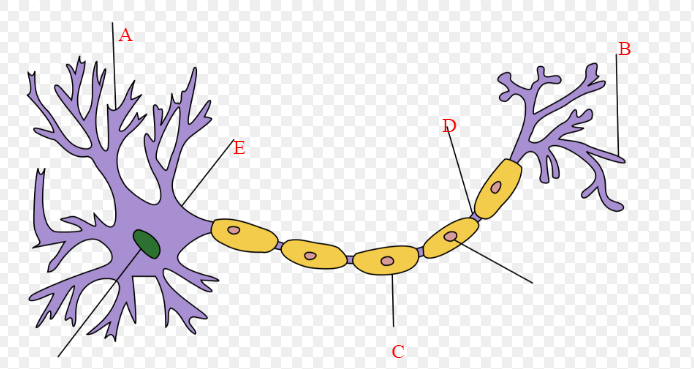
Which part sends nerve impulse to the next cell?
Dendrite
Axon
Axon Terminal
Cell Body

This part of the neuron receives chemical messages from the neurotransmitters of other neurons. It is labeled A in the diagram.
Dendrite
Axon
Axon Terminal
Cell Body
Which structure separates the left and right hemispheres of the cerebrum?
Transverse cerebral fissure
Central sulcus
Longitudinal fissure
Pre-central gyrus
What is the correct order of the meningeal layers from deep to superficial?
Pia mater, dura mater, arachnoid
Dura mater, arachnoid, pia mater
Arachnoid, pia mater, dura mater
Pia mater, arachnoid, dura mater
Dura mater, pia mater, arachnoid
The "grooves", or valleys, on the surface of the brain are called ______.
Gyri
Sulci
Cerebri
Cerebelli
The "bumps" on the surface of the brain are called ______.
Gyri
Sulci
Cerebri
Cerebelli

The spinal cord is part of the ____ nervous system.
Central
Peripheral

An example of voluntary movement would be:
Dancing
heart beat
digestion
breathing

Wrinkled part of the brain's surface where the body processes information
Brain stem
Cerebral Cortex (Cerebrum)
Corpus Callosum
Cerebellum


Which part of the brain controls vital functions (involuntarly) such as breathing and heart rate?
Diencephalon
Frontal Lobe
Medulla oblongata
Cerebellum


Which of the following is NOT a sense?
hearing
nose
smell
touch
Which part of the brain controls balance and coordination?
cerebrum
cerebellum
medulla
Which part of the brain controls senses, thinking, and memory?
cerebrum
cerebellum
medulla

The medulla is labeled as #...
1
2
3

The cerebellum is labeled as #...
1
2
3
What are the two divisions of the nervous system?
Central and Lower nervous systems
Central and Peripheral nervous systems
Lower and Cerebral nervous systems
Central and Muscular nervous systems

