
 Worksheets
GPPPU1-8 SY2026 (Poly, Proofs, Cong, Sim, RightTri, Vol, Prob)
Total questions: 369
Worksheet time: 119hrs 48mins
PRIORITY PRACTICE PROBLEMS (u1: Poly)
[BEGIN U1: Exploring Polynomial Expressions Through Geometry]
These problems are grouped in sets of 4 in this order ... 1. Add / Subtract Polynomials 2. Multiply Polynomials 3. Perimeter of <?> 4. Area of <?>
What is PERIMETER?
Simplify this expression:
(4a3 - 8a - 4a2) + (7a3 - 7 - 6a)
Simplify this expression:
(r + 7)(r − 7)

Find the perimeter of the triangle ...
4x+64
4x2+64
3x+50
3x2+50

The following image is a square. Find the PERIMETER AND AREA of the square.
PERIMETER: 16x3 AREA: 16x6
PERIMETER: 16x6 AREA: 16x3
PERIMETER: 8x3 AREA: 8x6
PERIMETER: 8x6 AREA: 8x3
Simplify this expression:
(2a2 + 5a + 3) - (a2 - 3a - 4)
3a2 + 2a - 1
a2 + 8a + 7
3a2 + 8a + 7
a2 + 2a - 1
Simplify this expression:
(3x – 1)(x + 5)

Find the perimeter of the rectangle ...

Find the area of the rectangle ...
Simplify this expression:
(x2 + 5x - 4) - (- x2 + 4x + 6)
2x2 + x + 2
x + 2
2x2 + x - 10
x - 10
Simplify this expression:
(3x2 – 1)(x2 + 5)
17x2 -5
3x4 + 7x2 - 5
3x4 + 14x2 - 5
3x4 + 14x2 + 5

6b
b + 5
b + 9
b - 13

Find the area of the rectangle ...
42x3+28x2
42x2+28x
42x3+4x2
13x3+11x2
Simplify this expression:
(3x2 + 4x – 1)(x2 + 5)
3x4 + 4x3 + 14x2 + 20x − 5
3x4 + 4x3 + 14x2 + 20x + 5
3x4 + 4x3 - x2 - 5
15x2 + 20x - 5
Simplify this expression:
(4a2 + 5a + 4) - (2a2 - 8a - 4)
6a2 - 3a + 8
2a2 + 13a
2a2 + 13a + 8
6a2 - 3a

4x
4x + 30
4x - 30
4x + 2

Find the area of the rectangle ...
18x2−48x+6
18x3−48x+6x
18x3−48x2+6x
9x3−14x2+7x
Simplify this expression:
(2x2 + 6x - 3) - (- 2x2 - 4x + 6)
4x2 + 10x + 9
10x + 9
10x - 9
4x2 + 10x − 9
Simplify this expression:
(3x2 + 4x – 1)(3x2 + 5)
9x4 + 12x3 + 12x2 + 20x + 5
3x4 + 4x3 + 14x2 + 20x + 5
3x4 + 4x3 - x2 - 5
9x4 + 12x3 + 12x2 + 20x − 5

What is the perimeter of the rectangle?
24w3 – 4
24w5 – 4
17w2 + 3w3
32w3 + 16w2 – 8

Find the perimeter ...
7x + 5
24x + 4
9x + 5
9x2 + 5
The dimensions of a rectangle are (4y2 – y + 6) feet by (2y2 + 3) feet. What is the perimeter of the rectangle?
12y2 – 2y + 18 feet
6y2 – y + 9 feet
2y2 – 2y + 3 feet
12y2 – y + 9 feet
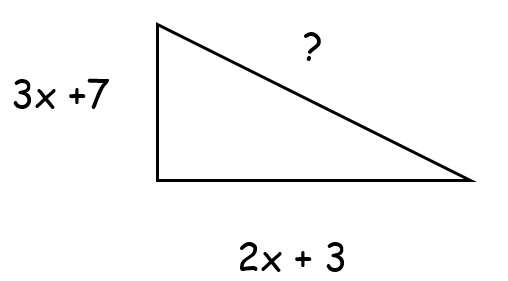
The perimeter of the triangle is 10x+20.
Find the length of the missing side (marked with '?') ...
What is the area of the rectangle?
24w3 – 4
56x6 + 56x5 − 32x3 − 32x2
56x6 + 56x5 − 32x3 + 32x2
32w3 + 16w2 – 8


PRIORITY PRACTICE PROBLEMS (u2: Proofs) (Problems 26 - 110)
U2 (Geometric Foundations and Proofs) ... these "Priority Practice Problems" are organized in the following order ...
Vocabulary and Language (5 problems) (26-30)
Angle and Segment Addition (7 problems) (31-37)
Triangle Sum Theorem | Exterior Angles Theorem (13 problems) (38-50)
Parallel Lines (15 problems) (51-65)
Parallel Line Proofs (20 problems) (66-85)
Quadrilateral Properties (10 problems) (86-95)
(Coordinate) Quadrilateral Proofs (15 problems) (96-110)
[BEGIN VOCABULARY and LANGUAGE] ∠1 and ∠3 can best be described as ...

In angle ABC, B is the ...
rays
plane
compass
vertex
In angle ABC, BA and BC are ...
rays
plane
compass
vertex

What does this symbol mean?
less than
greater than
congruent
similar

[END VOCABULARY and LANGUAGE] Name that figure!
Point
Line
Line segment
Ray

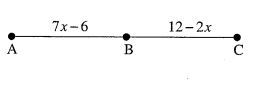
[BEGIN Angle and Segment Addition] Find the missing segment length / encontrar la longitud del segmento que falta ...
24
6
9
15

Use the figure to write and solve an equation for x.



Calculate m∠ABC.
45°
60°
105°
15°

[END Angle and Segment Addition] If m∠ABC = 103° find x.
(a)
[BEGIN Triangle Sum Theorem] The Triangle Sum Theorem: The sum of the 3 angles in a triangle is ______.

Find the measure of the indicated angle.
135°
55°
45°
60°

Find the measure of the indicated angle.
45°
33°
123°
147°
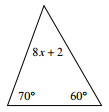
[END Triangle Sum Theorem] Solve for x.

[BEGIN Exterior Angle Theorem] Which of the following terms best describes Angle d?


Which two angles are the remote interior angles to Angle W?
Angle X and Angle Y
Angle X and Angle Z
Angle Y and Angle Z
Angle Z and Angle W

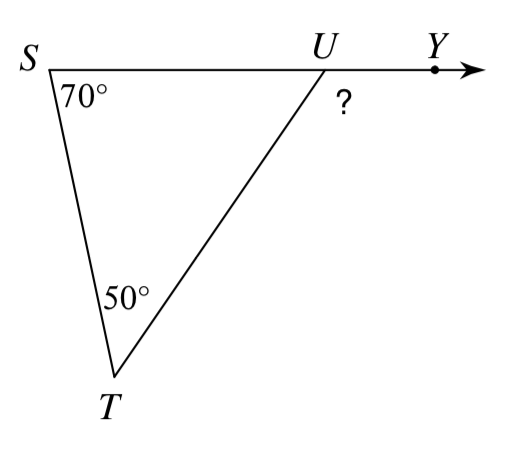
What is the value of the missing angle?
90
100
20
120

What is the value of x?
105°
144°
69°
111°


Find the indicated angle measure. (What is ?)
51°
37°
167°
41°

[END Exterior Angle Theorem] What is the value of x?
38
57
76
85

[BEGIN Parallel Lines and Transversals] What word describes line Z?
Consecutive Interiors


Consecutive Interior
Alternate Exteriors

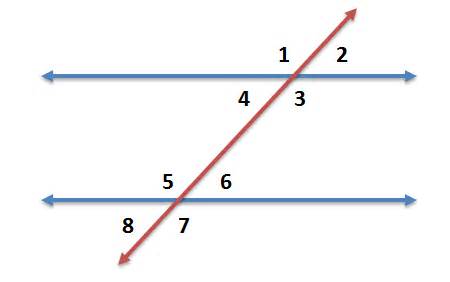

If the m∡1 = 118o find m∡5
118o
62o
82o
2o

If the m∡7 = 62o find m∡1
62o
28o
118o
138o

If the m∡3 = 81o find m∡6
180o
990
9o
81o

If the m∡2 = 32o find m∡3
132o
32o
148o
58o

If the m∡5 = 125o find m∡1
125o
35o
55o
100o

If the m∡6 = 71o find m∡3
171o
19o
109o
71o

If the m∡3 = 35o find m∡8
35o
550
135o
145o

If the m∡7 = 60o find m∡2
7o
60o
300
120o

[END Parallel Lines and Transversals] Solve for y.
y=55
y=35
y=70
y=45
[BEGIN Parallel Lines Proofs] If A=B and B=C, then A=C. What is this property?
Transitive
Reflexive
Symmetric
Substitution
Analogy
Transitive is to Congruence, as Substitution is to ???
Equalities
Congruences
Both
None of the above
I don't Know
If you know that angles 1 and 2 are vertical, what else do you know?
Angles 1 and 2 are congruent
Angles 1 and 2 are supplementary
Angles 1 and 2 are right angles
Angles 1 and 2 are corresponding angles
If A=10, then wherever there is an "A" value, you could replace it with 10. What property is this?
Substituion
Transitive
Symmetric
Plug it in
When two parallel lines are cut by a transversal, all pairs of angles created are either _________ or _________.
Congruent, supplementary
Congruent, complementary
Supplementary, complementary
Corresponding, vertical

What is the relationship of ∠1 and ∠5?
Corresponding Angles
Alternate Interior Angles
Alternate Exterior Angles
Consecutive Interior Angles
Vertical Angles
What is the relationship of ∠4 and ∠7?
Corresponding Angles
Alternate Interior Angles
Alternate Exterior Angles
Consecutive Interior Angles
Linear Pair
What is the relationship of ∠3 and ∠4?
Corresponding Angles
Alternate Interior Angles
Alternate Exterior Angles
Consecutive Interior Angles
Linear Pair
What is the relationship of ∠6 and ∠8?
Corresponding Angles
Alternate Interior Angles
Alternate Exterior Angles
Consecutive Interior Angles
Linear Pair

What statement can be made from the diagram using the Corresponding Angles Postulate?
∠1 and ∠2 are supplementary
m∠1 + m∠2 = 180°
∠1 ≅ ∠2
m∠1 = m∠2

What statement can be made from the diagram using the Alternate Interior Angles Theorem?
∠1 and ∠2 are supplementary
m∠1 + m∠2 = 180°
∠1 ≅ ∠2
m∠1 = m∠2

What statement can be made from the diagram using the Alternate Exterior Angles Theorem?
∠1 and ∠2 are supplementary
m∠1 + m∠2 = 180°
∠1 ≅ ∠2
m∠1 = m∠2

What statement can be made from the diagram using the Consecutive Interior Angles Theorem?
∠1 and ∠2 are supplementary
m∠1 + m∠2 = 180°
∠1 ≅ ∠2
m∠1 = m∠2

Supply the first statement.
m ll n
< 4 = < 6
Given
Definition of parallel lines

Supply the second reason.
Linear Pair Postulate
Alternate Interior Angles Theorem
Vertical Angles Theorem
Corresponding Angles Postulate

Supply the third reason.
Vertical Angle Theorem
Corresponding Angles Postulate
Alternate Interior Angles Postulate
Same Side Interior Angles Theorem

The last statement is <4 = <6. What is the last reason
Prove
Definition of congruent angles
Transitive Property
Alternate Interior Angles Theorem

[END Parallel Lines Proofs] Which proof is incorrect?


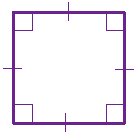
[BEGIN Quadrilateral Properties] What is the most specific name for this shape?
Square
Rectangle
Rhombus
Parallelogram
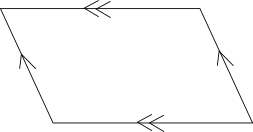

This is a parallelogram. What is the value of x?
7
12
112
68
This is a parallelogram. What is the value of y?
7
12
112
68
This is a parallelogram. What is the value of a?
7
12
112
68

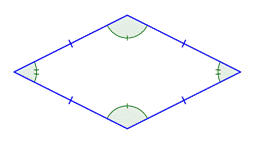
Select the most specific name for each of the following quadrilaterals shown to the left
Parallelogram
Rhombus
Trapezoid
Square
Rectangle

Select the most specific name for each of the following quadrilaterals shown to the left
Parallelogram
Rhombus
Trapezoid
Square
Rectangle

Find the missing angle.
30
60
90
120

[END Quadrilateral Properties] Find the measure of the angle x.
105
115
65
75
[BEGIN (Coordinate) Quadrilateral Proofs] What is this formula used for?
x2−x1y2−y1
To find the distance between two points
To find the slope between two points
To find the midpoint between two points
What is the formula below used for?
(x2−x1)2+(y2−y1)2To find the distance between two points
To find the slope between two points
To find the midpoint between two points

Josie found the slope of AB to be
43 . Use rise over run to check her answer.No, the slope should be 34
She was correct.

Brad proved that ABCD is a parallelogram by proving both sets of opposite sides to be parallel. What should he do next if he wants to prove it is a rhombus?
Find the distance of each line to see if they are congruent.
Compare the slopes of adjacent sides to see if they are perpendicular.

Brad proved that ABCD is a parallelogram and that all sides had the same distance What should he do next if he wants to prove it is a square?
He doesn't need to do anything else, it looks like a square so he is all set.
Compare the slopes of adjacent sides to see if they are perpendicular.

In the image, side AB has a slope of -3 and AD has a slope of 1/3. What does this mean is true?
Side AB and AD are parallel
Side AB and AD form a right angle
Side AB and AD are congruent
Nothing Specific
Drew used the distance formula and found each side to have a distance of 4. What does that mean?
Side AB and AD are parallel
Side AB and AD form a right angle
Side AB and AD are congruent
Nothing Specific
The slope of side AB is -3 and the slope of DC is -3. What does this mean?
Side AB and AD are parallel
Side AB and AD form a right angle
Side AB and AD are congruent
Nothing Specific

Julia proved ABCD is a parallelogram. She notices that side AB has a slope of 8/3 and BC has a slope of 1/3. What can she classify ABCD as?
A rectangle
A square
A rhombus
Just a parallelogram
Use the distance formula to see if side AB is congruent to side BC.
Yes they are congruent
No, they are not congruent
Use the distance formula to see if side BC is congruent to side AD.
Yes they are congruent
No, they are not congruent

What is the most specific name for quadrilateral ARMY?
Paralellogram
Square
Rectangle
Rhombus

What is the most specific name for quadrilateral DOGS?
Rhombus
Rectangle
Parallelogram
Square

What is the most specific name for quadrilateral FISH?
Parallelogram
Square
Rectangle
Rhombus

[END (Coordinate) Quadrilateral Proofs] What is the most specific name for quadrilateral NOSE?
Square
Parallelogram
Rectangle
Rhombus
[RESUME U3: Exploring Congruence (SEE Q1-Q10)] What does SAS stand for?
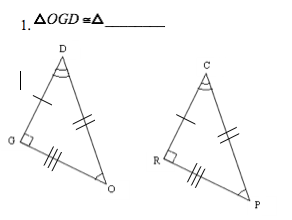
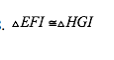
<F = ___

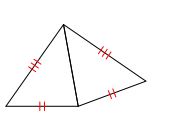
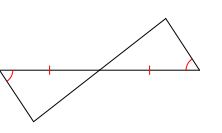
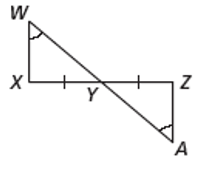

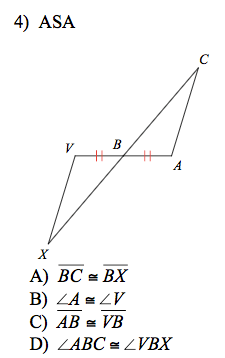
Which of the following are NOT sufficient to prove two triangles are congruent? Choose all that apply.
SSS
AAA
ASA
SSA
AAS
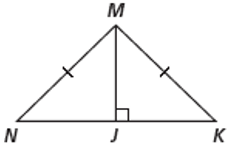
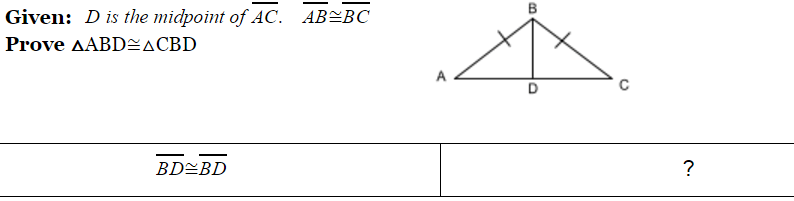
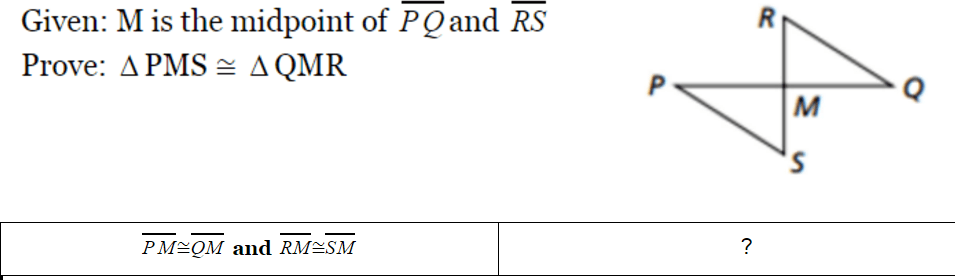
Identify the missing statement or reason
Reflexive Property
Definition of Midpoint
Given
Vertical Angles Theorem

A
B
C
D

Which statement is true for
ΔABC≅ΔDEF∠A≅∠B
∠A≅∠F
∠A≅∠D
∠A≅∠E
[END U3: Exploring Congruence (SEE Q1-Q10)] Which statement is true for
ΔABC≅ΔDEF
BC≅DE
BC≅EF
BC≅DF
[BEGIN U4 Investigating Similarity Test Review U4TR][LANGUAGE] What word was used a lot in this unit?
[LANGUAGE] Which of the following is NOT a rigid transformation?
dilation
translation
rotation
reflection
[LANGUAGE] Which statement describes a dilation?
ALWAYS makes a figure larger
preserves side lengths and angles
changes angles and side lengths
preserves angles, but changes side lengths
[LANGUAGE] What statement(s) best describe the difference between similar and congruent?
They are the same!
Similar means "alike in some ways", and congruent means "exactly the same"
Similar is harder to pronounce, and congruent is harder to spell
The similar operator is ~ ... the congruent operator is ≅
[LANGUAGE] A dilation's scale factor is used to perform what arithmetic operation?
addition
multiplication
subtraction
square roots
[LANGUAGE] A (a) is an explanation of why something is true.
[BEGIN U4: Investigating Similarity] An object before transformation is called the _______.
image
pre-image
post-image
answer
An object after transformation is called the _______.
image
pre-image
post-image
answer
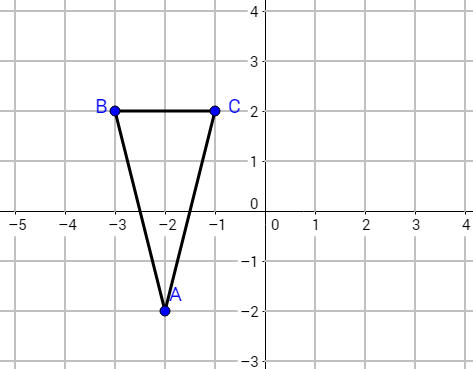
Dilate point B by a scale factor of 1/2
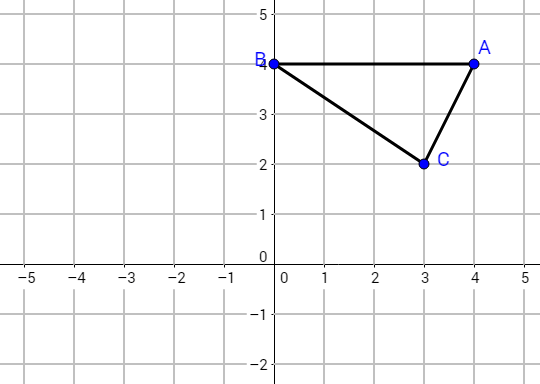
Dilate point B by a scale factor of 3:
Which of the following are dilations?
[END U4L1 (Dilations)] The point B (2, 1) was dilated to become point B' (6, 3). What was the scale factor?
1/3
2
3
1/2
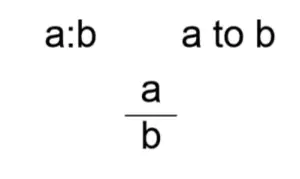
[BEGIN U4L3 (Similar Figures + Similarity Transformations)] A comparison of related quantities (like a:b or "a to b" or 1/2) is called a _______.
mystery
ratio
pre-image
IDK
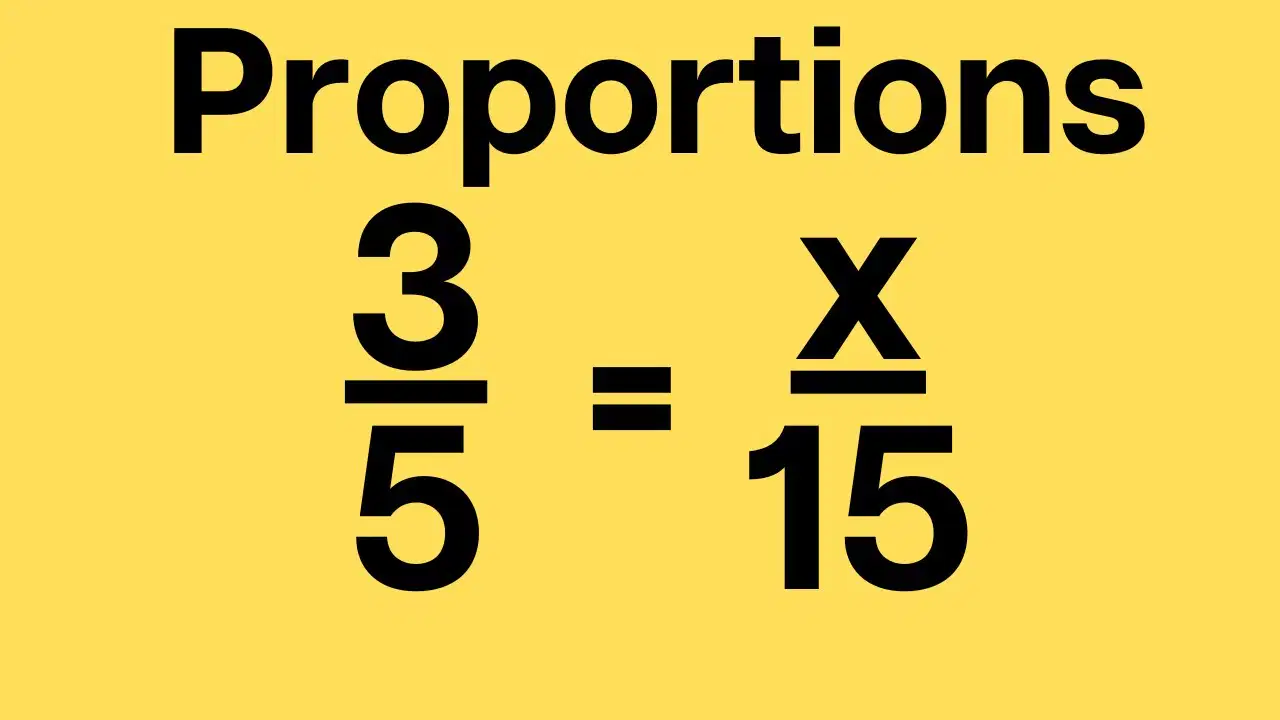
A proportion is an ___________ that compares two ratios.
equation
congruence statement
proof
definition
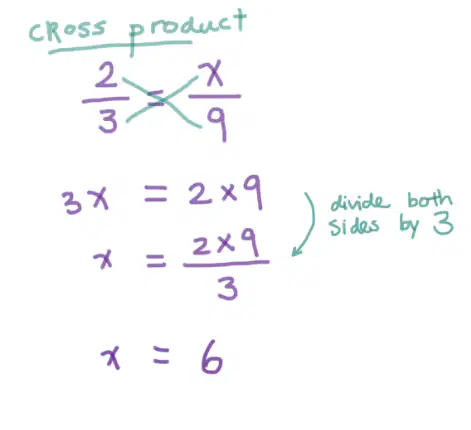
We solve proportions by using the ____________.
cross-product property
property of equality ("whatever I do to one side of the equation, I must do to the other side of the equation")
Pythagorean Theorem
triangle congruence theorem
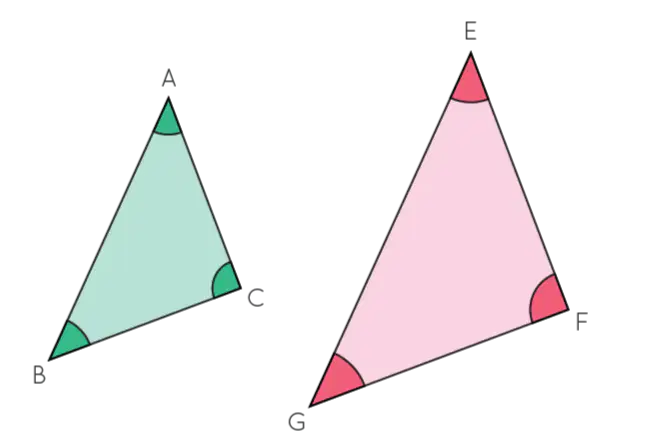
Polygons that have congruent corresponding angles and proportional corresponding sides are _______.
similar
congruent
the same
equal


The triangles are similar. Solve for the question mark.

Determine if the triangles are similar. If they are, identify the triangle similarity theorem(s) that prove(s) the similarity.
AA ~ Theorem
SAS ~ Theorem
SSS ~ Theorem
Not similar
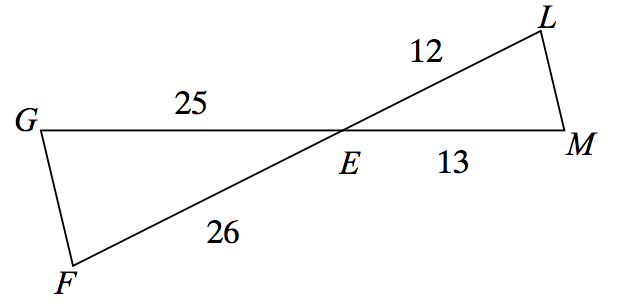
State if the triangles in each pair are similar. If so, state how you know they are similar.
Yes, AA Similarity
Yes, SSS Similarity
Yes, SAS Similarity
Not Similar


Complete the similarity statement: △ACB ~ _______
△HFG
△HGF
△FHG
△FGH


Are the triangles similar? If so, how?
Similar by AA
Similar by SAS
Similar by SSS
Not similar
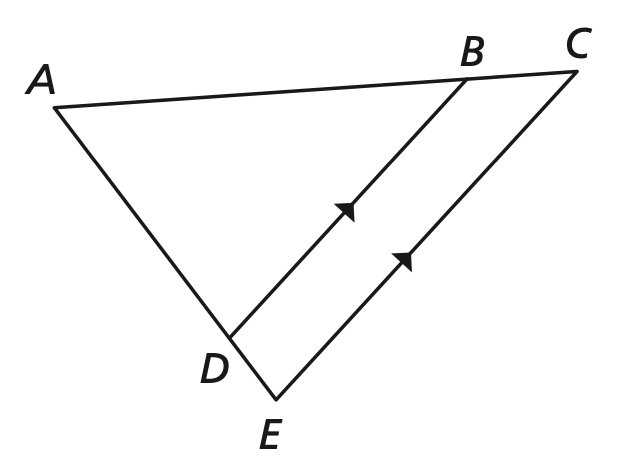
[END U3L3: Similar Figures + Similarity Theorems] Complete the similarity statement: △ADB ~ _______
△ACE
△AEC
△EAC
△ECA
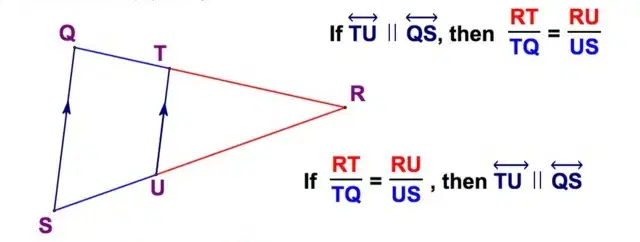
[BEGIN U4L4: Triangle Proportionality, Similarity Proofs] The TRIANGLE PROPORTIONALITY THEOREM says ___________ (check all that apply).
All triangles have 3 angles.
If a line segment divides two sides of a triangle proportionally, then it is parallel to the third side.
If a line segment is parallel to one side of a triangle and intersects the other sides, then it divides those intersected sides proportionally.
All triangles have 3 angles whose sum is 180 degrees.

PROPORTIONAL PARTS AND PARALLEL LINES: If 3 or more parallel lines are intersected by two ________, then the parallel lines divide the ________ proportionally.
perpendicular bisectors
angles
midpoints
transversals

AB / BM = ? / CD

Which proportion could be used to prove that HJ∥KL ?
HJKL=LGKG
KGKH=LJLG
JLHK=GKLG
HKGK=LJGL


Select the proportion that shows the Triangle Proportionality Theorem.
276=x7
216=x7
67=27x

What is the height of the flag pole?
Show your work.
205
105
230
135


Determine whether the triangles are similar by AA~, SSS~, SAS~, or not similar.
AA
SSS
SAS
no similar


(Hint: Look for non-labeled parts!)

[END U4L4: Triangle Proportionality, Similarity Proofs] Give the reason for similarity.
[BEGIN U5TR U5L1 Intro to Trig Ratios & Missing Sides]
---
[LANGUAGE] What word was used a lot in this unit?
[LANGUAGE] What is another word was used a lot in this unit?

What side is opposite ∠ J?
9
40
41
none
What side is the hypotenuse of the triangle?
9
40
41
none
What is the sine ratio?
hypotenuseadjacent
hypotenuseopposite
opposite adjacent
adjacent opposite
What is the cosine ratio?
hypotenuseadjacent
hypotenuseopposite
opposite adjacent
adjacent opposite
What is the tangent ratio?
hypotenuseadjacent
hypotenuseopposite
opposite adjacent
adjacent opposite
What is a common way to remember the definitions of the trig ratios?
SAH COH TOA
SOA COH TOA
SOH CAH TOA
ADJ OPP HYP

What is cosA ?
2029
2921
2920
2021
What is tanA ?
2029
2921
2920
2021
What is tan C ?
2120
2921
2920
2021
Which trig function does not include the hypotenuse?

Find tan( α ) in the triangle.
2921
2920
2021
2120

Find sin( α ) in the triangle.
3512
3735
1235
3712

[END U5TR U5L1 Intro to Trig Ratios & Missing Sides]
Find tan(C).

[BEGIN U5TR U5L2 Finding Missing Sides and Angles with Trig Ratios]
Find tan(X).


Find the missing side.


Solve for the missing angle ...
HINT 1: Which side lengths have values?
HINT 2: What trig ratio should be used?
HINT 3: How do we find the ANGLE?
32°
44°
61°
50°

Solve for the missing angle ...
HINT 1: Which side lengths have values?
HINT 2: What trig ratio should be used?
HINT 3: How do we find the ANGLE?

Solve for the missing angle ...
HINT 1: Which side lengths have values?
HINT 2: What trig ratio should be used?
HINT 3: How do we find the ANGLE?
9.4°
55.2°
20.15°
19.4°


Solve for the missing angle ...
HINT 1: Which side lengths have values?
HINT 2: What trig ratio should be used?
HINT 3: How do we find the ANGLE?

Solve for the missing angle ...
HINT 1: Which side lengths have values?
HINT 2: What trig ratio should be used?
HINT 3: How do we find the ANGLE?
50.2°
93.1°
12.6°
42.2°


[BEGIN U5TR U5L3 Complementary Angles] Find the measure of the angle x.
95°
85°
35°
45°
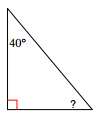
Solve for the missing angle ...
HINT 1: Which side lengths have values?
HINT 2: What trig ratio should be used?
HINT 3: How do we find the ANGLE?
Supplementary angle measures = (a) degrees.
Complementary angle measures = (a) degrees.
Find the complementary angle measures.
75 and 105
75 and 15
25 and 65
34 and 146
38 and 52

Find the missing angle.
72°
68°
90°
78°
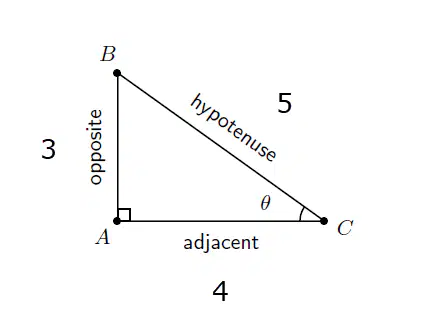
Sine is the ratio of the opposite leg / hypotenuse.
Cosine is the ratio of the adjacent leg / hypotenuse.
Tangent is the ratio of the opposite leg / adjacent leg.
In Right Triangle ABC with right angle A ...
If the cos C = 4 / 5, what is sin B?
3 / 5
3 / 4
4 / 5
5 / 4
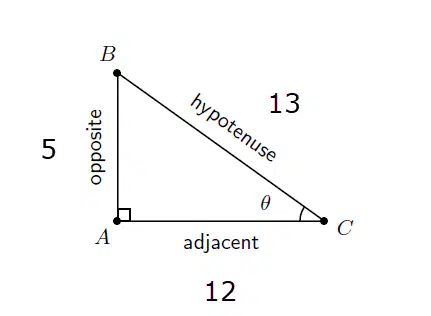
Sine is the ratio of the opposite leg / hypotenuse.
Cosine is the ratio of the adjacent leg / hypotenuse.
Tangent is the ratio of the opposite leg / adjacent leg.
In Right Triangle ABC with right angle A ...
If the sin C = 5 / 13, what is cos B?
13 / 5
5 / 13
5 / 12
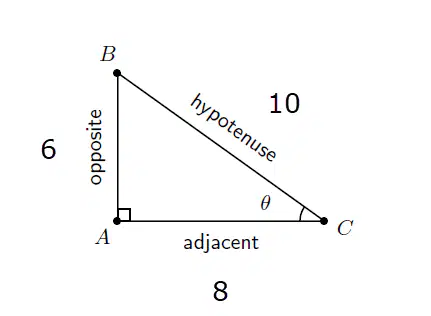
Sine is the ratio of the opposite leg / hypotenuse.
Cosine is the ratio of the adjacent leg / hypotenuse.
Tangent is the ratio of the opposite leg / adjacent leg.
In Right Triangle ABC with right angle A ...
If the cos C = 8 / 10, what is sin B?
10 / 8
6 / 10
8 / 10
[END U5L3 Complementary Angles]
[END U5TR]
---
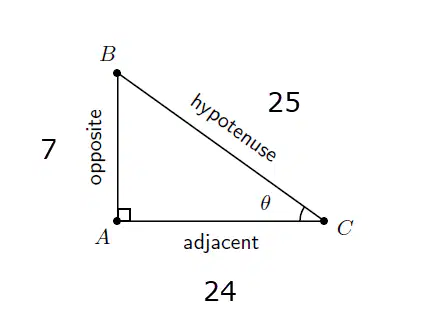
Sine is the ratio of the opposite leg / hypotenuse.
Cosine is the ratio of the adjacent leg / hypotenuse.
Tangent is the ratio of the opposite leg / adjacent leg.
In Right Triangle ABC with right angle A ...
If the sin C = 7 / 25, what is cos B?
7 / 25
7 / 24
24 / 25
[BEGIN U6AL10 Circles Test Review U6ATR][BEGIN U6AL1 (Circle Language)]
If you are given a radius, how can you find the diameter?
Divide the radius by 2
Square the radius
Multiply the radius by 2
Take the square root of the radius

What part of the circle is present?
Tangent
Secant
Chord
Diameter

What part of the circle is present?
diameter
radius
chord
secant
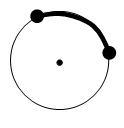
What part of the circle is present?
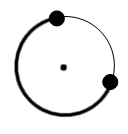
What part of the circle is present?
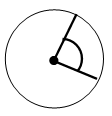
What part of the circle is present?
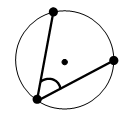
What part of the circle is present?
A segment that goes through a circle intersecting the circle at two points.
diameter
chord
tangent
secant
[END U6AL1 (Circle Language)] The distance from the center of a circle to the boundary of a circle (half of the diameter).

[BEGIN U6AL2 (Central and Inscribed Angles)] Angle a is a(n) ___ angle.
central
inscribed
Angle b is a(n) ___ angle.
central
inscribed

Find the measure of the marked angle.
52
104
26
13

Find the measure of the marked arc.
15
30
60
7.5

Find the measure of the marked angle.
22
44
11
66

Find the measure of the marked angle.
140
70
35
210
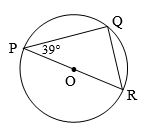
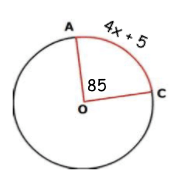

Find the measure of arc NM
192o
217o
186o
124o

Find the value of x.
(a)
[END U6AL2 (Central and Inscribed Angles)] In a circle (or congruent circles), the measure of an arc is:

[BEGIN U6AL3L4 (Angles Inside and Outside Circle)] Find the measure of angle ABD.

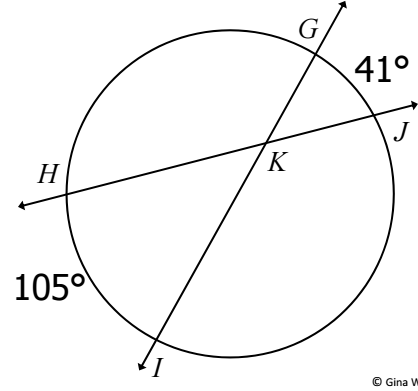


Find the arc indicated.
55
175
115
285

Find the arc indicated.
112
143
53
127

Find the arc indicated.
78
51
-78
102

Find the angle indicated.
70
50
60
55

[END U6AL3L4 (Angles Inside and Outside Circle)] Find the arc indicated.
185
75
110
100

[BEGIN U6AL6 (Triangles and Quadrilaterals Inscribed in Circles + Tangents)] AB is a diameter. The measure of angle B is 58 degrees. Find the m < A.
32
128
90
There is not enough information to determine m∠A

AB is a diameter. The measure of angle C is 90 degrees and angle A is 79 degrees. Find the m < B.
101
90
11

AB is a diameter. The measure of angle C is 90 degrees and angle B is 68 degrees. Find the m < A.
90
112
22

AB is a diameter. The measure of angle C is 90 degrees and angle A is 17 degrees. Find the m < B.
73
163
90

The m < B = 123 degrees. Find the m < D.
180
90
57

The m < C = 27 degrees. Find the m < A.
180
153
127

Find the m < x.
112 degrees
98 degrees
132 degrees

Find the m < y.
112 degrees
82 degrees
144 degrees

In the inscribed quadrilateral ABCQ, opposite angles are
congruent
supplementary
complementary
sum to 360o
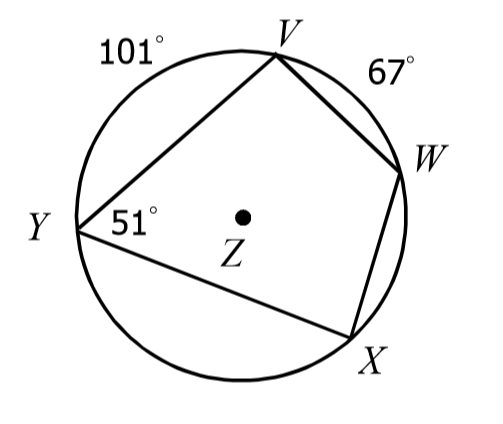
96°
129
84°
49°
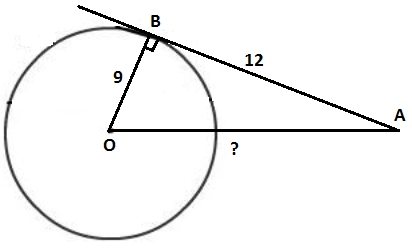
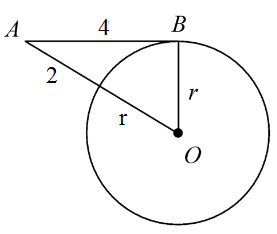

Determine if a tangent line is shown in the picture.
Yes
No
Not sure

Assume that the lines that appear to be tangent are tangent. O is the center of the circle. Find the value of x to the nearest tenth.
11.7
10.8
13.0
14.2

[END U6AL6 (Triangles and Quadrilaterals Inscribed in Circles + Tangents)] Find x. Assume that segments that appear to be tangent are tangent.

[BEGIN U6AL8 (Arc Length and Sector Area)] Find the arc length of arc AB.


[BEGIN U6AL9 (Equation of Circle)] In the equation (x - 3)2 + (y - 2)2 = 16, the center of the circle is...
(3, 2)
(-3, -2)
(-2, -3)
(2, 3)
In the equation (x - 4)2 + (y - 3)2 = 25, the radius is
4
3
5
25
(x - 7)2 + y2 = 9
x2 + (y -7)2 = 9
(x - 7)2 + y2 = 3
x2 + (y -7)2 = 3

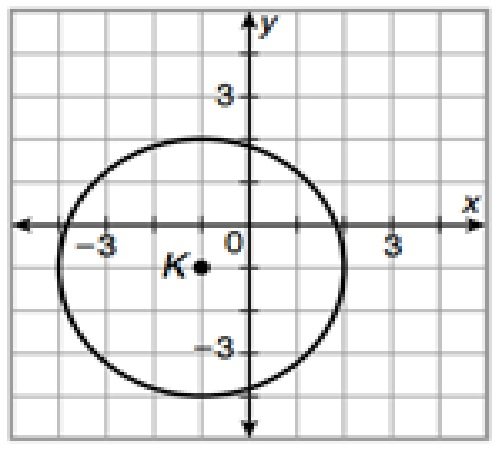
(x + 1)2 + (y + 1)2 = 3
(x + 1)2 + (y - 1)2 = 3
(x + 1)2 + (y + 1)2 = 9
(x - 1)2 + (y - 1)2 = 9


(x - 5)2 + (y + 2)2 = 144
(x - 5)2 + (y + 2)2 = 36
(x + 5)2 + (y - 2)2 = 36
(x + 5)2 + (y - 2)2 = 144
[END U6AL10 Circles Test Review U6ATR]
[END U6AL9 (Equation of Circle)]
What is the center of the circle with this equation is (x+2)²+(y-4)²=41?

[U6B Unit Circle ... 001-020 Special Right Triangles ... 021-040 Right Triangles on the Coordinate Plane ... 041-060 What is a Radian? Converting between Radians and Degrees | 061-080 Determining Values of Sine, Cosine, and Tangent ... 081-120 U6B Unit Circle Test Review U6BTR ...]
[BEGIN U6B Unit Circle Test Review U6BTR]
[BEGIN U6BL1 Special Right Triangles]
In this 45-45-90 triangle, I have been given a leg, so to find the other leg I ...


What is the length of y in this 45-45-90 triangle?

[END U6BL1 Special Right Triangles]
Find the value of x.
[BEGIN U6BL2L3 Right Triangles In The Coordinate Plane]
A "unicycle" has one wheel ... a "unicorn" has one horn ... in the card game "Uno", I must say "Uno!" when I have one card left ... a "unit" circle has a radius of _____.

What is the radius of this UNIT circle?
2
1
3
2
What is the ratio of the ADJACENT side to the HYPOTENUSE
(AKA cos θ )?
b1
1b=1
1a=a
a1
What is the ratio of the OPPOSITE side to the HYPOTENUSE
(AKA sin θ )?
ba
1b=1
1a=a
ab
What is the ratio of the OPPOSITE side to the ADJACENT side
(AKA tan θ )?
ba
1b=1
1a=a
ab
The UNIT CIRCLE has a radius of ______; its center is at the _______.
The UNIT CIRCLE is important because it provides a ______ way to understand and calculate trigonometric functions like sine, cosine, and tangent for any angle.
diameter; radius; EASY
3 ; y = x; DIFFICULT
2 ; equator; HEARTFELT
1; origin; VISUAL


[END U6BL2L3 Right Triangles In The Coordinate Plane]
What is sin 90°?

[BEGIN U6BL4 What Is A Radian? AND U6BL5 AND Converting between Radians and Degrees]
A RADIAN is the measure of a central angle that intercepts an arc whose length is equal to the ________.
diameter
radius
RADIANS and DEGREES give us two different ways to measure ________.
angles
arc length
sector area
circumference
To convert from DEGREES to RADIANS ... ________.
multiply by
180°π
multiply by
π180°
multiply by
2π
multiply by
3π
To convert from RADIANS to DEGREES ... ________.
multiply by
180°π
multiply by
π180°
multiply by
2π
multiply by
3π
Convert 4π from radians to degrees.
90⁰
45⁰
60⁰
30⁰
Convert 100⁰ to radians.
95π
59π
85π
910π
109π
What is the degree measure of an angle with a radian measure of 47π ?
310°
320°
315°
330°
[END U6BL4 What Is A Radian? AND U6BL5 AND Converting between Radians and Degrees]
Convert 150⁰ to radians.
[BEGIN U6BL5 Determining Values of Sine, Cosine, and Tangent]
tan(7π/4)
sin(7π/6)
tan (π)
What are the coordinates of 3π/4 radians on the unit circle?
What is cos(65π) ?
−21
21
23
−23
What are the coordinates of 34π radians?
(−21,−23)
(31,33)
(23,22)
(21,−23)
What is the order of the coordinate pairs for the points on the unit circle?
(tanθ,sinθ)
(cotθ,cosθ)
(sinθ,cosθ)
(cosθ,sinθ)

What are the coordinates of 225° on the unit circle?
(22,22)
(−22,22)
(−22,−22)
(22,−22)
sin(7π/6)
[END U6BL5 Determining Values of Sine, Cosine, and Tangent]
[END U6B Unit Circle Test Review U6BTR]
tan(-π)
[BEGIN U7 Volume Test Review U7TR ]
[BEGIN Volume of Prisms and Cylinders]
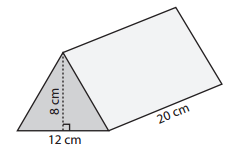
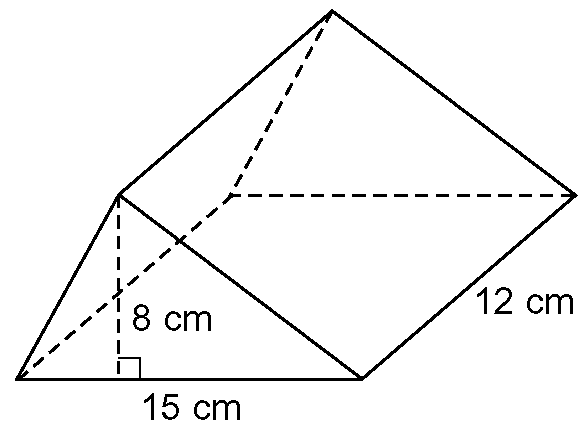
Find the volume of the triangular prism.
V = (base area)(height)
960 cm 3
240 cm 3
1920 cm 3
400 cm 3
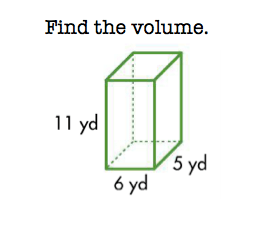
Find the volume of the rectangular prism.
55 yd3
121 yd3
22 yd3
330 yd3

Find the volume (leave answers in terms of 'pi') ...
484π cm3
88π cm3
176π cm3
1937π cm3


[END Volume of Prisms and Cylinders]
What is the volume of the cylinder?
4523.9 in3
18095.6 in3
942.5 in3
120 in3

[BEGIN Volume of Pyramids, Cones, and Spheres]
What shape is this?

Find the volume ...

Find the volume.

Find the volume. The radius is 10 units.

Find the volume.
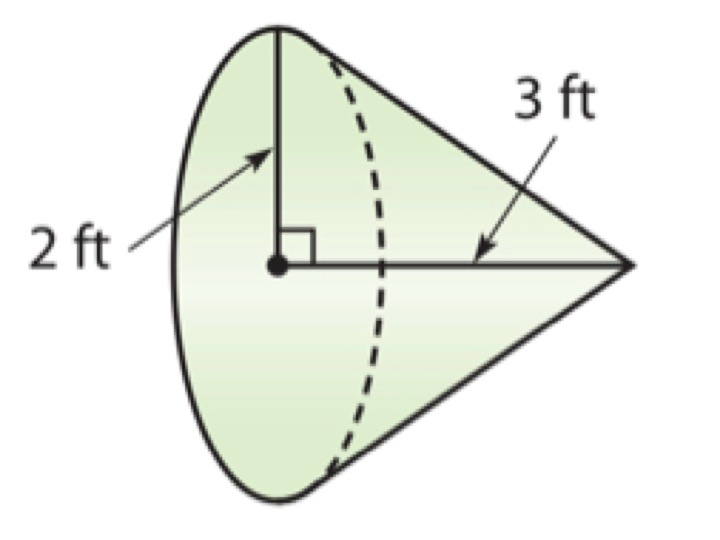
Find the volume.
4π ft3
12π ft3
48π ft3
16π ft3

[END Volume of Pyramids, Cones, and Spheres]
Find the volume of the hemisphere (HINT: this is half of a sphere) ...
288π cm3
72π cm3
36π cm3
144π cm3

[BEGIN Volume of Composite Solids]
What shape(s) make each layer of the cake?
Cone
Cylinder
Pyramid
Rectangular Prism

What is the volume of the composite solid?
19 in3
24 in3
29 in3
34 in3
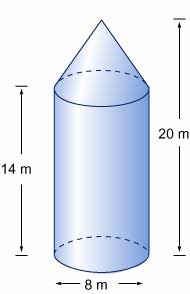
Find the volume of the following shape.
4155.27 m3
1038.82 m3
804.24 m3
1005.31 m3
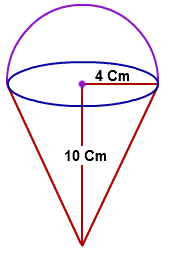

Find the volume ...
1412.4 cm3
965.2 cm3
1123.6 cm3
1348.6 cm3

Which equation would you use to find the volume of this composite figure?
83 + 4/3π(8)³
83 + 4/3π(4)³
83 + (1/2)(4/3)π(4)³
82 + 4/3π(8)³
82+(1/2)82π
[END Volume of Composite Solids]
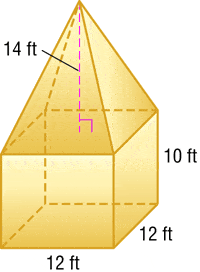
Find the volume of the composite figure.
[BEGIN Density]
What is the formula for density?

Which state has the greatest population density?
New Jersey
Rhode Island
Connecticut
Vermont

[END Density]
[END U7 Unit Test Review U7TR]
Which state has the population density of 41 people per square mile?
Connecticut
Maryland
Maine
New York
[BEGIN U8 Probability Test Review U8TR]
[BEGIN Probability Notations and Organizing Data (Set Notation and Venn Diagrams)]
What does this symbol ( ∩ ) represent in set theory?

Identify the shaded area...
A∩B
A∪B
A'∩B'
A'∪B'


[END Probability Notations and Organizing Data (Set Notation and Venn Diagrams)]
How many senior boys play football but do not wrestle?
[BEGIN Addition Rule]
What is the formula for the addition rule of probability?
P(A ∪ B) = P(A) + P(B) - P(A ∩ B)
P(A ∩ B) = P(A) - P(B)
P(A ∪ B) = P(A) * P(B)
P(A ∩ B) = P(A) + P(B)

Find the probability of choosing a card at random that is a spade OR a 7
1/52
1/13
4/13
17/52
A single card is chosen at random from a standard deck of 52 playing cards. What is the probability of choosing a king or a club?
1/52
16/52
17/52
None of the above
A glass jar contains 1 red, 3 green, 2 blue, and 4 yellow marbles. If a single marble is chosen at random from the jar, what is the probability that it is yellow or green?
3/10
4/10
7/10
None of the above
[END Addition Rule]
A number from 1 to 10 is chosen at random. What is the probability of choosing a 4 or an odd number?
3/5
1/2
1/5
None of the above
[BEGIN Multiplication Rule]
What is the significance of calculating probabilities in real-life scenarios?
It helps in making informed decisions based on the likelihood of various outcomes.
It guarantees success in all endeavors.
It eliminates uncertainty in decision-making.
It is only useful in academic settings.
What does 'without replacement' mean in probability?
It means that items are returned to the pool after selection.
It means that once an item is selected, it is not returned to the pool for subsequent selections.
It refers to selecting items in a random order without any restrictions.
It indicates that all items must be selected at once.


[END Multiplication Rule]
The spinner below is divided into 4 equal parts. It is spun once, and the coin is flipped once. What is the probability of obtaining red on the spinner followed by heads on the coin?
81
41
43
87
[BEGIN Conditional Probability]
P(A∣B)=
P(A⋂B)/P(A)
P(A⋂B)/P(B)
P(A⋃B)/P(A)
P(A⋃B)/P(B)

What is the probability that a student has a brother given that they do not have a sister?
*Write your answer as a fraction*
(a)


What is the probability that a student plays sports given that they do community service?
155
95
275
159
[END] Conditional Probability]
A box contains 3 blue marbles, 5 red marbles, and 4 white marbles.
Find P(red given not white).
3/8
1/4
5/12
5/8
[BEGIN Permutations and Combinations]
A DJ has to choose three songs for the last few minutes of his evening show. If there are nine songs that he feels are appropriate for that time slot, then how many ways can he choose and arrange to play three of those nine songs?
Is this a Permutation or Combination?
Permutation - the order of the songs matters
Combination - the order of the songs does not matter
The ski club has 10 members and is choosing three officers for the season. How many ways can they pick a captain, co-captain and secretary?
720
120
10!
3!
You have DVD collection with 20 DVDs. You can only take five DVDs with you on vacation. How many different sets of five DVDs can you take?
15504
20!
5!
205=0.25
A group of 25 people are going to run a race. The top 8 finishers advance to finals. How many different combinations can there be?
625
4.36 X 10¹⁰
1,081,575
[END Permutations and Combinations]
Ambry must submit 4 paintings as part of her application to art school. If she has 25 to choose from, how many ways can she pick 4?
[BEGIN Probability Distributions and Expected Value]
A fair, 6-sided dice is thrown 18 times.
Roughly how many times would you expect the number 6 to come up?
1
3
6

Is this a probability distribution?
No
Yes
X 50 20 5
P(X) 0.1 0.3 0.6
A student group sells 500 raffle tickets for $2 each. At the drawing the top prize will be a gift certificate for $100. Second prize will be a $50 gift card and there will be five 3rd prizes, each a $20 gift card. Do you expect to win or lose (on average)? How much?
lose an average of $5.50
lose an average of $1.50
win an average of $2.00
lose an average of $10.00
[END U8 Probability Test Review U8TR]
[END Probability Distributions and Expected Value]
A coin is flipped 3 times. If you get tails once you get $5, tails twice you get $15, and tails on all three flips you get $40. What is the expected amount of money you will get?