
 Worksheets
PHSL101 Nerve and Muscle Lectures
Total questions: 25
Worksheet time: 13mins
What is the resting membrane potential of neurons maintained by?
Chemically-gated Na+ Channels
Chemically-gated K+ channels
Na+/K+ ATPase pump
Na+/H+ ATPase pump
Repolarisation of an activated neuron does not include:
Shifting membrane potential towards resting levels
Opening of voltage-gated K+ channels
Opening of voltage-gated Na+ channels
Inactivation of voltage-gated Na+ channels
Which statement is INCORRECT about axon myelination?
Myelin sheathes the axon
Schwann cells aid in the myelination of axons
Myelin slows down the conduction of action potentials along the axon
Myelin increases the speed of conduction of action potentials.
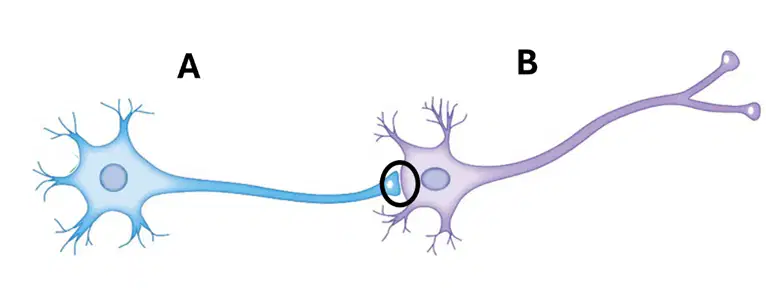
In the image, cell A is a _________ neuron and cell B is a ________ neuron.
Presynaptic; Postsynaptic
Postsynaptic; Presynaptic
Soma; Axon
Dendrite; Soma
Which of the following is INCORRECT regarding the axon hillock:
It is a site of summation of local potentials
It is where the threshold for action potential firing can occur
It requires ATP
Local potentials have to occur within the same space and time.
Which of the following ions stimulates neurotransmitter release?
Calcium
Sodium
Potassium
Magnesium
The Neuromuscular Junction are made up of the following EXCEPT:
Axon terminal of motor neuron
Synaptic cleft
Post-synaptic sarcolemma membrane
T-tubule
Which of the following is NOT a source of ATP production for muscle?
Anaerobic pathways
Creatine phosphate shuttling
Caffeine
Aerobic pathways
The detachment of the actin/myosin cross-bridge is triggered by:
Calcium ions
The hydrolysis of ATP
The attachment of ATP to myosin heads
Repolarisation of T-tubules
What is a motor unit?
A muscle fibre and all the neurons it innervates
A motor neuron and all the muscle fibres that it innervates
All the muscle fibres contained in one fascicle
All the nerve fibres and muscle fibres in a single muscle bundle
Which of the following is the CORRECT order for excitation-contraction coupling of a skeletal muscle?
Action potential propagates along sarcolemma, Sarcoplasmic reticulum releases Ca2+, Ca2+ binds to troponin, Cross-bridge formation
Ca2+ levels in the sarcoplasm increase, Action potential travels down T-tubules, Ca2+ binds to myosin, Sarcomere shortens
Action potential propagates along sarcolemma, Sarcoplasmic reticulum releases Ca2+, ATP binds to myosin head, Cross-bridge formation
Action potential causes release of Acetylcholine, Ca2+ levels in sarcoplasm increase, ATP binds to myosin head, Cross bridge undergoes a power stroke
Incomplete tetanus is:
A progressive increase in twitch tension
The addition of one twitch to another
A muscle producing almost peak tension during rapid cycles of contraction and relaxation
A muscle producing peak tension from high frequency stimulation, eliminating the relaxation phase
Skeletal muscle recruitment is caused by:
A high frequency of action potentials leading to sustained contraction in the muscle
A single action potential causing a twitch
Increasing the number of motor neurons firing action potentials
Decreasing the number of motor neurons firing action potentials
Eccentric contraction of a skeletal muscle is when:
Muscle does not change length during contraction
Muscle changes length during contraction
Peak tension less than load, and muscle elongates
Peak tension greater than load, and muscle shortens
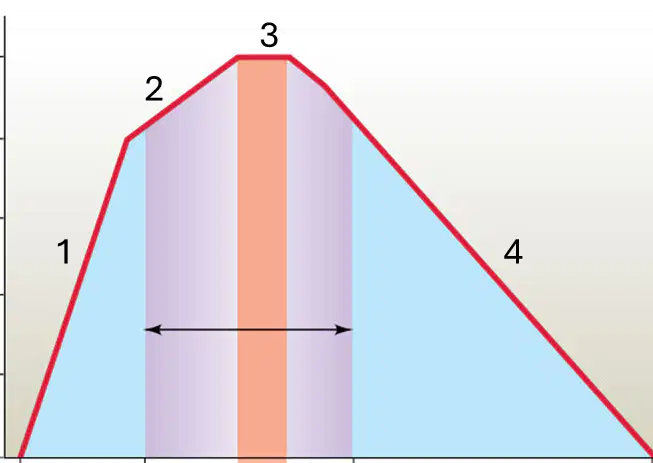
Which label shows the optimal length of a skeletal muscle?
1
2
3
4
Which of the following statements about muscle fibre types is INCORRECT?
Type 1 fibres rely on aerobic metabolism and have high fatigue resistance
Type 2b fibres rely on anaerobic metabolism and have low fatigue resistance
Type 2a fibres contract at a medium speed and have intermediate fatigue resistance
Type 1 fibres contract quickly and are primarily used in high-intensity exercise
Muscle atrophy refers to an increase in muscle cells as a result of exercise
True
False
The axon hillock is the region of a neuron membrane that generates nerve impulses
True
False
An inhibitory neurotransmitter causes graded hyperpolarization.
True
False
Smallest motor units are usually recruited for larger demands for force.
True
False
Myofibrils extend the length of a skeletal muscle fibre and contain repeating units called sarcomeres
True
False
Skeletal Muscle fibres are striated, mono-nucleated and branched
True
False
In non-excited neurons and skeletal muscle fibres, typical resting membrane potentials are -70 mV.
True
False
Single muscle twitches only occur in the ocular (eye) muscles.
True
False
Myosin reactivation occurs when ADP and a phosphate group combines to form ATP
True
False

