
 Worksheets
Pediatric dysphagia
Total questions: 31
Worksheet time: 31mins
What is the main focus of the article 'Acute Pediatric Dysphagia: When Ingestion of a Foreign Body or Caustic Material Is Not the Cause'?
The article focuses on rare causes of acute pediatric dysphagia other than the more common cause of foreign body or caustic material ingestion.
The article discusses only the treatment of caustic material ingestion in children.
The article reviews common symptoms of food allergies in pediatric patients.
The article is about chronic dysphagia management in adults.
Achalasia is characterized by which of the following?
Excessive peristalsis and normal lower esophageal sphincter function
Absent lower esophageal peristalsis and dysfunction in the lower esophageal sphincter
Inflammation of the upper esophagus
Obstruction due to foreign body
The majority of pediatric patients with achalasia present with vomiting and dysphagia, with occasional regurgitation of undigested food.
True
False
What is the preferred test to exclude achalasia in pediatric patients?
Manometry is the preferred test to exclude achalasia.
Barium swallow is the preferred test to exclude achalasia.
Endoscopy is the preferred test to exclude achalasia.
pH monitoring is the preferred test to exclude achalasia.
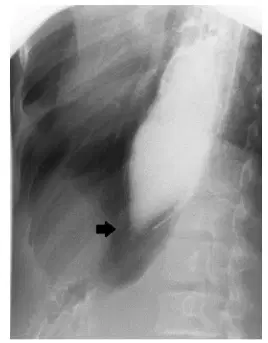
What is the diagnosis shown in Figure 1?
Achalasia
Esophageal cancer
Gastroesophageal reflux disease (GERD)
Esophageal stricture
What is the minimum number of eosinophils per high-power field required for the diagnosis of eosinophilic esophagitis?
15 eosinophils
5 eosinophils
30 eosinophils
50 eosinophils
The esophagram is a reliable means of diagnosing eosinophilic esophagitis because it is always abnormal in biopsy-confirmed cases.
True
False
Which of the following is NOT a common clinical symptom of eosinophilic esophagitis?
Dysphagia
Chronic cough
Headache
Food impaction
According to the text, what is the definitive treatment for eosinophilic esophagitis if proton pump inhibitor therapy fails?
Antibiotics
Corticosteroids
Surgery
Antihistamines
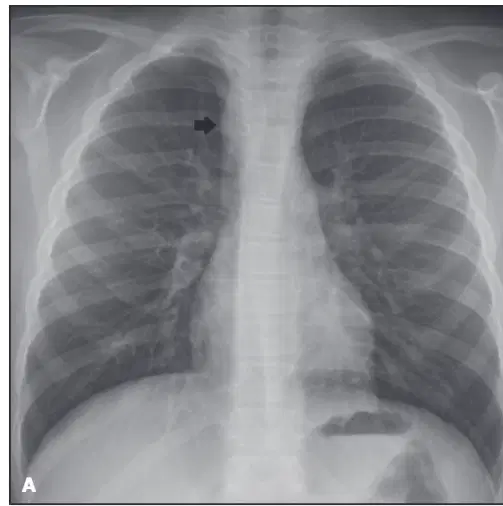
Figure 2 shows a right aortic arch with aberrant left subclavian artery. What radiographic finding is indicated by the arrow in image A?
A right aortic arch
A left aortic arch
A double aortic arch
A coarctation of the aorta
What is the most common radiographic finding in patients with abnormal esophagrams and eosinophilic esophagitis?
The so-called ringed-esophagus, with multiple strictures less than 5 cm in length.
Diffuse esophageal dilation without strictures.
Isolated lower esophageal web formation.
Prominent gastric air bubble with normal esophagus.
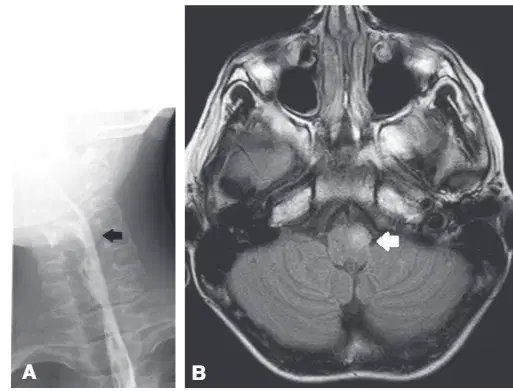
Figure 3 describes a case of oropharyngeal dysphagia in an 11-year-old boy. What was the likely cause of the left pharyngeal paresis in this patient?
Esophageal stricture
Brainstem lesion
Eosinophilic esophagitis
Gastric volvulus
What is a gastrointestinal duplication cyst?
A gastrointestinal duplication cyst is a spherical or tubular structure in or immediately adjacent to a portion of the gastrointestinal tract, with a lining of the duplication that may be in continuity with or separate from the bowel lumen.
A gastrointestinal duplication cyst is a benign tumor found only in the liver, unrelated to the gastrointestinal tract.
A gastrointestinal duplication cyst is a type of polyp that forms exclusively in the esophagus and is always malignant.
A gastrointestinal duplication cyst is a vascular malformation that occurs in the lungs and is not associated with the gastrointestinal tract.
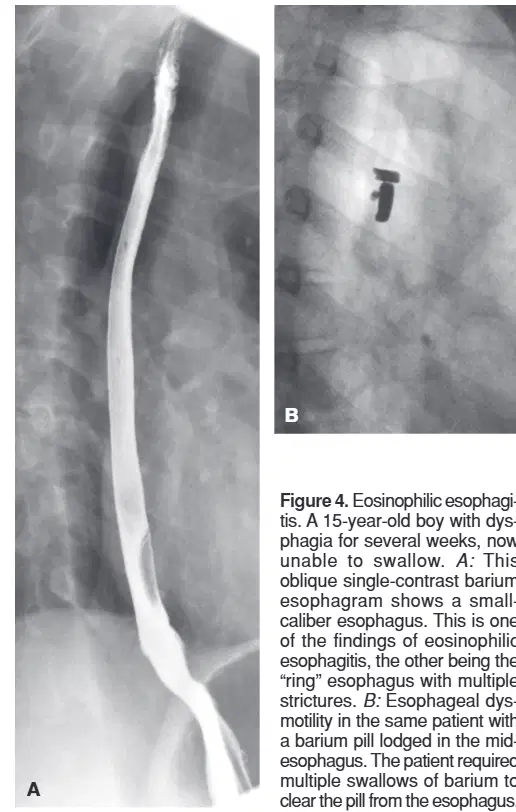
Figure 4 describes a 15-year-old boy with dysphagia for several weeks, now unable to swallow. What is one of the findings of eosinophilic esophagitis shown in the oblique single-contrast barium esophagram?
Large-caliber esophagus
Small-caliber esophagus
Gastric volvulus
Brainstem lesion
What is the classic triad of gastric volvulus (Borchardt triad)?
Epigastric pain, retching, and inability to pass a tube beyond the stomach.
Epigastric pain, hematemesis, and fever.
Abdominal distension, diarrhea, and jaundice.
Nausea, vomiting blood, and constipation.
Which subtype of gastric volvulus is less common in the pediatric population: organoaxial or mesenteroaxial?
Organoaxial gastric volvulus
Mesenteroaxial gastric volvulus
Mixed gastric volvulus
Paraoesophageal gastric volvulus
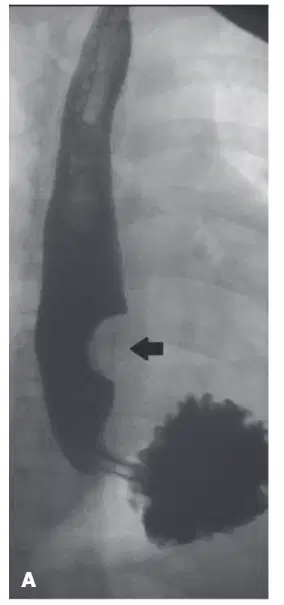
What imaging technique showed a circumscribed filling defect in the distal third of the esophagus?
Contrast esophagram
Ultrasound
CT scan
MRI
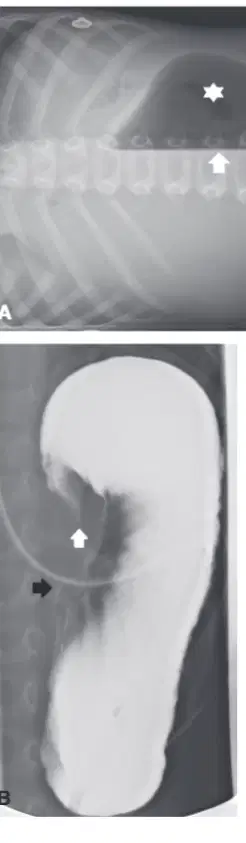
According to Figure 6, what abnormality is indicated by a dilated stomach with an air-fluid level in a 2-year-old boy with acute onset of inability to swallow and abdominal distention?
Gastric volvulus
Intussusception
Pyloric stenosis
Duodenal atresia
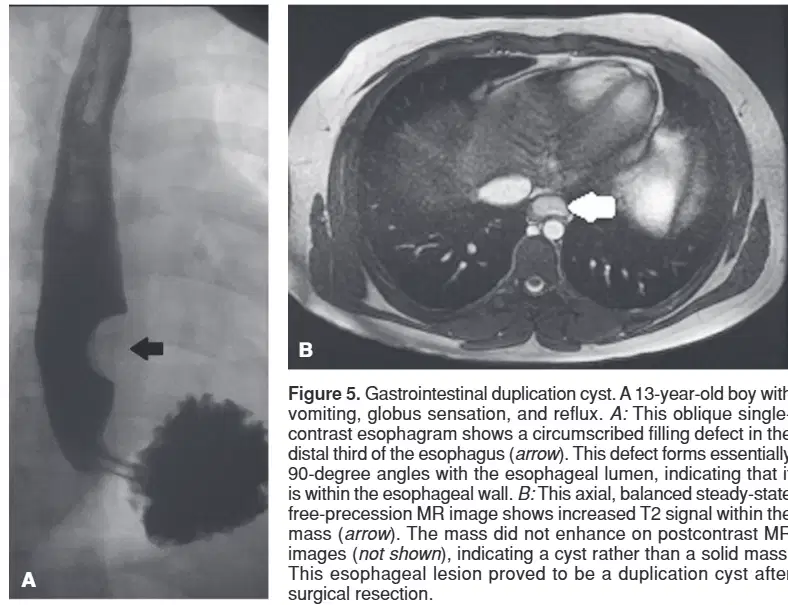
The mass described in Figure 5 did not enhance on postcontrast MR images, indicating a cyst rather than a solid mass.
True
False
Which of the following is NOT mentioned as an underlying anatomic abnormality associated with gastric volvulus?
Eventration of the diaphragm
Congenital diaphragmatic hernia
Esophageal atresia
Wandering spleen
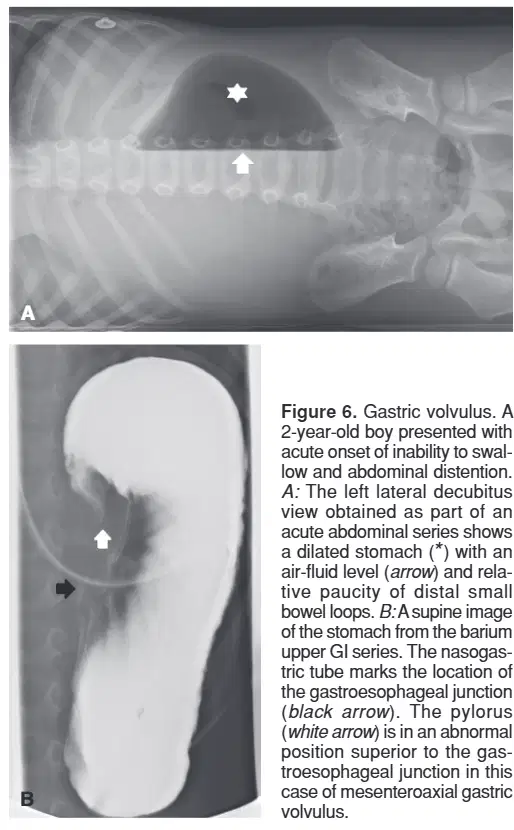
What is the key imaging finding for diagnosing gastric volvulus?
A distended stomach with an air-fluid level
Multiple small bowel loops in the pelvis
Pneumoperitoneum under the diaphragm
Thickened colonic haustra
Which one of the following vascular anomalies is most likely to be associated with congenital heart disease?
Right aortic arch with aberrant left subclavian artery
Double aortic arch
Left aortic arch with aberrant right subclavian artery
Right aortic arch with mirror-image branching of the great vessels
All of the above
All of the following underlying anatomic abnormalities may be present in a child with gastric volvulus, except
eventration of the diaphragm
intestinal malrotation
situs inversus
congenital diaphragmatic hernia
paraesophageal hernia
In a 9-year-old girl with dysphagia, an esophagram shows a “beak-like” narrowing of the distal esophagus. The most likely diagnosis is
eosinophilic esophagitis
achalasia
esophageal duplication cyst
vascular ring
oropharyngeal dysphagia
In a 14-year-old boy with dysphagia, an esophagram shows a “ringed esophagus.” The most likely diagnosis is
eosinophilic esophagitis
achalasia
esophageal duplication cyst
oropharyngeal dysphagia
gastric volvulus
The esophagram of a 15-year-old girl with dysphagia for several weeks revealed a diffusely small-caliber esophagus (<2 cm in diameter). The most likely diagnosis is
oropharyngeal dysphagia
esophageal duplication cyst
achalasia
vascular ring
eosinophilic esophagitis
In the setting of oropharyngeal dysphagia in a child, the major cause of morbidity is
esophageal rupture due to caustic ingestion
development of esophageal malignancy due to reflux
failure to thrive due to inability to swallow food
aspiration with recurrent pneumonia
dependent on the underlying cause
Which one of the following statements regarding gastric volvulus in the pediatric population is false?
Most cases present with nonbilious emesis, epigastric pain, and abdominal distention.
In the organoaxial subtype, the greater curvature rotates superior to the lesser curvature.
In the mesenteroaxial subtype, the pylorus lies superior to the gastroesophageal junction.
The organoaxial subtype is more common than the mesenteroaxial subtype.
A 10-year-old boy presented with intermittent vomiting and dysphagia with occasional regurgitation of undigested food. An esophagram was normal. The most likely diagnosis is
right aortic arch with aberrant left subclavian artery
achalasia
esophageal duplication cyst
oropharyngeal dysphagia
eosinophilic esophagitis
Dysphagia lusoria is associated with
left aortic arch with an aberrant right subclavian artery
esophageal duplication cyst
achalasia
oropharyngeal dysphagia
eosinophilic esophagitis
The most common location of an esophageal duplication cyst is
upper third of the esophagus
middle third of the esophagus
lower third of the esophagus
within the inferior pericardial recess
in the carina

