
 Worksheets
Macular Degeneration: Key Concepts and Diagnostic Approaches
Total questions: 14
Worksheet time: 7mins
Sebastian, George, and Arjun are on a quest to uncover the secrets behind macular degeneration! Which of the following is absolutely essential for them to truly understand the underlying causes of this condition?
Recognizing clinical signs and imaging findings
Understanding the anatomical and pathological basis
Discussing cases for differential diagnosis
Reviewing diagnostic tools and classification systems

Lily, Alexander, and Aarav are learning about eye health in class. Their teacher asks: Which of the following best describes the primary impact of macular degeneration?
Complete blindness
Peripheral vision loss
Central vision loss with preserved peripheral vision
Night blindness
Aarav, Isla, and Mia are curious about eye health! Can you help them solve this mystery: Which of the following is the leading cause of irreversible central vision loss in adults over 50?
Glaucoma
Cataracts
Age-related macular degeneration (AMD)
Diabetic retinopathy
Lily, Eesha, and Sebastian are studying for their ophthalmology exam. Can you help them figure out the correct sequence of events in dry AMD that leads to geographic atrophy?
RPE dysfunction → photoreceptor loss → geographic atrophy
Choroidal neovascularization → hemorrhage → atrophy
Leaky vessels → fluid accumulation → atrophy
Photoreceptor loss → RPE dysfunction → fibrosis

Evie, Ishaan, and Rohan are having a friendly debate about the eye! They want to know: what is the primary function of the fovea in the macula?
Provides high cone density for sharp central vision
Produces aqueous humor
Regulates intraocular pressure
Supplies blood to the optic nerve
George, Muhammad, and Charlie are studying eye diseases. They come across a case of wet age-related macular degeneration (AMD). Which fundus sign should they look for that is specifically linked to this condition?
Subretinal hemorrhage
Pigmentary changes
Geographic atrophy
Hard exudates
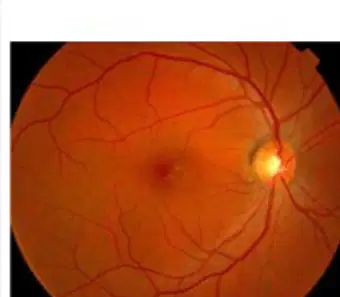
Benjamin and Anaya are studying for their eye exam, and they come across this retinal image. They wonder: Which AREDS category is characterized by several hard drusen or a few intermediate-sized drusen (63-124μm diameter) in one or both eyes? Help them choose the right answer!
Category 1 (No AMD)
Category 2 (Early AMD)
Category 3 (Intermediate AMD)
Category 4 (Late-Stage/Advanced AMD)
Chloe, Isabella, and Alexander are studying Wet AMD together. Can you help them figure out what CNV formation in Wet AMD results from?
Due to VEGF release from ischemic retina
Due to increased intraocular pressure
Due to retinal detachment
Due to optic nerve atrophy
During a clinical eye exam, Sophia and Arthur are curious about a special tool called the Amsler grid. What is its primary purpose?
To test for color blindness
To test for metamorphopsia
To measure intraocular pressure
To assess night vision
Isabelle and Max are studying eye conditions, and they come across Indocyanine Green Angiography (ICGA). Which condition do you think ICGA is especially helpful for diagnosing?
Polypoidal choroidal vasculopathy
Diabetic retinopathy
Retinal detachment
Glaucoma

Evie and Alexander are studying the Beckman Classification of AMD. They come across a patient who has medium drusen (> 63 μm and ≤ 125 μm) but no AMD pigmentary abnormalities. Aarav challenges them: "Can you guess which stage of AMD this patient falls under according to the Beckman Classification?" What should they answer?
Early AMD
Intermediate AMD
Late AMD
No apparent aging changes
Kiara, Aarav, and Noah are in their ophthalmology class, and their professor challenges them: Which imaging modality is the best detective for spotting early neovascular changes in wet AMD?
Visual field testing
Direct ophthalmoscopy
Ultrasound B-scan
Optical coherence tomography (OCT)
Amelia, Sophie, and Kiara are discussing eye health in class. Which main risk factor should they be most concerned about when it comes to developing age-related macular degeneration (AMD)?
History of ocular trauma
Myopia
High intraocular pressure
Advanced age
Freya and Alexander are studying for their ophthalmology exam. Freya asks Alexander, "Which of the following clinical findings is most characteristic of dry (non-exudative) AMD?" Can you help Alexander choose the right answer?
Retinal detachment
Subretinal fluid accumulation
Drusen deposits in the macula
Vitreous hemorrhage

