
 Worksheets
Chemical Examination of Urine
Total questions: 28
Worksheet time: 19mins
What is the primary purpose of a urine dipstick test?
To analyze cholesterol content in blood.
To quickly assess the presence of substances in urine for health diagnosis.
To determine blood sugar levels.
To measure blood pressure levels.
Reading time for glucose.
(a)
What does a positive result for protein in urine indicate?
It indicates a urinary tract infection.
It suggests dehydration or low fluid intake.
It indicates potential kidney damage or disease.
It means the presence of excess vitamins in the body.
The reagent strip reaction that requires the longest reaction time is the:
(a)
The principle of the reagent strip test for pH is the:
Dissociation of a polyelectrolyte
Pseudoperoxidase activity if hemoglobin
Sodium nitroprusside reaction
Diazo reaction
A patient with a 2+ protein reading in the afternoon is asked to submit a first morning specimen. The second specimen has a negative protein reading. This patient is:
Positive for cadet proteinuria
Negative for orthostatic proteinuria
Positive for Bence Jones protein
Negative for clinical proteinuria
The principle of the creatinine reagent pad on microalbumin reagent strips is the:
Double indicator reaction
Diazo reaction
Pseudoperoxidase reaction
Reduction of a chromogen
A patient with a normal blood glucose and a positive urine glucose should be further checked for:
Diabetes mellitus
Renal disease
Gestational diabetes
Pancreatitis
The three intermediate products of fat metabolism include all of the following except:
Acetoacetic acid
Ketoacetic acid
β-hydroxybutyric acid
Acetone
The most significant reagent strip test that is associated with a positive ketone result is:
(a)
The principle of the reagent strip tests for glucose is the:
Peroxidase activity of glucose
Glucose oxidase reaction
Double sequential enzyme reaction
Dye-binding of glucose and chromogen
Screening tests for urinary infection combine the leukocyte esterase test with the test for:
(a)
An elevated urine bilirubin with a normal urobilinogen is indicative of:
(a)
A speckled pattern on the blood pad of the reagent strip indicates:
Hematuria
Hemoglobinuria
Myoglobinuria
All of the above

Identify which parameter has this series of results.
(a)
What are the major chemical reagent strip brands used by most laboratories? Separate your answer with a comma and a space.
Example: Nike, Adidas
(a)
What do you call the material that helps absorb moisture inside the chemical reagent strip bottle?
(a)
In performing the reagent strip quality control, water can be used as a negative control.
True
False
What is the alkaline indicator used in the pH dipstick parameter?
(a)
This refers to a temporary increase in the alkalinity (or decrease in acidity) of body fluids, particularly urine, that typically occurs after a meal.
(a)
This is a situation where high concentrations of glucose in a urine sample cause an initial color change in a glucose test (like Clinitest) that rapidly progresses through the expected color range and then reverts to a darker color, potentially leading to an underestimation of the actual glucose level. Essentially, the test result appears normal, but the high glucose concentration has been missed due to this rapid color change.
Indicate the complete answer.
(a)
Tamm-Horsfall Protein (THP) is also known as:
(a)
This is a syndrome of inadequate reabsorption in the proximal renal tubules of the kidney. The syndrome can be caused by various underlying congenital or acquired diseases, by toxicity, or by adverse drug reactions.
(a)
Which of the following conditions is not of renal origin?
Diabetic nephropathy
Amyloidosis
Postural proteinuria
Multiple myeloma
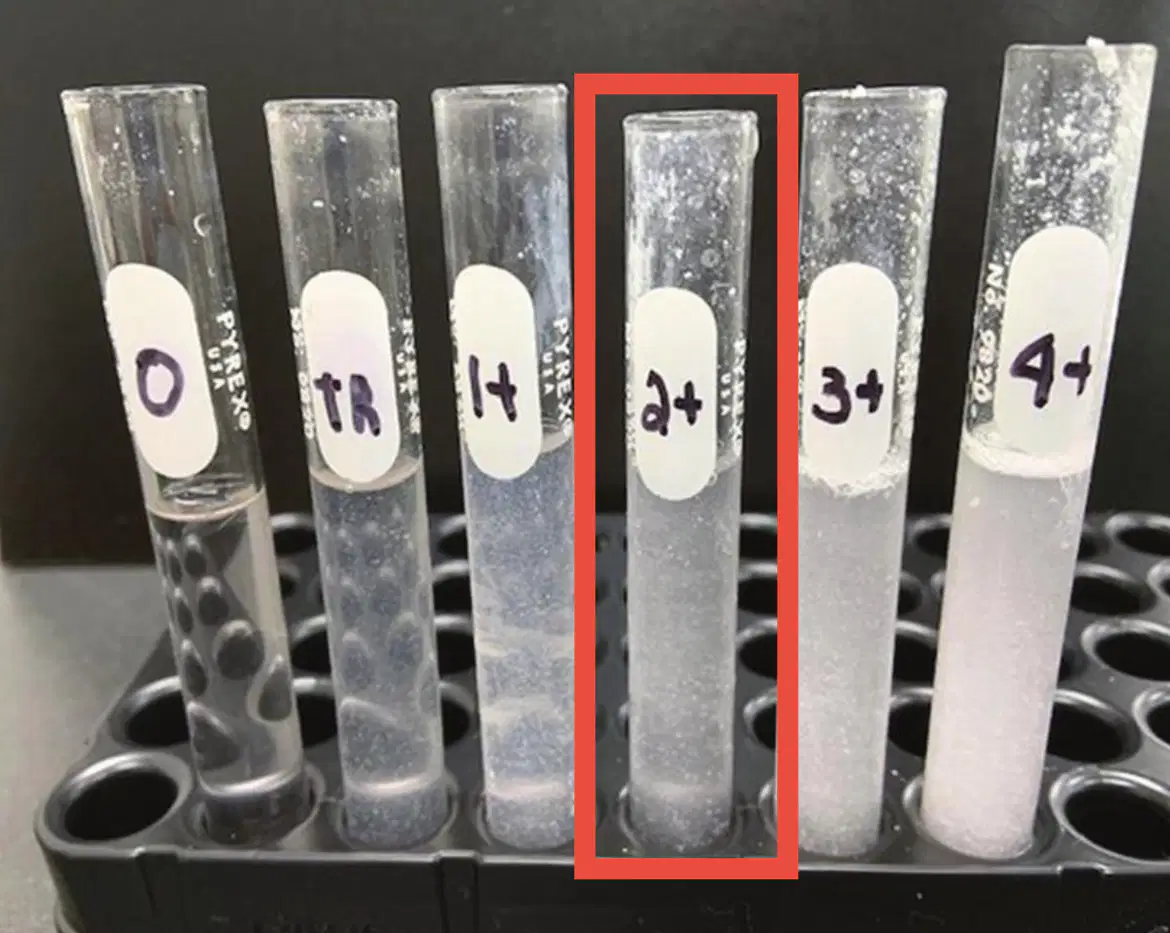
Report the tube in the box.
Distinct turbidity, no granulation
Turbidity, granulation, no flocculation
Turbidity, granulation, flocculation
Clumps of protein
What are the enzymes involved in the reagent strip test for glucose? Encode them in order. Separate your answer with a comma and a space.
Example: Nike, Adidas
(a)
Identify the parameter which has a chemical correlation with urobilinogen.
(a)
Positive dipstick reaction for nitrite.
(a)

