
 Worksheets
Ch 19 part1
Total questions: 35
Worksheet time: 18mins
Where do Class II caries occur?
Incisal surfaces
Proximal surfaces of posterior teeth
Occlusal surfaces
Interproximal surfaces of anterior teeth
Indicate whether the statement is true or false. 15. The microetcher is a smaller version of the air abrasion unit.
True
False
Most handpieces used in patient care today are (a) -driven.
motor
belt
air
water
The parts of a dental hand instrument include all of the following EXCEPT the (a) .
shank
handle
working end
bur
The bur of choice to open and extend the cavity preparation is the (a) .
pear
round
end-cutting
wheel
A high-speed handpiece operates at (a) rpm.
6,000 to 30,000
100,000 to 400,000
500,000 to 800,000
50,000 to 100,000
Indicate whether the statement is true or false. 20. Heatless stones are used to polish a restoration without creating frictional heat.
True
False
Indicate whether the statement is true or false. 29. The shaft is the part of the handpiece held in the operator’s hand.
True
False
Which class of dental caries may occur in the lingual pits on molars?
Class VI
Class III
Class IV
Class I
Indicate whether the statement is true or false. 31. Rotary instruments should be stored in a sterile instrument package.
True
False
Polishing rotary instruments should be sterilized in an autoclave.
True
False
Cotton rolls are commonly used in the dental office for (a) .
cleaning and disinfecting
testing the articulation of teeth
retracting tissues
removing debris from the proximal surfaces of teeth
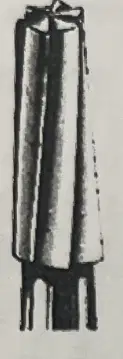
What type of bur is this?
Pear bur
Inverted bur
Straight bur
Tapered bur
When setting up for the lengthwise tray, hand instruments should be placed so that the handles face the direction of the hand that the dentist will use to take the instrument from the dental assistant.
True
False
What instrument is used to pack amalgam into a cavity preparation?
Amalgam carrier
Carver
Condenser
Burnisher
Cutting burs have more flutes than finishing burs.
True
False

This image shows an example of a ________ bur.
End cutting
Straight
Pear
Tapered
What type of disc is thin, brittle, and breaks easily?
Stone
Sandpaper
Carborundum
Diamond
Indicate whether the statement is true or false. A benefit of electric handpieces is that they can be sterilized.
True
False
Indicate whether the statement is true or false. 38. The neck of a rotary instrument is placed into the handpiece chuck.
True
False
Indicate whether the statement is true or false. 39. Rubbing multiuse abrasive instruments together to try to clear difficult-to-remove debris will damage their surfaces.
True
False
The pigtail, shepherd's hook, and right angle are types of ends found on __________.
excavators
explorers
mirrors
periodontal probes
The part of the handpiece that attaches to the power source is the __________.
head
working end
shank
connection end
Which type of bur is used to form the shoulders for a crown preparation?
Wheel
Pear
Round
End-cutting
Indicate whether the statement is true or false. 43. When preparing a tray, the dental assistant should place a paper barrier before placing any instruments.
True
False
The Hollenback and cleoid-discoid are examples of ___________.
pluggers
carriers
condensers
carvers
The second number in Black's three number formula is the measurement of the ___________.
width of the blade
angle of the cutting edge to the handle
length of the blade
angle of the blade to the long axis of the handle
How does using a standard tray setup enhance productivity?
It eliminates the need for the dentist to have a dental assistant present during surgical procedures.
It allows the dental assistant to simply dispose of instruments after procedures.
Most of the instruments in a standard tray setup can be used for multiple purposes.
It helps eliminate confusion during procedures.
Indicate the answer choice that best completes the statement or answers the question. 60. Abrasives such as garnet, sand, emery, and cuttlefish are examples of _______ discs.
sandpaper
stone
carborundum
diamond
A monangle has how many angles?
None
One
Two
Three
Indicate the answer choice that best completes the statement or answers the question. 48. A red band on a finishing bur indicates that it has how many blades?
8 or 12
45
30
16 or 20
Indicate whether the statement is true or false. 49. Using a preset tray system saves time for the dental assistant.
True
False
Indicate whether the statement is true or false. 50. The periodontal probe is part of a basic tray setup.
True
False
Indicate whether the statement is true or false. 51. If an item is expendable, it means that it is discarded after use.
True
False
The instrument used to remove carious material and debris from the teeth is the (a) .
hoe
hatchet
chisel
excavator

