
 Worksheets
Truth, Paraphrasing, Citing Sources
Total questions: 15
Worksheet time: 10mins
Which of these is NOT an example of a fact?
97% of Earth's water is saltwater.
The sun is about 400 times larger than the moon.
Greek Mythology has some of the greatest stories ever made.
The Cesar Salad was invented in 1924.
Which of these is NOT an opinion?
Dogs are the best pets you can have.
The average person blinks 14 to 17 times per minute.
The ugliest animal on the planet is the naked mole rat.
October is WAY too early to start Christmas shopping.
Statement: Drinking bleach cures COVID-19 instantly.
This is an example of...
Fact
Opinion
Misinformation
True or False: People often don't check online sources before sharing them with others.
True
False
True or False: Some people share false information just because they want to go viral.
True
False
Which of these DOESN'T help you spot fake news?
Look for unusual urls: ex: .lo | .com.co
Cross check information: are other articles telling you the same thing?
Dig deeper: who wrote the article and who supports the site?
Check how many views it has: has it been posted multiple times on social media?
What's the difference between paraphrasing and plagiarism?
Paraphrasing is rewriting information from an article in YOUR OWN WORDS and without changing the meaning.
Plagiarism is copying the information word for word and not giving credit to the author.
Paraphrasing is taking notes on an article by writing exactly what it says. Plagiarism is when you forget to give the author credit.
Paraphrasing is creating a story from information you find online. Plagiarism is when you play with the words to make it more interesting.
Which of these DOES NOT help you paraphrase a text?
Change the order of the words, but write the same words as the article.
Read the source, then
close it and say it in your own words.
Use quotes “ ” only for exact words.
Add a citation to show where it comes from.

Which answer shows correct paraphrasing of this text?
There are more than 500 species of sharks swimming in the world’s oceans. Most people think of sharks as large, sharp-toothed and scary beasts. But that generalization does sharks a huge disservice, because they actually have far more variety. Some are the length of a human hand, while others are over 39 feet (12 meters) long. Half of all shark species are less than one meter (about 3 feet). They come in a variety of colors, like bubble gum pink, and some eat plankton while others eat bigger fish and squid. They live in almost every kind of ocean habitat, including under Arctic ice.
There are over 500 different shark species living throughout the world’s oceans. However, many people tend to think of sharks as large, dangerous, sharp-toothed creatures. This stereotype overlooks the true diversity of these animals. Sharks vary widely in size, from just a few inches to more than 39 feet (12 meters), with many species measuring under a meter in length. They also come in a range of colors—even pink—and their diets differ too, from tiny plankton to larger sea creatures like squid and fish. Sharks live in nearly every ocean environment, from coral reefs to the deep sea, and even beneath the Arctic ice.
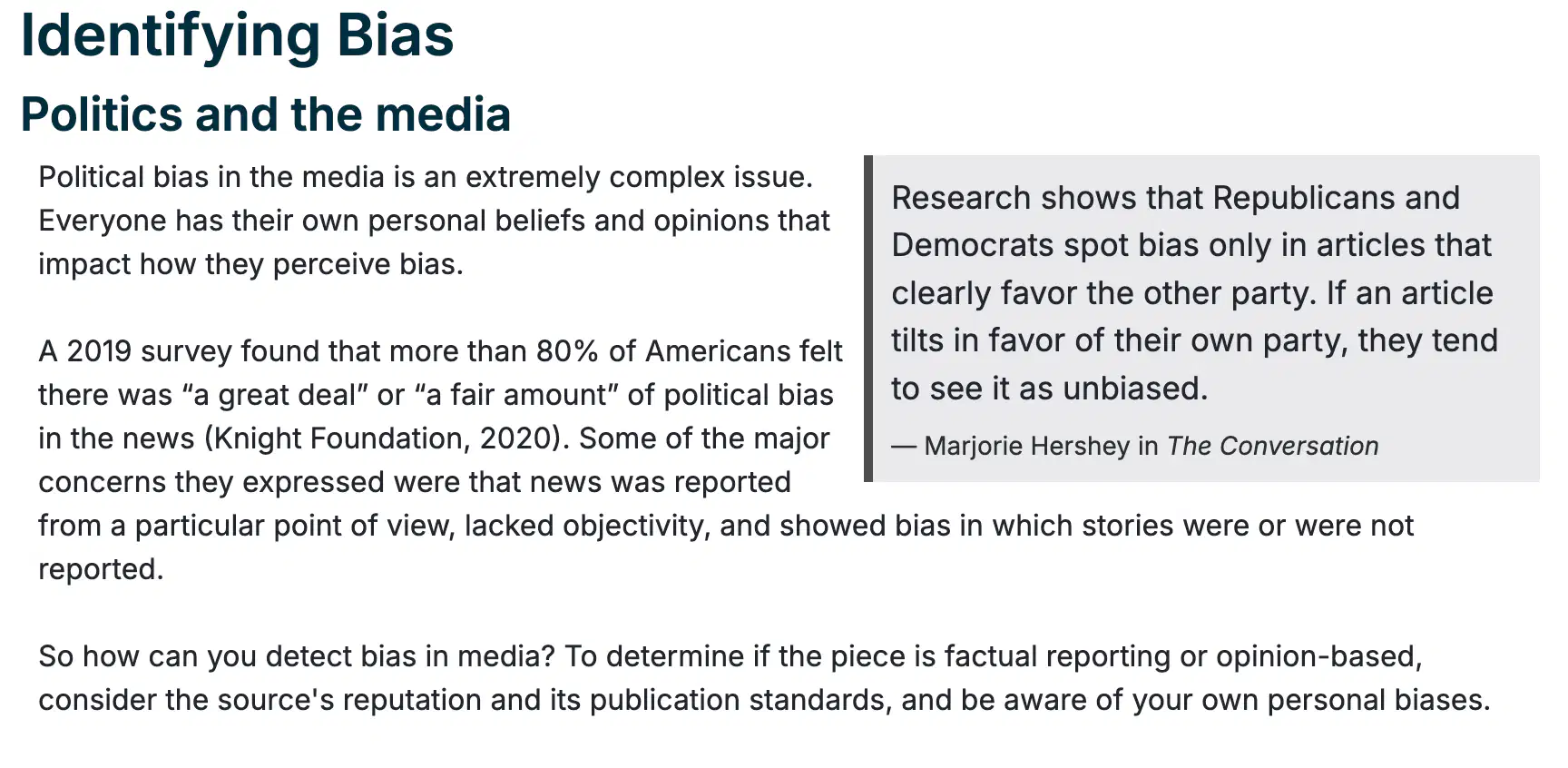
Which answer shows plagiarism of this text?
Political bias in the media is an extremely complex issue. Everyone has their own personal beliefs and opinions that impact how they perceive bias. A 2019 survey found that more than 80% of Americans felt there was a great deal or a fair amount of political bias in the news. Some of the major concerns they expressed were that news was reported from a particular point of view, lacked objectivity, and showed bias in which stories were or were not reported. Research shows that Republicans and Democrats spot bias only in articles that clearly favor the other party. If an article tilts in favor of their own party, they tend to see it as unbiased.
Media bias, especially in political reporting, is a complicated topic because individuals interpret bias through the lens of their own beliefs and opinions. According to a 2019 study by the Knight Foundation, over 80% of Americans believed political bias was present in the news to a significant extent. Many were concerned that news was being delivered with a particular slant, lacking neutrality, and that editorial choices showed partiality. Research by Marjorie Hershey also points out that people tend to recognize bias only when it contradicts their own political views—while they often consider articles that support their side as unbiased. To spot bias, readers should assess the credibility of the source, its editorial standards, and their own preconceptions.
Why do we cite sources?
To make your paper longer and fill up space.
To give credit to the author and help others find the same source.
Because teachers like seeing random names and dates.
So you can copy someone else's work without getting caught.
A citation includes:
Author, Popularity, Followers, Date.
Photographer, Title, Number of viewers.
Author, Title, Publisher, Date.
Websites name, your opinion, date of your presentation, number or sources you used.
Which citation is complete?
Smith, Patricia. “Checks & Balances.” The New York Times Upfront, The New York Times Upfront, 2 Sept. 2019, upfront.scholastic.com/pages/archives/articles/what-you-need-to-know-about-checks-and-balances.html?language=english#1170L. Accessed 8 Aug. 2025.
Smith, Patricia. “Checks & Balances.” 2 Sept. 2019, upfront.scholastic.com/pages/archives/articles/what-you-need-to-know-about-checks-and-balances.html?language=english#1170L.
Which citation is complete?
Kiffel-Alcheh, Jamie. ‘Hawai'i Volcanoes National Park.’ National Geographic Kids, n.d., https://kids.nationalgeographic.com/nature/article/hawaii-volcanoes. Accessed 20 July 2025.
Kiffel-Alcheh, Jamie. National Geographic Kids. https://kids.nationalgeographic.com/nature/article/hawaii-volcanoes.

Look at the citation formula in the picture and use it to create a citation for this website:

