
 Worksheets
AP Chapter 3
Total questions: 92
Worksheet time: 46mins
The Mongol conquests were significant in world history because they:
created one of the largest empires and facilitated trade and cultural exchange across Eurasia.
led to the complete destruction of all major cities in Asia and Europe.
resulted in the permanent end of all nomadic societies.
caused the immediate collapse of the Roman Empire.
The struggles Chinggis Khan faced in his youth and early career reveal what about the organization and values of Mongol society?
They highlight the importance of loyalty, adaptability, and merit in Mongol society.
They show that Mongol society valued wealth above all else.
They indicate that Mongol society was strictly hierarchical with no social mobility.
They suggest that Mongol society discouraged alliances and cooperation.
The struggles Chinggis Khan faced in his youth and early career reveal what about the organization and values of Mongol society?
They highlight the importance of loyalty, adaptability, and merit in Mongol society.
They show that Mongol society valued wealth above all else.
They indicate that Mongol society was strictly hierarchical with no social mobility.
They suggest that Mongol society discouraged alliances and cooperation.
By 1350, the Mongols directly controlled which parts of the world?
China, Persia, and Russia
India, Arabia, and Spain
Japan, Korea, and Italy
France, Egypt, and Greece
The Mongol conquest of China was a particularly important component of the Mongol period overall because:
it unified a vast territory under Mongol rule, greatly expanding their empire.
it marked the end of the Silk Road trade routes.
it led to the immediate collapse of the Mongol Empire.
it resulted in the complete destruction of Chinese culture.
The main types of interregional trade in the Mongol era included which of the following?
Silk, spices, and precious metals
Oil, coal, and automobiles
Electronics, plastics, and pharmaceuticals
Coffee, sugar, and tobacco
In 1206, who took the name of Chinggis Khan and founded the Mongol state?
Temujin
Kublai Khan
Ogedei Khan
Batu Khan
What major event happened in 1215 involving the Mongols and North China?
First Mongol attacks on North China; Beijing captured
Mongols signed a peace treaty with North China
The Mongols were defeated by the Jin Dynasty
Genghis Khan abdicated the throne
Between 1219 and 1223, what regions did the Mongols invade for the first time?
Russia and Islamic world
China and Korea
India and Southeast Asia
Europe and Japan
Who was named successor after the death of Chinggis Khan in 1227?
Ogedei
Tolui
Jochi
Chagatai
In what year did the Mongols take all of North China and end the Jin empire?
1234
1215
1241
1227
From 1235 to 1279, what region did the Mongols conquer, ending the southern Song dynasty?
South China
Japan
India
Persia
Between 1236 and 1240, which region did the Mongols conquer?
Russia
China
Persia
India
During 1240–1241, which part of Europe did the Mongols invade?
Western Europe
Southern Europe
Northern Europe
Eastern Europe
In 1253, the Mongols achieved victory over which group, leading to the rise of the Ottoman Turks in the Middle East?
Seljuk Turks
Byzantine Empire
Mamluks
Crusaders
What city was destroyed by the Mongols in 1258?
Baghdad
Constantinople
Cairo
Samarkand
In 1260, who defeated the Mongols at Ain Jalut, marking the end of their westward expansion?
Mamluk (slave) rulers of Egypt
Ottoman Turks
Byzantine Empire
Seljuk Turks
Who reigned in China from 1260 to 1294?
Kubilai Khan
Qin Shi Huang
Emperor Taizong
Emperor Kangxi
Emperor Wu of Han
Between 1271 and 1295, who journeyed to Central Asia, China, and Southeast Asia?
Marco Polo
Christopher Columbus
Ferdinand Magellan
Vasco da Gama
From 1271 to 1368, which dynasty ruled China?
Yuan (Mongol) dynasty
Song dynasty
Ming dynasty
Qing dynasty
Which country did the Mongols fail to invade between 1274 and 1280?
Japan
China
Korea
Vietnam
In the 1290s, what technological advancement was first used in China?
First true guns
Printing press
Steam engine
Compass
Who was a prominent figure from 1336 to 1405?
Timur
Genghis Khan
Akbar
Charlemagne
What major pandemic spread across Eurasia in the mid-fourteenth century?
Black Death
Spanish Flu
SARS
Ebola
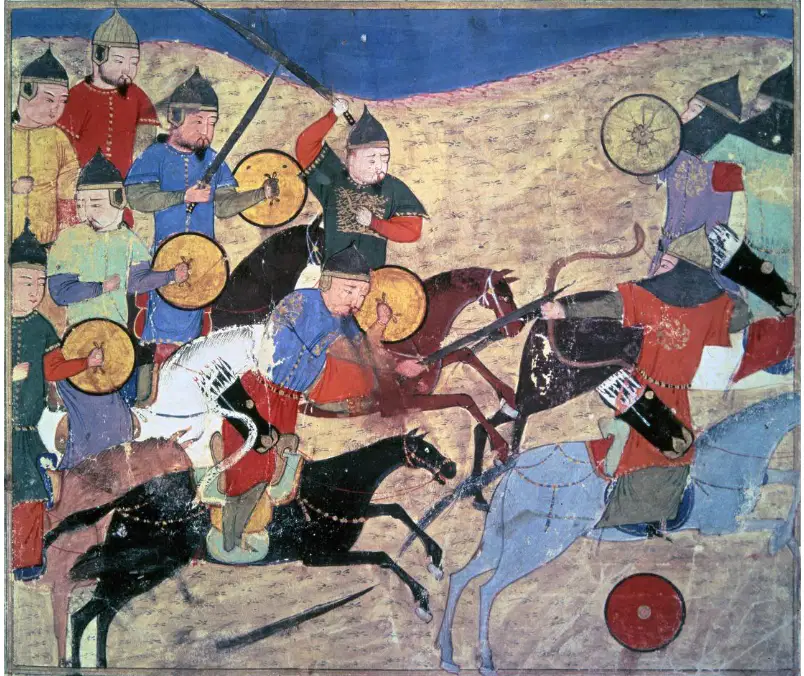
What does the fourteenth-century miniature painting from Rashid al-Din’s History of the World depict?
Mongol cavalry charging into battle against retreating Persians
Persian cavalry charging into battle against Mongols
Mongol cavalry retreating from battle
Persian infantry defending a city
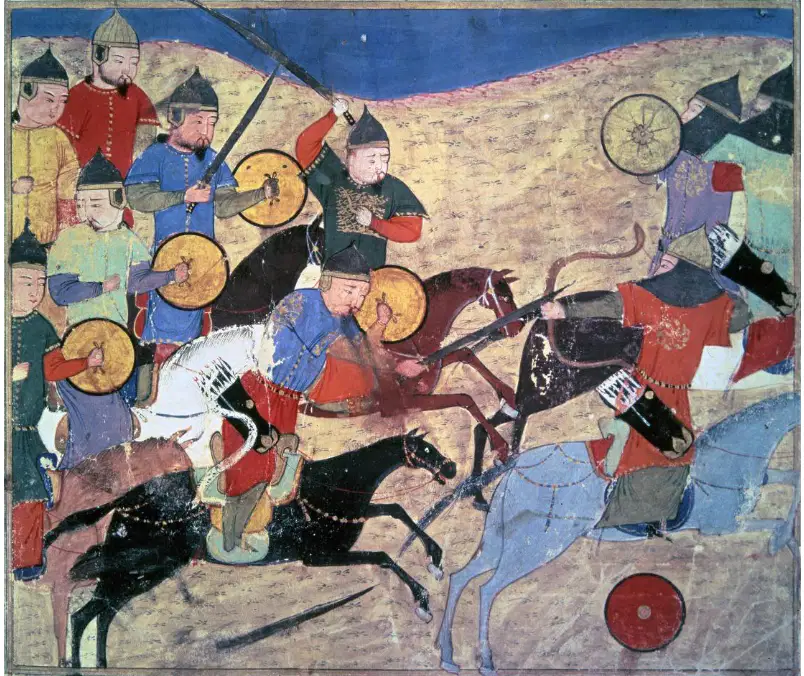
According to the painting and its description, what were often the only options for those overrun by Mongol units?
Surrender or death
Join the Mongol army
Negotiate a peace treaty
Escape to another country
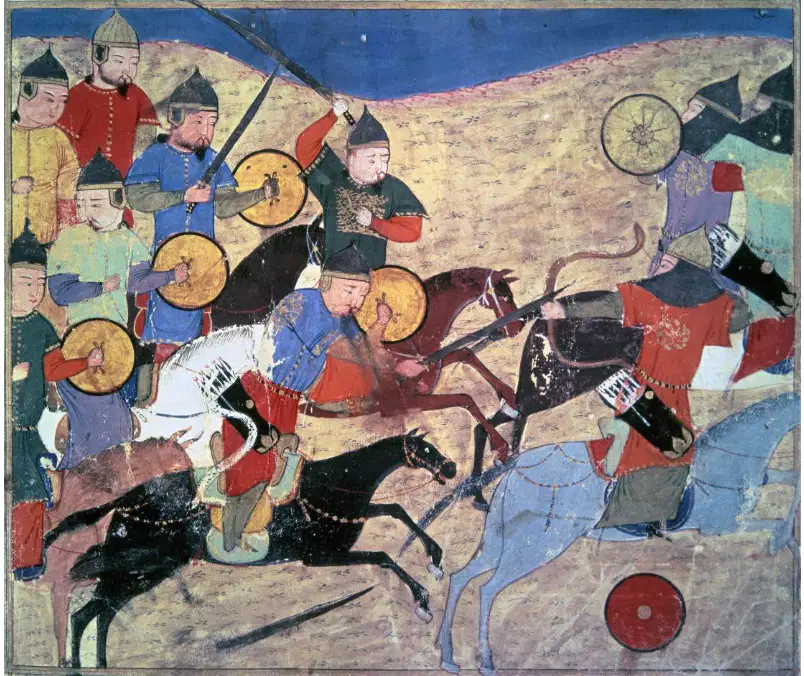
The speed and endurance of Mongol cavalry made it difficult for routed foes to escape because:
they could pursue fleeing enemies over long distances
they used heavy armor to block escape routes
they built fortifications quickly to trap enemies
they relied on naval forces to cut off escape
During which years did the New Mongol States exist according to the slide?
1200 to 1450
1000 to 1150
1500 to 1700
900 to 1100
Which regions did the Mongol conquests reshape for centuries?
Asia and Europe
Africa and Australia
North America and South America
Antarctica and Oceania
What was one of the impacts of the Mongol conquests?
Decreased trade
New interest in interregional contacts
Isolation of regions
Decline in knowledge exchange
The Mongol decline occurred by which century?
Fifteenth century
Thirteenth century
Seventeenth century
Nineteenth century
Which of the following was NOT listed as an impact of the Mongol conquests?
Knowledge and ideas exchange
New initiatives by other countries
Complete isolation of Asia
Some seek ways to prevent future invasions
What was one impact of the Mongol Period? Fill in the blank: New interest in __________ contacts.
interregional
domestic
religious
artistic
What was one impact of the Mongol Period? Fill in the blank: New links among __________.
regions
continents
empires
languages
What was one impact of the Mongol Period? Fill in the blank: Widespread __________ and ideas exchange.
knowledge
famine
isolation
warfare
What was one impact of the Mongol Period? Fill in the blank: New __________ by other countries.
initiatives
wars
religions
languages
Which of the following countries sought ways to prevent future invasions after the Mongol Period?
Russia
China
Both A and B
Neither
According to the passage, the Mongol Empire stretched from which regions?
A) Europe to Africa
B) Middle East to China Sea
C) India to Russia
D) Japan to Korea
According to the passage, what type of society were the Mongols?
Agricultural
Industrial
Nomadic
Urban
According to the passage, what supplemented herding in Mongol society?
Fishing
Trade
Farming
Mining
According to the passage, what is the basic unit of Mongol society?
Villages
Cities
Tribes
Kingdoms
According to the passage, Mongol tribes are made up of _________.
kin-related clans
trading partners
neighboring villages
religious sects
According to the passage, what happens when Mongol tribes are threatened?
They disband
They combine in confederations
They move to cities
They surrender
According to the passage, who elected the leaders of Mongol tribes?
The king
The elders
Free men
The army

According to the map titled 'Map 3.1 THE TRANSCONTINENTAL EMPIRE OF CHINGGIS KHAN', which empire was the largest built before the Industrial Revolution?
Byzantine Empire
Mongol Empire
Seljuk Empire
Russian States

Based on the map, in which year did the Mongol Empire reach its greatest extent as shown in the darker orange area?
1227
1290
1500
1000
Fill in the blank: The Mongol Empire linked most of the great _______ centers of civilization, according to the map caption.
Eurasian
African
American
Oceanic
The Mongol Empire was significant in world history, according to the map and its caption, because:
it connected much of Eurasia through conquest and trade.
it was the smallest empire in history.
it only affected China and Mongolia.
it lasted for over a thousand years.
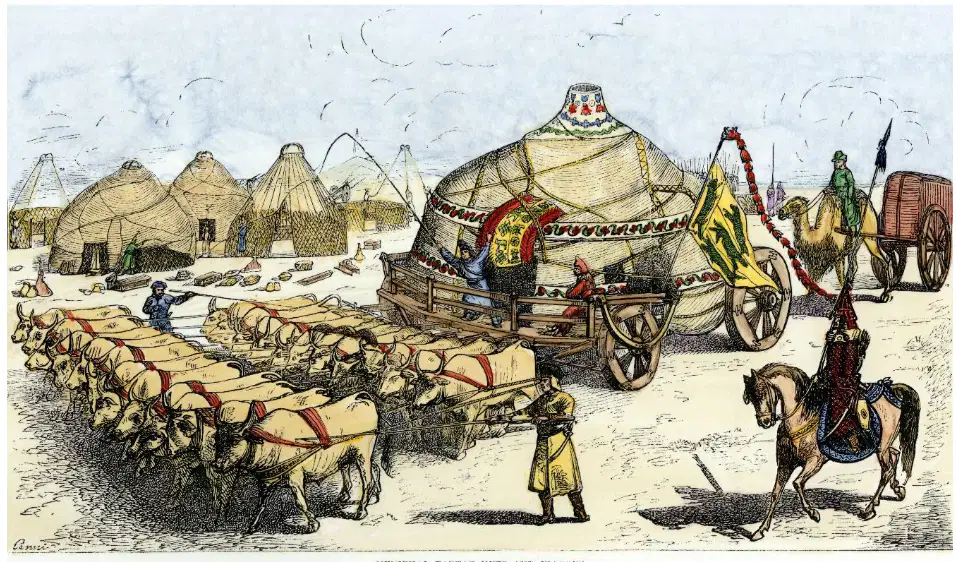
According to the passage, what animals did the Mongols depend on for food, clothing, and shelter?
Horses
Sheep
Camels
Oxen
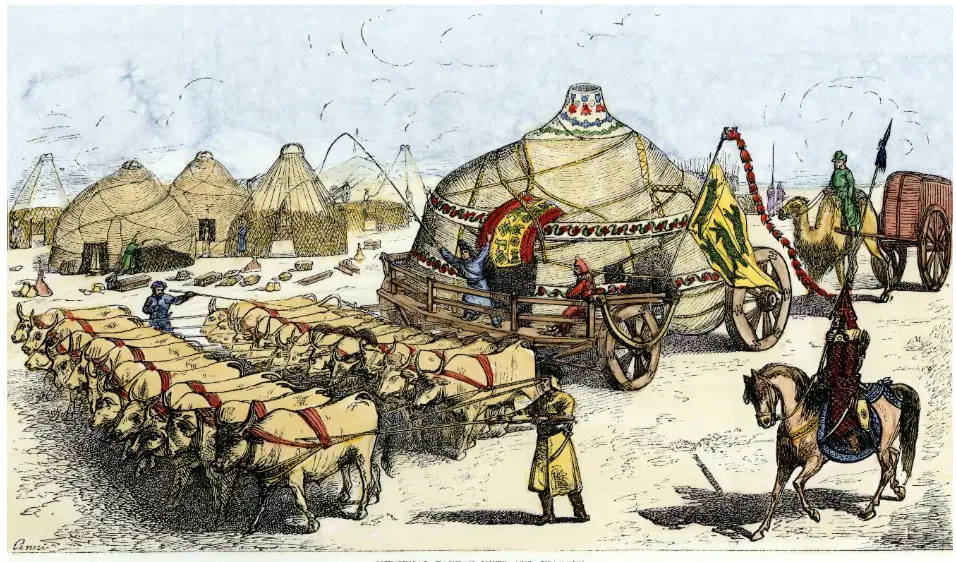
The Mongols used oxen to transport their housing for seasonal or longer-term migrations.
True
False
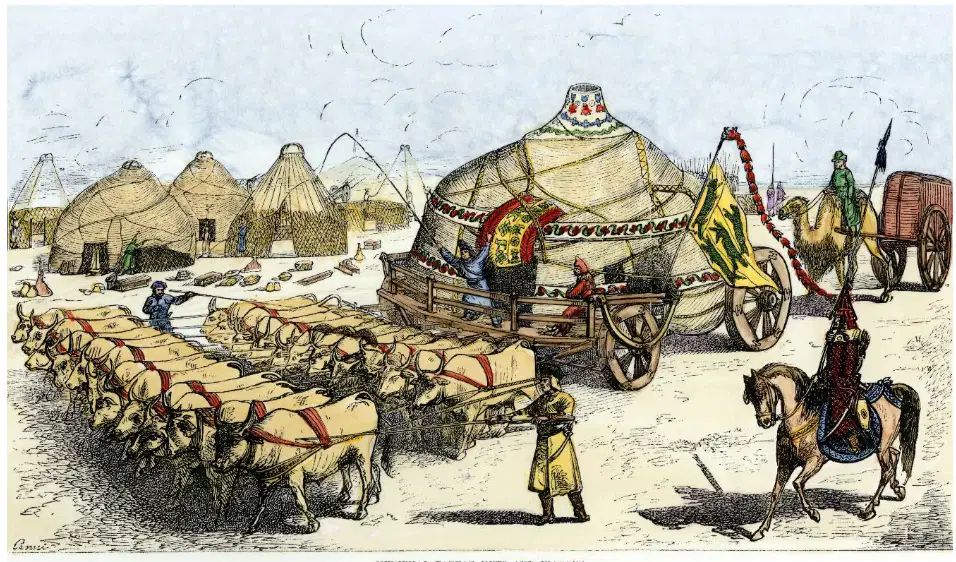
Fill in the blank: The Mongols mounted their tents and other goods on enormous wagons so heavy that large teams of ______ were required to pull them.
oxen
horses
camels
mules
The Mongols were one of the most mobile preindustrial societies because of:
their use of horses for transportation and warfare
their advanced shipbuilding techniques
their reliance on fortified cities
their use of elephants in battle
Who led a Mongol alliance in the 12th century against enemies?
Temujin
Kabul Khan
Khagan
Kuriltai
What is the name of the meeting at which the supreme Mongol ruler is elected?
Khagan
Kuriltai
Temujin
Khanate
Temujin was later renamed ________ after being elected as the supreme Mongol ruler.
Chinggis Khan
Kublai Khan
Ogedei Khan
Batu Khan
Who was elected khagan at the kuriltai?
Temujin (Chinggis Khan)
Kublai Khan
Ogedei Khan
Batu Khan
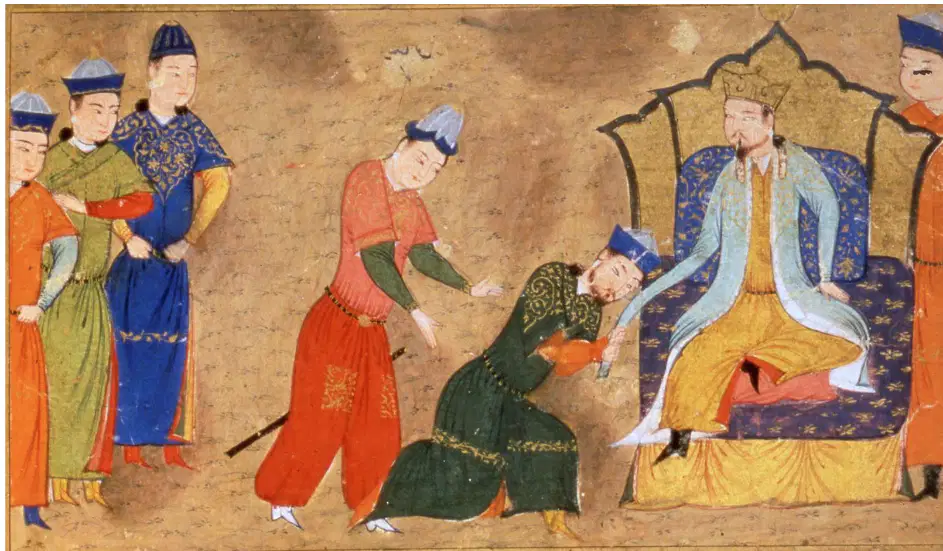
In this miniature from a Persian history text, who is shown acknowledging the submission of a rival prince?
Alexander the Great
Chinggis Khan
Julius Caesar
Kublai Khan

According to the passage, Chinggis Khan's rule was dependent on the loyalty of which group?
Bureaucrats
Vassal chieftains
Merchants
Priests
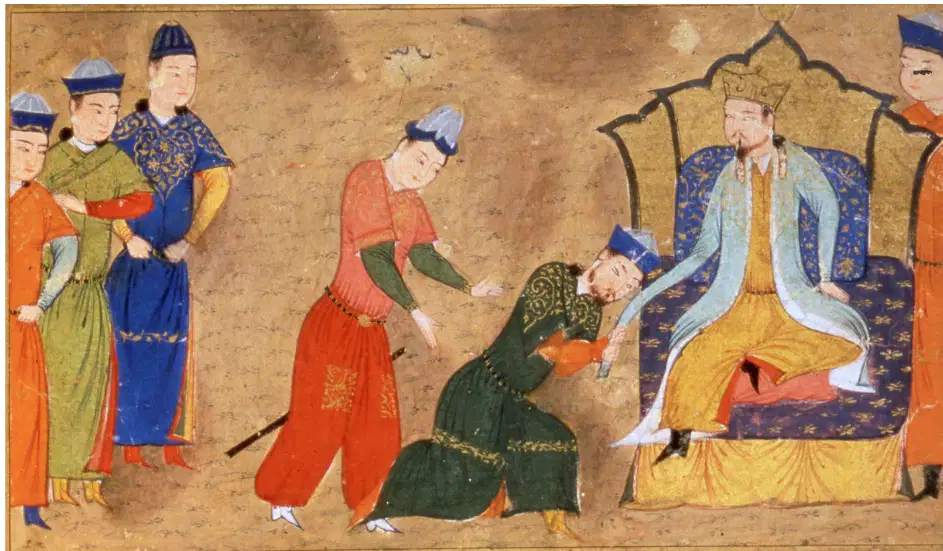
Fill in the blank: When the military strength of the Mongol Empire began to decline, subject princes soon rose up to establish the _______ of their domains.
independence
unity
loyalty
expansion
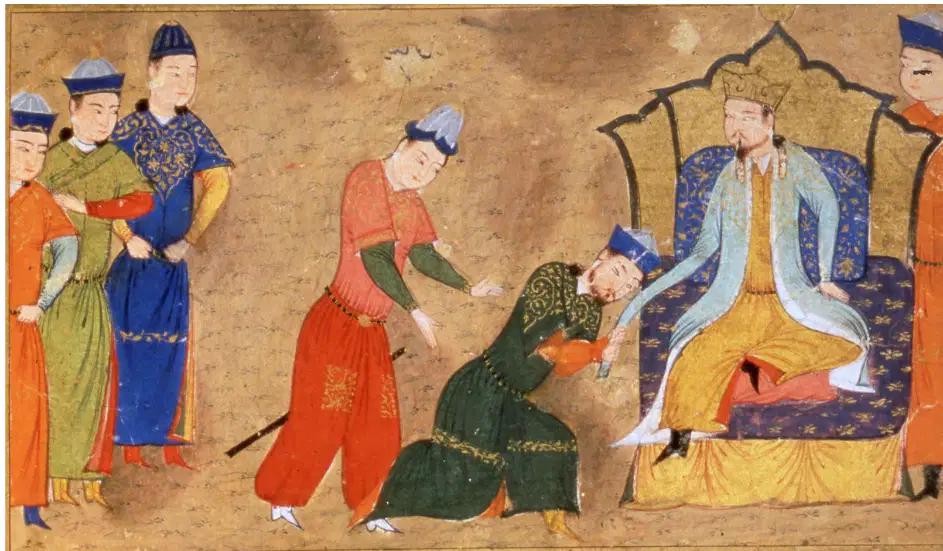
Chinggis Khan lived long enough to build a regular bureaucracy to govern his empire.
True
False
What did Chinggis Khan bring to the Mongol warriors?
Organization, discipline, and unity of command
New religions
Agricultural reforms
Trade agreements
What was the basic fighting unit of the Mongol forces called?
Legions
Tumens
Battalions
Regiments
Fill in the blank: Tumens consisted of ________ cavalrymen and were further divided into units of 1,000, 100, and 10.
10,000
1,000
5,000
100,000
The Mongol forces under Chinggis Khan had a formal code of warrior behavior.
True
False
Which of the following did Khan’s forces use to gain an advantage?
Maps, spies, and new weapons
Religious leaders
Naval fleets
Fortified castles
Khan’s forces benefited from increased grass supply due to what environmental factor?
Flooding
Warming period
Drought
Earthquakes
What was the first campaign of the Mongols in Northwest China?
Conquers Jin empire
Conquers Tangut
Attacks Khwarazm Empire
Moves west against Kara Khitai Empire
After attacking the Jin empire, which empire did the Mongols move west against next?
Khwarazm Empire
Kara Khitai Empire
Tangut
North China Sea
By 1227, the Mongols ruled from _______ to the North China Sea.
Eastern Persia
Western Europe
Northern India
Arabian Peninsula
According to the passage, what qualities did the Mongol rulers possess?
Smart and tolerant
Cruel and intolerant
Weak and indecisive
Isolated and secretive
Who established the new capital at Karakorum between 1220 and 1260?
Kublai Khan
Chinggis Khan
Ogedei Khan
Batu Khan
Fill in the blank: The new capital of the Mongol Empire established by Chinggis Khan was ________.
Karakorum
Samarkand
Baghdad
Beijing
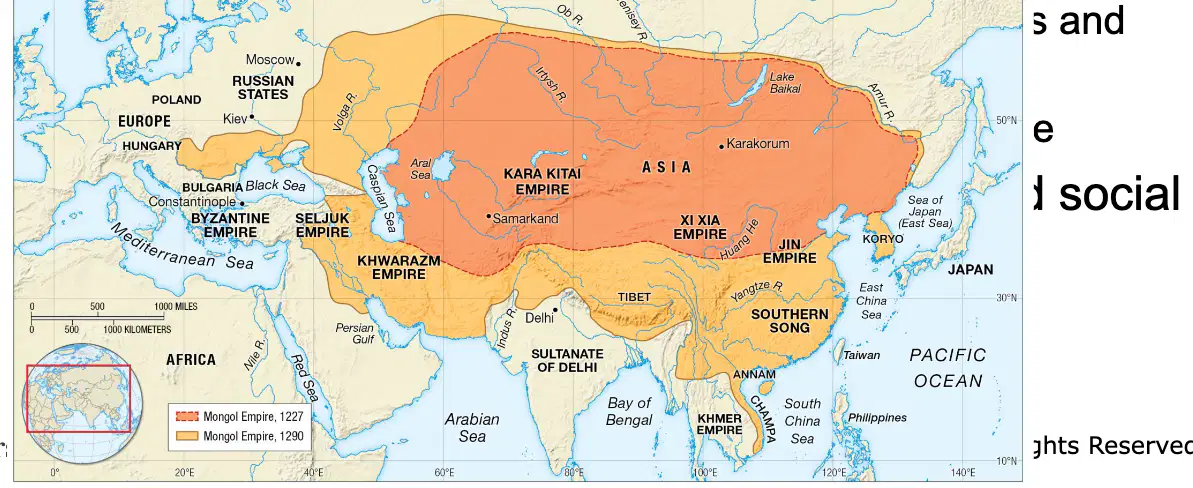
In which year did the Mongol Empire reach the extent shown in the orange shaded area?
1200
1227
1260
1300
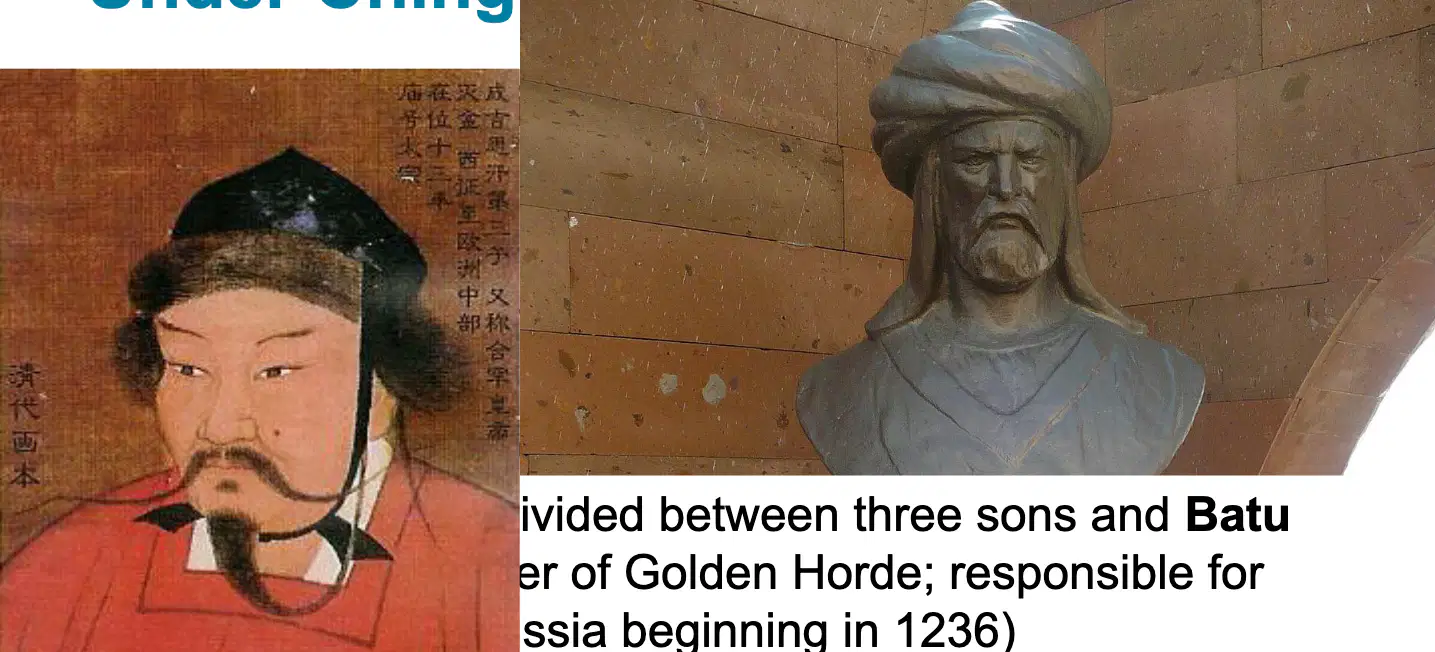
Who was responsible for the conquest of Russia beginning in 1236?
Ogedei
Batu
Chinggis Khan
Kublai Khan
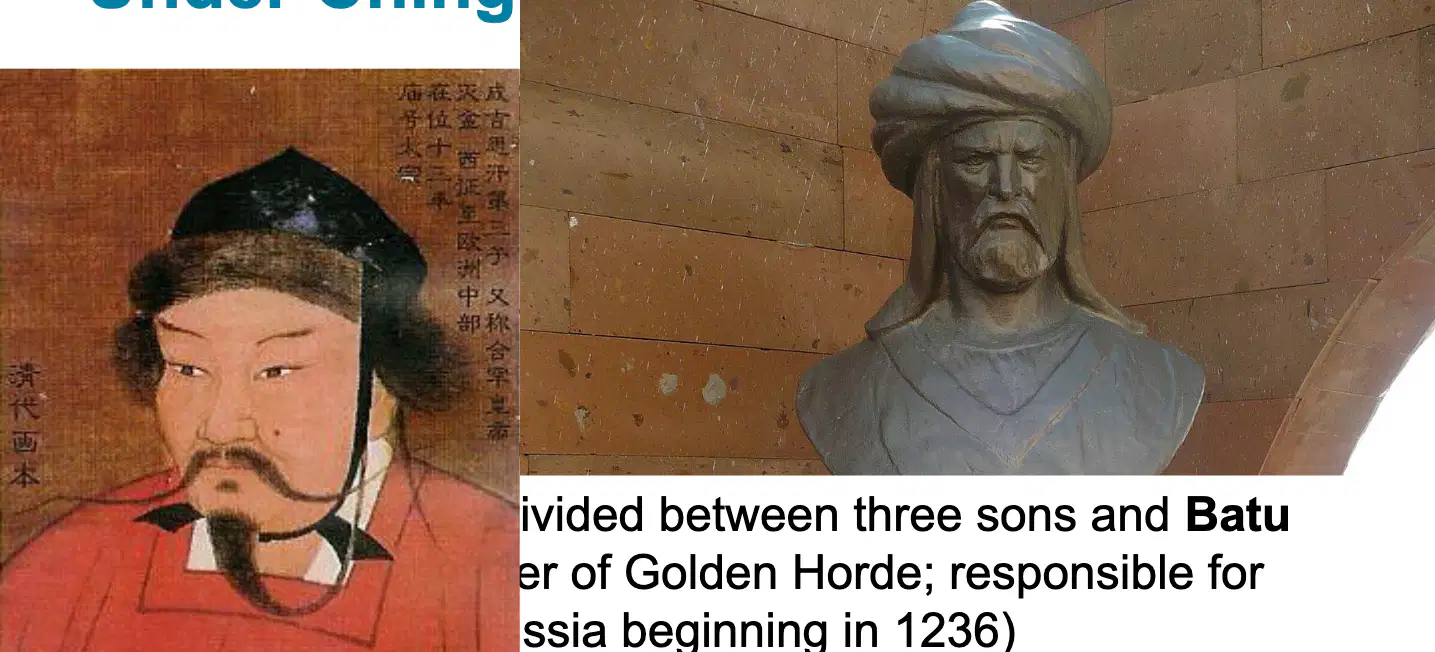
Who was the third son of Chinggis Khan and elected khagan?
Batu
Ogedei
Kublai Khan
Tolui

The Mongol Empire was divided between three sons and Batu after the death of Chinggis Khan.
True
False
What was one of the four subdivisions of the Mongol Empire after Chinggis Khan’s death, originally ruled by his grandson Batu, and covered much of what is today south-central Russia?
The Golden Horde
The Red Horde
The Blue Horde
The Silver Horde
How many great khanates arose following the death of Chinggis Khan?
Four
Two
Five
Three
Who led the invasion of Russia after the death of Chinggis Khan?
A) Batu
B) Ogedei
C) Kublai
D) Temujin
The Mongol force that invaded Russia consisted of over ________ Tatars (Tartars) in multiple campaigns.
120,000
50,000
200,000
300,000
Which city was destroyed during the Mongol campaigns in Russia?
Kiev
Moscow
Novgorod
St. Petersburg
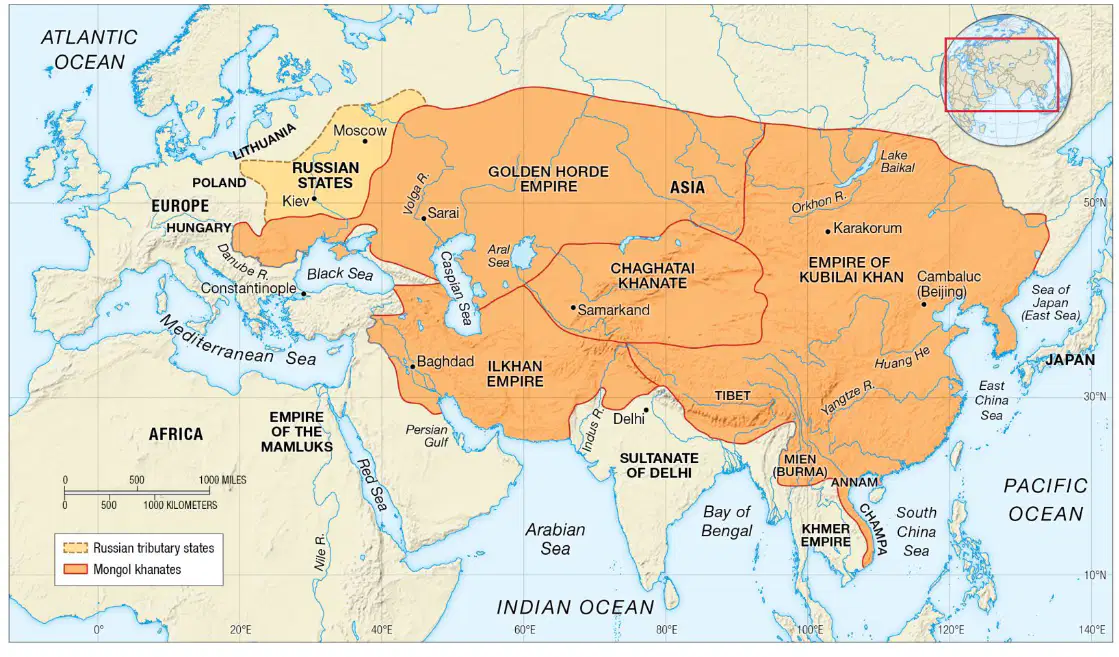
According to the map 'THE FOUR KHANATES OF THE DIVIDED MONGOL EMPIRE,' which of the following was NOT one of the four main khanates?
Golden Horde Empire
Ilkhan Empire
Chagatai Khanate
Empire of the Mamluks

According to the map 'THE FOUR KHANATES OF THE DIVIDED MONGOL EMPIRE,' which city was located in the Empire of Kublai Khan?
Baghdad
Cambaluc (Beijing)
Moscow
Samarkand
Fill in the blank: Sheer distance and slow-moving modes of transportation made it difficult to hold together the vast domains conquered by _______ and his immediate successors.
Chinggis Khan
Alexander the Great
Julius Caesar
Charlemagne
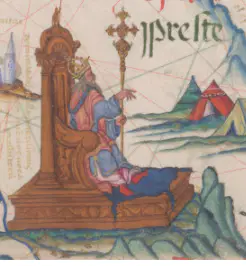
Christian leaders first believed that the Mongol khan was which mythical Christian monarch whose kingdom was cut off from Europe by Muslim conquests?
King Bela of Hungary
Prester John
King Henry of Silesia
Genghis Khan
Which European rulers were slow to realize the threat of the Mongols?
A) King Bela of Hungary and King Henry of Silesia
B) Prester John and Genghis Khan
C) King Louis IX and King Richard I
D) Pope Urban II and King John
Early Mongol victories opened the door to further _______.
raids
treaties
defeats
alliances
The death of the khagan forced the Mongol withdrawal, and European incursions _______.
end
increase
continue
expand
Which dynasty did the Mongols end in Persia and Mesopotamia?
The Mongols ended the Abbasid dynasty in Persia and Mesopotamia.
The Mongols ended the Umayyad dynasty in Persia and Mesopotamia.
The Mongols ended the Safavid dynasty in Persia and Mesopotamia.
The Mongols ended the Seljuk dynasty in Persia and Mesopotamia.
In what year were the Mongols defeated by the Mamluks at Ain Jalut?
1260
1241
1299
1258
Who commanded the Mongol forces that were defeated by the Mamluks at Ain Jalut?
Hulegu.
Subotai.
Batu Khan.
Ogedei.
The Mamluks were originally slave soldiers who became rulers in Egypt.
True
False

