
 Worksheets
CHEM 1405 final exam review
Total questions: 79
Worksheet time: 45mins
Dalton's atomic theory originally states...
elements are composed of atoms
compounds are formed when atoms combine in simple, whole # ratios
an oxygen atom combines with 1.5 hydrogen atoms to form water
atoms of a given element have the same properties and are distinguishable from other elements
which statement accurately describes the contributions of Thomson?
proposed matter was continuous
proposed the MODERN atomic theory
discovered the existence of electrons
created the modern periodic table
which of the statements about electrons is FALSE??
because atoms are neutral, the existence of a negative charged particle implies the existence of a positive one
Rutherford proved the plum pudding model correct
all of the above are true
they exist outside the nucleus
which of the following are consistent with Rutherford's nuclear theory?
the volume of an atom is mostly empty space
neutral potassium atoms contain more protons than electrons
neutral potassium atoms contain more neutrons than protons
atomic nuclei are small compared to atoms
Rutherford's nuclear theory states-
a neutral atom has the same number of electrons as protons
most of an atom's mass and positive charge is in the small center of the nucleus
most of the volume of an atom is taken up by protons
most of the volume of an atom is empty space
the atomic mass unit is defined as-
1/12 the mass of a carbon atom containing 6 protons and 6 neutrons
the mass of electrons
1/14 the mass of atom containing 7 protons and 7 neutrons
none of the above
if the atomic mass is 87.08 amu which isotope is more abundant?
96 amu
80 amu
86 amu
90 amu
what is the ionic charge of an ion with 13 protons and 10 electrons
3-
4+
3+
2-
express the number of electrons lost/gained in Se
+2 electrons
-2 electrons
a compound that forms a hydrogen bond is
H2
H2O
O2
SI units
meter
gram
kilogram
kelvin
cubic cm
what must be supplied for a decomp reaction to occur?
light
energy
heat
electrical current
any of the above

Which scientist theorized, but incorrectly stated, that all atoms of an element were identical and were indivisible?


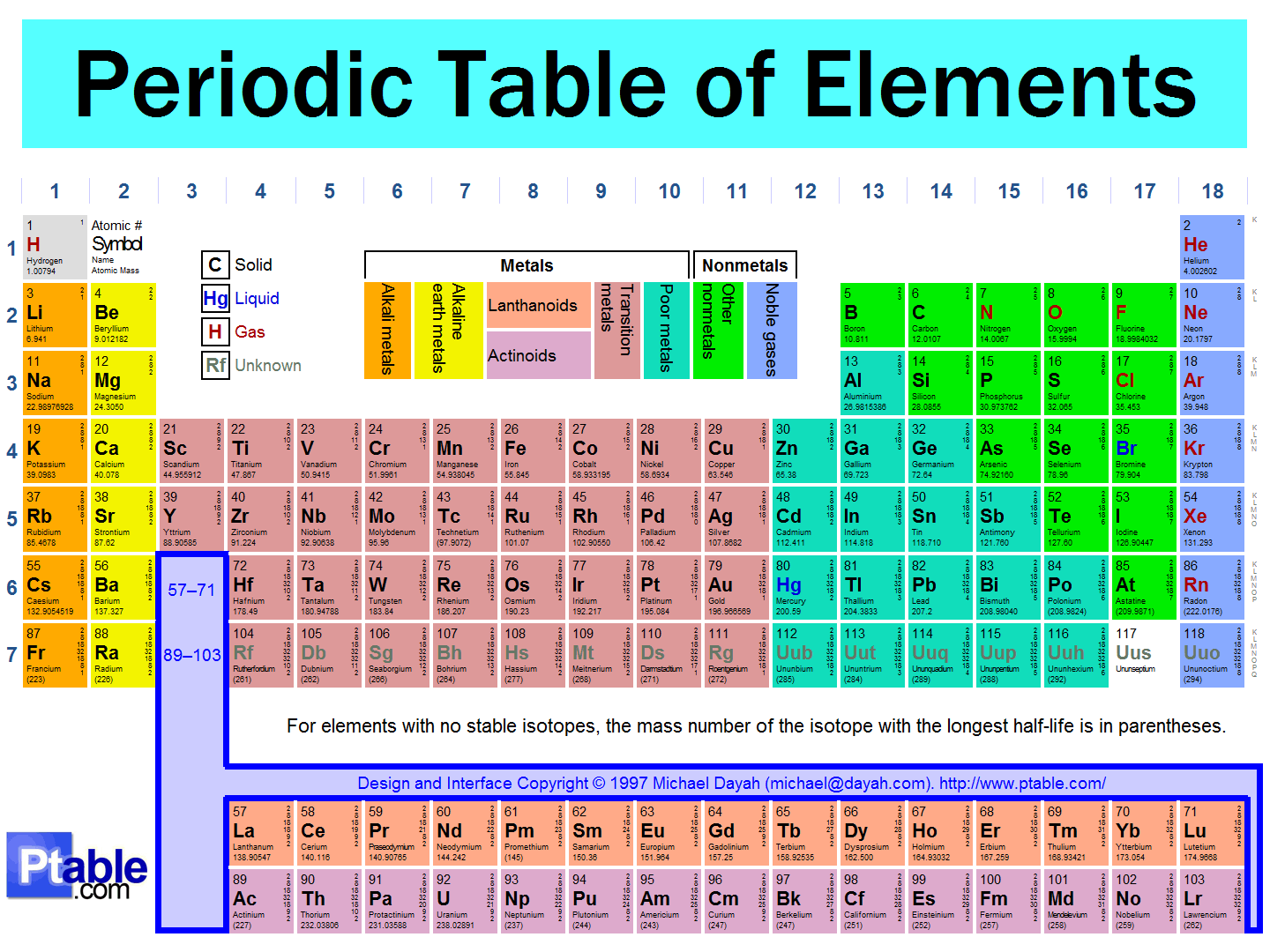

Predict the bond formed between Be and F
Covalent-bond
Ionic-bond
Metallic-bond
Hydrogen-bond

If an atom's charge becomes +2, what does that mean about the atom?
The atom gained 2 electrons.
The atom lost 2 electrons.
The atom is bonded to another atom in a covalent bond.
The atom has 2 protons.

Fluorine GAINS electrons. Fluorine is now more _____ than it was before.
positive
negative

Mg and F
Ionic
Covalent
metric units
gram
kilogram
Liter
celsius
meter
measured number
height, weight, temp.
uses estimates
1 mol = 6.02 x10^23
1L= 1000mL
unlimited sig figs
has a fixed composition, elements, compounds
pure substance
mixture
- definite shape
- definite volume
- particles are close together
- particles move slowly
liquid
gas
solid
- indefinite shape
- definite volume
- hold the shape of their container
- particles are close but mobile (slow)
liquid
gas
solid
- indefinite shape and volume
- same shape/volume as container
- particles are far apart and fast moving
liquid
gas
solid
temp indicates heat flow from
hot to cold
cold to hot
coldest temp
273 celsius , 0
-273 celsius, 0K
1 cal =
1000 kcal
4.184 J
1 kcal =
4.184 J
1000 cal
the amount of energy needed to raise the temp of 1 gram of water by 1 degree celsius is-
a joule
a calorie
pure substances
CANNOT be broken down
CAN be broken down
Alkali metals
Group 1
Group 2
Group 7
Group 8
alkaline metals
Group 1
Group 2
Group 7
Group 8
noble gases
Group 1
Group 2
Group 7
Group 8
halogens
Group 1
Group 2
Group 7
Group 8
a proton has a mass of about
1.0007 amu
1.0008 amu
.000549 amu
a neutron has a mass of about
1.0007 amu
1.0008 amu
.000549 amu
an electron has a mass of about
1.0007 amu
1.0008 amu
.000549 amu
isotopes have the same
protons, different neutrons
neutrons, different protons
atomic size and metallic character-
INCREASE going UP a group
DECREASE from left to right
INCREASE going DOWN a group
DECREASE from left to right
ionization energy-
DECREASES going DOWN a group
INCREASES left to right
DECREASES going UP a group
INCREASES left to right
density =
m / v
v / m
v x m
volume =
m / v
m / d
m x d
1 kg =
1000 g
100 g
1 kg =
2.2 lbs
3 lbs
1 ft =
1 yd
12 in
specific gravity formula
density of sample
/
density of water
density of water
/
density of sample
specific heat
q=mcAt
M= qcAt
do metals lose or gain electrons?
lose
gain
do positive ions have low or high ionization energies
high
low
do nonmetals lose or gain electrons?
lose
gain
do negative ions have high or low ionization energies?
high
low
electronegativity-
DECREASES down a group and INCREASES towards the right
INCREASES down a group and DECREASES towards the right
electronegativity is ____ for nonmetals and ____ for metals
HIGH ; LOW
LOW ; HIGH
in NONPOLAR bonds electrons are shared
EQUALLY
UNEQUALLY
in POLAR bonds electrons are shared
EQUALLY
UNEQUALLY
E.N difference greater than 0.4 but less than 1.8
polar
nonpolar
ionic
E.N difference between 0 and 0.4
polar
nonpolar
ionic
E.N difference is greater than 1.8
polar
nonpolar
ionic
(for ideal gases) when volume DECREASES pressure
INCREASES
DECREASES
if the pressure is DOUBLED then the volume is
HALVED
TRIPLED
(Boyles law) the pressure and volume formula
(P1)(V1) = (P2)(V2)
P1V1
/
P2V2
(Charles' law) the volume temp formula
(V1)(T1) = (V2)(T2)
V1/T1 = V2/T2
combined gas law (Boyle and Charles)
P1V1/T1 = P2V2/T2
P1 + V2 = P2 + V2
(Avogadro's law) volume and mole formula
v / n
V1/N1 = V2/N2
(for ideal gases) when the amount INCREASES the volume
INCREASES
DECREASES
(for ideal gases) when temp INCREASES the volume
INCREASES
DECREASES
- dissociates 100% in water
- produces positive and negative ions
- forms solutions with strong electrical currents
strong electrolyte
weak electrolyte
nonelectrolyte
- dissociates only slightly in water
- forms a solution with few ions, mostly molecules
strong electrolyte
weak electrolyte
nonelectrolyte
- dissolves as molecules in water
- do NOT produce ions
- do NOT conduct an electrical current
strong electrolyte
weak electrolyte
nonelectrolyte
solution that contains all of the solute and CAN dissolve
saturated
unsaturated
if solute can readily dissolve without the max amount of solute
saturated
unsaturated
Arrhenius acids
produce hydrogen ions when they dissolve
produce negative ions when they dissolve
- electrolytes
- sour taste
- turn blue litmus red
- corrode some metals
arrhenius acids
arrhenius bases
- produce hydroxide (OH-) ions in water
- taste bitter/chalky
- electrolytes
Arrhenius acids
Arrhenius bases
named as hydroxides
acids
bases
- feels slippery
- turns litmus indicator blue
- turns phenolphthalen indicator pink
OH- in water
H+ in water

