
 Worksheets
Water Resources Quiz
Total questions: 70
Worksheet time: 48mins
Which one of the following types describes water as a resource?
Abiotic resource
Biotic Resource
Non-renewable Resources
Cyclic Resource
Which of the given method is NOT related to rainwater harvesting:
Green Belt
Check Dam
Recharge Wells
Eris
Watershed management involves: I. Efficient management and conservation of surface and groundwater resources. II. It involves prevention of runoff III. It involves storage and recharge of groundwater IV. It involves saving water for generating hydel power
Statement I,II and III are true.
Statement I,III and IV are true.
Statement II,III and IV are true.
Statement I,II and IV are true.
State the negative impact of intensive irrigation in the states of Punjab, Haryana and western Uttar Pradesh?
Increasing soil erosion
Increasing salinity in the soil
Soil becomes alkaline
Decrease of soil fertility
Which group of states are highly affected by concentration of fluoride in ground water resources?
Haryana-Uttar Pradesh
Bihar-West Bengal
Rajasthan-Maharashtra
Punjab-Haryana
Pradhan Mantri Krishi Sinchayee Yojana has been launched by the Central Government during 2015-16 with the broad objectives of : I. Enhance the physical access of water on the farm and expand cultivable area under assured irrigation II. Promote integration of water source, distribution and its efficient use, to make best use of water through appropriate technologies and practices. III. Improve on-farm water use efficiency to reduce wastage and increase availability both in duration and extent; irrigation and other water saving technologies IV. Introduce sustainable water conservation practices to ensure industrial development Choose the correct options:
I ,II & IV are correct
II,III,& IV are correct
I,II & III are correct
I, III & IV are correct
Assumption(A): The Ganga, the Brahmaputra, and the Indus have 60 per cent of the total surface water resources. Reason (R): Precipitation is relatively high in the catchment areas of these rivers.
Both A and R are true and R is the correct explanation of A.
Both A and R are true but R is NOT the correct explanation of A.
A is true but R is false.
A is false and R is true.
Assumption (A): The level of groundwater utilisation is relatively high in the river basins Lying in north-western region and parts of south India. Reason (R): The states of Punjab, Haryana, Rajasthan and Tamil Nadu have high level of ground water utilization
Both A and R are true and R is the correct explanation of A.
Both A and R are true but R is NOT the correct explanation of A.
A is true but R is false.
A is false and R is true.
Assumption (A): The States like Kerala, Odisha and West Bengal have vast surface water resources in the form of lagoons and lakes. Reason (R): India has a vast coastline and the coast is very indented in some states.
Both A and R are true and R is the correct explanation of A.
Both A and R are true but R is NOT the correct explanation of A.
A is true but R is false.
A is false and R is true.
Assumption (A): The per capita availability of water is dwindling day-by-day . Reason (R): Increase in population & increasing level of pollution has limited the extent of usable water resource
Both A and R are true and R is the correct explanation of A.
Both A and R are true but R is NOT the correct explanation of A.
A is true but R is false.
A is false and R is true.
Assumption (A): There is need to encourage watershed development, rainwater harvesting, water recycling and reuse, and conjunctive use of water for sustaining water supply in long run. Reason (R): Freshwater constitutes only about 3 per cent of the total water. In fact, a very small proportion of freshwater is effectively available for human use.
Both A and R are true and R is the correct explanation of A.
Both A and R are true but R is NOT the correct explanation of A.
A is true but R is false.
A is false and R is true.
Which of the following constitutes the largest share of water utilisation in India?
Domestic use
Industrial use
Irrigation
Hydropower
India accounts for about what percentage of the world's water resources?
2.45%
4%
16%
32%
Which state has made water harvesting structures in houses compulsory?
Punjab
Tamil Nadu
Rajasthan
Maharashtra
Which river basin has the highest surface water resources in India?
Krishna
Godavari
Ganga
Mahanadi
Which of the following is not a source of surface water in India?
Rivers
Lakes
Glaciers
Tanks
Assertion (A): Agriculture in Punjab and Haryana depends largely on groundwater irrigation. Reason (R): More than 80% of their net sown area is under irrigation, mostly from wells and tubewells.
Both A and R are true and R is the correct explanation of A.
Both A and R are true but R is NOT the correct explanation of A.
A is true but R is false.
A is false and R is true.
Assertion (A): Water quality in rivers deteriorates more in summer. Reason (R): Flow of water is reduced, increasing concentration of pollutants.
Both A and R are true and R is the correct explanation of A.
Both A and R are true but R is NOT the correct explanation of A.
A is true but R is false.
A is false and R is true.
Assertion (A): The share of agriculture in total water use in India is expected to increase in future. Reason (R): Industrial and domestic water demands are projected to rise faster than agricultural needs.
Both A and R are true and R is the correct explanation of A.
Both A and R are true but R is NOT the correct explanation of A.
A is true but R is false.
A is false and R is true.
Identify the incorrect match:
Kund/Tanka - Rajasthan
Johad - Maharashtra
Neeru-Meeru - Andhra Pradesh
Arvary Pani Sansad - Rajasthan
Match the following and choose the correct code: List I (Project) List II (State) A. Hirakud Dam 1. Odisha B. Bhakra-Nangal 2. Punjab-Haryana C. Indira Gandhi Canal 3. Rajasthan D. Nagarjuna Sagar 4. Telangana-Andhra Pradesh Codes:
A-1, B-2, C-3, D-4
A-2, B-1, C-3, D-4
A-1, B-3, C-2, D-4
A-1, B-2, C-4, D-3
Consider the following statements about National Water Policy, 2002: 1. Drinking water has the highest priority in water allocation. 2. Both surface and groundwater quality should be regularly monitored. 3. Hydro-power generation is given priority over drinking water. Which of the above are correct?
1 and 2 only
1 and 3
Both surface and groundwater quality should be regularly monitored. Hydro-power generation is given priority over drinking water. Which of the above are correct?
1 and 2 only
1 and 3 only
2 and 3 only
1, 2, and 3
Which of the following statements is/are true about watershed management? It involves only groundwater recharge. It aims to balance natural resources and society. Community participation is essential for its success.
1 and 2 only
2 and 3 only
1 and 3 only
1, 2, and 3
Clue: This South Indian state utilises the highest percentage of its total groundwater potential.
Kerala
Tamil Nadu
Karnataka
Telangana
Clue: This programme in Rajasthan constructs percolation tanks, dug out ponds (Johads), and check dams through people's participation.
Haryali
Neeru-Meeru
Arvary Pani Sansad
Jal Kranti Abhiyan
Clue: In this case study, a village in Maharashtra transformed through voluntary labour, ban on open grazing, and water conservation.
Ralegan Siddhi
Hivre Bazar
Punsari
Mawlynnong
The total utilizable water resources in India are approximately:
1,869 cubic km
1,122 cubic km
4,000 cubic km
432 cubic km
Out of the total replenishable groundwater resources, which basin/region shows the highest utilisation?
North-eastern India
North-western India
Coastal Andhra Pradesh
Himalayan region
The share of the industrial sector in surface water utilisation is:
2%
5%
9%
10%
The share of the agricultural sector in total water utilisation is declining because:
Less area is being irrigated
Domestic and industrial water demand is increasing
Monsoon rainfall is increasing
More dams are built for hydropower
(Imagine you are shown the map of river basins in India) Which of the following river basins together account for about 60% of total surface water resources in India?
Ganga, Yamuna, Godavari
Ganga, Brahmaputra, Barak
Ganga, Krishna, Kaveri
Brahmaputra, Mahanadi, Godavari
Identify the correct statements: Rainwater harvesting improves groundwater quality. It can prevent saltwater intrusion in coastal areas. It increases dependence on groundwater.
1 and 2 only
1 and 3 only
2 and 3 only
1, 2, and 3
The Water (Prevention and Control of Pollution) Act was passed in:
1972
1974
1977
1986
Assertion (A): The Yamuna river is one of the most polluted rivers in India. Reason (R): It receives heavy loads of organic and bacterial pollutants, especially between Delhi and Etawah.
Assertion (A): Ralegan Siddhi banned the cultivation of sugarcane. Reason (R): Sugarcane is a water-intensive crop.
Find the incorrect pair: Haryali - Central Government watershed project Neeru-Meeru - Andhra Pradesh Arvary Pani Sansad - Gujarat Kund/Tanka - Rajasthan
Match the following Acts with their purpose: List I (Act) List II (Purpose) A. Water Act, 1974 1. Pollution control B. Water Cess Act, 1977 2. Reduce pollution C. Environment Protection Act, 1986 3. Protect environment
A-1, B-2, C-3
A-3, B-1, C-2
A-2, B-3, C-1
A-1, B-3, C-2
Clue: A watershed project in Andhra Pradesh with the slogan 'Water and You.'
Clue: Underground covered tanks used in Rajasthan for storing rainwater.
If current trends continue, which sector will see the largest percentage increase in water demand in India by 2050?
Agriculture
Industry
Domestic
Hydropower
Which of the following is the most effective low-cost eco-friendly method to reduce groundwater depletion in urban areas?
Large dams
Desalination
Rooftop rainwater harvesting
River interlinking
Intensive irrigation in Punjab and Haryana has led to: Decline in groundwater table Increase in fluoride concentration in groundwater Soil salinity
1 and 2 only
1 and 3 only
1, 2, and 3
2 and 3 only
Which of the following measures taken in Ralegan Siddhi is not directly related to water conservation?
Ban on sugarcane cultivation
Construction of percolation tanks
Ban on liquor production
Ban on open grazing
The major lesson from Ralegan Siddhi's success story is: a) Government funding is essential for rural development b) Voluntary community participation ensures sustainability c) Use of water-intensive crops boosts economy d) Dams are the only solution for water scarcity
a
b
c
d
In coastal Tamil Nadu, rainwater harvesting also helps prevent:
Groundwater depletion
Soil erosion
Saltwater intrusion
All of the above
Which one of the following is the first priority as per National Water Policy, 2002?
Irrigation
Drinking water
Hydro-power
Industrial use
Identify the primary objective of the National River Conservation Plan:
To promote industrial development
To enhance irrigation facilities
To improve water quality in rivers
To increase hydropower generation
Which of the following practices is essential for sustainable water management?
Excessive use of chemical fertilizers
Monoculture farming
Rainwater harvesting
Over-extraction of groundwater
Match the following and choose the correct code:
List I (Project)- List II (State)
A. Hirakud Dam- 1. Odisha
B. Bhakra-Nangal- 2. Punjab-Haryana
C. Indira Gandhi Canal- 3. Rajasthan
D. Nagarjuna Sagar- 4. Telangana–Andhra Pradesh
a) A–1, B–2, C–3, D–4
b) A–2, B–1, C–3, D–4
c) A–1, B–3, C–2, D–4
d) A–1, B–2, C–4, D–3
Which of the following statements is/are true about watershed management?
1..It involves only groundwater recharge.
2.It aims to balance natural resources and society.
3.Community participation is essential for its success.
1 and 2 only
2 and 3 only
1 and 3 only
1,2 and 3
Clue: This South Indian state utilises the highest percentage of its total groundwater potential.
a) Kerala
b) Tamil Nadu
c) Karnataka
d) Telangana
Clue: This programme in Rajasthan constructs percolation tanks, dug out ponds (Johads), and check dams through people’s participation.
a) Haryali
b) Neeru–Meeru
c) Arvary Pani Sansad
d) Jal Kranti Abhiyan
Clue: In this case study, a village in Maharashtra transformed through voluntary labour, ban on open grazing, and water conservation.
a) Ralegan Siddhi
b) Hivre Bazar
c) Punsari
d) Mawlynnong
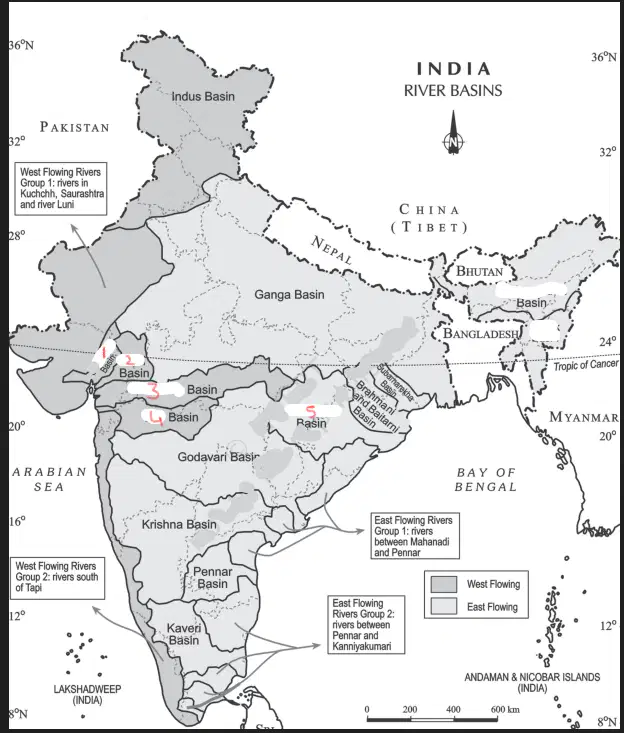
(Imagine you are shown the map of river basins in India)
Which of the following river basins together account for about 60% of total surface water resources in India?
a) Ganga, Yamuna, Godavari
b) Ganga, Brahmaputra, Barak
c) Ganga, Krishna, Kaveri
d) Brahmaputra, Mahanadi, Godavari
Find the incorrect pair:
a) Haryali – Central Government watershed project
b) Neeru–Meeru – Andhra Pradesh
c) Arvary Pani Sansad – Gujarat
d) Kund/Tanka – Rajasthan
Match the following Acts with their purpose:
List I (Act) List II (Purpose)
A. Water Act, 1974- 1. Pollution control
B. Water Cess Act, 1977- 2. Reduce pollution
C. Environment Protection Act, 1986- 3. Protect environment
a) A–2, B–3, C–1
b) A–3, B–1, C–2
c)A–1, B–2, C–3
d) A–1, B–3, C–2
Which of the following is the most effective low-cost eco-friendly method to reduce groundwater depletion in urban areas?
a) Large dams
d) River interlinking
b) Desalination
c) Rooftop rainwater harvesting
d) River interlinking
(Ralegan Siddhi example)
Which of the following measures taken in Ralegan Siddhi is not directly related to water conservation?
a) Ban on sugarcane cultivation
b) Construction of percolation tanks
c) Ban on liquor production
d) Ban on open grazing
The major lesson from Ralegan Siddhi’s success story is:
a) Government funding is essential for rural development
b) Voluntary community participation ensures sustainability
c) Use of water-intensive crops boosts economy
d) Dams are the only solution for water scarcity
ASSERTION (A)Growing Population is the main reason for water scarcity.
REASON(R) Irrigation from tube wells and canals is responsible for water scarcity.
(A)Both assertion and reason are true and reason is the correct explanation of assertion.
(B) Assertion and reason are true but reason is not the correct explanation of assertion
(C) Assertion is true, reason is false
(D) Assertion is false, reason is true
ASSERTION(A): The over-use of ground water resources has led to decline in ground water table in some states.
REASON(B): Intensive irrigation in Punjab, Haryana is increasing salinity in the soil and depletion of ground water resources.
(A)Both assertion and reason are true and reason is the correct explanation of assertion.
(B) Assertion and reason are true but reason is not the correct explanation of assertion
(C) Assertion is true, reason is false
(D) Assertion is false, reason is true
Which of the following is not the benefit of rain water harvesting?
(A) It increases water availability
(B) It checks the declining ground water table
(C) It improves the quality of ground water through dilution of contaminants like fluoride and nitrates
(D)Helpful in production of hydro electricity
Which of the following programme has been launched by union government for the cleaning of river Ganga?
(A) Ganga action plan
(B) Namami Gange
(C) Ganga namami Action plan
(D) Ganga cleaning mission
In which year, Government of India has launched “Jal Kranthi Abhiyan”?
(A) 2011-12
(B) 2013-14
(C) 2015-16
(D) 2017-18
Which of the following states made compulsory to install rainwater harvesting system while constructing houses or buildings?
(A) Tamil Nadu
(B). Karnataka
(C) Kerala
(D) Andhra Pradesh
Haryali programme is related to --
(A) Forest cover
(B) Watershed development
(C) Soil conservation
(D) Food grain production
Which one the following rivers have the highest replenishable ground water resources in the Country.
(A) The Indus
(B) The Brahmaputra.
(C) The Ganga
(D)The Godavari
What is the negative impact of intensive irrigation in the states of Punjab, Haryana and Western Uttar Pradesh?
(A) Increasing salinity in the soil
(B) Increasing soil erosion
(C) Soil decreases alkalinity
(D) Decreasing of soil fertility
Which of the following is not the benefit of Rainwater harvesting?
(A) It increases water availability
(B) It checks the declining ground water
(C) It improves the quality of ground water through dilution of contaminants like Fluoride and nitrates.
(D) Helpful in the production of hydroelectricity

